
Blog
How Long are Literature Reviews |Best Example

Introduction: How Long are Literature Reviews and Their Role in a Thesis
- Definition and Purpose
- A literature review is a well-structured summary and critical evaluation of existing research on a particular topic.
- It helps scholars, students, and researchers situate their research question within the current state of research, highlighting gaps and inconsistencies in the body of literature.
- In a thesis, dissertation, or research paper, the literature review section often serves as a foundation for the methodology and subsequent chapters.
- Role in a Thesis or Dissertation
- Provides context for your research objectives and hypothesis.
- Demonstrates familiarity with different disciplines, research methods, and scholars’ contributions.
- Helps to summarize and synthesize prior findings, offering a comprehensive synthesis that supports your research project.
- Offers a platform to provide a critical analysis of existing studies, guiding the methodological choices in your research methodology.
- Serves as a standalone piece in some doctoral or postgraduate work, or as an integral part of the introduction chapter.
- Importance of Structure
- A well-structured lit review ensures clarity, readability, and a logical flow from background section to main body.
- Use subsections and key themes to organize the relevant literature effectively.
- Consider breadth and depth: include enough journal articles, published papers, and full text sources to cover the topic thoroughly without becoming repetitive.
- Key Takeaways
- Understanding how long are literature reviews is crucial for planning your writing.
- The review may vary in length depending on whether it is part of a dissertation, thesis, or research paper, and the amount of literature available.
7-Step Process to Write a Literature Review Effectively
- Define Your Research Topic and Objectives
- Clarify your research question and hypothesis.
- Identify the scope: will your review focus on a doctoral dissertation, postgraduate thesis, or a research paper?
- Understand the discipline and research field, as different fields have different conventions.
- Search and Collect Relevant Literature
- Use databases, journal articles, and published papers to find relevant literature.
- Take notes while reviewing full text and keep an annotated bibliography.
- Record keywords, methodologies, research methods, and findings for later synthesis.
- Evaluate and Select Sources
- Assess each study based on criterion such as relevance, research methodology, and credibility of scholars’ work.
- Distinguish between systematic reviews, narrative reviews, qualitative, and methodological studies.
- Decide which sources will strengthen your literature review section.
- Organize the Literature
- Create subsections based on key themes, methodologies, or chronology.
- Use an organizational and explanatory approach for clarity.
- Determine breadth and depth to ensure a concise, well-structured narrative without losing critical detail.
- Summarize and Synthesize
- Summarize key points from each source.
- Synthesize findings to create a comprehensive synthesis of the current research.
- Highlight gaps in knowledge, contradictions, and emerging trends in the research field.
- Write the Literature Review
- Begin with an introduction chapter or background section.
- Use constructive, creative processes to link studies together.
- Ensure citing and referencing are accurate and consistent.
- Integrate methodological, thematic, and discipline-specific analyses for a well-written material.
- Refine and Edit
- Review for conciseness, clarity, and logical flow.
- Check that all research objectives are addressed and the review may guide the methodology in later sections.
- Seek feedback from a teacher or mentor for refinement and constructive suggestions.
Understanding Different Kinds of Literature for Your Review
- Primary vs. Secondary Sources
- Primary sources: original research papers, doctoral dissertations, journal articles, or published papers presenting new findings.
- Secondary sources: reviews, summaries, narrative reviews, or systematic reviews analyzing existing research.
- Qualitative vs. Quantitative Studies
- Qualitative studies focus on descriptive insights, often using interviews or observations.
- Quantitative studies provide measurable data and statistical analysis.
- Narrative Reviews vs. Systematic Reviews
- Narrative reviews summarize and interpret the body of literature without strict criteria.
- Systematic reviews follow a structured, criterion-based methodology to ensure comprehensiveness.
- Kinds of Literature by Discipline
- Humanities: often rely on narrative reviews, historical analysis, and thematic studies.
- Sciences and Social Sciences: emphasize systematic reviews, meta-analyses, and methodological rigor.
- Tailor the literature review style to match the research field and thesis requirements.
- Other Considerations
- Annotated bibliographies help in synthesizing and tracking current research.
- Consider research objectives to decide which kinds of literature to include.
How Long are Literature Reviews: Guidelines by Academic Level
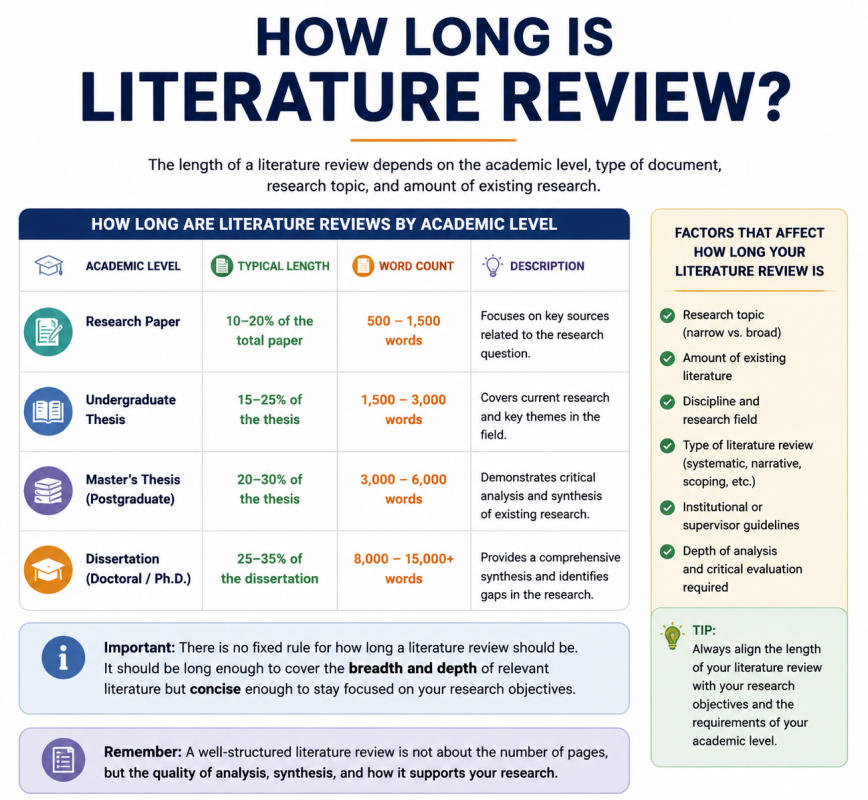
- Undergraduate Research Papers
- Typically 1,500–3,000 words depending on the research project and discipline.
- The literature review section provides context and background section, but is less detailed than postgraduate work.
- Postgraduate Theses
- 5,000–10,000 words is common for a master’s thesis.
- Requires a comprehensive synthesis, critical analysis, and well-structured subsections.
- Doctoral Dissertations or Ph.D. Projects
- Can range from 10,000–30,000 words, sometimes more depending on the amount of literature and research methodology.
- Includes systematic reviews, narrative reviews, and methodological critiques.
- Must highlight gaps, current research, and knowledge in the field.
- Factors Affecting Length
- Breadth and depth of the research topic.
- Amount of literature available in the research field.
- Requirements of your teacher or mentor or academic institution.
- Whether the literature review is a standalone piece or part of the introduction chapter.
- Key Takeaway
- Understanding how long are literature reviews helps you plan research, take notes, and structure your lit review for maximum impact.
Common Mistakes to Avoid When Writing a Literature Review
- Being Descriptive Rather Than Analytical
- Avoid simply summarizing studies; aim to synthesize and evaluate findings.
- Ignoring the Research Methodology
- Ensure you address research methods, qualitative or quantitative approaches, and methodological strengths/weaknesses.
- Lack of Organization
- Poor organizational flow can confuse readers. Use subsections, key themes, and a main body structure.
- Overlooking Relevant Literature
- Do not ignore published papers, journal articles, or existing research. A well-structured review should capture current research and knowledge in the field.
- Failure to Cite Properly
- Inaccurate citing and referencing can lead to plagiarism. Ensure full text sources are correctly referenced.
- Not Addressing Gaps or Critical Analysis
- Highlight gaps, research objectives, and current state of research. Provide a critical analysis of the body of literature rather than just listing studies.
- Writing Too Long or Too Short
- Be aware of how long are literature reviews recommended for your discipline and academic level.
Avoid When Writing a Literature Review
- Being Descriptive Instead of Analytical
- Merely summarizing published papers without critical analysis weakens a lit review.
- Effective literature review writing requires you to synthesize findings across scholars’ work.
- Ask: Does this literature review section highlight gaps and contribute to the current state of research?
- Ignoring Methodology and Research Methods
- Failing to evaluate methodological quality can compromise your research project.
- Consider qualitative, quantitative, systematic reviews, and narrative reviews when assessing sources.
- Discuss how research methods influence results to provide a critical perspective.
- Poor Organization
- A well-structured review is easier to read and follow.
- Use subsections, key themes, and main body divisions to create organizational clarity.
- A disorganized review may confuse readers and obscure your research objectives.
- Overlooking Relevant Literature
- Failing to include existing research or published papers may leave gaps in understanding your research topic.
- Conduct thorough searches in databases and track sources with an annotated bibliography.
- Excessive Length or Shortness
- Consider the breadth and depth appropriate for your discipline.
- Not knowing how long are literature reviews may lead to incomplete or overly verbose sections.
- Improper Citation and Referencing
- Incorrect citing and referencing can reduce credibility.
- Always track full text sources and include accurate journal article references.
- Neglecting Critical Gaps
- A lit review should summarize, synthesize, and evaluate current research.
- Avoid writing a purely descriptive background section; instead, provide constructive refinement and critical analysis.
How Long are Literature Reviews in Thesis Projects: Examples and Tips
- Postgraduate Theses
- Usually 5,000–10,000 words, depending on research field and amount of literature.
- Must include systematic and narrative reviews, research methodology explanations, and a well-structured main body.
- Include subsections for different kinds of literature, research objectives, and key themes.
- Doctoral or Ph.D. Dissertations
- Can range from 10,000–30,000 words.
- Often includes a standalone piece lit review chapter or section.
- Should provide a comprehensive synthesis of current research, existing research, and knowledge in the field.
- Examples of Effective Literature Reviews
- Concise introduction chapter with background section summarizing research project and research question.
- Main body organized around methodological, thematic, or disciplinary differences.
- Synthesis of studies to highlight gaps, evaluate approaches, and guide research methodology.
- Tips for Maintaining Quality
- Take notes on full text sources and published papers.
- Maintain an annotated bibliography to track citations.
- Focus on breadth and depth, not just quantity of journal articles.
- Seek feedback from a teacher or mentor for refinement and constructive guidance.
- Consider Discipline-Specific Norms
- Sciences: heavier reliance on systematic reviews, data synthesis, and research methodology rigor.
- Humanities: more narrative reviews, descriptive synthesis, and creative process for explanatory writing material.
Strengthening Your Literature Review: Integrating Sources and Analysis
- Synthesizing and Evaluating Research
- Combine insights from different disciplines, published papers, and journal articles.
- Go beyond summary: synthesize, evaluate, and provide a critical perspective.
- Highlight gaps in knowledge, methodological inconsistencies, or contradictions in existing research.
- Using Subsections and Organizational Strategies
- Structure around key themes, research methods, hypotheses, or research objectives.
- Ensure subsections flow logically, from background section to main body.
- Maintain conciseness while covering breadth and depth of the body of literature.
- Integration of Methodological Insights
- Evaluate qualitative and quantitative research.
- Include commentary on systematic reviews, narrative reviews, and research methodology relevance.
- Show how prior studies inform your dissertation or thesis research methodology.
- Enhancing Critical Analysis
- Compare scholars’ findings to identify strengths, weaknesses, and gaps.
- Explain implications for your research project or hypothesis.
- Use annotated bibliography and citing and referencing to track relevant literature and full text sources.
- Practical Tips for Effective Literature Review Writing
- Take detailed notes while conducting research.
- Summarize key findings and synthesize across published papers.
- Refine using a creative process, ensuring well-structured and explanatory written material.
- Use teacher or mentor feedback for constructive refinement.
- Making it Readable and Engaging
- Use concise sentences and organizational flow.
- Integrate examples from dissertations, theses, and research papers to illustrate concepts.
- Ensure the literature review section is standalone if required or clearly linked to the introduction chapter.
Conclusion: How Long are Literature Reviews and Best Practices for Success
- Key Takeaways
- Understanding how long are literature reviews is essential for planning a thesis, dissertation, or research paper.
- The length depends on discipline, amount of literature, and academic level.
- Best Practices for Writing
- Begin with a clear research question and hypothesis.
- Conduct thorough research, using databases, journal articles, and published papers.
- Evaluate and synthesize studies to provide a comprehensive synthesis of existing research.
- Structural Tips
- Organize around key themes, methodologies, and kinds of literature.
- Use subsections, main body, and background section for clarity.
- Maintain well-structured, concise, and explanatory written material.
- Methodological Considerations
- Include qualitative and quantitative research as appropriate.
- Incorporate systematic reviews or narrative reviews based on discipline.
- Provide critical analysis to guide research methodology in your dissertation or thesis.
- Final Advice for Success
- Keep breadth and depth in balance: enough relevant literature without overwhelming the reader.
- Maintain accurate citing and referencing for all full text and published papers.
- Use feedback from teacher or mentor for constructive refinement.
- Remember, a well-written literature review strengthens your research project, demonstrates mastery of the research field, and positions your hypothesis within the current state of research.
- Closing Statement
- By following these strategies, scholars can confidently write a literature review that is effective, well-structured, and meets academic standards while understanding how long are literature reviews at various levels.
