
Blog
How Many Sources Should a Literature Review Have?

Introduction: How Many Sources Should a Literature Review Have? – Definition and Key Concepts
- Definition of a literature review
- A literature review is a systematic summary and synthesis of existing research studies, reviews of the literature, and scholarly articles relevant to a particular subject or research question.
- It forms the body of the review in a research paper, thesis, or dissertation, providing a solid background and demonstrating the breadth and depth of knowledge in the discipline.
- Understanding how many sources should a literature review have is critical because it affects the quality, credibility, and comprehensiveness of your research work.
- Purpose of a literature review
- Identify gaps in current knowledge and highlight areas for further research.
- Provide a theoretical and methodological framework for your study.
- Offer a synthetic overview of studies in your field, integrating qualitative and quantitative research.
- Establish your credibility as a researcher by showing you can evaluate, summarize, and synthesize research systematically.
- Key terms to know
- Reference: Any scholarly source used to support your review. This includes peer-reviewed journals, books, review articles, theses, and conference publications.
- Systematic review vs. scoping review: Different types of literature review serve different purposes. A systematic review is exhaustive and protocol-driven, whereas a scoping review provides a broader overview of the field.
- Research question: Your literature review must directly relate to your study’s research question; it guides what sources to search and include.
- Importance of determining the number of sources
- A review with too few references may appear superficial or biased.
- Too many sources without synthesis can overwhelm the reader and obscure key insights.
- A good literature review balances depth and breadth, drawing on recent articles, seminal works, and interdisciplinary perspectives to provide a solid background.
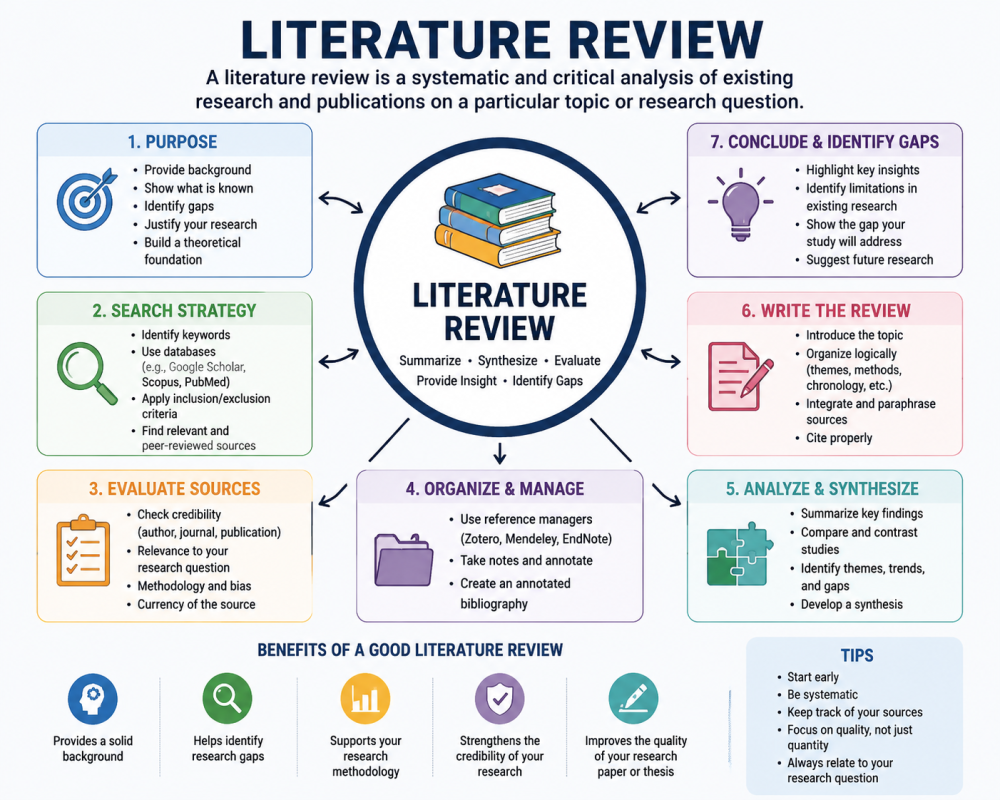
7-Step Process to Determine How Many Sources Should a Literature Review Have
- Clarify the research question and scope
- Begin by reviewing your thesis, research paper, or study objectives.
- Identify keywords, concepts, and aspects of the field to focus your search.
- A clear research question ensures your search strategy is efficient and relevant.
- Identify the type of literature review required
- Determine whether your review will be systematic, scoping, narrative, conceptual, or full literature review.
- Each type has a different expectation for the number of sources.
- Systematic reviews may include hundreds of studies.
- A narrative or conceptual review might focus on 20–50 key sources.
- Develop a search strategy
- Select databases such as Google Scholar, MED, PubMed, Scopus, or discipline-specific databases.
- Use Boolean operators (AND, OR, NOT) to refine searches.
- Identify inclusion and exclusion criteria such as publication date, peer-reviewed status, methodological rigor, and relevance to the research question.
- Conduct a preliminary search
- Find articles across multiple databases to get a sense of the field’s breadth.
- Look at abstracts, keywords, and citations to identify influential and recent studies.
- Keep a running annotated bibliography to track sources for synthesis and citation.
- Evaluate sources
- Critically assess peer-reviewed articles, reviews of the literature, and journal publications for relevance, quality, and methodological soundness.
- Check for bias, inconsistency, and citation credibility.
- Prioritize recent articles and seminal works to ensure a theoretical and methodological overview.
- Decide on the number of sources
- There is no universal number; it depends on discipline, level (undergraduate, PhD), and type of review.
- As a rough guideline:
- Undergraduate literature review: 20–40 references
- Master’s thesis: 40–80 references
- PhD thesis or systematic review: 100+ references
- Focus on quality over quantity, ensuring each source contributes meaningfully to the review.
- Start writing and refine as you go
- Begin writing the body of the review, synthesizing findings from your sources.
- Reassess the number of sources during the writing stage; add references if gaps are found or remove unnecessary citations.
- Always summarize, paraphrase, and synthesize research studies rather than just listing them.
Understanding Different Types of Literature Review and Their Source Requirements
- Narrative review (traditional review)
- Focuses on summarizing and synthesizing studies around a conceptual theme or theoretical perspective.
- Typically 20–50 key sources; breadth is more important than exhaustive coverage.
- Systematic review
- Aims to be comprehensive and reproducible.
- Sources are identified using a protocol, and inclusion is guided by strict criteria.
- Often includes hundreds of references and focuses on specific research questions.
- Scoping review
- Provides a broad overview of the field, including emerging studies and interdisciplinary perspectives.
- Sources may vary widely depending on research breadth; good for mapping gaps and trends.
- Meta-analysis review
- Combines quantitative results from multiple studies.
- Requires selecting studies that are methodologically compatible.
- Conceptual or theoretical review
- Focuses on theoretical frameworks and conceptual models.
- Source selection is strategic, emphasizing in-depth analysis over volume.
- Interdisciplinary reviews
- Draw from multiple disciplines to provide synthetic insights.
- Balance between breadth and depth; number of sources depends on coverage required to address multiple perspectives.
Effective Search Strategies for Gathering References for Your Literature Review
- Identify key databases and search engines
- Use Google Scholar, MED, discipline-specific databases, and library portals.
- Consider using reference lists from review articles to locate additional studies.
- Develop search terms and Boolean combinations
- Include keywords, synonyms, and related concepts.
- Combine with AND/OR/NOT to refine the search, for example:
"literature review" AND "research question""systematic review" OR "scoping review"
- Use filters and criteria
- Limit by publication year to include the latest studies.
- Focus on peer-reviewed journals to ensure scholarly credibility.
- Apply methodological criteria: qualitative vs. quantitative, study design, sample size.
- Track and organize sources
- Maintain an annotated bibliography with summaries, keywords, and citation information.
- Note the relevance to the research question and how it contributes to gaps, synthesis, or theory.
- Evaluate sources critically
- Check for bias, quality, and consistency.
- Compare methodologies and findings across studies.
- Determine which sources provide insight, support, or contrast in your literature review.
- Iteratively refine search
- Conduct multiple rounds of search and evaluation to ensure comprehensiveness.
- Adjust search terms and criteria based on gaps identified during the writing stage.
Evaluating Sources to Build a Good Literature Review
- Understand the purpose of evaluation
- To create a good literature review, each source must contribute meaningful insight, help identify gaps, and support your research question.
- Evaluation ensures the body of the review is credible, methodologically sound, and free from unnecessary bias.
- Criteria for evaluating sources
- Relevance: Does the source directly address your research question or aspect of the field?
- Publication type: Prioritize peer-reviewed journals, review articles, and reputable books over non-scholarly publications.
- Methodology: Assess whether the study uses qualitative, quantitative, or mixed methods, and if it aligns with your review’s objectives.
- Recency: Include recent articles to ensure your review reflects latest studies while maintaining a balance with seminal works.
- Citation and impact: Consider how frequently a study has been cited to gauge influence in the discipline.
- Steps to evaluate effectively
- Read the abstract first to gain a rough idea of the study’s relevance.
- Assess methodology: Check if sample size, design, and analysis meet your review’s quality standards.
- Examine findings and discussion: Determine if the results contribute insight or theoretical understanding to your topic.
- Check for bias or inconsistency: Look for methodological flaws or conflicts with other research studies.
- Record essential details in an annotated bibliography: Include citation, methodology, key findings, and relevance to your review.
- Organizing sources for synthesis
- Group studies by theme, methodology, or type of literature review.
- Summarize each reference, noting strengths, limitations, and contribution.
- Use this structure to paraphrase, synthesize, and integrate sources into the writing stage.
- Tools for evaluation
- Google Scholar alerts and databases like MED, Scopus, or discipline-specific portals help you find articles efficiently.
- Consider systematic reviews and scoping reviews as starting points for overview and insight.
Aligning Your Literature Review with Your Research Question
- Central role of the research question
- Your research question guides which sources to include, how to summarize findings, and the scope of your review.
- A literature review that does not align may miss gaps, overlook methodological aspects, or appear superficial.
- Steps to ensure alignment
- Define the focus: Identify keywords, concepts, and aspects of the field linked to your research question.
- Select relevant sources: Prioritize studies that directly address the topic and provide insight into gaps.
- Organize by themes or methodology: Group studies to create a synthetic overview that maps directly to your research objectives.
- Evaluate contribution: Determine how each reference informs your understanding or supports the rationale for your study.
- Synthesize findings: Highlight trends, inconsistencies, and interdisciplinary perspectives that shape your research direction.
- Importance of scope and type of review
- A full literature review is broader, potentially including 50–100+ sources for PhD-level research.
- A conceptual or narrative review may be narrower, focusing on key studies to illustrate theoretical or methodological frameworks.
- Aligning breadth and depth ensures that your review answers the research question effectively.
- Maintaining focus during writing
- Regularly check that each source contributes to the argument or gap identification.
- Use summaries, paraphrasing, and synthesis to integrate findings rather than listing references.
- Consult your supervisor or coauthor if in doubt about the relevance of particular sources.
Common Mistakes to Avoid When Deciding How Many Sources Should a Literature Review Have
- Including too few sources
- May result in a shallow review, limited insight, and missing important studies.
- Undergraduate students often underestimate the number of sources needed for a good literature review.
- Overloading with sources
- Including every article found can clutter the body of the review.
- Leads to repetition, difficulty in synthesis, and reader fatigue.
- Focus instead on quality, relevance, and contribution to your research question.
- Ignoring methodological quality
- Including studies without evaluating design, bias, or validity undermines credibility.
- Poor-quality references reduce the strength of your thesis or research paper.
- Neglecting recent studies
- Failing to include latest studies may make the review outdated or incomplete.
- Balance foundational studies with recent peer-reviewed publications.
- Lack of alignment with the research question
- A review that strays from the research question can appear scattered.
- Each reference should support a synthetic perspective, highlight a gap, or illustrate a methodological approach.
- Insufficient synthesis
- Simply summarizing each source without comparison or integration results in a fragmented review.
- A good literature review emphasizes connection, patterns, and contrasts among studies.
- Not tracking sources properly
- Incomplete citations or missing reference details can create issues during submission.
- Maintain an annotated bibliography from the start to systematically organize sources.
Summary and Best Practices on How Many Sources Should a Literature Review Have
- General guidelines for number of sources
- Undergraduate literature review: ~20–40 references
- Master’s thesis: ~40–80 references
- PhD-level or systematic review: 100+ references
- These are flexible; the goal is to provide a solid background and comprehensive overview.
- Best practices
- Focus on quality, relevance, and breadth rather than sheer number.
- Include peer-reviewed journals, review articles, and scholarly publications.
- Balance qualitative and quantitative studies for methodological diversity.
- Use databases and search engines like Google Scholar or MED to ensure no major studies are missed.
- Organizational tips
- Maintain a structured annotated bibliography with summaries and key insights.
- Group studies by theme, methodology, or type of review for easier synthesis.
- Use paraphrasing and summary techniques to integrate sources smoothly.
- Alignment and synthesis
- Regularly check that references support your research question, gaps, and theoretical framework.
- Ensure the review provides a synthetic and in-depth perspective rather than a list of citations.
- Writing and refinement
- Begin writing once a rough idea of sources is established.
- Adjust the number of sources during the writing stage based on coverage, gaps, and feedback.
- Seek input from a supervisor or coauthor to ensure a balanced and credible review.
- Final insight
- Determining how many sources should a literature review have requires systematic searching, evaluation, and synthesis.
- By following structured steps, applying criteria for relevance and quality, and focusing on alignment with the research question, researchers can write a literature review that is insightful, comprehensive, and credible.
