
Blog
How To Conclude a Literature Review? |Best Example

How To Conclude a Literature Review? | Introduction and Key Definitions
- Understanding the Purpose of a Literature Review
- A literature review is a comprehensive summary of existing research on a topic.
- It evaluates and synthesizes findings from multiple sources to highlight trends, gaps in existing research, and current knowledge in the field.
- Writing the literature review is a critical part of a research paper because it situates your research question within the scholarly context and provides a coherent framework for your study.
- The literature review section serves as an introduction to the research problem, showing the significance of your topic and the development of the field over time.
- Key Terms and Concepts
- Conclusion: The final section of the literature review that summarizes the key points, evaluates existing research, and proposes directions for future research.
- Synthesize: Combining findings from different sources to produce a coherent understanding of the research area.
- Gap: Areas where research is lacking or questions remain unanswered. Highlighting gaps helps justify the significance of your research.
- Methodology: Understanding the methods used in existing studies allows you to critique and compare the results critically.
- Academic Writing: The literature review should maintain a scholarly tone, analyze and contrast different sources, and remain objective.
- Research Process: Conducting a thorough review is an integral step, helping to refine the research question and structure the study.
- Why the Conclusion Matters
- The conclusion ties together the findings of the literature review.
- It ensures that the review does not stand as a standalone summary but informs the larger paper.
- The conclusion should summarize, evaluate, and propose future directions while maintaining relevance to the research question and thesis.
How To Conclude a Literature Review? | 7-Step Process to Formulate a Strong Conclusion
- Review the Key Findings
- Begin by summarizing the main points from the literature review.
- Highlight significant trends, consistent findings, and areas of consensus.
- Discuss how these findings relate to your research question.
- Ensure that the conclusion accurately reflects the critical evaluation conducted in the main body of the review.
- Identify Gaps in Existing Research
- Analyze the literature to detect unanswered questions, contradictions, or under-researched areas.
- Clearly state the gaps and explain why they are significant.
- This will provide direction for future research and demonstrate the relevance of your own study.
- Synthesize, Don’t Just Summarize
- Combine insights from multiple sources rather than listing them individually.
- Show relationships between different studies, comparing and contrasting results.
- Discuss how the collective evidence supports or challenges your research topic.
- Link Back to Your Research Question
- Demonstrate how the review informs the larger research paper.
- Explicitly connect the conclusion to the thesis or main objectives of your research.
- Highlight the significance of the literature in shaping your research methodology or theoretical approach.
- Provide Insight and Interpretation
- Move beyond summary to critique and evaluate the studies.
- Introduce new ideas or perspectives that emerge from the review process.
- Discuss the scientific or academic implications of the findings.
- Propose Future Directions
- Suggest areas where further research is needed to fill gaps.
- Indicate potential avenues for new studies or development in the field.
- Ensure the proposed directions are specific, feasible, and relevant to your research area.
- Ensure Coherence and Flow
- Make sure the conclusion flows naturally from the main body of the literature review.
- Use transitions to connect the summarized findings, evaluation, and future directions.
- Edit and revise carefully to maintain a logical and organized structure.
Writing the Literature Review: How To Conclude a Literature Review? Best Practices
- Start With a Strong Summary
- Summarize the key concepts, main points, and trends identified in the literature review.
- Focus on relevance: include findings that directly relate to your research question or thesis.
- Ensure each paragraph contributes to an overarching understanding rather than isolated observations.
- Evaluate Critically
- Assess the quality of the source material and methodology used in the studies.
- Compare and contrast results across different literature review articles.
- Highlight debates or conflicting findings to provide a nuanced perspective.
- Maintain Organizational Clarity
- Structure the conclusion so it mirrors the logic of the review: chronological, thematic, or methodological organization.
- Ensure the conclusion is coherent, synthesizing multiple sources into a unified narrative.
- Emphasize Knowledge Advancement
- Indicate how your literature review advances understanding of the topic.
- Highlight how it addresses gaps in existing research and identifies the significance of new findings.
- Connect to the Larger Paper
- Clearly indicate how the literature review informs the main body and methodology of your research paper.
- Position the conclusion as a bridge between existing research and your own contribution.
- Focus on Relevance and Specificity
- Avoid introducing unrelated studies or tangential debates.
- Concentrate on studies that directly inform your research topic and objectives.
- Keep the conclusion concise but informative.
- Ensure a Scholarly Tone
- Use formal academic writing, precise language, and evidence-backed statements.
- Avoid personal opinion unless explicitly framed as an interpretation based on the literature.
- Edit and Revise Thoroughly
- Review for clarity, coherence, and accuracy.
- Ensure citations are correct and all statements are supported by credible sources.
- Rewrite sentences where necessary to improve flow and readability.
Organize and Structure Your Review Before the Conclusion
- Plan the Organizational Flow
- Decide whether your review follows a chronological, thematic, methodological, or mixed structure.
- Organize paragraphs logically so each leads naturally to the conclusion.
- Introduce Key Concepts Early
- Ensure the introduction of the literature review provides context for the findings.
- Clarify the research area, background, and significance of the topic.
- Highlight Critical Evaluations
- Each paragraph should evaluate existing research and identify key trends or gaps.
- Use transitions to connect ideas and maintain coherence.
- Ensure Paragraph-Level Coherence
- Start paragraphs with topic sentences introducing the focus.
- Summarize, discuss, and critique within each paragraph.
- End with a mini-summary to reinforce the contribution of that section to the larger review.
- Synthesize Across Sources
- Compare findings from different research papers to identify patterns.
- Discuss methodological differences and implications for interpretation.
- Integrate new information with existing knowledge to enhance the literature review’s depth.
- Maintain an Academic and Informative Tone
- The literature review should be analytical, informative, and standalone in terms of presenting knowledge in the field.
- Avoid mere listing of studies; focus on critical evaluation and synthesis.
- Prepare for a Strong Conclusion
- Organize the review so the conclusion naturally summarizes the key points, highlights gaps, and proposes directions for future research.
- Ensure that the conclusion section will clearly answer the question: how to conclude a literature review?
How to Conduct a Literature Review That Leads to a Clear Conclusion
- Define Your Research Scope and Topic
- Begin by clearly identifying the research question or thesis for your paper.
- Introduce the topic and explain its significance in the field.
- Determine the scope of your literature review by selecting relevant studies, literature review articles, and source material.
- Focus on studies that are current, scholarly, and directly relevant to your research area.
- Plan Your Literature Review Structure
- Decide on an organizational approach: chronological, thematic, methodological, or a combination.
- Each paragraph should introduce, discuss, and synthesize findings from multiple sources.
- Maintain a coherent structure so that the main points naturally lead to the conclusion.
- Conduct a Comprehensive Review
- Search databases and journals to gather relevant existing research.
- Include literature that highlights key trends, debates, and gaps in existing research.
- Evaluate the methodology and reliability of each study to inform critical analysis.
- Compare results from multiple sources to identify patterns and contrasts.
- Analyze and Synthesize Findings
- Summarize each study’s key findings while highlighting relevance to your research question.
- Identify gaps in existing research that require further investigation.
- Synthesize insights from multiple sources to create an overview of the current state of knowledge.
- Highlight the significance of these findings for the development of your larger paper.
- Maintain a Coherent Flow Toward the Conclusion
- Use transitions between paragraphs to guide the reader through your analysis.
- Ensure the review process is logical and leads naturally to summarizing and evaluating the key points.
- Keep each paragraph focused on a specific aspect, such as trends, methodologies, or scholarly debates.
- Link Findings to Your Research Question
- Discuss how the compiled evidence supports or challenges your thesis.
- Clearly indicate the relevance of each key point in shaping the direction of your study.
- This linkage will make the conclusion of your literature review strong, informative, and purposeful.
- Prepare for a Comprehensive Conclusion
- Highlight main points, trends, and gaps identified in the literature review.
- Outline potential directions for future research based on gaps or inconsistencies.
- Ensure your review sets the stage for advancing knowledge in your field and informs the larger paper.
Editing and Revising: Strengthen Your Literature Review Conclusion
- Review the Draft for Coherence
- Check that your conclusion summarizes and synthesizes the key findings clearly.
- Ensure each paragraph contributes to a cohesive narrative that connects back to your research question.
- Evaluate whether the conclusion provides a standalone overview of the literature review section.
- Ensure Critical Evaluation and Accuracy
- Critique source material for reliability, methodology, and relevance.
- Compare results across studies and highlight debates or contrasting findings.
- Identify gaps in existing research and explain their significance in advancing your research area.
- Refine Structure and Organization
- Reorganize paragraphs if necessary to improve the flow from introduction to conclusion.
- Use transitions to connect ideas and maintain coherence between main points.
- Ensure the conclusion is logically aligned with the main body of the review.
- Highlight Key Points and Significance
- Summarize major trends, key findings, and gaps in a concise manner.
- Evaluate the overall contribution of the literature review to the research paper.
- Include a summary of how the literature review informs methodology and research design.
- Edit for Academic Style
- Maintain a scholarly and objective tone throughout.
- Rewrite sentences for clarity, avoiding ambiguity or overly complex language.
- Ensure proper citation of all studies and sources used in the review process.
- Verify Relevance to Your Research Question
- Check that all summarized information directly contributes to your thesis or research objectives.
- Eliminate content that does not support your conclusion or the larger paper.
- Incorporate Directions for Future Research
- Propose specific avenues for new research based on identified gaps.
- Explain how new research could advance knowledge in the field and inform scientific research practices.
- Emphasize the significance of these proposed studies in contributing to the development of your research area.
Common Mistakes to Avoid When Writing the Literature Review Conclusion
- Repeating the Introduction or Main Body
- Avoid simply restating points from earlier sections without synthesis.
- The conclusion should summarize key findings, not reintroduce all paragraphs.
- Neglecting Critical Evaluation
- Do not overlook evaluating the methodology, reliability, and significance of the source material.
- Avoid listing studies without analyzing or contrasting the results.
- Ignoring Gaps in Existing Research
- Failing to highlight gaps reduces the relevance of the literature review and weakens the justification for your study.
- Gaps should inform future directions and emphasize the contribution of your research.
- Poor Organization and Coherence
- Avoid unstructured conclusions that jump between unrelated points.
- Ensure the paragraph structure is logical, and each key finding flows naturally to the next.
- Overgeneralizing Findings
- Avoid vague statements that do not specify trends, debates, or critical insights.
- Ensure that every claim in the conclusion is supported by evidence from the literature review articles.
- Introducing New Source Material
- Do not bring in new studies in the conclusion; the focus should be on synthesizing and evaluating previously discussed findings.
- Weak Connection to the Research Question
- Ensure the conclusion explicitly relates back to the research question or thesis.
- Avoid writing a conclusion that feels disconnected from the purpose of the research paper.
- Neglecting the Future Directions
- Avoid omitting recommendations for further research.
- Highlighting future directions strengthens the relevance and scholarly contribution of the literature review.
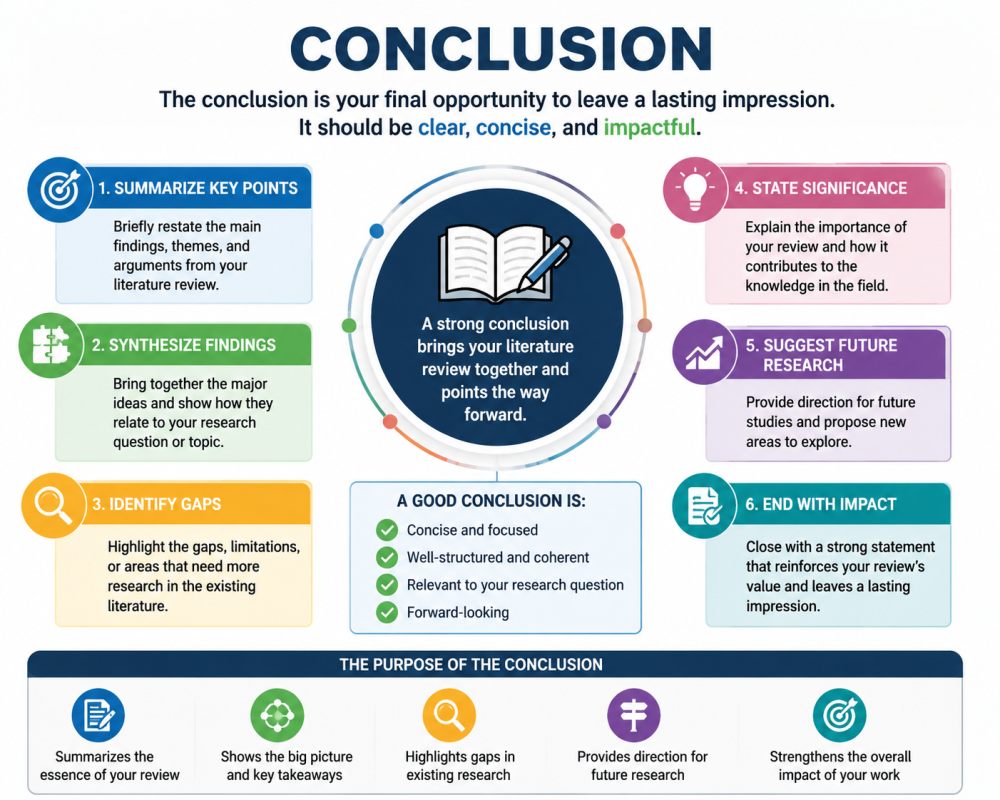
Final Thoughts: How To Conclude a Literature Review? for Your Research Paper
- Summarize the Key Points Effectively
- The conclusion should accurately summarize the main findings, highlight trends, and synthesize results from multiple sources.
- Emphasize the significance of these findings in the context of your research question and topic.
- Connect to the Larger Paper
- Ensure the literature review conclusion bridges the gap between the review and the main body of your research paper.
- Show how the synthesized knowledge informs methodology, research design, or thesis development.
- Highlight Gaps and Propose Future Directions
- Identify gaps in existing research that the study or future studies can address.
- Propose directions for new research that are feasible, relevant, and scientifically significant.
- Maintain Scholarly Tone and Coherence
- Use academic writing to communicate critical evaluation, analysis, and synthesis.
- Organize paragraphs logically, with transitions linking trends, gaps, and conclusions.
- Ensure Relevance and Clarity
- Focus on points that advance knowledge in the field and contribute to your research area.
- Make sure the conclusion is informative, concise, and specific to the topic.
- Edit and Revise Thoroughly
- Check for clarity, coherence, and accuracy in summarizing key points.
- Verify that all statements are supported by literature review articles and source material.
- Rewrite sentences where necessary to improve readability and flow.
- Reinforce the Research Significance
- Conclude by emphasizing the contribution of the literature review to the research question and field.
- Highlight how new ideas, critical evaluation, and synthesized knowledge advance scientific research and academic understanding.
- Final Checklist for a Strong Conclusion
- Summary of key points and trends ✔
- Critical evaluation and synthesis ✔
- Identification of gaps in existing research ✔
- Proposed future directions ✔
- Coherence, logical structure, and clarity ✔
- Direct relevance to research question and thesis ✔
- Remember the SEO Perspective
- The section repeatedly addresses the central question: how to conclude a literature review?
- Integrating the SEO keyword naturally throughout ensures clarity for readers and search engines.
