
Blog
How to Write Research Question |Best Example

Introduction to How to Write Research Question: Definition and Importance of a Research Question
- Understanding the Research Question:
- A research question is the central element that drives a research project, thesis, dissertation, or health research study.
- It defines the problem to be investigated and guides the research design, methodology, and data collection.
- The SEO keyword, How to Write Research Question, emphasizes learning the process to formulate a clear and impactful question for any research project.
- Purpose of a Research Question:
- A well-defined research question helps the writer direct his or her research systematically.
- It narrows broad topics or general topics into specific, researchable areas of interest.
- By framing a strong research question, researchers can avoid unfocused studies and maintain clarity in scope, study design, and research objectives.
- Linking to Research Objectives:
- The research question ensures alignment with research objectives.
- It ensures the methodology, whether quantitative or qualitative research, effectively addresses the problem.
- A research question is not just a query—it is a framework that informs hypothesis development, study design, and data collection strategies.
- Impact on Study Quality:
- Strong research questions are answerable with a simple “yes” or “no” in quantitative research, or open-ended in qualitative research.
- They guide evidence-based, systematic reviews and help identify gaps in existing literature.
- The quality of your research question directly impacts the feasibility and success of your research project, dissertation, or thesis.
- Iterative Nature:
- Writing a research question is an iterative process; it requires refining, narrowing your focus, and considering resources available.
- Even well-defined questions may need more revising to ensure they are effective in helping the writer direct research methods and analysis.
Step-by-Step Guide: How to Write Research Question | Best Example in 7 Steps
- Step 1: Start with a Broad Topic
- Identify your general topic or area of interest.
- Consider the field of study and interdisciplinary connections, for example, computational linguistics or organizational studies.
- This initial stage frames the foundation for narrowing your focus toward a specific, researchable question.
- Step 2: Conduct a Literature Review
- Explore existing literature, systematic reviews, and prior studies in the area of interest.
- Identify what has already been done, where gaps exist, and areas requiring further research.
- Understanding what is already known helps refine your research question and ensures it is both researchable and evidence-based.
- Step 3: Narrow Your Focus
- Move from a broad topic to a more specific question by considering feasibility, scope, and methodological constraints.
- Decide whether your study will use qualitative or quantitative research methods—or a mix of both (quantitative and qualitative).
- Focus on creating a research question narrow enough to be answered effectively within the resources and time available.
- Step 4: Define the Type of Study
- Determine whether your research is exploratory, methodological, clinical, or computational.
- For health research, you might consider frameworks such as PICO (Population, Intervention, Comparison, Outcome) to structure your question systematically.
- Clearly defining your type of study ensures your research question is aligned with your research design and data collection methods.
- Step 5: Formulate a Clear and Well-Defined Question
- A good research question must be clearly defined and specific.
- It should be as clear as possible in order to guide the writer through the research process effectively.
- Use precise language to avoid ambiguity, ensuring the question can guide hypothesis development or open-ended inquiry.
- Step 6: Evaluate the Question for Feasibility and Significance
- Consider resources available, time constraints, and the amount of existing literature.
- A strong research question requires the writer to assess whether a significant difference or meaningful findings can be obtained.
- Ensure the research question helps you understand the subject and is actionable for designing clinical research or computational studies.
- Step 7: Refine and Iterate
- Continuously revise your research question to enhance specificity, clarity, and answerability.
- Seek feedback from mentors, colleagues, or advisors to help refine the question further.
- Remember that formulation of research is an iterative process that strengthens focus and ensures the question is well-defined, clear, and effective.
Characteristics of a Good Research Question: Tips to Formulate Effectively
- Clarity and Specificity:
- A good research question must be clearly defined to avoid confusion and direct research effectively.
- It should clearly outline what is being studied, in what context, and using which methodology.
- Example: “Does a structured PICO framework improve patient outcomes in systematic health research compared to traditional clinical protocols?”
- Researchable and Feasible:
- The question must be answerable using available data collection techniques, resources, and research methods.
- Consider the scope: it should be narrow enough to allow in-depth analysis but broad enough to be meaningful.
- Aligned with Objectives:
- Good research questions link directly to research objectives and study design.
- They help the writer define a hypothesis or identify key outcomes for quantitative and qualitative research.
- Methodological Fit:
- The research question must align with chosen methods—quantitative research favors measurable, answerable questions; qualitative research allows open-ended exploration.
- The methodology should be clearly indicated in the question’s scope to ensure a systematic approach.
- Significance and Originality:
- A strong research question addresses areas where much research is not available, identifies gaps in the field, and contributes to successful research outcomes.
- For example, in health research, a question that compares interventions across populations may be highly valuable.
- Flexibility for Refinement:
- Even well-crafted questions may need iteration; they should be open to refinement as the researcher gains deeper understanding of the topic.
- Tools such as frameworks, PICO, or computational models can help refine questions in interdisciplinary and organizational studies.
Common Mistakes to Avoid When You Write a Research Question
- Being Too Broad or Unfocused:
- Avoid general topics or questions that are vague, unfocused, or lack specificity.
- Broad questions dilute the research objectives and make data collection unmanageable.
- Creating Unanswerable Questions:
- A research question must be answerable with available resources and data collection methods.
- Avoid questions that require speculation or cannot be systematically tested.
- Neglecting the Methodological Fit:
- Do not formulate questions without considering the research methods.
- Quantitative research questions require measurable outcomes, while qualitative questions benefit from exploratory, open-ended formats.
- Ignoring Existing Literature:
- Avoid questions that have already been done extensively unless a novel angle is being explored.
- Conduct systematic reviews to ensure the question contributes to the field.
- Poorly Defined Scope:
- Avoid questions that are too narrow or too broad; balance feasibility with significance.
- The research question must guide the research process effectively, ensuring clear, well-defined objectives.
- Lack of Clarity in Language:
- Ambiguity in wording can make a research question ineffective.
- Must be as clear as possible in order to support designing clinical research, evidence-based studies, and thesis work.
- Skipping Iteration and Feedback:
- A research question rarely becomes perfect on the first attempt.
- Iterative refinement, mentor feedback, and pilot testing help ensure it is strong, well-defined, and researchable.
- Disregarding Feasibility and Resources:
- Consider time, access to data, ethical concerns, and computational or field resources.
- A good research question balances ambition with what is realistically achievable.
Using a Conceptual Framework to Formulate Your Research Question
- Purpose of a Conceptual Framework:
- A conceptual framework is a structured approach that guides the formulation of research questions and the research process.
- It helps the writer define the scope, research objectives, and type of study, whether quantitative research, qualitative research, or a mixed-methods approach.
- In health research or clinical studies, frameworks like PICO (Population, Intervention, Comparison, Outcome) are often used to craft well-defined, answerable research questions.
- Connecting Frameworks to Research Design:
- The framework links the research topic to methodology and data collection, ensuring alignment with your dissertation, thesis, or research project.
- It helps in narrowing broad topics into specific questions that are feasible, researchable, and clear enough to guide the study systematically.
- By using a conceptual framework, you can avoid unfocused or exploratory questions that are difficult to operationalize.
- Steps to Use a Conceptual Framework:
- Identify your area of interest or general topic.
- Review existing literature and systematic reviews to see what has already been done and what gaps remain.
- Define key concepts, variables, or constructs relevant to your research topic.
- Map relationships between these concepts to guide the formulation of research questions.
- Refine the research question iteratively, ensuring it is well-defined, answerable, and directly linked to your framework.
- Benefits for Strong Research Questions:
- Using a conceptual framework ensures your research question is aligned with methodological considerations, study design, and data collection strategies.
- It helps the writer develop a strong research question that is researchable, feasible, and focused enough to yield meaningful results.
- In interdisciplinary fields such as computational linguistics or organizational studies, a framework provides clarity on how multiple variables interact and guide the formulation of specific, testable questions.
Systematic Approaches to Strengthen Your Research Question
- Importance of a Systematic Process:
- A systematic approach ensures the research question is answerable, feasible, and aligned with the research objectives.
- Systematic reviews, iterative processes, and methodological frameworks help refine research questions to enhance specificity and clarity.
- This approach is particularly useful in evidence-based health research, organizational studies, and interdisciplinary research projects.
- Step 1: Map Your General Topic to Specific Questions:
- Begin with a broad topic and narrow your focus by identifying potential gaps in existing literature.
- A good research question must focus on a particular subject and be well-defined to guide the research process effectively.
- Step 2: Align With Study Design and Methodology:
- Consider whether the research question is suited for quantitative research, qualitative research, or a mixed-methods approach.
- Ensure it is answerable with a simple “yes” or “no” for quantitative studies or allows open-ended exploration for qualitative studies.
- Step 3: Evaluate Feasibility and Resources:
- A research question must consider available resources, data collection methods, and the time frame of the research project.
- Feasibility ensures that the research question is realistic and can lead to successful research outcomes.
- Step 4: Iterative Refinement:
- Crafting a research question is an iterative process requiring repeated refining, narrowing, and clarity enhancement.
- Feedback from supervisors, colleagues, or mentors helps ensure the question is as clear as possible in order to direct research effectively.
- Step 5: Integration of Hypotheses and Objectives:
- Ensure the research question links to hypotheses, research objectives, and study design.
- This alignment ensures that the research question helps you understand the topic and contributes to meaningful outcomes.
- Step 6: Check for Specificity and Researchability:
- A strong research question is researchable, narrow enough to be specific, and broad enough to be significant.
- It avoids unfocused, open-ended questions that cannot be answered systematically.
- Step 7: Evaluate Using Evidence-Based Standards:
- Ensure the research question addresses gaps identified in systematic reviews or existing literature.
- The question should have potential for a significant difference, methodological clarity, and contribute to advancing knowledge in the field of study.
Examples of How to Write Research Question | Best Example Across Different Disciplines
- Health Research Example:
- Research Topic: Effectiveness of structured clinical interventions in reducing patient readmissions.
- Research Question: “Does implementing a PICO-based framework in hospital discharge protocols reduce readmission rates compared to standard procedures?”
- Explanation: This question is well-defined, quantitative, feasible, and answerable with a simple “yes” or “no.”
- Organizational Studies Example:
- Research Topic: Employee engagement strategies in large organizations.
- Research Question: “How do structured feedback frameworks influence employee productivity and satisfaction in multinational corporations?”
- Explanation: This strong research question is exploratory, qualitative, and uses a conceptual framework to guide data collection.
- Computational Linguistics Example:
- Research Topic: Natural language processing applications in sentiment analysis.
- Research Question: “Can a hybrid computational model improve accuracy in sentiment detection compared to traditional linguistic models?”
- Explanation: This quantitative and computational research question is clearly defined, feasible, and directly linked to the study design.
- Educational Research Example:
- Research Topic: Effects of flipped classroom approaches on student engagement.
- Research Question: “Does a flipped classroom methodology improve critical thinking skills among undergraduate students compared to traditional lecture-based approaches?”
- Explanation: This research question is specific, answerable, well-defined, and helps refine the research process systematically.
- Interdisciplinary Research Example:
- Research Topic: Organizational impact of AI adoption on workflow efficiency.
- Research Question: “How does AI integration in organizational workflows influence decision-making speed and accuracy across departments?”
- Explanation: This question combines quantitative and qualitative research methods, is answerable, and directly guides the research design.
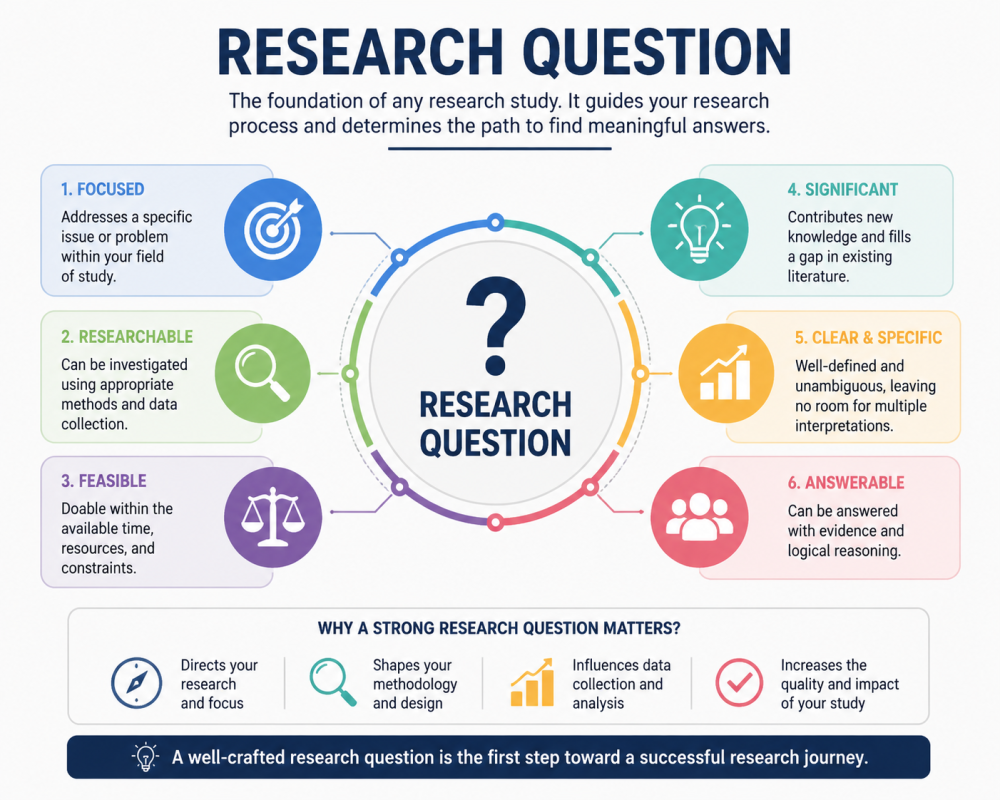
Refining and Evaluating Your Research Question for Maximum Impact
- Importance of Refinement:
- Even strong research questions often need more revising to ensure they are effective.
- Iterative refinement helps you narrow your focus, define the scope, and improve specificity.
- Techniques to Refine Your Research Question:
- Break broad topics into a couple of specific questions.
- Use frameworks, such as PICO or Hulley’s methodological guides, to identify the main variables.
- Assess whether your question is researchable, feasible, and aligned with study design.
- Evaluate clarity: the question must be as clear as possible in order to help the writer direct research effectively.
- Evaluation Criteria:
- Answerable: Can it be addressed with available resources and research methods?
- Specificity: Is it narrow enough to focus on a particular subject without being overly restrictive?
- Relevance: Does it contribute to the field and address gaps in existing literature or systematic reviews?
- Feasibility: Are data collection and analysis practical within the research project’s scope and resources?
- Alignment: Does it align with research objectives, hypothesis, and study design?
- Iterative Process and Feedback:
- Refining a research question requires an iterative process.
- Seek feedback from mentors, peers, or experts in the field of study.
- This ensures that the research question is not unfocused, is well-defined, and maximizes the potential for successful research outcomes.
- Final Considerations for Maximum Impact:
- Ensure the research question is directly related to your research topic, thesis, or dissertation.
- Use clear and precise language, avoiding ambiguity or jargon unless methodologically necessary.
- A well-crafted, strong research question guides the formulation of research, study design, data collection, and ultimately the success of the research project.
