
Blog
How To Write Predictive Research Questions With Examples

How To Write Predictive Research Questions With Examples: Definition, Meaning, and Its Role as a Type of Research Question
What Are Predictive Research Questions?
- Predictive Research Questions are research questions designed to forecast or estimate future outcomes, behaviors, events, patterns, or occurrences based on existing information, relationships, or historical data.
- Unlike other types of questions that focus on describing or explaining a phenomenon, predictive research questions seek to predict what is likely to happen in the future.
- A predictive research question examines relationships between variables to determine whether one variable can be used to forecast another variable.
- In many research studies, researchers use predictive questions when their objective is to identify future trends, probabilities, or expected outcomes.
- Predictive Research Questions are commonly used in:
- Business research
- Education research
- Healthcare research
- Economics
- Marketing
- Social sciences
- Machine learning applications
- Predictive analytics projects
Definition of Predictive Research Questions
- A predictive research question can be defined as: A research question that seeks to determine whether existing data, patterns, or variables can be used to predict future outcomes, events, or behaviors.
- The main goal is not merely to describe a current situation but to estimate what may occur later.
- Because prediction relies heavily on measurable variables, Predictive Research Questions are usually associated with quantitative research.
Meaning of Predictive Research Questions
- The term “predictive” refers to the ability to forecast future outcomes.
- Predictive Research Questions focus on:
- Future performance
- Future behavior
- Future trends
- Future occurrences
- Future responses
- These questions require researchers to:
- Analyze existing information
- Examine patterns
- Evaluate relationships
- Construct prediction models
- Generate evidence-based forecasts
- For example: Instead of asking:
- What is the relationship between study time and academic performance?
- To what extent can study time predict students’ academic performance?
- Notice that the second question moves beyond description and focuses on prediction.
Predictive Research Questions as a Type of Research Question
- Predictive Research Questions represent an important type of research question within the broader research process.
- Researchers generally encounter several types of questions during inquiry:
Descriptive Questions
- Descriptive questions seek to define or describe a phenomenon.
- Example:
- What are the study habits of university students?
- These questions focus on characteristics rather than future outcomes.
Exploratory Questions
- Exploratory questions investigate areas with limited knowledge.
- Example:
- What factors influence students’ choice of online learning platforms?
- These questions help researchers explore a research topic in greater depth.
Comparative Questions
- Comparative questions compare groups or conditions.
- Example:
- Do online students perform better than traditional classroom students?
Causal Questions
- Causal questions attempt to determine cause-and-effect relationships.
- Example:
- Does increased study time cause higher academic achievement?
Predictive Questions
- Predictive questions estimate future outcomes.
- Example:
- Can study time predict academic achievement among university students?
- This distinction makes Predictive Research Questions unique and highly valuable.
Characteristics of Strong Predictive Research Questions
A strong research question should be:
Specific
- Clearly identify the variables involved.
Measurable
- Variables should be observable and quantifiable.
Answerable
- Sufficient data should exist to address the question.
Relevant
- The question should address a meaningful research gap.
Focused
- Avoid overly broad questions.
Predictive
- Explicitly seek a future outcome or forecast.
Why Researchers Use Predictive Research Questions
Researchers use Predictive Research Questions because they help:
- Predict future trends.
- Improve planning and decision-making.
- Support policy development.
- Enhance predictive analytics systems.
- Guide business strategies.
- Improve resource allocation.
- Evaluate future risks.
- Automate forecasting processes.
- Generate practical solutions.
As a result, Predictive Research Questions play a crucial role in modern research studies and data-driven decision-making.
How To Write Predictive Research Questions With Examples: A 4-Step Process for Writing a Good Research Question and Building Strong Predictive Questions
Step 1: Define the Research Topic and Outcome to Predict
- Every predictive inquiry starts with a clearly defined research topic.
- Ask yourself:
- What future event do I want to predict?
- What phenomenon am I studying?
- What outcome matters most?
Examples
- Student academic success
- Employee turnover
- Customer purchasing behavior
- Disease occurrence
- Stock market trends
- Clearly defining the objective ensures focus throughout the research process.
Step 2: Identify the Predictor Variables
- Predictor variables are factors expected to influence or forecast the outcome.
- Researchers should examine existing literature to identify relevant variables.
Examples
For academic performance:
- Study hours
- Attendance
- Motivation
- Socioeconomic status
For employee retention:
- Salary
- Job satisfaction
- Work-life balance
- Selecting appropriate variables strengthens the study design.
Step 3: Formulate the Predictive Research Question
- Transform the research topic into a predictive question.
Useful question starters include:
- To what extent can X predict Y?
- Which factors best predict Y?
- How accurately can X predict Y?
- Can X be used to predict Y?
Examples
- To what extent can attendance predict academic success among university students?
- Which factors best predict customer loyalty in online businesses?
- Can social media engagement predict consumer purchasing behavior?
- At this stage, focus on writing a good research question that is precise and measurable.
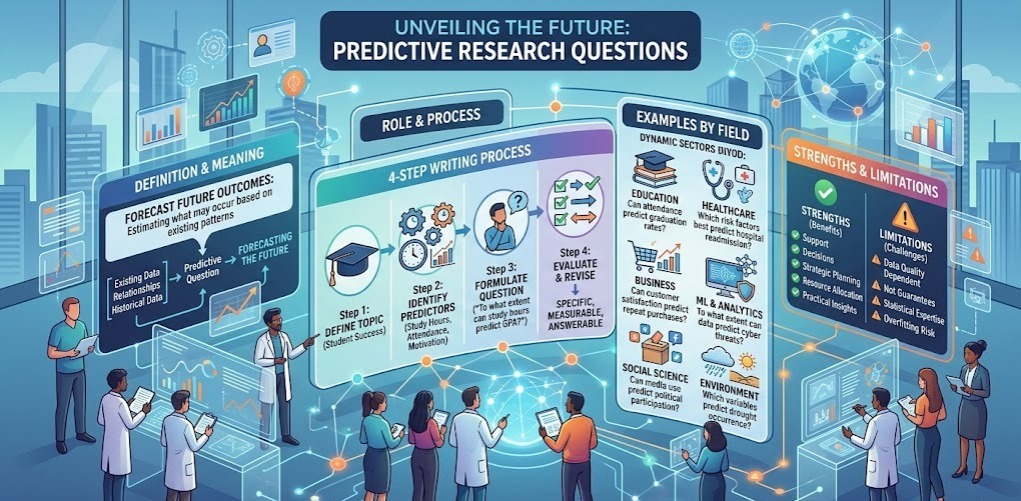
Step 4: Evaluate and Revise the Question
Before finalizing the question, evaluate whether it meets quality standards.
Ask:
- Is the question specific?
- Is it answerable?
- Can the variables be measured?
- Does it address a meaningful gap?
- Is the prediction realistic?
Revision Example
Weak question:
- Can education predict success?
Strong research question:
- To what extent can undergraduate GPA predict first-year job performance among business graduates?
- Revising improves clarity and relevance.
- This final step helps researchers formulate Predictive Research Questions that can support meaningful data analysis and valid conclusions.
Predictive Research Questions Examples: Good Research Question Samples for Different Types of Research
Education
- To what extent can attendance predict academic achievement among high school students?
- Can study habits predict graduation rates among university students?
- Which academic factors best predict student retention?
Healthcare
- Can lifestyle behaviors predict the occurrence of Type 2 diabetes?
- To what extent can patient adherence predict treatment outcomes?
- Which risk factors best predict hospital readmission rates?
Business and Marketing
- Can customer satisfaction predict repeat purchases?
- Which marketing channels best predict sales growth?
- To what extent can online reviews predict product demand?
Human Resource Management
- Can employee engagement predict turnover intentions?
- Which workplace factors best predict employee productivity?
- Can leadership style predict employee job satisfaction?
Economics
- Can inflation rates predict unemployment trends?
- To what extent can consumer confidence predict economic growth?
- Which economic indicators best predict recessions?
Technology and Machine Learning
- Can user behavior data predict cybersecurity threats?
- Which machine learning variables best predict customer churn?
- To what extent can predictive analytics forecast online purchasing behavior?
Social Sciences
- Can social media use predict political participation among young adults?
- Which demographic factors best predict voting behavior?
- Can family support predict psychological well-being?
Environmental Studies
- Can rainfall patterns predict agricultural productivity?
- To what extent can climate indicators predict drought occurrence?
- Which environmental variables best predict flooding events?
Examples of Weak and Strong Predictive Questions
Weak Example
- Will students succeed?
Problems:
- Too broad
- Undefined variables
- Difficult to measure
Strong Example
- To what extent can weekly study hours predict first-year GPA among undergraduate students?
Strengths:
- Specific
- Measurable
- Quantitative
- Answerable
- Predictive
How To Write Predictive Research Questions With Examples: Advantages, Strengths, Disadvantages, and Limitations of Predictive Research Questions for Researchers
Advantages and Strengths of Predictive Research Questions
Support Future Decision-Making
- Predictive Research Questions help organizations make informed decisions.
- Predictions allow leaders to prepare for future developments.
Improve Strategic Planning
- Businesses can forecast customer behavior.
- Educational institutions can identify at-risk students.
- Healthcare providers can predict patient outcomes.
Enhance Quantitative Research
- Predictive Research Questions align naturally with quantitative research methodologies.
- Researchers can use statistical models to evaluate relationships among variables.
Facilitate Predictive Analytics
- Predictive analytics relies heavily on predictive questions.
- These questions form the foundation for forecasting systems.
Improve Resource Allocation
- Organizations can allocate resources more effectively.
- Forecasts reduce uncertainty.
Support Machine Learning Applications
- Many machine learning systems are built around prediction.
- Predictive Research Questions help define model objectives.
Generate Practical Research Findings
- Results often have direct real-world applications.
- Stakeholders can implement findings immediately.
Identify Future Trends
- Researchers can analyze patterns and forecast future trends.
- This capability is increasingly important in dynamic environments.
Disadvantages and Limitations of Predictive Research Questions
Dependence on Data Quality
- Poor-quality data produces inaccurate predictions.
- Reliable data collection is essential.
Predictions Are Not Guarantees
- Even strong models cannot guarantee outcomes.
- Unexpected events may affect results.
Complex Statistical Requirements
- Many predictive studies require advanced quantitative techniques.
- Researchers may need specialized analytical skills.
Limited Use of Qualitative Data
- Predictive Research Questions often emphasize quantitative data.
- Rich qualitative data may receive less attention.
Risk of Overfitting
- Models may fit existing data perfectly but perform poorly in new situations.
Changing Conditions
- Social, economic, and technological environments change over time.
- These changes can reduce prediction accuracy.
Potential Bias
- Biased datasets can produce biased predictions.
- Researchers must carefully evaluate data sources.
Resource Intensive
- Predictive studies may require:
- Large datasets
- Advanced software
- Extensive data analysis
- Specialized expertise
Final Thoughts
- Predictive Research Questions are among the most valuable tools available to modern researchers.
- They help predict future outcomes, identify trends, evaluate risks, and support evidence-based decision-making.
- By defining a clear research topic, identifying relevant variables, formulating a precise question, and revising it carefully, researchers can develop a strong research question that generates meaningful insights.
- Whether preparing a thesis, research paper, dissertation, or professional study, mastering Predictive Research Questions enables a researcher to conduct more impactful and forward-looking research studies.
- When properly constructed, Predictive Research Questions transform research from merely understanding the present to anticipating the future.
Research Questions
Types of Research Questions
Explore different categories of research questions used in academic studies.
Descriptive Research Question
What is happening?
→
Exploratory Research Question
Explore unknowns
→
Explanatory Research Question
Why it happens
→
Comparative Research Question
Compare variables
→
Relationship-Based Research Question
Connections
→
Causal Research Question
Cause-effect
→
Predictive Research Question
Future outcomes
→
Evaluative Research Question
Assess value
→
Interpretive Research Question
Meaning focus
→
Action Research Question
Practical change
→
Phenomenological Research Question
Lived experience
→
Grounded Theory Research Question
Theory building
→
Historical Research Question
Past events
→
Ethnographic Research Question
Culture study
→
Systematic Review Research Question
Evidence synthesis
→
PICO Research Question
Clinical format
→
PEO Research Question
Qualitative health
→
FINER Research Question
Quality criteria
→
Hypothesis-Based Research Question
Testable design
→
Mixed Methods Research Question
Combined approach
→
