
Blog
How To Write Action Research Questions With Examples

Understanding Action Research Questions: Definition, Purpose, and Their Role in Action Research Practice
What Are Action Research Questions?
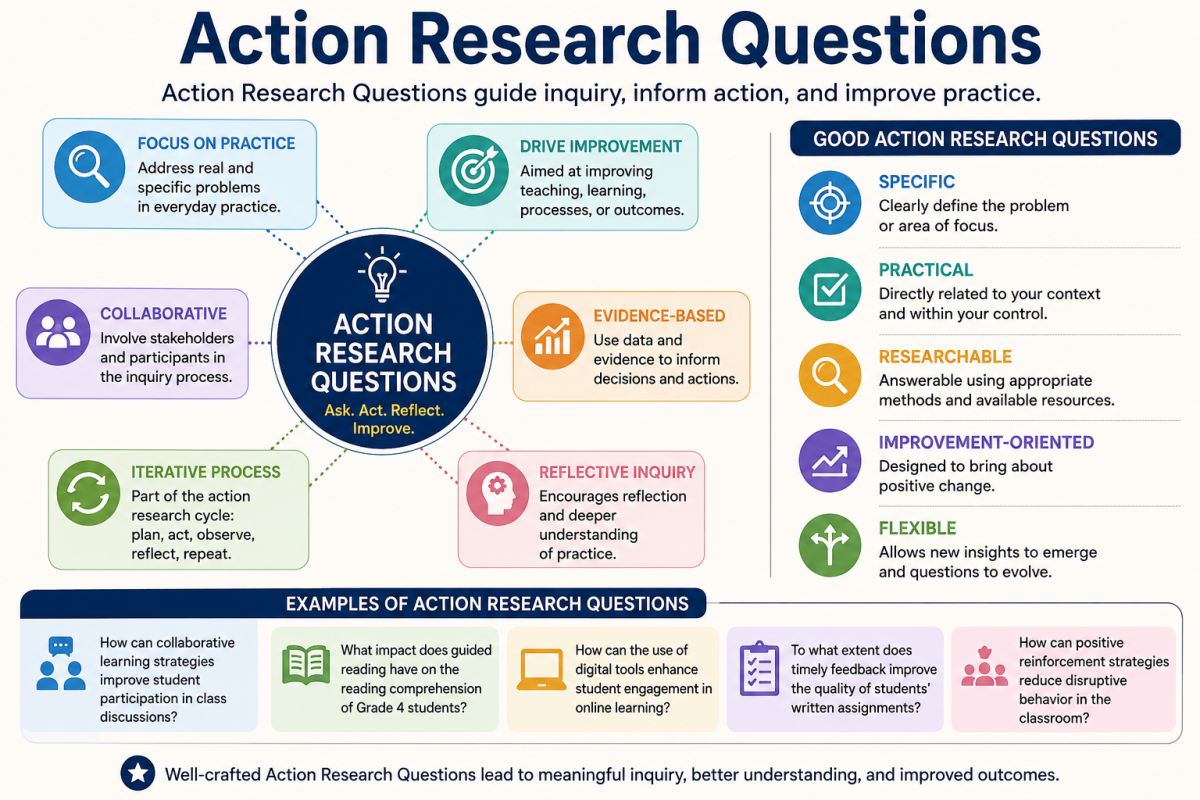
- Action Research Questions are specific questions developed to investigate a practical issue, challenge, or opportunity for improvement within a real-world setting.
- They are commonly used in action research, a systematic inquiry process that combines investigation with taking action to improve practice.
- Unlike questions used in traditional research, Action Research Questions focus on solving immediate and local problems rather than producing universally applicable theories.
- These questions guide the entire action research process by helping the researcher define the problem, collect relevant evidence, implement interventions, and evaluate outcomes.
- In many educational contexts, Action Research Questions help teachers examine classroom challenges and improve teaching practice.
- A practitioner may formulate Action Research Questions to understand why a learning strategy is ineffective, how student engagement can be increased, or what intervention can improve academic performance.
- The primary aim is not merely to generate knowledge but to improve daily practice through systematic reflection and inquiry.
Definition of Action Research
- Action research is a research method that combines investigation, reflection, and action.
- It involves identifying a problematic situation, implementing a strategy, evaluating results, and modifying practice based on findings.
- The action research cycle typically includes:
- Identifying a problem.
- Planning an intervention.
- Taking action.
- Collecting data.
- Conducting data analysis.
- Reflecting on outcomes.
- Beginning another cycle if necessary.
- The process is collaborative and often involves stakeholders such as teachers, students, administrators, or community members.
Purpose of Action Research Questions
Action Research Questions serve several important purposes:
They Provide Direction
- They establish a clear research focus.
- They help researchers remain focused on the most relevant issue.
- They define the boundaries of the research project.
They Help Identify Solutions
- They enable practitioners to explore practical solutions.
- They encourage evidence-based decision-making.
- They support continuous improvement.
They Guide Data Collection
- They determine what observations should be made.
- They influence interview questions.
- They help identify relevant variables.
- They guide the selection of qualitative or quantitative research methods.
They Support Reflection
- Reflection is a core component of action research.
- Well-written Action Research Questions encourage researchers to reflect on their assumptions and practices.
- They promote professional development and continuous learning.
Characteristics of Good Action Research Questions
Good Action Research Questions should be:
Specific
- Focus on a clearly defined issue.
- Avoid broad or vague wording.
- Address one central concern.
Practical
- Related directly to daily practice.
- Connected to realistic classroom or workplace challenges.
- Capable of producing actionable findings.
Researchable
- Possible to investigate using available resources.
- Supported by suitable research methods.
- Appropriate for the intended participant group.
Improvement-Oriented
- Designed to improve a process, strategy, or outcome.
- Focused on positive change.
Flexible
- Allow understanding to emerge throughout the research cycle.
- Can be refined as new evidence becomes available.
The Role of Action Research Questions in Educational Research
- Action Research Questions are especially important in educational research.
- They help educators evaluate teaching strategies.
- They support evidence-based instruction.
- They allow teachers to assess classroom interventions.
- They contribute to improved student outcomes.
- They help bridge the gap between theory and practice.
- They encourage collaborative problem-solving among educational stakeholders.
How To Write Action Research Questions With Examples: A 4-Step Process to Formulate Effective Research Questions
Creating effective Action Research Questions requires careful planning and reflection. The following four-step process provides guidance for developing meaningful questions.
Step 1: Identify a Problem or Area for Improvement
Start With Observation
- Observe your environment carefully.
- Look for recurring challenges.
- Identify patterns that affect performance or outcomes.
Ask Reflective Questions
Examples include:
- What classroom issue occurs repeatedly?
- Which instructional strategy seems ineffective?
- What aspect of teaching practice needs improvement?
- What challenge affects participant engagement?
Example
Problem identified:
- Students rarely participate during classroom discussions.
Potential research focus:
- Improving student participation.
Step 2: Define the Purpose and Objective
Clarify What You Want to Achieve
Determine:
- What outcome you hope to improve.
- What intervention you want to test.
- What understanding you want to gain.
Consider Stakeholder Needs
Stakeholders may include:
- Students.
- Teachers.
- School administrators.
- Parents.
- Community members.
Example Objective
- To improve student participation through collaborative learning activities.
Step 3: Formulate the Research Question
Use Clear and Practical Language
Your research question should:
- Focus on action and improvement.
- Be realistic and manageable.
- Address a specific issue.
Helpful Question Starters
- How can…
- To what extent…
- What impact does…
- In what ways…
- How does…
Example
Weak question:
- Why do students struggle?
Improved Action Research Question:
- How can collaborative learning strategies improve student participation during classroom discussions?
Step 4: Evaluate and Refine the Question
Assess Quality
Ask:
- Is the question specific?
- Is it researchable?
- Is it relevant to practice?
- Is it realistic?
- Does it support meaningful evaluation?
Revise if Necessary
Initial question:
- How can technology help students?
Refined question:
- How can interactive learning applications improve reading comprehension among Grade 5 students?
Final Check
A strong question should:
- Address a real problem.
- Enable systematic inquiry.
- Support data collection.
- Produce actionable findings.
- Contribute to professional development.
Action Research Questions With Examples: How Researchers Identify Problems and Develop Research Questions for Better Practice
Example 1: Student Participation
Problem
- Students rarely engage in classroom discussions.
Research Question
- How can cooperative learning activities improve student participation in classroom discussions?
Possible Data Sources
- Observation records.
- Student interviews.
- Participation logs.
- Reflection journals.
Example 2: Reading Performance
Problem
- Reading scores remain below expectations.
Research Question
- What impact does guided reading instruction have on reading comprehension outcomes among elementary students?
Data Collection Methods
- Assessment results.
- Classroom observation.
- Student feedback.
Example 3: Homework Completion
Problem
- Many students fail to complete assignments.
Research Question
- How can digital reminders improve homework completion rates among middle school students?
Variables
- Independent variable: Digital reminders.
- Dependent variable: Homework completion rates.
Example 4: Teacher Feedback
Problem
- Students struggle to apply feedback effectively.
Research Question
- How does timely teacher feedback influence student revision quality?
Expected Outcome
- Improved assignment quality.
- Better student understanding.
Example 5: Classroom Behavior
Problem
- Frequent classroom disruptions.
Research Question
- To what extent can positive reinforcement strategies reduce disruptive classroom behavior?
Possible Intervention
- Reward systems.
- Recognition programs.
- Positive behavior supports.
Example 6: Online Learning Engagement
Problem
- Low participation during virtual lessons.
Research Question
- How can interactive online activities improve student engagement during virtual instruction?
Research Methods
- Qualitative interviews.
- Quantitative participation tracking.
- Surveys.
Example 7: Professional Development
Problem
- Teachers need improved technology integration skills.
Research Question
- How does participation in technology-focused professional development improve instructional effectiveness?
Stakeholders
- Teachers.
- Administrators.
- Students.
Example 8: Attendance Improvement
Problem
- Chronic absenteeism affects achievement.
Research Question
- What effect does parent communication have on student attendance rates?
Potential Findings
- Increased attendance.
- Improved academic outcomes.
- Better stakeholder engagement.
Example 9: Science Learning
Problem
- Students struggle with science concepts.
Research Question
- How can experimental learning activities improve student understanding of science concepts?
Research Focus
- Active learning.
- Hands-on instruction.
- Concept mastery.
Example 10: Collaborative Learning
Problem
- Students work independently and avoid teamwork.
Research Question
- How does collaborative project-based learning influence teamwork skills and academic performance?
How To Write Action Research Questions With Examples: Strengths, Advantages, Limitations, and Challenges in Action Research Research Practice
Strengths and Advantages of Action Research Questions
Direct Connection to Practice
- Action Research Questions focus on real-world challenges.
- They support meaningful improvement efforts.
- They address issues practitioners encounter daily.
Immediate Application of Findings
- Findings can be implemented quickly.
- Solutions can be tested and modified simultaneously.
- Improvements often occur during the research process itself.
Encourages Reflection
- Researchers continuously reflect on practice.
- Reflection supports deeper understanding.
- Reflection promotes professional growth.
Supports Collaboration
- Action research projects frequently involve multiple stakeholders.
- Collaborative inquiry improves decision-making.
- Different perspectives strengthen findings.
Flexible Methodology
- Questions can evolve as new insights emerge.
- Researchers can modify procedures when necessary.
- The methodology adapts to changing circumstances.
Promotes Professional Development
- Practitioners become active researchers.
- Research skills improve over time.
- Confidence in evidence-based decision-making increases.
Enhances Problem Solving
- Action Research Questions help identify root causes.
- They encourage systematic evaluation.
- They support effective intervention design.
Limitations of Action Research Questions
Limited Generalizability
- Findings often apply only to specific contexts.
- Results may not transfer to other settings.
Small Participant Groups
- Action research often involves limited participants.
- Small samples may reduce broader applicability.
Potential Researcher Bias
- Researchers are frequently directly involved.
- Personal expectations may influence interpretation.
Time Demands
- The action research process requires substantial commitment.
- Data collection and reflection can be time-consuming.
Resource Constraints
- Limited funding may affect implementation.
- Access to tools and technology may be restricted.
Challenges Researchers Commonly Face
Defining the Problem Clearly
- Some issues appear broader than they actually are.
- Researchers may struggle to identify a manageable focus.
Maintaining Objectivity
- Practitioners may find it difficult to judge outcomes objectively.
- Continuous reflection helps reduce bias.
Collecting Reliable Data
- Inconsistent observation procedures can affect quality.
- Strong methodology improves reliability.
Selecting Appropriate Research Methods
Researchers must decide whether to use:
- Qualitative methods.
- Quantitative research approaches.
- Mixed-method strategies.
Managing Multiple Responsibilities
- Teachers often conduct research while teaching.
- Balancing research and professional duties can be challenging.
Best Practices for Overcoming Challenges
Establish Clear Objectives
- Define the purpose early.
- Clarify expected outcomes.
Use Multiple Data Sources
Examples include:
- Interviews.
- Surveys.
- Assessments.
- Observation notes.
- Reflection journals.
Seek Stakeholder Input
- Collaboratively develop solutions.
- Gather diverse perspectives.
Maintain Detailed Records
- Document procedures carefully.
- Record interventions systematically.
- Track changes throughout each cycle.
Focus on Continuous Improvement
- View findings as part of an ongoing research cycle.
- Use each cycle to improve future practice.
Final Thoughts
- Action Research Questions are powerful tools for investigating and improving real-world practice.
- They help researchers identify meaningful problems, formulate focused inquiries, conduct systematic investigations, and evaluate outcomes.
- Whether used in educational research, education research, organizational settings, or other professional environments, Action Research Questions enable practitioners to connect inquiry with action.
- By following a structured process, selecting appropriate research methods, and maintaining a commitment to reflection, researchers can generate valuable findings that improve practice and contribute to long-term professional development.
- Most importantly, Action Research Questions transform research from a purely academic exercise into a practical process for understanding challenges, implementing solutions, and creating measurable improvements.
