
Blog
How to Conduct Historical Research Design with Example

What is Historical Research Design in Qualitative Research Designs?
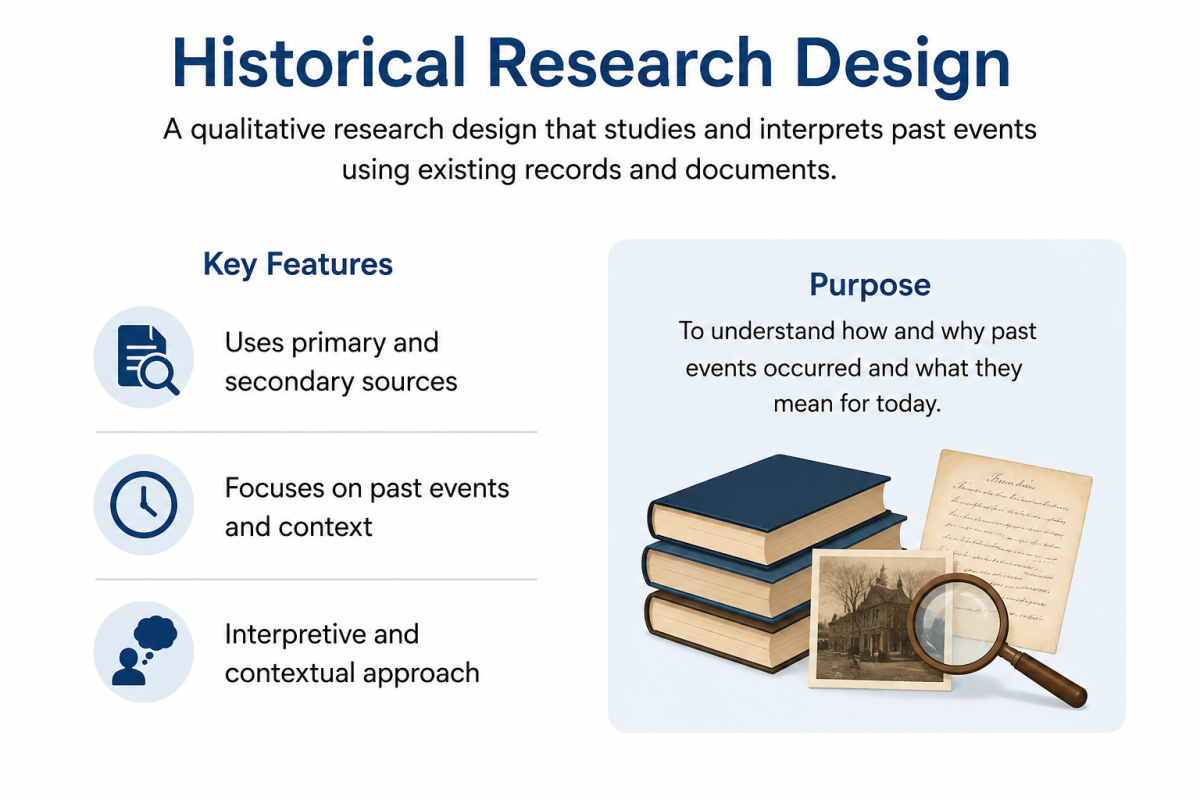
- Historical Research Design is a type of research design used within qualitative research methods to study, describe, and interpret past events, people, and social phenomena. Rather than collecting new data through surveys or experiments, historical research relies on existing source materials, historical records, and accounts of historical events to reconstruct what happened, why it happened, and what it means for present-day understanding.
- At its core, this research method treats history not just as a timeline of facts but as a subject that can be systematically studied using structured research methods. Historical researchers gather evidence from primary sources (such as letters, diaries, official records, and photographs) and secondary sources (such as books, journal articles, and other scholars’ interpretations of past events) to build a coherent, evidence-based narrative.
- Historical Research Design sits firmly within qualitative research because it emphasizes meaning, context, and interpretation over numerical measurement. While quantitative research seeks to quantify variables and test hypotheses through statistical analysis, historical research design is more concerned with understanding the social and cultural context surrounding past events, the motivations of historical actors, and the broader significance of a historical period.
- Unlike other qualitative research methods that collect data directly from living participants (such as interviews or focus groups), Historical Research Design works with what has already been left behind. This makes source criticism — evaluating the authenticity and reliability of a source — a central part of the research process.
- Key characteristics of Historical Research Design include:
- Reliance on primary and secondary sources: Historical researchers cannot generate new data from the past, so they depend on existing documents, artifacts, and oral histories as their sources of information.
- Systematic and methodological approach: Even though it deals with old material, historical research design follows a structured research process, much like other qualitative studies, involving planning, data collection, analysis, and interpretation.
- Contextual interpretation: Researchers must interpret data within the social, political, and cultural context of the time period being studied, rather than judging past events through a modern lens alone.
- Focus on a specific research question: Like any research project, historical research design begins with a clear research question that guides which sources are relevant and how they should be analysed.
- This type of research is widely used in the discipline of history, but it also appears in fields like international relations, global politics, sociology, and education, where understanding historical context helps explain present-day patterns and key issues. Resources such as the SAGE Research Methods database and the Princeton Guide to Historical Research are commonly cited references that outline standardized research methods for history and help researchers apply consistent historical methods across different historical studies.
Philosophical Assumptions of The Historical Research Design
- Every research design is built on underlying philosophical assumptions, and Historical Research Design is no exception. These assumptions shape how historical researchers approach source materials, interpret historical data, and construct historical knowledge from fragmented or incomplete records.
- Ontological assumption (the nature of historical reality)
- Historical Research Design assumes that past events actually occurred and left traces — documents, artifacts, and testimonies — that can be studied today.
- However, it also assumes that historical reality is not always fully recoverable. Researchers can only reconstruct an approximation of the past based on the surviving historical records, meaning some details may be permanently lost or distorted.
- Epistemological assumption (how we come to know the past)
- This research method assumes that knowledge of past events is gained through careful examination and interpretation of primary and secondary sources, not through direct observation, since the events themselves cannot be re-experienced.
- Knowledge in historical research design is therefore mediated — it is built from the researcher’s interpretation of evidence, which means two historical researchers analysing the same accounts of historical events may reach different, yet equally valid, conclusions.
- Interpretivist orientation
- Historical Research Design generally aligns with an interpretivist paradigm rather than a positivist one. It assumes that understanding historical events requires interpreting the meaning behind actions, decisions, and social behaviors within their specific historical period, rather than simply recording facts.
- This contrasts with quantitative research, which often assumes an objective, measurable reality that can be tested through statistical analysis and numerical data.
- Assumption of source criticism
- A foundational philosophical assumption in historical research design is that not all sources are equally trustworthy. This gives rise to two key techniques used by historians:
- External criticism: Evaluating whether a source is authentic — was it actually created in the time and place it claims to be from?
- Internal criticism: Evaluating the accuracy and reliability of the content within the source itself, checking for personal bias, exaggeration, or factual errors.
- This dual-layered scrutiny reflects the assumption that historical data is never entirely neutral; every diary, letter, or official record was created by someone with a particular perspective, motive, or limitation.
- A foundational philosophical assumption in historical research design is that not all sources are equally trustworthy. This gives rise to two key techniques used by historians:
- Assumption of contextualism
- Historical Research Design assumes that past events cannot be properly understood in isolation. Social, cultural, political, and economic contexts must be factored into any interpretation, which is why researchers often draw on knowledge from social research and other qualitative research methods to enrich their analysis.
- Constructivist elements
- Many historical researchers also operate under a mild constructivist assumption — that historical narratives are, to some degree, constructed through the researcher’s selection, interpretation, and framing of evidence. This doesn’t mean history is purely subjective, but it acknowledges that the researcher’s own methodological choices shape the final account of past events.
- Together, these philosophical assumptions explain why Historical Research Design demands rigor, transparency, and reflexivity from historical researchers, even though it deals with material that cannot be re-tested or re-observed like data in quantitative research.
How To Conduct an Historical Research Design In 4 Easy Steps?
Conducting a Historical Research Design doesn’t have to be overwhelming. Breaking the research process into clear steps makes it manageable, even for those new to qualitative research. Here are four easy steps to guide your research project:
- Step 1: Identify a Research Question and Define the Historical Period
- Every strong historical research design starts with a focused research question. Ask yourself what you want to know about a particular historical period, event, or phenomenon, and why it matters.
- Narrow your topic down. Instead of “the history of education,” consider something more specific like “how access to education changed for women in a specific decade or region.”
- At this stage, also define the scope: the timeframe, geographic location, and social or cultural context you’ll be examining. This keeps your historical research focused and prevents the research process from becoming unmanageable.
- Consider consulting resources such as the Princeton Guide to Historical Research or SAGE Research Methods for guidance on refining research questions specific to historical studies.
- Step 2: Locate and Collect Primary and Secondary Sources
- Once your research question is clear, begin data collection by identifying relevant source materials. This is one of the most time-intensive parts of historical research design.
- Primary sources are firsthand accounts or original materials from the period being studied — diaries, letters, official records, photographs, newspapers, government documents, and oral histories from people who lived through the events.
- Secondary sources are interpretations or analyses created after the fact — books, academic articles, documentaries, and commentaries written by other historians or scholars.
- Search archives, libraries, historical societies, digital databases, and academic journals to build a well-rounded collection of sources of data. The goal is to gather a range of methods and a variety of source types, since relying on a single type of source can create a skewed or incomplete picture.
- Step 3: Evaluate and Analyse the Sources (Source Criticism)
- Not every document you find will be reliable, so this step involves applying source criticism to determine which sources are trustworthy and relevant.
- Apply external criticism to verify the authenticity of a source — confirming it genuinely originates from the claimed time period and author.
- Apply internal criticism to assess the accuracy of the content itself, watching for personal bias, contradictions, or motivated reasoning within the source.
- Cross-reference multiple accounts of the same event to identify consistencies and discrepancies. When different sources tell different versions of a story, this often reveals valuable insight into differing perspectives, social tensions, or gaps in the historical record.
- This step is where the qualitative data collected in Step 2 begins to be shaped into meaningful evidence, ready for deeper interpretation.
- Step 4: Interpret Findings and Construct the Historical Narrative
- With verified and analysed sources in hand, the final step is to interpret the data and synthesize it into a coherent narrative that answers your original research question.
- Organize your findings thematically or chronologically, depending on what best serves your research project.
- Interpret the meaning behind events by placing them into their broader social, cultural, and political context — don’t just report what happened, but explain why it happened and what it reveals.
- Where relevant, connect your findings to existing hypothesis or theories in the field, showing how your historical research design either supports, challenges, or adds nuance to current historical knowledge.
- Finally, write up your findings following standard conventions for research and writing in your discipline, being transparent about the limitations of historical research you encountered, such as missing records or potential bias in surviving sources.
- Following these four steps transforms a broad curiosity about the past into a structured, credible Historical Research Design that produces genuine historical insights.
What are the Advantages and Disadvantages of Historical Research Design in Qualitative Research Designs?
Like any research method, Historical Research Design comes with distinct strengths and weaknesses. Understanding both sides helps researchers decide whether this approach suits their research project and how to manage its inherent limitations.
Advantages of Historical Research Design
- Provides deep contextual understanding
- Historical Research Design allows researchers to understand past events within their full social and cultural context, offering richer insight than a simple timeline of facts. This depth is difficult to achieve with quantitative research alone.
- Uses a wide range of source materials
- Because this research method draws from primary and secondary sources such as diaries, official records, oral histories, and secondary source commentary, researchers can triangulate information from multiple angles, strengthening the credibility of their conclusions.
- Helps explain present-day phenomena
- Many key issues in fields like international relations, global politics, and sociology are better understood by examining their historical roots. Historical research design helps connect past events to current situations, offering valuable historical insights for policy, education, and cultural understanding.
- Cost-effective and non-intrusive
- Unlike research designs involving live human participants, historical research does not require recruiting participants, running experiments, or navigating certain ethical concerns tied to direct human interaction. Researchers work primarily with existing sources of information, which can make data collection more accessible.
- Preserves and reinterprets historical knowledge
- This type of research keeps historical events alive by revisiting and reinterpreting sources materials, sometimes uncovering overlooked perspectives or correcting earlier misinterpretations found in older historical works.
- Flexible across disciplines
- Historical Research Design isn’t limited to the discipline of history. It’s used across qualitative research methods in social research, education, political science, and international relations, making it a versatile type of research.
- Supports theory development
- Findings from historical research can help researchers form or refine a hypothesis about long-term social patterns, institutional change, or recurring historical cycles, contributing to broader academic conversations, including recent trends in historical studies.
Disadvantages and Limitations of Historical Research Design
- Incomplete or missing source materials
- One of the most significant limitations of historical research is that not all relevant source materials survive. Documents may be lost, destroyed, or simply never recorded, leaving gaps that researchers cannot fill no matter how thorough their data collection process is.
- Risk of personal bias in sources
- Diaries, letters, and official records were created by individuals with their own perspectives, motivations, and blind spots. This personal bias can distort accounts of historical events, making it essential — but also challenging — to apply rigorous source criticism.
- Difficulty verifying authenticity
- Confirming that a source is genuine (external criticism) can be difficult, especially with older or poorly preserved historical records. Forged or misattributed documents can mislead even experienced historical researchers.
- Time-consuming research process
- Locating, evaluating, and analysing large volumes of primary and secondary sources is often slow. Unlike some quantitative research that can process large datasets quickly through statistical analysis, historical research design requires careful, manual interpretation of qualitative data.
- Interpretation is subjective
- Because Historical Research Design relies heavily on interpretation, different historical researchers analysing the same evidence may arrive at different conclusions. This subjectivity, while valuable for generating diverse historical insights, can also make findings harder to generalize or replicate.
- Limited ability to test hypothesis directly
- Since researchers cannot manipulate variables or observe past events firsthand, testing a hypothesis in historical research design is more about building a persuasive, evidence-based argument than proving causation in the way quantitative research methods might.
- Sources may lack diversity
- Historical records have often favored certain voices — typically those in power — over marginalized or underrepresented groups. This means historical research design can inadvertently reproduce gaps or biases present in the original source materials, requiring researchers to actively seek out lesser-known or alternative sources of data.
- Despite these limitations of historical research, when combined with careful methodological rigor, Historical Research Design remains one of the most valuable qualitative research methods for understanding the past and its ongoing influence on the present.
Examples of Historical Research Design
To better understand how Historical Research Design works in practice, here are several examples across different disciplines that illustrate the research process from start to finish:
- Example 1: Studying the Evolution of Women’s Voting Rights
- A researcher exploring how women’s voting rights evolved in a specific country might use historical research design to examine newspaper archives, government records, personal diaries of activists, and photographs from suffrage movements.
- By applying source criticism to verify authenticity and cross-referencing multiple accounts of the same event, the researcher can construct a nuanced narrative of how social attitudes and legal frameworks changed over a historical period, offering historical insights relevant to ongoing conversations about gender equality.
- Example 2: Tracing the Development of a Historical Society or Institution
- Historical societies themselves are often subjects of historical research design. A researcher might study founding documents, meeting minutes, and correspondence to trace how a local historical society formed, evolved, and influenced its community over time.
- This example highlights how official records and organizational archives serve as valuable primary sources for understanding institutional history.
- Example 3: Analysing Diplomatic Decisions in International Relations
- In the field of international relations, historical research design is frequently used to analyse past diplomatic events, treaties, or conflicts. Researchers might examine declassified government documents, diplomatic cables, and memoirs of political figures to understand the decision-making processes behind major historical events.
- This kind of research in history helps explain recurring patterns in global politics and provides context for current international relations, showing how the discipline of history connects directly to present-day policy discussions.
- Example 4: Using Oral Histories to Document a Community’s Past
- A researcher studying the experiences of a specific community — such as immigrants, war survivors, or indigenous groups — might rely heavily on oral histories, since written records for marginalized groups are often scarce.
- This example demonstrates how historical research design adapts its data collection methods depending on what source materials are actually available, and how oral testimony can serve as a rich, though sometimes contested, form of qualitative data.
- Example 5: Examining Shifts in Economic Policy Through Historical Records
- A study on how a country’s economic policy shifted over several decades might combine primary sources like government budget reports and policy speeches with secondary source analysis from economic historians.
- Researchers would interpret this historical data within its broader social and cultural context, connecting economic decisions to political pressures, public sentiment, and global events of the time.
- Example 6: A Comparative Historical Research Design Across Two Historical Periods
- Some historical studies compare two distinct historical periods to identify patterns or contrasts — for instance, examining public health responses during two separate pandemics a century apart.
- This type of research design draws on a wide range of methods, from analysing official records and medical journals to reviewing news coverage, to identify what changed, what stayed the same, and what lessons can be drawn for the present.
- Each of these examples shows how Historical Research Design can be tailored to different research questions, disciplines, and available source materials, while still following the same underlying research process: identifying a question, collecting primary and secondary sources, applying source criticism, and interpreting findings within their proper historical context. Whether used in the discipline of history, international relations, or social research more broadly, this qualitative research method continues to offer valuable tools and techniques for making sense of past events and their lasting relevance today.
