
Blog
How to Conduct Action Research Design with Example

What is Action Research Design in Qualitative Research Designs?
Action research design is a research approach that sits within the broader family of qualitative research designs, though it can also incorporate quantitative data when needed. Understanding this concept properly means looking at it from a few different angles:
- Definition of action research: At its core, the definition of action research describes a research method where practitioners study their own practice in real-world settings, with the goal of solving practical problems while simultaneously generating new knowledge. Unlike traditional research, which often studies a phenomenon from a distance, action research is a research approach that puts the researcher directly inside the situation they are studying.
- The dual purpose: Action research design is built around two simultaneous goals — taking action to address a real problem, and contributing to theory and practice within a given field. This is why many scholars describe it as bringing together action and reflection, and theory and practice, in a single research process.
- Origins in social science: The concept of action research traces back to psychologist Kurt Lewin, widely regarded as the founder of this research method. Kurt Lewin introduced the idea in the 1940s as a way of using action research to address social problems through cycles of planning, acting, observing, and reflecting. His work laid the foundation for how action research is a research method still used across social science today.
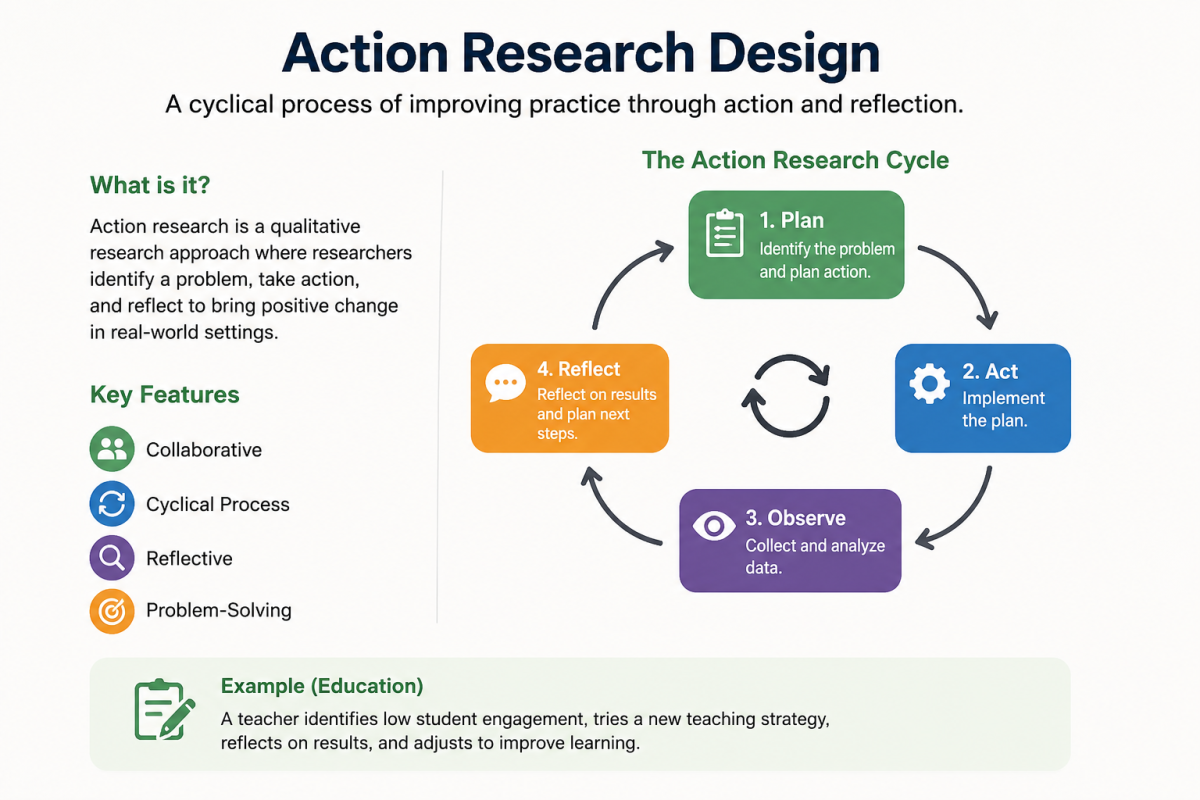
- A cyclical research process: Rather than following a single straight line from research question to conclusion, action research design uses a repeating cycle. Each cycle includes identifying a research problem, developing a plan of action, implementing that plan, and then critically reflecting on the results before starting the next cycle. This cyclical nature of action research is one of its defining features and distinguishes it clearly from other types of research.
- Collaborative and participatory: Action research design is inherently collaborative and participatory. It typically involves participation with others — such as teachers, employees, community members, or healthcare workers — as co-researchers rather than passive subjects of the research. This participatory action research approach means the people affected by the problem help shape the research question, the data collection methods, and the interpretation of results.
- Where it fits among qualitative research designs: While action research design can use surveys and quantitative data as part of triangulation, it is most often classified under qualitative research designs because it emphasizes understanding context, meaning, and lived experience. The nature of action research is fundamentally exploratory and improvement-focused rather than purely measurement-focused.
- Common settings: Action research in education is one of the most well-known applications, where teachers use action research to improve teaching methods, but action research studies also appear in healthcare, business management, community development, and organizational change projects.
In short, action research design offers a flexible, real-world-oriented research approach for anyone looking to bridge the gap between theory and practical solutions.
Philosophical Assumptions of The Action Research Design
Before diving into how to conduct action research, it helps to understand the philosophical foundation behind this research method. These assumptions shape why action research design looks and feels so different from traditional research methodologies.
- Reality is socially constructed: Action research design rests on the assumption that knowledge and reality are shaped through social interaction. This means the researcher doesn’t simply “discover” an objective truth sitting out there — instead, understanding emerges through dialogue, participation, and shared experience among those involved in the research project.
- Knowledge should lead to action: A defining philosophical assumption is that the purpose of research isn’t just to describe the world, but to change it for the better. Action research emphasizes practical outcomes over abstract theorizing alone, meaning research findings are expected to directly inform taking action to address real problems.
- Participatory and democratic values: Action research design assumes that the people experiencing a problem are best positioned to help solve it. This participatory stance treats participants as co-researchers with valuable expertise, rather than as passive data sources, which is a sharp departure from more hierarchical, traditional research approaches.
- Emancipatory intent: Many scholars, particularly those referencing the Handbook of Action Research, describe an emancipatory dimension to this research approach. Action research often aims to empower marginalized groups or under-resourced practitioners by giving them ownership over the research process and the solutions that come out of it.
- Iterative and reflective epistemology: Action research design assumes that understanding deepens over time through cycles of critical reflection action research. Rather than settling on a fixed hypothesis at the outset, knowledge is built progressively, with each cycle informed by what was learned in the last.
- Context-dependent knowledge: Because action research is a research method conducted in real settings — classrooms, hospitals, workplaces — it assumes that knowledge is context-bound. What works in one setting through action research might not transfer directly elsewhere, which is why generalizability is treated differently than in quantitative, experimental design studies.
- Blending pragmatism with critical theory: Depending on the type of action research, philosophical grounding can lean toward pragmatism (solving practical problems efficiently) or critical theory (challenging power structures and pursuing social justice). Collaborative action research, for instance, often leans toward pragmatism, while participatory action research leans more toward emancipatory, critical aims.
- Action and reflection as inseparable: Perhaps the clearest philosophical assumption is that you cannot separate doing from knowing. Action research design treats taking action and reflecting on that action as two sides of the same coin, feeding continuously into one another throughout the research process.
Understanding these philosophical assumptions matters because they explain why action research design values collaboration, practical relevance, and iterative learning over the detached objectivity often prized in traditional quantitative research.
How To Conduct an Action Research Design In 4 Easy Steps?
Using action research effectively means following a structured yet flexible research process. While different action research studies may add extra detail, most action research projects follow these four core steps.
Step 1: Identify the Research Problem and Develop a Research Question
- Start by pinpointing a specific, practical problem within your field — this could be a classroom challenge, a workplace inefficiency, or a community issue.
- Frame this problem into a clear research question that will guide your action research project. A good research question should be specific enough to investigate but open enough to allow for a deeper understanding of the issue.
- Engage stakeholders early. Because action research design is participatory, involve the people affected by the problem in shaping the research question from the very beginning.
- Review existing literature, such as the Sage Research Methods database or the Handbook of Action Research, to understand how similar research problems have been addressed in past action research studies.
Step 2: Develop a Plan of Action
- Once the research problem and research question are clear, develop a plan of action that outlines the specific intervention or change you intend to implement.
- Decide on your data collection methods. Action research design often uses multiple sources of data — interviews, observations, surveys, and existing documents — to allow for triangulation in action research and to strengthen the validity of your research findings.
- Consider whether you’ll need qualitative data, quantitative data, or a mixture of both. Many action research projects blend qualitative methods like interviews with quantitative data like surveys to get a fuller picture.
- Set a realistic timeline and clarify roles among the collaborative team, since action research is inherently a team-based research approach.
Step 3: Take Action and Collect Data
- Implement the plan of action within the real-world setting, whether that’s a classroom, clinic, or business unit.
- This is the “action” in action research — you are actively intervening to try to improve a real practical problem, not just observing from the sidelines.
- Carry out your data collection methods consistently throughout the intervention. Document changes, challenges, and unexpected outcomes as they happen, since this ongoing data collection is central to the nature of action research.
- Maintain flexibility. Action research design allows adjustments mid-cycle if early observations suggest the original plan needs modification — this responsiveness is one of the strengths of using action research over rigid experimental design approaches.
Step 4: Reflect, Evaluate, and Plan the Next Cycle
- Analyze the data collected to determine whether the action taken led to the desired improvement. This is where critical reflection action research becomes essential — evaluating not just what happened, but why.
- Share research findings with the collaborative group involved in the research project, since shared reflection is part of what makes action research participatory.
- Decide whether another cycle is needed. Because action research design is cyclical, most action research projects go through multiple rounds of planning, acting, observing, and reflecting before reaching a satisfactory practical solution.
- Document lessons learned and disseminate results, whether through internal reports, case studies, or academic publications, to help other action researchers facing similar research problems.
Following these four steps transforms an abstract idea into a working, structured method for using action research to generate practical solutions to issues of pressing concern.
What are the Advantages and Disadvantages of Action Research Design in Qualitative Research Designs?
Like any research approach, action research design comes with a distinct set of strengths and limitations. Weighing these carefully helps determine when this method is the right fit for your research project.
Advantages of Action Research Design
- Practical, real-world relevance: Action research focuses on improving actual practices rather than producing purely theoretical research findings. This practical focus makes it especially valuable for professionals looking for practical solutions to issues they face daily.
- Bridges the gap between theory and practice: One of the most cited strengths is that action research design bridges the gap between theory and practical application. Practitioners don’t just read about research methodologies — they apply them directly and see results in real time.
- Collaborative and empowering: Because it’s participatory, action research design gives voice to those directly involved in a research problem. This collaborative approach often increases buy-in and makes practical solutions more sustainable, since the people implementing changes helped design them.
- Flexibility and adaptability: Unlike rigid experimental design methods, action research design allows adjustments mid-process. If data collection reveals the original plan of action isn’t working, action researchers can pivot quickly rather than waiting until the end of a fixed study.
- Rich, deep understanding: Because action research uses multiple sources of data — qualitative and quantitative data alike — it allows for triangulation, giving researchers a deeper understanding of complex, real-world problems than a single-method study might provide.
- Encourages continuous learning: The cyclical nature of action research supports action learning, meaning organizations and individuals build ongoing capacity for improvement rather than treating research as a one-time event.
- Applicable across many fields: From action research in education to healthcare, business, and community development, this research method is remarkably versatile. Many action research case studies show successful application across vastly different practical problems.
Disadvantages of Action Research Design
- Limited generalizability: Because action research design focuses on a specific context — one classroom, one team, one community — research findings may not generalize well to other settings. This is a common criticism when comparing action research to more traditional research approaches.
- Time-intensive process: The cyclical design process, involving repeated rounds of planning, acting, and reflecting, can take considerably longer than a single cross-sectional survey or a one-off experimental design study.
- Risk of researcher bias: Since action researchers are often embedded participants rather than neutral outsiders, there’s a risk that personal involvement could influence how data is collected, interpreted, or reported, potentially compromising objectivity.
- Requires strong collaboration skills: Successful collaborative action research depends heavily on genuine participation with others. If stakeholders are unwilling or unable to engage meaningfully, the entire research process can suffer.
- Less standardized methodology: Compared to types of research with fixed protocols, action research design can vary considerably between action research projects, which sometimes makes it harder to compare or replicate research findings across studies.
- Data collection challenges: Balancing the demands of taking action with the rigor needed for solid data collection can be difficult. Practitioners juggling both roles — implementer and researcher — may struggle to maintain the consistency needed for reliable qualitative data or quantitative data.
- Ethical complexities: Because participants are also collaborators, questions about consent, ownership of results, and power dynamics within the group need careful navigation throughout the research process.
Ultimately, action research design offers a powerful research method for those prioritizing practical solutions and real-world change, but it requires careful planning to manage its inherent trade-offs compared to more traditional, standardized research methodologies.
Examples of Action Research Design
Seeing real examples helps clarify how action research design plays out in practice across different types of action research and various fields.
- Action research in education example: A high school teacher notices students are disengaged during group projects. Using action research, the teacher develops a research question around improving collaboration skills, implements new group structures as a plan of action, collects qualitative data through student surveys and observation notes, and reflects on outcomes after each unit. Over several action research cycles, the teacher refines the group-work strategy based on ongoing research findings — a classic example of action research in the field of education.
- Healthcare example: A hospital unit facing high patient readmission rates uses participatory action research to involve nurses, doctors, and patients in identifying causes. The team develops a plan of action involving revised discharge protocols, collects both quantitative data (readmission rates) and qualitative data (patient interviews), and adjusts protocols based on what the data collection reveals. This case demonstrates using action research to solve a practical problem through collaborative action research involving multiple stakeholders.
- Business and organizational example: A retail company experiencing declining employee morale uses action research design to investigate the underlying research problem. Managers and staff collaboratively develop a research question, implement new communication practices, and use surveys alongside informal interviews for triangulation in action research. After each cycle of taking action and reflecting, the company adapts its approach — illustrating how action research provides organizations with practical, adaptable solutions to issues of pressing concern.
- Community development example: A local nonprofit addressing food insecurity in an underserved neighborhood uses participatory action research to include community members as co-researchers. Together, they define the research problem, gather qualitative data through focus groups, and develop a plan of action for a community garden initiative. Ongoing critical reflection action research allows the nonprofit to refine the initiative across multiple cycles, ensuring the solution stays grounded in genuine community needs rather than external assumptions.
- Environmental sustainability example: A local government agency piloting a recycling awareness campaign uses action research studies to measure behavior change. They combine quantitative data (recycling rates) and qualitative data (resident feedback) as multiple sources of data, adjusting messaging strategies each cycle based on data collection results — another strong example of applied research grounded in real-world action.
- Types of action research reflected in these examples: These case studies touch on several types of action research, including participatory action research (community and healthcare examples), collaborative action research (business example), and practical action research focuses on immediate classroom improvement (education example). Each demonstrates how action research design adapts flexibly to different subject areas, research problems, and organizational goals.
Across all these examples, one theme remains constant: action research emphasizes solving genuine, practical problems through a collaborative, cyclical research process — proving why action research design continues to be a trusted research method in both academic and applied research settings, including within qualitative research designs used across the social science field.
