
Blog
How To Conduct Discourse Analysis Research Design

What is Discourse Analysis Research Design in Qualitative Research Designs?
- Discourse analysis research design is a qualitative research method that examines how language is used in real contexts to construct meaning, identity, and social relations. Rather than treating language as a neutral tool for communication, this research design treats language use as something that actively shapes how people understand and experience the world around them.
- At its core, discourse analysis in qualitative research looks beyond words and sentences on a page. It asks what the use of language reveals about power, culture, and society. This is why discourse analysis research design is considered one of the richest qualitative methods available to researchers studying social interaction and communication.
- Discourse, in this sense, is not just spoken or written text. It includes gestures, symbols, images, and even silences that carry meaning within a particular social context. A discourse analysis research design therefore requires researchers to look at both the linguistic content and the broader circumstances surrounding it.
- Unlike content analysis, which often focuses on counting themes or categorizing text, discourse analyses dig into the underlying assumptions, ideologies, and power dynamics embedded in language. This makes discourse analysis research design particularly useful in fields like sociology, linguistics, political science, and media studies.
- There are multiple types of discourse analysis depending on the research question and disciplinary focus:
- Critical discourse analysis (CDA) — examines power relations, inequality, and ideology in language use, often drawing on the work of theorists like Michel Foucault.
- Conversation analysis — focuses on the structure and sequencing of talk in social interaction.
- Rhetorical analysis — studies persuasive strategies in political discourse or public communication.
- Narrative analysis — explores how people construct stories to make sense of experience.
- A well-designed discourse analysis research design helps researchers move from simply describing what was said to explaining why it was said that way, and what social function it serves. This makes it a powerful qualitative research method for understanding identity, ideology, and social construction in everyday life.
- Because discourse shapes and is shaped by social and cultural context, this research design is especially valuable when studying topics such as gender, race, institutional power, and media representation, where discourse analysis focuses on uncovering hidden assumptions that a purely quantitative approach would miss.
Philosophical Assumptions of The Discourse Analysis Research Design
- Every qualitative research approach rests on certain philosophical assumptions, and discourse analysis research design is no exception. Understanding these assumptions helps researchers apply the method with clarity and rigor.
- Social constructionism: This is arguably the most foundational assumption behind discourse analysis. It holds that reality, knowledge, and identity are not fixed truths waiting to be discovered but are actively built through social interaction and language use. In other words, language constructs our shared understanding of the world rather than simply describing it.
- Language as action, not just description: Discourse analysts assume that language does things — it persuades, excludes, legitimizes, or challenges. A sentence is never neutral; it performs a social practice. This assumption pushes researchers to ask not just “what was said?” but “what did saying it accomplish?”
- The centrality of power: Drawing heavily from Michel Foucault, many discourse analysts assume that discourse and power are inseparable. Foucault argued that knowledge and power circulate through discourse, shaping what is considered “normal,” “true,” or “acceptable” in a given society. This assumption underlies critical discourse analysis in particular, where uncovering power dynamics is a central goal.
- Context-dependency of meaning: A discourse analysis research design assumes that meaning cannot be separated from context. The same words can carry entirely different meanings depending on the social context, cultural context, historical period, or relationship between speakers. This is why discourse analysts always situate their data analysis within the circumstances surrounding the text.
- Relativism over universal truth: Because meaning is seen as socially constructed, discourse analysis research design tends to reject the idea of one objective, universal truth. Instead, it embraces multiple, sometimes competing, interpretations of the same type of discourse, depending on whose perspective is being centered.
- Interconnectedness of language, identity, and society: Discourse analysis assumes a deep relationship between language and identity — that social identities (such as gender, class, ethnicity, or profession) are performed and negotiated through language use rather than fixed in advance.
- These philosophical assumptions distinguish discourse analysis research design from more positivist qualitative research approaches, and they explain why the research process in this method is more interpretive and reflexive than purely descriptive.
How To Conduct an Discourse Analysis Research Design In 4 Easy Steps?
Conducting a discourse analysis research design does not have to be overwhelming. Breaking the research process into clear steps makes the method far more manageable, even for first-time qualitative researchers.
- Step 1: Define your research question and select the type of discourse analysis
- Every strong discourse analysis research design begins with a focused research question. Ask yourself what you want to understand — is it how power is exercised in a workplace, how gender is represented in media, or how a community makes sense of a shared experience?
- Once your research question is clear, choose the appropriate form of discourse analysis for your goals:
- Choose critical discourse analysis if your focus is on power relations and ideology.
- Choose conversation analysis if you’re studying the structure of talk.
- Choose rhetorical analysis if you’re interested in persuasion, especially in political discourse.
- Choose narrative analysis if you want to understand how people construct meaning through storytelling.
- This decision shapes every later step, since different discourse analysis methods require different analytical lenses.
- Step 2: Collect your data sources
- Identify appropriate data sources for discourse analysis, which might include interview transcripts, speeches, social media posts, news articles, policy documents, or recorded conversations.
- Ensure your data sources are rich enough in linguistic content to support meaningful qualitative data analysis. A single tweet may be too thin, while an in-depth interview transcript often offers more analytical depth.
- Consider triangulating with document analysis, especially when studying institutional or organizational discourse, to strengthen the credibility of your findings.
- At this stage, it helps to also gather background information about the social context in which the discourse was produced, since this contextual information will be essential during data analysis.
- Step 3: Transcribe and immerse yourself in the data
- If working with spoken discourse, transcribe recordings carefully, since even pauses, interruptions, and tone can carry meaning in discourse analysis.
- Read and re-read the material multiple times. This immersion phase is crucial in any qualitative approach, allowing patterns, contradictions, and recurring themes to surface naturally.
- Begin noting initial observations about words and sentences, phrasing choices, and repeated ideas — these early notes often become the seeds of your later analytical framework.
- Step 4: Analyze the discourse in context and interpret findings
- This is the most important step in discourse analysis: examining how language use relates to broader social and cultural context.
- Look for patterns in how ideas, identities, or groups are represented. Ask what assumptions are being taken for granted, and whose voice is centered or silenced.
- Apply your chosen discourse analytical framework systematically — for instance, in critical discourse analysis, you might map out how specific word choices legitimize certain power relations while marginalizing others.
- Situate your interpretation within the relevant cultural context, historical background, and institutional setting to avoid a shallow reading of the text.
- Finally, write up your findings by connecting specific linguistic examples back to your original research question, demonstrating clearly how the discourse analysis research design answered it.
- Following these four steps consistently keeps your research method transparent and replicable, which strengthens the credibility of your qualitative research overall, even though discourse analysis is inherently interpretive.
What are the Advantages and Disadvantages of Discourse Analysis Research Design in Qualitative Research Designs?
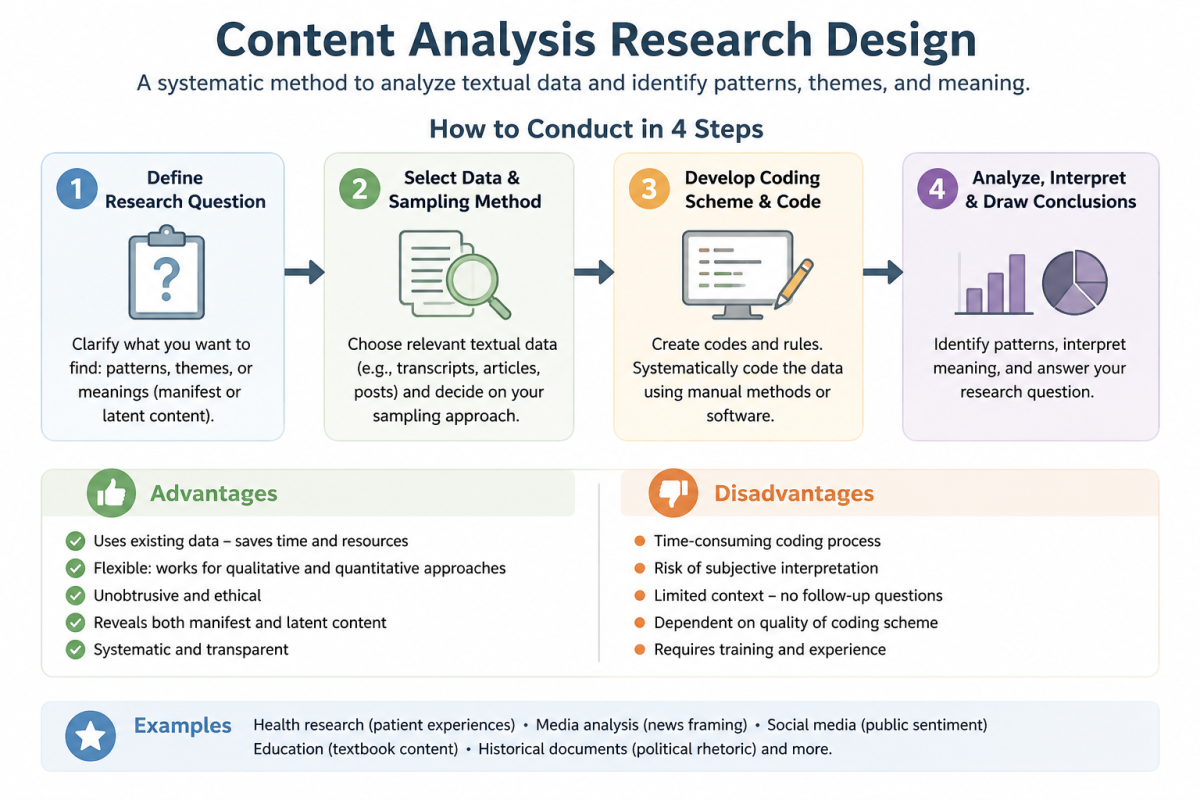
Like any qualitative research method, discourse analysis research design comes with distinct strengths and limitations that researchers should weigh carefully before choosing it.
Advantages:
- Reveals hidden power dynamics: One of the biggest strengths of discourse analysis research design is its ability to expose power relations that are otherwise invisible in everyday language use. This is especially true of critical discourse analysis, which is specifically designed to uncover inequality embedded in discourse.
- Rich, contextualized understanding: Because this method insists on situating linguistic analysis within social context and cultural context, it produces a deeper, more nuanced understanding of discourse than surface-level content analysis can offer.
- Flexibility across disciplines: Discourse analysis research design is highly adaptable. It can be applied in sociology, media studies, education, political science, and healthcare communication, making it one of the most versatile qualitative methods available.
- Captures the social construction of meaning: This design is uniquely suited to studying social construction, identity formation, and ideology, since it treats discourse as something that actively builds social reality rather than just reflecting it.
- Complements other qualitative approaches: Discourse analysis pairs well with thematic analysis, narrative analysis, and even document analysis, allowing researchers to triangulate findings and strengthen the validity of their qualitative data interpretations.
- Encourages critical reflexivity: Because discourse analysts must constantly interrogate their own assumptions, this method encourages researchers to remain reflexive about their position and biases throughout the research process.
- Well-suited to studying change over time: Discourse analysis research design can track how political discourse, media narratives, or institutional language shift over time, offering insight into evolving social relations and cultural attitudes.
Disadvantages:
- Time-consuming and labor-intensive: Transcribing, immersing in, and interpreting qualitative data for discourse analysis requires significant time investment compared to more structured quantitative approaches.
- High degree of subjectivity: Since discourse analysis research design relies heavily on interpretation, two discourse analysts examining the same type of discourse may reach different conclusions, raising questions about reliability.
- Difficult to generalize findings: Because discourse analysis research design typically works with small, context-specific data sources, findings are often not generalizable to larger populations in the way some other qualitative methods or quantitative designs might be.
- Requires strong linguistic and theoretical grounding: Conducting rigorous discourse analysis demands familiarity with linguistics, social theory, and often the work of scholars like Michel Foucault. Without this background, analytical depth can suffer.
- Risk of over-interpretation: Because discourse analysis research design encourages reading deeply into words and sentences, there is a genuine risk of researchers projecting meaning onto data that may not be fully supported by the text.
- Context dependency can limit comparability: Since meaning is so tightly tied to social context, comparing discourse analyses across very different settings or cultures can be challenging and sometimes misleading.
- Less suited to large datasets: Unlike content analysis, which can process large volumes of text efficiently, discourse analysis research design is not well suited to big data or large-scale quantitative style analysis, since its strength lies in depth rather than breadth.
- On balance, these advantages and disadvantages show that discourse analysis research design is best chosen when the research question calls for depth, nuance, and an understanding of power dynamics, rather than breadth or statistical generalizability.
Examples of Discourse Analysis Research Design
- Political speech analysis: A classic application of discourse analysis involves studying political discourse, such as presidential speeches or campaign rhetoric. Researchers might use rhetorical analysis to examine how politicians use metaphors, repetition, or emotionally charged language to construct a particular version of national identity or justify policy decisions.
- Media representation studies: Discourse analysis research design is often applied to news coverage to study how social identities — such as immigrants, women, or minority groups — are represented. A critical discourse analysis of headlines and framing can reveal underlying biases and power relations that shape public perception.
- Healthcare communication: Researchers frequently use discourse analysis research design to study doctor-patient interactions. By applying conversation analysis, they can examine turn-taking, interruptions, and word choice to understand power dynamics within clinical settings and how these dynamics affect patient trust and outcomes.
- Workplace and organizational discourse: Discourse analysis is also used to study social interaction in professional settings — for example, analyzing meeting transcripts or internal emails to understand how authority is communicated and negotiated among colleagues. This is a strong example of discourse analysis applied to organizational culture and social relations.
- Educational settings: In classrooms, discourse analysis research design can examine teacher-student interactions to understand how language constructs authority, encourages participation, or reinforces certain social hierarchies. This type of discourse analysis often draws on thematic analysis alongside close linguistic analysis.
- Social media discourse: With the rise of digital communication, researchers increasingly use discourse analysis research design to study how online communities construct social identities and negotiate social and cultural context through hashtags, memes, and comment threads. This is a rapidly growing application of discourse analysis in contemporary qualitative research.
- Foucauldian institutional analysis: Inspired directly by Michel Foucault, some researchers apply discourse analysis research design to institutions like prisons, hospitals, or schools to study how discourse produces and normalizes certain forms of knowledge and control. This remains one of the most influential applications of critical discourse analysis in sociology.
- Legal and policy document analysis: Discourse analysis research design is also used in document analysis of laws, policies, and official reports to uncover how language legitimizes certain actions or excludes alternative perspectives, offering insight into institutional power relations.
- Across all these examples, one thing remains constant: discourse analysis aims to reveal how language use does more than communicate information — it actively shapes social practice, identity, and power dynamics within a given social context. Whether applied to politics, healthcare, education, or media, discourse analysis research design consistently proves itself as a flexible and insightful qualitative research method for understanding the world through the lens of language.
