
Blog
How to Conduct Interpretive Phenomenological Analysis

What is Interpretive Phenomenological Analysis in Qualitative Research Designs?
- Interpretive Phenomenological Analysis (IPA) is a qualitative research approach that focuses on how people make sense of their own lived experience, particularly experiences tied to major life events, transitions, or chronic illness. Rather than testing a hypothesis or measuring variables, IPA asks: what did this experience actually mean to the person who lived it?
- IPA sits within the broader family of qualitative research methods, but it has a distinct identity. It draws on phenomenology (the study of experience and consciousness) and hermeneutics (the theory of interpretation), which is why researchers often describe it as a “double hermeneutic” — the participant is making sense of their world, and the researcher is making sense of the participant making sense of their world.
- Developed largely by Jonathan Smith in the 1990s and refined through work with collaborators like Osborn and Larkin, IPA emerged as a response to the limitations of purely descriptive or purely numbers-driven approaches in psychology and the social sciences. It gave researchers a structured yet flexible way to explore personal experience without flattening it into categories that don’t fit.
- A defining feature of interpretive phenomenological analysis is that it is idiographic. This means IPA is committed to understanding the particular before making any claims about the general. A study might involve a single participant, or a small handful, examined in painstaking depth, rather than a large sample examined broadly.
- IPA typically works with rich, first-person data: in-depth interviews, diaries, or open-ended written accounts. The data collection process is deliberately unstructured or semi-structured, using open-ended questions that invite participants to talk freely about their experience in their own words.
- The output of an IPA study isn’t a set of statistics — it’s a detailed, interpretive account of how a person, or a small group of people, experienced and made sense of something significant in their lives. This makes it a popular choice for researchers in psychology, nursing, health sciences, and sociology who want to understand experience from the inside out.
- In short, interpretive phenomenological analysis is not just a method and research technique — it’s a philosophical stance about what counts as valid knowledge, and it privileges depth, meaning, and individual perspective over breadth and generalizability.
Philosophical Assumptions of The Interpretive Phenomenological Analysis
- Phenomenology is the first pillar of IPA. This tradition, rooted in the work of Husserl, argues that we should study experience as it is lived and perceived, setting aside (as much as possible) our assumptions about what “really” caused or explains that experience. IPA borrows this commitment to staying close to the participant’s own account.
- Husserl’s original phenomenology emphasized bracketing — trying to set aside preconceptions to see a phenomenon freshly. IPA acknowledges this ideal but treats it as an aspiration rather than something fully achievable, since researchers always interpret through their own lens.
- Hermeneutics, the second pillar, comes largely from Heidegger and later Merleau-Ponty, who argued that human beings can’t be understood apart from their world, their body, and their history. Heidegger’s influence pushes IPA away from a purely descriptive stance and toward genuine interpretation — understanding a person’s experience in the context of their life, relationships, and circumstances.
- Merleau-Ponty’s emphasis on embodiment adds another layer: IPA recognizes that people don’t just think about their experiences, they embody them — physical sensation, emotion, and meaning are often tangled together, especially in experiences like chronic illness or grief.
- This combination gives rise to the double hermeneutic mentioned earlier. The participant interprets their own experience in the interview; the researcher then interprets that interpretation while analysing the transcript. Nothing about this process is neutral or purely descriptive — it is interpretive from start to finish.
- Idiography is the third philosophical commitment. Where much of qualitative research (and virtually all quantitative research) aims for conclusions that generalize to a population, IPA is idiographic: it insists on understanding one participant, one case, in full detail before ever considering what might be shared with others.
- Together, these three commitments — phenomenology, hermeneutics, and idiography — mean that IPA researchers approach data collection and data analysis with humility. They are not looking to confirm existing theories; they are trying to let the participant’s experience of living through something guide the analytic process, while being transparent (through reflexivity) about their own role in shaping the interpretation.
How To Conduct an Interpretive Phenomenological Analysis In 4 Easy Steps?
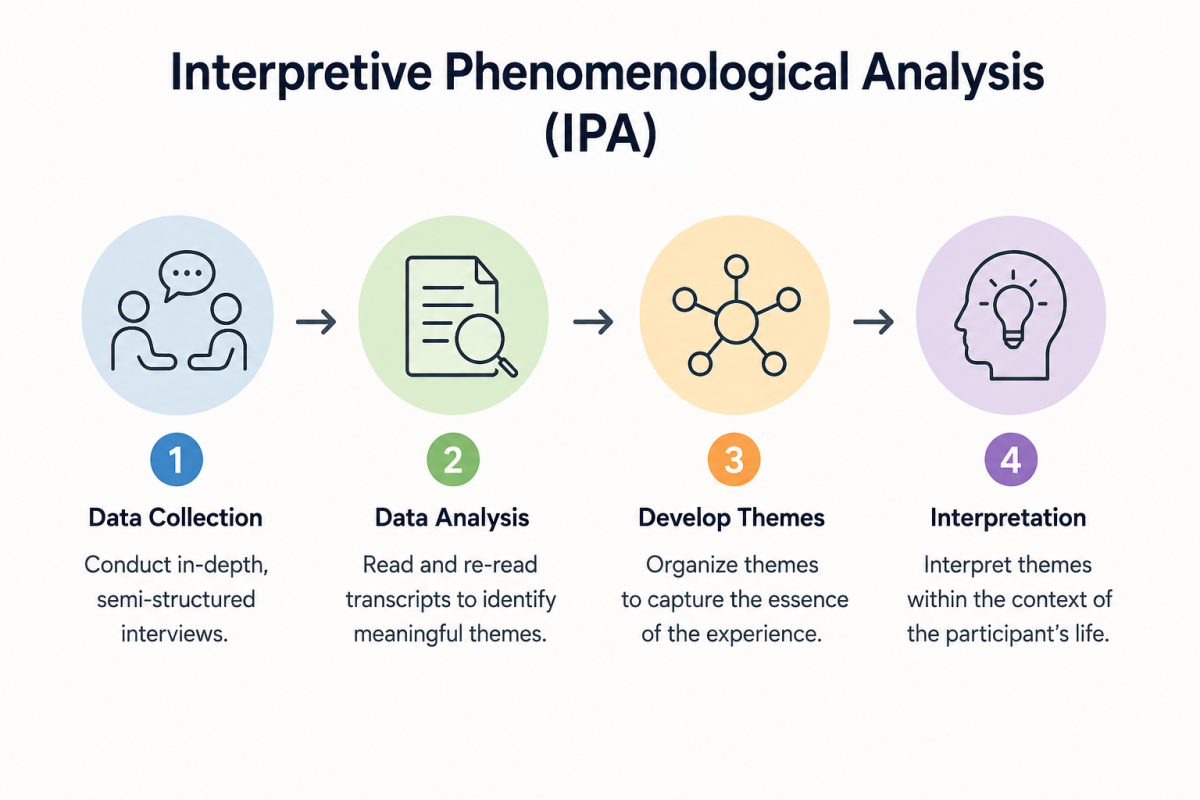
Conducting interpretive phenomenological analysis follows a fairly consistent research process, even though the interpretive work within each stage can be iterative and non-linear. Here is a practical guide to IPA, broken into four core steps:
1. Participant Recruitment and Data Collection
- Because IPA is idiographic, samples are small and purposive — researchers deliberately select participants who have direct, relevant experience of the phenomenon under study (for example, people diagnosed with a chronic illness, or people who have gone through a specific major life transition).
- A homogeneous sample is preferred: participants who share the experience closely enough that meaningful comparison across cases is possible, even with a small sample size.
- Data collection is usually done through semi-structured, in-depth interviews using open-ended questions, though diaries and written reflections are also used. The interviewer’s role is to create space for the participant to talk freely, only gently steering the conversation when needed.
- Interviews are typically audio-recorded and transcribed verbatim, since the transcript becomes the primary unit of analysis.
2. Reading and Re-Reading the Transcript
- The researcher begins by immersing themselves in a single transcript, reading and re-reading it multiple times before attempting any formal coding.
- This close examination step is about becoming familiar with the participant as a whole person and their story, not jumping straight to fragments or codes.
- Researchers often note initial impressions, emotional reactions, and questions in the margins — an early, informal layer of interpretation that will be refined later.
3. Initial Noting and Developing Emergent Themes
- The researcher then works line by line through the transcript, making notes under three broad lenses: descriptive (what was said), linguistic (how it was said), and conceptual (what it might mean at a deeper level).
- From these detailed notes, the researcher starts to identify emergent themes — short phrases that capture something meaningful in a section of text.
- This stage is highly analytic and requires the researcher to code the transcript carefully, always checking new interpretations against what the participant actually said, to keep the analysis grounded and defensible.
4. Developing Superordinate Themes and Writing Up
- Emergent themes are then clustered together based on conceptual similarity, producing a smaller number of superordinate themes that represent the participant’s experience at a higher level.
- Only after this single-case analysis is complete does the researcher move to the next transcript, repeating the process before eventually looking for patterns across participants — common themes that appear in several cases, alongside meaningful differences.
- The final step is the write-up, where the researcher presents each superordinate theme with direct extracts from participants’ own words, alongside the researcher’s interpretive commentary, producing a rich, first-person account of the phenomenon under study.
- Throughout all four steps, reflexivity remains essential: researchers keep a reflective log of their own assumptions and reactions so that the interpretive phenomenological analysis remains transparent and methodologically sound.
What are the Advantages and Disadvantages of Interpretive Phenomenological Analysis in Qualitative Research Designs?
Like any qualitative research approach, IPA has clear strengths, along with limitations that researchers should weigh before choosing it as their methodology.
Advantages
- Deep, rich understanding of lived experience. Because IPA is idiographic and analytic in nature, it produces a level of depth about individual experience that broader qualitative or quantitative methods often can’t match.
- Flexibility. IPA doesn’t require a rigid theoretical framework going in. Researchers are encouraged to let themes emerge from the data rather than forcing participants’ experiences into existing theories, which suits exploratory research questions well.
- Strong fit for sensitive or complex topics. IPA is widely used in health psychology and social sciences to study experiences of chronic illness, trauma, bereavement, and other major life events, precisely because it gives space for nuance, emotions and feelings, and ambiguity that more structured methods might flatten.
- Transparency through reflexivity. The emphasis on the researcher’s own reflexivity means readers can better judge how conclusions were reached, which strengthens the credibility of the research project.
- Encourages participant voice. By staying close to first-person accounts and using direct quotations, IPA studies let participants’ own words carry weight in the findings, rather than reducing their experience to abstract categories.
- Well-suited to small-scale, exploratory studies. For researchers without the resources for a large sample, IPA offers a methodologically respected way to still produce meaningful, publishable qualitative data analysis.
Disadvantages
- Small sample size limits generalizability. Because IPA typically involves a handful of participants, or sometimes just one, findings cannot be generalized to a wider population in the way quantitative or larger qualitative studies can.
- Time-intensive process. The multiple readings, detailed line-by-line coding, and iterative theme development required at each stage make IPA a slow, labor-intensive method compared to some other qualitative research approaches, such as basic thematic analysis.
- Highly dependent on researcher skill. Because so much of the analysis rests on interpretation, the quality of an IPA study depends heavily on the researcher’s analytic skill, sensitivity, and honesty about their own preconceptions.
- Risk of subjectivity. Critics argue that despite reflexivity practices, IPA analysis can still be shaped too much by the researcher’s own perspective, raising questions about how defensible any single interpretation really is.
- Not suited to every research question. IPA works well when the goal is to explore how individuals make sense of experience, but it is a poor fit for questions about causation, prevalence, or comparison across large groups.
- Requires articulate participants. Since IPA depends on participants being able to talk in detail about their inner experience, it can be harder to apply with populations who struggle to verbalize their thoughts and feelings.
Overall, the advantages and disadvantages of interpretive phenomenological analysis point to the same conclusion: IPA is a powerful tool when the research question calls for depth over breadth, but it is not a one-size-fits-all methodology for every qualitative research project.
Examples of Interpretive Phenomenological Analysis
To make the method more concrete, here are examples of how researchers have used IPA across different fields:
- Chronic illness experience. A classic use of IPA involves interviewing a small number of participants living with a chronic illness — such as diabetes, cancer, or chronic pain — to explore how the illness has reshaped their sense of identity, relationships, and daily routine. These IPA studies often reveal superordinate themes such as loss of control, renegotiating the body, and adapting to a “new normal.”
- Bereavement and grief. Researchers have used IPA to study how individuals make sense of losing a spouse or close family member, focusing on the emotions and feelings involved and how meaning is reconstructed over time. The idiographic, case-by-case approach captures how grief is experienced differently by each participant, even while some common themes emerge across the sample.
- Transition to parenthood. IPA has been applied to explore the experience of becoming a parent for the first time, examining how new mothers or fathers make sense of shifting identity, relationship changes, and unexpected emotional responses during a major life transition.
- Workplace and career transitions. Studies have used IPA to examine experiences like job loss, retirement, or career change, uncovering how participants reconstruct their sense of purpose and self-worth outside familiar professional identities.
- Mental health recovery. In clinical psychology, IPA studies have explored how individuals experience recovery from conditions such as depression or anxiety, often highlighting the role of relationships, self-understanding, and turning points in the recovery journey.
- Trauma and major life events. IPA is also used in social sciences research examining experiences of trauma, migration, or significant life disruption, where the aim is to catalogue and interpret how participants narrate and integrate difficult events into their broader life story.
Across all of these examples, the same underlying logic applies: a small, carefully selected sample; open-ended, in-depth interviews; and a slow, layered analytic process that moves from individual transcripts toward broader, defensible themes. This consistency is part of what makes interpretive phenomenological analysis such a trusted qualitative research approach across psychology, health sciences, and sociology, even as it continues to be adapted to new topics and populations.
