
Blog
How To Write A Critical Literature Review |Best Example

Introduction to How To Write A Critical Literature Review | Best Example: Definitions and Purpose
- Defining a Critical Literature Review
- A critical literature review (CLR) is more than a summary of existing literature; it is a systematic process of evaluating, analyzing, and synthesizing research within a particular field.
- Unlike traditional literature, a CLR focuses on critical evaluation rather than mere description, highlighting the strengths, limitations, and gaps in existing knowledge.
- The aim is to provide a comprehensive understanding of the research area, presenting arguments that advance knowledge and identify directions for future research.
- Purpose of a Critical Literature Review
- Evaluate existing research: Researchers must examine how previous studies address the research questions and the methodologies used.
- Identify research gaps: By critically evaluating different studies, a CLR helps to spot inconsistencies, contradictions, or missing areas in the existing body of knowledge.
- Develop a theoretical framework: Synthesizing findings enables the formulation of hypotheses and conceptual models that guide new research.
- Support evidence-based research: A CLR ensures that future research is built upon a well-defined foundation of relevant literature rather than assumptions or anecdotal evidence.
- Encourage critical thinking: By reading critically and analyzing underlying assumptions, scholars refine their argumentation and develop original perspectives.
- Importance in Academic Research
- Literature reviews play a central role in academic research, providing context for new studies and ensuring that researchers build on existing knowledge effectively.
- Conducting a critical literature review underscores the importance of objectivity, avoiding potentially leading interpretations or preconceived notions.
- It helps advance knowledge in a given field by integrating findings, proposing new theories, and suggesting future research directions.
Step-by-Step Process for Conducting a Critical Literature Review | How To Write A Critical Literature Review
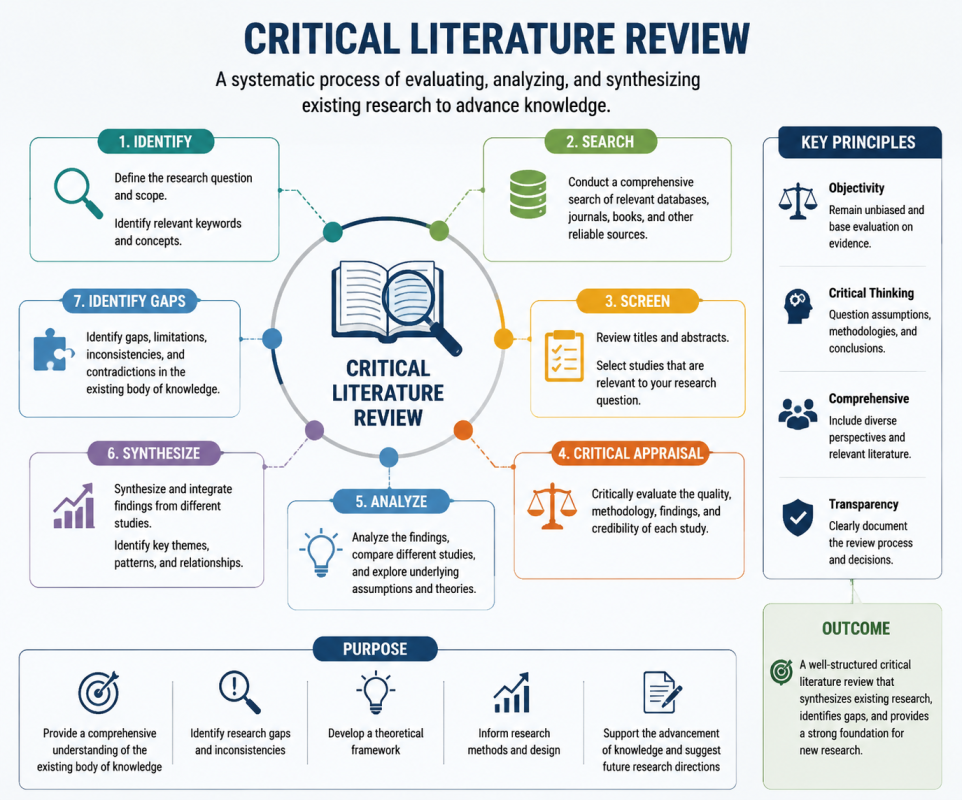
- Define the Scope and Objectives
- Clearly state the purpose of your critical literature review. Are you aiming to explore specific research questions, develop a theoretical framework, or provide a comprehensive synthesis of a research area?
- Identify the key concepts and the research area you want to address. This ensures that the review remains focused and relevant.
- Search and Identify Relevant Literature
- Conduct a systematic review of academic databases, journals, and other scholarly sources.
- Include both current research and previous research to understand the evolution of ideas within the field.
- Ensure sources are relevant and impactful, avoiding outdated or tangential studies that do not align with your objectives.
- Critically Read and Analyze Sources
- Engage in critical reading to evaluate research methods, methodologies, and findings.
- Identify gaps and limitations, contradictions, or areas where the results of different studies fail to align.
- Pay attention to the underlying assumptions and potential biases in each study.
- Organize the Literature
- Group research findings based on key themes, methodologies, or theoretical frameworks.
- A well-organized review allows for a depth of analysis, highlighting relationships between studies and ensuring clarity for readers.
- Evaluate and Synthesize the Information
- Critically assess each study for quality, relevance, and methodological rigor.
- Synthesize the information by integrating findings from different studies, highlighting patterns, trends, and contradictions.
- This process creates a comprehensive synthesis that contributes to the existing body of knowledge.
- Summarize and Interpret Findings
- Provide a summarized account of existing literature while emphasizing gaps, limitations, and key contributions.
- Link your findings to the research questions or hypotheses you aim to address, showing how the review informs your study.
- Propose Implications and Future Directions
- Suggest areas for future research, based on identified gaps or underexplored perspectives.
- Discuss potential new theories or refinements to existing frameworks, ensuring that the review advances knowledge meaningfully.
Key Principles of Critically Evaluating Literature Reviews
- Maintain Objectivity
- Researchers must adhere to impartial evaluation, avoiding biases or preconceived notions.
- Critical appraisal involves acknowledging potentially leading assumptions in previous studies and focusing on evidence-based conclusions.
- Depth of Critical Analysis
- A critical review requires evaluating the methodology, research process, and research methods used in studies.
- Examine the strengths and weaknesses of each study, including sample size, data collection, and analysis techniques.
- Consider inconsistencies across studies and provide explanations for contradictions.
- Integration Across Studies
- Synthesize information from multiple sources to provide a comprehensive understanding of the existing body of knowledge.
- Highlight connections between studies, identifying patterns, research gaps, and opportunities for original perspectives.
- Focus on Relevant and Impactful Literature
- Prioritize studies that directly inform your research questions or specific field.
- Exclude research that is tangential or does not provide substantial insight for the purpose of the review.
- Critical Appraisal of Existing Knowledge
- Assess how current research builds upon traditional literature.
- Determine whether studies are well-designed, methodologically sound, and contribute to the advancement of knowledge.
Techniques for Synthesizing Information in a Critical Literature Review
- Thematic Synthesis
- Organize studies around key themes, concepts, or theoretical frameworks.
- Compare and contrast findings, emphasizing areas of agreement and contradiction.
- This method allows for integration of diverse perspectives among scholars and provides a clear structure for readers.
- Methodological Synthesis
- Evaluate and critically assess research methods across studies.
- Identify gaps in methodology and potential negative impacts of flawed approaches on research findings.
- This synthesis aids in advancing knowledge by highlighting best practices in conducting research.
- Chronological Synthesis
- Examine how research has evolved over time.
- Identify how hypotheses, theoretical frameworks, and methodologies have shifted, and assess their relevance to current research questions.
- This approach emphasizes the development of knowledge and understanding within a particular research area.
- Integrative Synthesis
- Synthesize the information from different studies into a coherent narrative.
- Develop connections between findings, highlight research gaps, and propose new research directions.
- Ensure that your synthesis aligns with the purpose of a critical literature review and contributes meaningfully to the existing body of knowledge.
- Critical Appraisal and Argumentation
- Provide well-reasoned evaluations of each study, noting contradictions, inconsistencies, and limitations.
- Highlight key themes, gaps, and areas needing refinement, ensuring your review offers educational research value and guidance for future studies.
- Maintaining Objectivity and Original Perspectives
- Avoid preconceived notions and personal bias in your synthesis.
- Present findings in a balanced manner, underscoring the importance of diverse perspectives and evidence-based conclusions.
- Linking Synthesis to Theoretical Frameworks
- Use the review to develop a theoretical framework or refine existing models.
- Demonstrate how the synthesis supports hypotheses, research questions, or proposes new theories.
- This approach ensures the literature review is not only descriptive but analytical and forward-looking, contributing to advancement of knowledge in the field.
Maintaining Objectivity and Avoiding Bias in a Critical Review
- Understanding Objectivity in a Critical Literature Review
- Objectivity is central to conducting a critical literature review; it ensures that your analysis and evaluation are evidence-based rather than influenced by personal opinions or preconceived notions.
- Researchers must adhere to well-defined review methods, critically evaluating studies based on methodology, research methods, and research findings, rather than their alignment with a preferred hypothesis.
- Objectivity strengthens the advancement of knowledge by providing a clear, unbiased perspective that integrates existing literature with current research.
- Identifying and Minimizing Bias
- Bias can arise from preconceived notions, selective inclusion of literature, or emphasizing studies that support a specific argument.
- Conduct a systematic review by defining inclusion and exclusion criteria, ensuring that relevant sources from diverse perspectives are considered.
- Be vigilant for potentially leading studies that may skew interpretations or create contradictions within the review process.
- Critical Appraisal Techniques
- Critically assess each source to examine the rigor of the research methodology, appropriateness of sample selection, and validity of findings.
- Identify underlying assumptions and potential negative influences that may affect the reliability of research outcomes.
- Highlight inconsistencies or contradictions among scholars to provide comprehensive synthesis and a nuanced understanding of the topic.
- Maintaining Transparency
- Document the review process clearly, explaining why certain studies were included or excluded.
- Transparency in conducting a critical literature review fosters credibility and allows readers to understand the basis for conclusions.
- Provide detailed explanations for analysis and evaluation, particularly where interpretations may be subjective.
- Balancing Diverse Perspectives
- Include research from different studies, fields, and theoretical frameworks to ensure comprehensive understanding.
- Avoid over-relying on traditional literature or one school of thought; embrace diverse perspectives to strengthen argumentation and highlight potential gaps in existing research.
- Synthesize findings to reflect original perspectives while maintaining alignment with the purpose of a critical literature review.
- Regular Self-Reflection
- Researchers must continually reflect on their own biases, assumptions, and expectations throughout the review process.
- Engage in critical reading and in-depth critical evaluation of existing literature to recognize personal inclinations that could compromise objectivity.
- This practice underscores the importance of objectivity in advancing knowledge and developing a robust theoretical framework.
Aligning Your Critical Literature Review with Research Hypotheses
- Connecting the Review to Research Questions
- The review should align with your specific research questions and overarching objectives.
- Each section of the literature review must demonstrate how existing research informs or challenges your hypotheses.
- Literature reviews play a critical role in identifying the gaps and limitations that your research aims to address.
- Developing a Theoretical Framework
- Integrate findings from the existing body of knowledge to develop a theoretical framework that guides your research design.
- Critically evaluate how previous studies contribute to well-defined concepts, hypotheses, and research methods.
- A strong theoretical framework ensures your review provides a comprehensive synthesis of knowledge while proposing new theories or refinements.
- Critically Evaluating Methodology and Findings
- Analyze research methods in prior studies to determine their reliability and relevance to your specific field.
- Examine research findings for consistency with previous research, noting contradictions or potential inconsistencies that could influence your hypothesis.
- Synthesize information to propose new research directions, demonstrating how your work builds upon the existing body of knowledge.
- Ensuring Coherence and Alignment
- Check that your critical literature review presents a coherent narrative that links research questions, methodologies, and findings.
- Highlight the key themes, underlying assumptions, and gaps that emerge across studies.
- Aligning the review with hypotheses underscores the importance of a systematic and well-structured approach in academic research.
- Integrating Critical Analysis
- Use critical analysis to assess the strengths, weaknesses, and limitations of existing research.
- Discuss how the literature supports or challenges your hypothesis and how integrating findings from different studies informs future research directions.
- A critical evaluation fosters original perspectives and encourages advancing knowledge beyond the current research landscape.
- Highlighting Research Gaps
- Identify gaps within the existing body to justify the relevance of your research.
- Provide a comprehensive understanding of the field while suggesting areas where new research can make meaningful contributions.
- Emphasize research gaps in methodology, theory, or findings that could be addressed through your study.
- Refinement and Continuous Alignment
- Continuously refine the review to ensure that critical evaluation aligns with evolving insights and hypotheses.
- Ensure the review remains relevant, impactful, and evidence-based, integrating findings in a way that strengthens the argumentation of your research.
Common Challenges and Key Considerations in Conducting a Critical Literature Review
- Identifying Relevant Literature
- A key challenge is locating studies that are relevant and impactful to the research area.
- Researchers must critically assess sources for academic rigor, credibility, and relevance to their research questions.
- Over-reliance on traditional literature can limit perspectives and hinder advancement of knowledge.
- Synthesizing Information Across Studies
- Scholars often struggle to synthesize findings from different studies due to variations in methodology, sample populations, or theoretical perspectives.
- Effective synthesizing information involves integrating findings into a coherent narrative that highlights key themes, contradictions, and research gaps.
- Aim for comprehensive synthesis that reflects both current research and previous research in the field.
- Maintaining Objectivity and Avoiding Contradictions
- Bias and subjective interpretation are potential negative influences in conducting a critical literature review.
- Researchers must adhere to objective evaluation, critically reading each source and avoiding preconceived notions.
- Highlight contradictions or inconsistencies but provide analysis and evaluation to reconcile differences.
- Balancing Depth and Breadth of Analysis
- Conducting a critical literature review requires balancing depth of analysis with a broad overview of the field.
- Avoid excessive focus on a narrow topic while neglecting the existing body of knowledge that informs your research area.
- Use structured review methods to ensure all relevant sources are considered while maintaining focus.
- Evaluating Methodology Across Studies
- Assess the strengths and weaknesses of research methods to determine the reliability of findings.
- Consider how methodologies affect research outcomes, particularly in educational research or fields with diverse study designs.
- Identify methodological gaps that may suggest opportunities for future research directions.
- Identifying Research Gaps and Advancing Knowledge
- Highlight gaps and limitations in the literature to justify the need for new research.
- Provide a comprehensive understanding of the field to support advancing knowledge and the development of a theoretical framework.
- Suggest areas for refinement, new hypotheses, or original perspectives that contribute to educational research and academic discourse.
Best Practices and Examples of How To Write A Critical Literature Review | Best Example
- Start with a Clear Purpose
- Define the purpose of a critical literature review early, whether to summarize existing research, develop a theoretical framework, or propose new theories.
- Identify key concepts and research questions to ensure the review remains focused and relevant.
- Adopt a Systematic Review Process
- Follow review methods that are transparent, reproducible, and rigorous.
- Conduct a systematic review to ensure comprehensive coverage of relevant literature, minimizing bias and preconceived notions.
- Critically Evaluate Existing Literature
- Conduct in-depth critical analysis of studies, focusing on methodology, research methods, and research findings.
- Identify gaps and limitations, inconsistencies, and underlying assumptions to provide a comprehensive understanding.
- Synthesize and Integrate Findings
- Synthesize the information by integrating insights from different studies to highlight patterns, contradictions, and key themes.
- Provide a comprehensive synthesis that links findings to research questions and hypotheses.
- Maintain Objectivity and Original Perspectives
- Ensure that the review remains objective, avoiding potential bias.
- Include diverse perspectives among scholars and encourage original perspectives that contribute to advancing knowledge.
- Provide Examples and Case Illustrations
- Illustrate best practices with practical examples, showing how to critically assess, synthesize, and summarize existing literature effectively.
- Include examples from educational research, academic research, and relevant studies in the field.
- Highlight Implications for Future Research
- Suggest future research directions, identifying areas where new research can contribute to theory or methodology.
- Link the review to potential hypotheses, new theories, or refinements in the theoretical framework.
- Refine and Review Iteratively
- Continuously refine the review to ensure depth of analysis and alignment with research objectives.
- Conduct iterative critical evaluation to maintain clarity, coherence, and relevance of the review.
