
Blog
How To Conduct Narrative Research Design with Examples

What is Narrative Research Design in Qualitative Research Designs?
- Narrative research design is one of the core qualitative research designs used across the social sciences, education, psychotherapy, and social work to understand how people make sense of their lives through storytelling. At its heart, this research approach treats narrative as both the object of study and the method of inquiry, meaning the researcher collects and analyzes the stories people tell about their lived experience rather than reducing those experiences to numbers or statistics.
- In qualitative research, narrative research design falls under the broader umbrella of narrative inquiry, a research methodology that focuses on individual experiences, personal narratives, and life stories as legitimate sources of qualitative data. Unlike quantitative methods that seek to measure and generalize, narrative researchers are interested in the richness, structure, and meaning embedded in a single storied account or a small set of individual narratives.
- The central idea behind this research design is simple but powerful: human beings naturally organize their experiences into stories. When a researcher asks a participant to tell their story about an illness, a career transition, a migration journey, or a classroom experience, that participant doesn’t just recount facts — they construct a narrative with a beginning, middle, and end, complete with characters, turning points, and meaning-making. Narrative researchers study this storied construction closely, paying attention to narrative structure, sequence, tone, and context.
- Narrative research design typically draws on data collection methods such as in-depth interviews, narrative interviews, oral history, life histories, and sometimes field notes or documents that add contextual information to a participant’s account. Because the focus is on depth rather than breadth, sample sizes tend to be small — often just one to a handful of research participants — allowing the researcher to spend significant time with each individual’s story.
- This design is especially valuable in fields like social work, education, nursing, and psychotherapy, where understanding the lived experience of a client, student, or patient can inform practice, policy, or theory. For example, a social science researcher studying the lived experiences of students transitioning out of foster care might use narrative research design to capture rich, first-person accounts rather than survey data.
- What distinguishes narrative research from other qualitative approaches like grounded theory, phenomenology, ethnography, or case study research is its explicit focus on the story itself as the unit of analysis. While phenomenology seeks the essence of a shared experience across multiple perspectives and grounded theory aims to build theory from patterns in qualitative data, narrative analysis instead honors the individuality, subjectivity, and coherence of a single narrative or set of personal narratives.
- Ultimately, narrative research design offers qualitative researchers a way to preserve the complexity and context of human experience, making it a preferred research approach when the goal is to understand meaning, identity, and change over time through the participant’s own storied voice.
Philosophical Assumptions of The Narrative Research Design
- Like all qualitative research designs, narrative research design is grounded in specific research paradigms and philosophical assumptions that shape how researchers approach data collection, data analysis, and interpretation. Understanding these assumptions helps qualitative researchers justify why this research methodology is appropriate for studying human experience.
- Ontological assumption (the nature of reality): Narrative researchers assume that reality is subjective and multiple. Rather than believing in one fixed, objective truth, this research approach holds that each research participant constructs their own version of reality through the stories they tell. This means two people who experienced the same event may narrate it very differently, and both accounts are considered valid within their own context.
- Epistemological assumption (how we come to know things): Narrative research design assumes that knowledge is co-constructed between the researcher and the interviewee. Knowledge isn’t simply “discovered” by a neutral observer; instead, it emerges through the relationship, dialogue, and trust built during narrative interviews. This interpretive stance means the researcher’s presence inevitably shapes the story being told, and this is accepted as part of the process rather than a limitation to eliminate.
- Axiological assumption (the role of values): Narrative researchers openly acknowledge that their own values, background, and positionality influence the research. Rather than pretending to be a neutral, invisible observer, the researcher’s subjectivity is recognized as something that shapes which stories are told, how they are interpreted, and which patterns are identified during analysis.
- Rhetorical assumption (the language of research): This research design favors personal, narrative, and often literary language over technical, detached academic language. Researchers frequently use first-person voice, direct quotations, and storytelling techniques when reporting findings, because the goal is to preserve the participant’s voice rather than translate it into abstract variables.
- Methodological assumption (the process of research): Narrative research design follows an inductive, flexible, and evolving process. The researcher doesn’t begin with rigid hypotheses to test; instead, categories, themes, and meanings emerge from the narrative data itself as it’s collected and analyzed. This is similar to grounded theory in its inductive nature, though narrative analysis remains centered on the story as a whole rather than fragmenting data into abstract theoretical categories.
- Constructivist and interpretive roots: Narrative research design is deeply rooted in constructivist and interpretive research paradigms, both of which assume that individuals construct meaning through social interaction and lived experience. This sociocultural grounding means researchers pay close attention to the cultural, historical, and social context surrounding a participant’s story, recognizing that personal narratives are never told in a vacuum but shaped by broader master narratives circulating in society.
- Temporal and relational assumptions: Narrative researchers also assume that experience is inherently temporal — it unfolds over time — and relational, meaning it’s shaped through interaction with others. This is why narrative inquiry often asks participants to reflect not just on isolated events but on how their experience connects across time, relationships, and place.
- Together, these philosophical assumptions explain why narrative research design is uniquely suited to studies of identity, transformation, trauma recovery, professional development, and any topic where understanding an individual’s storied, subjective experience matters more than statistical generalization.
How To Conduct an Narrative Research Design In 4 Easy Steps?
Conducting narrative research design doesn’t have to be overwhelming once broken into a clear process. Below are four practical steps to guide qualitative researchers through a successful narrative study, from planning to reporting.
Step 1: Identify the Phenomenon and Select Research Participants
- Begin by clearly defining the phenomenon of human experience you want to explore. Are you interested in life stories related to career change, illness, immigration, education, or trauma recovery? A focused research question keeps the narrative research design manageable and meaningful.
- Purposefully select research participants who have directly lived through the experience you’re studying. Because narrative research prioritizes depth over breadth, sample sizes are usually small — sometimes a single case study, sometimes a handful of individuals whose personal narratives can offer multiple perspectives on a shared phenomenon.
- Consider ethical approval, informed consent, and confidentiality early, especially when working with vulnerable populations in fields like social work or psychotherapy, where personal narratives may touch on sensitive or traumatic material.
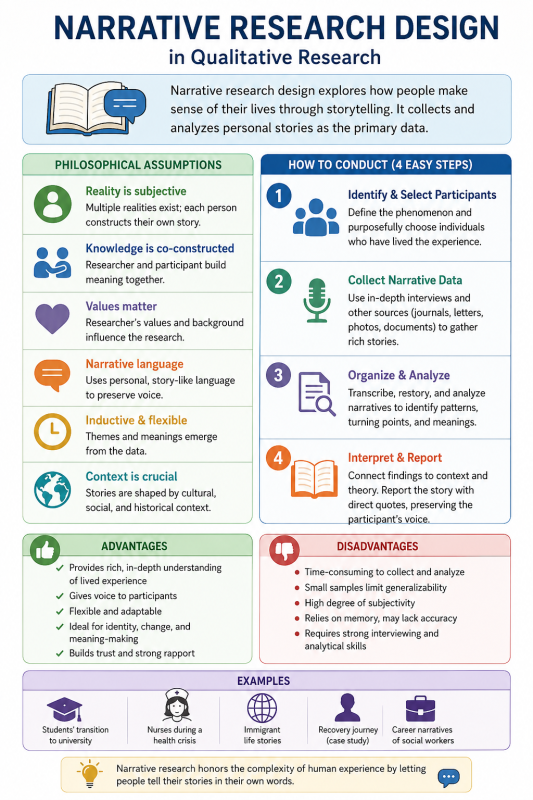
Step 2: Collect Narrative Data Through Interviews and Other Sources
- The most common data collection method in narrative research design is the in-depth interview, often conducted as a semi-structured or unstructured conversation that gives participants space to tell their story in their own words and their own order.
- Narrative interviews typically begin with a broad, open-ended prompt — such as “Tell me about your experience of…” — allowing the interviewee to shape the narrative structure rather than following a rigid question list. Follow-up questions help the researcher probe deeper into key turning points, emotions, and meaning-making.
- Beyond interviews, narrative researchers may supplement qualitative data with journals, letters, photographs, oral history recordings, field notes, or documents that provide additional contextual information about the participant’s life histories.
- Some studies incorporate focus groups or multiple sessions with the same participant to build a fuller, richer account. Recording and later transcribing conversations word-for-word is essential, since the exact language, pauses, and phrasing often carry meaning in narrative analysis.
Step 3: Organize, Restory, and Analyze the Narrative Data
- Once interviews are transcribed, the researcher begins data analysis by reading and re-reading the narrative data multiple times to become deeply familiar with each participant’s story.
- A common technique is “restorying,” where the researcher reorganizes the participant’s account into a chronological or thematic sequence, clarifying the narrative structure while staying faithful to the original meaning.
- Analysis methods in narrative research design vary but often include thematic analysis, structural analysis (looking at how the story is built), or dialogic analysis (looking at how the story was co-constructed in conversation). Researchers identify patterns, turning points, conflicts, and resolutions across the narrative.
- Triangulation — comparing narrative data against field notes, documents, or multiple participants’ stories — helps strengthen the credibility and trustworthiness of the qualitative analysis.
Step 4: Interpret Findings and Report the Story
- The final step involves interpreting what the narrative reveals about the broader research question, connecting individual experiences to existing theory, sociocultural context, or practical implications for practice.
- Reporting in narrative research design often looks different from other qualitative research designs. Instead of presenting isolated themes, researchers frequently write findings as a cohesive, storied narrative, complete with direct quotations that preserve the participant’s authentic voice.
- Throughout reporting, the researcher should remain transparent about their own positionality and interpretive choices, since subjectivity is an accepted part of this research methodology rather than something to hide.
- Sharing findings back with participants (sometimes called member-checking) can further validate that the researcher’s interpretation resonates with the participant’s own understanding of their lived experience.
Following these four steps allows researchers to conduct narrative research in a way that is systematic, ethical, and rich in meaning, even though the process remains flexible and responsive to each participant’s unique story.
What are the Advantages and Disadvantages of Narrative Research Design in Qualitative Research Designs?
Advantages of Narrative Research Design
- Rich, in-depth understanding of lived experience: One of the biggest strengths of narrative research design is its ability to capture the full complexity of human experience. Rather than reducing experience to numbers, this research approach preserves nuance, emotion, and context, giving readers a genuine sense of what it was like to live through a particular event or period.
- Gives voice to research participants: Narrative research design centers the participant’s own words and interpretations. This is especially valuable in social work and other human sciences, where amplifying marginalized or underrepresented voices is often a core goal of the research.
- Flexible and adaptable research methodology: Because narrative interviews are typically semi-structured or open-ended, this design adapts well to unexpected directions in a participant’s story. Researchers aren’t locked into rigid questions, which allows unanticipated but important themes to surface naturally.
- Strong fit for studying identity, change, and meaning-making: Life stories reveal how people construct identity and make sense of transitions, making narrative research design ideal for studying processes like recovery, career development, immigration, or educational journeys over time.
- Useful across multiple disciplines: From psychotherapy to anthropological research to education and social science, narrative inquiry is a versatile research approach. It can stand alone or be combined with other qualitative research designs, such as case study or ethnography, to add depth to broader qualitative research.
- Encourages reflexivity and multiple perspectives: Because the design assumes subjectivity, researchers are encouraged to critically reflect on their own role in shaping the narrative, often resulting in more thoughtful, transparent, and ethically grounded research.
- Builds strong rapport and trust: The in-depth, conversational nature of narrative interviews often allows participants to open up about sensitive topics more comfortably than they might in a structured survey or brief interview, leading to more authentic and detailed narrative data.
Disadvantages of Narrative Research Design
- Time-consuming data collection and analysis: Conducting in-depth interviews, transcribing them fully, and performing careful narrative analysis takes considerably more time than many other qualitative or quantitative research methods. Restorying and identifying patterns across long transcripts can be a slow, labor-intensive process.
- Small sample sizes limit generalizability: Because narrative research design typically relies on a small number of participants — sometimes just one case study — findings can’t be statistically generalized to a larger population. This is a common criticism, especially from researchers trained in quantitative traditions.
- High degree of subjectivity: Since both the participant’s storytelling and the researcher’s interpretation are inherently subjective, two different researchers analyzing the same narrative data might arrive at different conclusions. Critics argue this can raise questions about the reliability and rigor of narrative analysis.
- Risk of researcher bias: Because the researcher plays an active role in restorying and interpreting the account, there’s a risk that personal assumptions or preconceptions unintentionally shape the final narrative, even when researchers try to remain reflexive and transparent.
- Memory and accuracy limitations: Personal narratives rely heavily on memory, which can be selective, reconstructed, or influenced by time and later experiences. A participant’s account of an event years later may not perfectly reflect what actually happened, complicating claims about factual accuracy.
- Ethical complexity with sensitive topics: Because narrative research often explores deeply personal or traumatic experiences, researchers must navigate emotional risk carefully, particularly in fields like psychotherapy or social work, where recounting difficult life histories could cause distress to participants.
- Difficult to standardize across studies: Unlike more structured qualitative research designs, narrative research design lacks a single, universally agreed-upon analysis method, which can make it harder to compare findings across different narrative studies or replicate research methodology consistently.
- Requires strong interviewing and analytical skill: Successfully conducting narrative research demands that the researcher be skilled at building rapport, asking thoughtful follow-up questions, and identifying subtle narrative structure — skills that take time and experience to develop.
Despite these limitations, many qualitative researchers argue that the depth and authenticity narrative research design provides outweigh its challenges, particularly when the research goal is understanding meaning and lived experience rather than producing generalizable statistics.
Examples of Narrative Research Design
- Example 1: Lived experiences of students transitioning to university. A researcher interested in the lived experiences of students moving from high school to university might use narrative research design to interview a small group of first-year students. Through semi-structured, in-depth interviews conducted over a semester, the researcher collects personal narratives about identity, independence, academic struggles, and social belonging. The analysis of the narrative reveals shared turning points, such as the first failed exam or a meaningful mentorship, that shape students’ broader story of adjustment.
- Example 2: Life histories of nurses working through a public health crisis. In social science and health research, narrative researchers might collect life histories from nurses who worked through a pandemic. Using narrative interviews and field notes, the researcher captures individual experiences of fear, resilience, and professional identity change. This kind of narrative study can inform hospital policy and mental health support programs by revealing patterns invisible in quantitative surveys.
- Example 3: Oral history of immigrant communities. Oral history projects are a classic form of narrative research design. A researcher might conduct interviews with first-generation immigrants, asking them to tell their story of migration, cultural adjustment, and identity formation. This anthropological approach often incorporates sociocultural context, comparing individual narratives against broader master narratives about migration in the host country, and may include triangulation with historical documents or family records.
- Example 4: Case study of a single individual’s recovery journey. Narrative research design is well suited to single case study research, such as documenting one person’s journey through addiction recovery. Through multiple in-depth interviews conducted over months, the researcher explores how the participant’s self-narrative evolved, what turning points mattered most, and how relationships influenced their recovery. This example highlights how narrative analysis can produce a deeply detailed, storied account that other research designs might overlook.
- Example 5: Career narratives of social workers. A qualitative researcher studying burnout and job satisfaction in social work might use narrative research design to gather personal narratives from practitioners across different career stages. Combining narrative interviews with reflective journaling as a secondary data collection method, the researcher identifies recurring themes such as compassion fatigue, professional growth, and shifting motivations, offering insight that pure quantitative research would likely miss.
- Example 6: Narrative inquiry in psychotherapy research. In clinical settings, therapists and researchers sometimes use narrative research design to explore how clients construct meaning from traumatic experiences during therapy. By analyzing session transcripts and interviews as narrative data, researchers can identify how a client’s self-narrative shifts over the course of treatment, offering valuable insight into therapeutic progress and identity reconstruction.
- Example 7: Educational research combining narrative and case study approaches. Some researchers blend narrative research design with case study or ethnography for added depth. For instance, a study on the lived experience of teachers implementing a new curriculum might combine classroom observations (field notes) with narrative interviews, allowing researchers to triangulate participants’ stories against real classroom practice for a more contextual, credible qualitative analysis.
These examples show how flexible and far-reaching narrative research design can be — spanning education, healthcare, social work, psychotherapy, and cultural research — always centered on capturing authentic, storied accounts of human experience through the participant’s own voice.
