
Blog
How To Conduct Case Study Research Design with Example

What is Case Study Research Design in Qualitative Research Designs?
- Case study research design is a qualitative research approach that involves an in-depth, detailed examination of a particular case — whether that’s an individual, group, organization, event, or specific context — within its real-world setting. Unlike other research methods that aim to generalize findings across large populations, case study research prioritizes depth over breadth.
- At its core, case study research is grounded in the idea that some phenomena can only be fully understood by looking closely at how they unfold within a specific context. This makes it one of the most flexible research methods available to a researcher, especially when the boundaries between the phenomenon and its real-life context aren’t clearly evident.
- Case study research design sits comfortably within qualitative research because it relies heavily on qualitative data — interviews, observations, documents, and artifacts — to build a rich, contextualized narrative. That said, many case studies also incorporate quantitative data, making mixed methods research a common and effective research approach in this space.
- A well-structured case study design typically begins with a clear research question — one that asks “how” or “why” something happens, since these types of questions benefit most from an in-depth understanding of the case being studied.
- The unit of analysis is a foundational concept in case study research. It refers to the specific entity — a person, a team, a policy, an institution — that forms the boundary of the study. Defining the unit of analysis early on helps the researcher stay focused and avoid scope creep.
- Case study research is widely used across social science disciplines like sociology, psychology, education, political science, and business, as well as in information systems research, where understanding complex, real-world systems is essential.
- One of the defining features of this research design is its ability to capture the nature of the case in its full complexity — including the social, cultural, historical, and organizational factors that shape it. This is something that purely quantitative methods often struggle to achieve, since numbers alone can’t always explain “why” something happens.
- Case study research design can involve a single case study or multiple case studies, depending on the purpose of the study and the scope of the research question. Both approaches are valid, but they serve different analytical goals — something we’ll explore further in the next sections.
- Ultimately, case study research design is less about proving a hypothesis and more about generating a deep, contextual, and often nuanced understanding of the case — making it an indispensable tool in qualitative inquiry.
Philosophical Assumptions of The Case Study Research Design
- Every research design is rooted in a particular research paradigm, and case study research design is no exception. Understanding these underlying philosophical assumptions helps researchers justify their methodological choices and interpret findings appropriately.
- Constructivism (Interpretivism): Much of case study research leans on a constructivist worldview, which assumes that reality is socially constructed and that multiple, subjective truths exist depending on perspective. Under this assumption, the researcher doesn’t seek a single objective truth but instead tries to understand how different stakeholder groups experience and interpret the phenomenon of interest.
- Ontology (the nature of reality): Case study researchers generally assume that reality is context-dependent and multi-layered. This means the same event or issue can look completely different depending on who you ask or which angle you study it from — which is why triangulation (using multiple sources of evidence) is so critical in this research approach.
- Epistemology (how we come to know things): Case study research design typically adopts an epistemological stance that values direct engagement with the case being studied. Knowledge is generated through close interaction with participants, documents, and settings, rather than through detached, controlled observation — a key point of difference from experimental design.
- Pragmatism: Some case study researchers, especially those conducting mixed methods case study research, adopt a pragmatic stance. Pragmatism doesn’t commit fully to either qualitative or quantitative assumptions but instead focuses on using whatever methods best answer the research question — combining qualitative and quantitative data collection where useful.
- Holism: Case study research design assumes that a phenomenon can’t be properly understood by isolating variables (as in quantitative experiments). Instead, it must be studied holistically, within the case, taking into account the interplay of context, people, processes, and history.
- Contextual embeddedness: A core philosophical assumption is that findings from a case are deeply tied to their specific context. This is why case study research doesn’t aim for broad statistical generalization the way quantitative methods do; instead, it aims for analytical or theoretical generalization — extending insights to similar contexts or theoretical propositions rather than entire populations.
- Case selection philosophy: The philosophical grounding of case study research also shapes case selection. Because the goal is rich understanding rather than statistical representativeness, cases are often selected purposefully — chosen because they are typical, unique, extreme, or theoretically significant to the issue or phenomenon being studied.
- Recognizing these philosophical assumptions is essential because they guide every decision in the study — from how the researcher frames the research question, to how data collection and analysis are approached, to how findings are ultimately reported in the final case report.
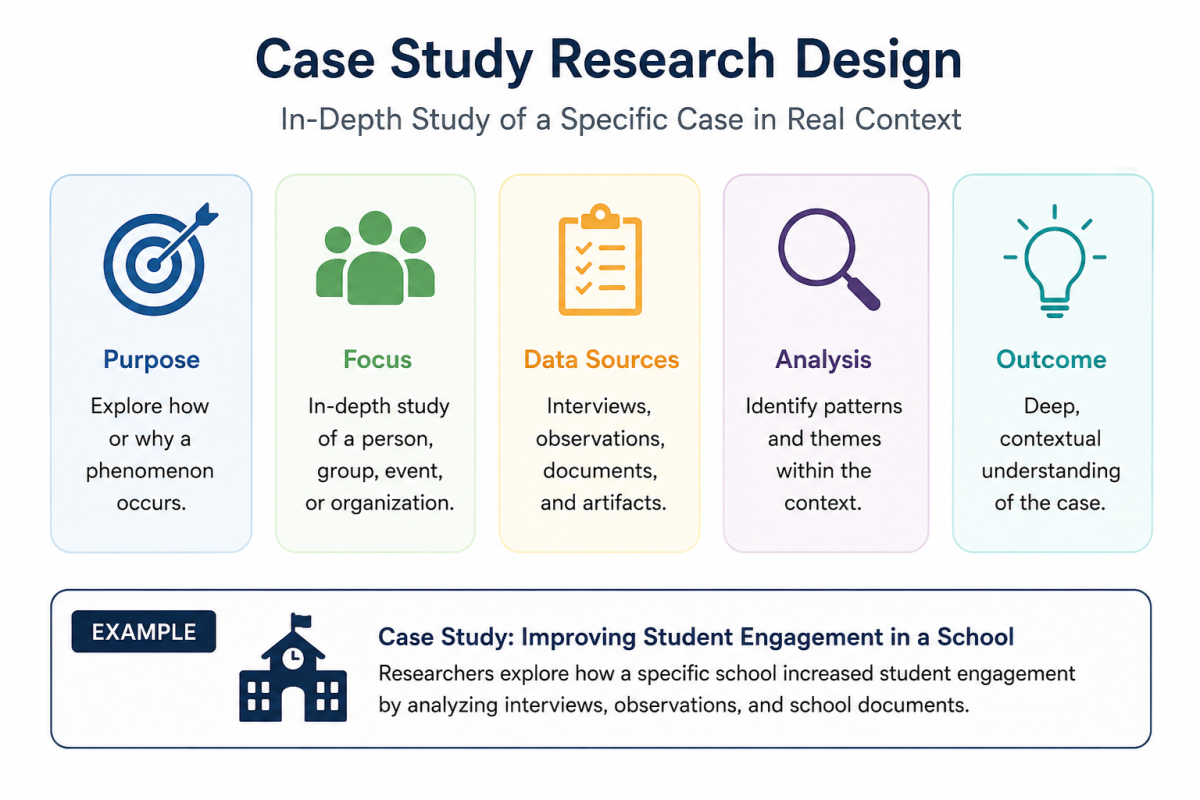
How To Conduct a Case Study Research Design In 4 Easy Steps?
Conducting case study research doesn’t have to be overwhelming. Below are four practical steps to help you design a case study that is rigorous, credible, and insightful.
Step 1: Define the Research Question and Select the Case
- Start with a clear, focused research question — ideally a “how” or “why” question, since these are best suited to the depth that case study research design offers.
- Decide whether you need a single case study or multiple case studies. A single case is ideal when you’re studying something rare, extreme, or highly revelatory. Multiple case studies, on the other hand, allow you to compare findings across cases, strengthening the reliability of your conclusions.
- Case selection should be purposeful, not random. Choose a case (or cases) that will give you the richest insight into your phenomenon of interest. Consider whether you need an exploratory case, a descriptive case, or an explanatory case, as this will shape how you approach the rest of the study.
- Determine your unit of analysis clearly at this stage — is it an individual, a team, an organization, or an event? This decision anchors the rest of your research design.
Step 2: Choose Your Case Study Methodology and Design Type
- Decide on the specific case study methodology you’ll follow. Common types of case studies include:
- Intrinsic case studies — conducted because the case itself is of unique interest.
- Instrumental case study — used to gain insight into a broader issue, with the case serving as a tool for understanding.
- Collective or multiple case studies — used to compare and contrast findings across several cases.
- Consider whether a mixed methods case study approach fits your purpose of the study. Combining qualitative and quantitative data can add depth and validity, especially in information systems research or clinical case studies where numerical data (like performance metrics) complements narrative insight.
- Outline your data collection methods at this stage. Most case study research relies on multiple sources of evidence — interviews, observations, documents, archival records, and sometimes surveys — to ensure triangulation and strengthen credibility.
Step 3: Collect and Analyze Your Data
- Begin data collection, keeping detailed records (field notes, transcripts, documents) as you go. This step often takes the most time in conducting case study research, since building an accurate, in-depth understanding requires patience and multiple rounds of engagement with the case being studied.
- Use qualitative data analysis software (such as NVivo, ATLAS.ti, or MAXQDA) to help organize, code, and interpret large volumes of qualitative data. This kind of data analysis software is especially useful when working with multiple case studies, as it helps identify patterns across cases.
- Apply thematic or pattern-matching techniques during data analysis, cross-referencing your findings against your original research question to ensure everything ties back to your central inquiry.
- If your study involves quantitative data, run the appropriate statistical analysis alongside your qualitative coding, and look for points of convergence or divergence between the two data sets — a hallmark of strong mixed methods case study work.
Step 4: Interpret Findings and Write the Case Report
- Synthesize your findings into a coherent narrative that reflects the nature of the case and answers your original research question.
- Write your case report in a way that highlights both within the case findings (for single case studies) and across cases findings (for multiple case studies), depending on your research design.
- Discuss the broader implications of your findings for theory, practice, or policy, while being careful not to overstate generalizability — remember, case study research prioritizes depth within a specific context over broad statistical claims.
- Finally, reflect on the limitations of your case study approach, including any constraints in case selection, data collection, or access to stakeholder perspectives, to maintain transparency and academic rigor.
What are the Advantages and Disadvantages of Case Study Research Design in Qualitative Research Designs?
Like any research method, case study research design comes with distinct strengths and limitations. Understanding both sides helps researchers decide when this research approach is the right fit.
Advantages of Case Study Research Design
- Rich, in-depth understanding: Perhaps the biggest strength of case study research is its ability to generate a deep, nuanced understanding of the case, capturing complexities that quantitative methods often miss.
- Contextual insight: Because case study research design examines phenomena within a specific context, it allows researchers to see how environmental, social, and organizational factors shape outcomes — something a controlled experimental design cannot replicate.
- Flexibility in data sources: Case study researchers can draw from multiple sources of evidence — interviews, observations, documents, and even quantitative records — allowing for robust triangulation and a well-rounded case report.
- Useful for exploratory research: When little is known about an issue or phenomenon, an exploratory case study can help generate new hypotheses, theories, or frameworks for future study, including future quantitative research.
- Real-world relevance: Because case studies are grounded in real settings, findings often resonate strongly with practitioners and stakeholder groups, making them highly practical for fields like business, education, and healthcare (e.g., a clinical case study).
- Supports theory development and testing: An explanatory case study can help test existing theories or refine them based on real-world evidence, bridging the gap between abstract theory and practical application.
- Works well with multiple case studies for comparison: When researchers use multiple case studies, they can identify patterns, similarities, and differences across cases, strengthening the credibility and transferability of findings.
- Compatible with mixed methods: Case study research design pairs naturally with mixed methods research, allowing researchers to combine qualitative and quantitative data for a more comprehensive understanding of the case.
Disadvantages of Case Study Research Design
- Limited generalizability: Because case study research often focuses on a single case study or a small number of cases, findings may not be statistically generalizable to broader populations — a common critique from researchers trained in quantitative traditions.
- Time-intensive process: Conducting case study research typically requires extensive data collection and analysis, including multiple interviews, document reviews, and observation periods, making it more time-consuming than many quantitative methods.
- Risk of researcher bias: Since the researcher is often deeply embedded in the data collection process, there’s a risk of subjective interpretation influencing the findings, particularly in intrinsic case studies where personal interest in the case may unconsciously shape conclusions.
- Difficulty with case selection: Choosing the right case (or cases) is critical, but case selection can be challenging — a poorly chosen single case may not adequately represent the phenomenon of interest, weakening the study’s overall validity.
- Complex data management: With multiple sources of qualitative data (and sometimes quantitative data too), organizing and analyzing information can become overwhelming without the right data analysis software, especially in large multiple case studies projects.
- Challenges in replication: Unlike experimental design, where studies can often be replicated under controlled conditions, replicating a single-case study is difficult due to its deep ties to a specific context that may not exist elsewhere.
- Balancing depth and scope: Researchers conducting multiple case studies must balance the desire for depth within the case against the practical limits of studying too many cases at once, which can dilute the richness typically associated with case study research.
- Vulnerability to over-interpretation: Because case study research design relies so heavily on qualitative data and interpretation, there’s a risk of drawing conclusions that go beyond what the evidence actually supports, especially when triangulating findings from multiple sources.
Despite these limitations, the advantages of case study research design often outweigh the drawbacks — particularly when the research question calls for depth, context, and nuance rather than statistical generalization. Choosing between case study research and other research methods ultimately comes down to the purpose of the study and the nature of the research question being asked.
Examples of Case Study Research Design
To bring case study research design to life, here are practical examples across different types of case studies, illustrating how this research approach plays out in real social science research.
Example 1: Single Case Study — Organizational Change
- A researcher studying how a mid-sized company implemented a major digital transformation might use a case study to explore employee experiences, leadership decisions, and outcomes.
- This would be a single case study, focused on one organization as the unit of analysis, using data collection methods like employee interviews, internal documents, and performance metrics.
- Because the goal is to understand why the transformation succeeded or struggled, this qualifies as an explanatory case, aiming to uncover causal mechanisms within the case.
Example 2: Multiple Case Studies — Comparing Schools
- A study comparing how three different schools implemented a new curriculum would rely on multiple case studies, allowing the researcher to identify patterns across cases.
- This research design would involve conducting a qualitative case study at each school, collecting qualitative data through classroom observations, teacher interviews, and student surveys, while comparing outcomes across all three sites.
- The number of cases here strengthens the study’s credibility, since consistent findings across cases suggest more transferable insights than a single case study could provide.
Example 3: Instrumental Case Study — Public Policy Analysis
- A political scientist examining the broader issue of housing policy might select one city as an instrumental case study — not because the city itself is the focus, but because it offers valuable insight into the larger policy issue.
- Here, the selected case serves as a vehicle for understanding a bigger phenomenon of interest, illustrating how case study methodology can extend beyond the particular case to inform wider theoretical or policy discussions.
Example 4: Intrinsic Case Study — A Unique Clinical Case
- In healthcare research, a clinical case study documenting a rare medical condition in a single patient represents an intrinsic case study — the case is studied because it is inherently interesting or unusual, not necessarily to generalize findings elsewhere.
- This type of single-case study often appears in medical journals as a case report, offering an in-depth understanding of symptoms, treatment, and outcomes.
Example 5: Mixed Methods Case Study — Business Performance
- A researcher studying a startup’s growth trajectory might combine qualitative data (founder interviews, internal strategy documents) with quantitative data (sales figures, growth metrics), forming a mixed-methods case study.
- This blended research approach allows the study to capture both the numerical performance indicators and the deeper organizational story behind them — showcasing how quantitative and qualitative methods can work together within a single case study design.
Example 6: Descriptive Case Study — Community Program Evaluation
- An evaluator documenting how a community health program operates day-to-day, without necessarily testing a specific hypothesis, would be conducting a descriptive case study.
- This approach focuses on providing a thorough, accurate account of the case being studied, offering stakeholder groups a clear picture of program implementation within its specific context.
Across all these examples, one thing remains consistent: case study research design thrives when researchers commit to rigorous data collection, thoughtful case selection, and a genuine curiosity about the case being studied. Whether you’re working with a single case or multiple case studies, this research method remains one of the most powerful tools in the social science researcher’s toolkit for uncovering rich, contextual, real-world insight.
