
Causal Research Questions

Causal research questions ask whether a change in one variable produces a change in another, for example whether a new handover method reduces medication errors. They require designs that rule out other explanations, such as randomised trials or strong quasi-experiments.
This guide explains what causal research questions are, what you need to show cause, gives five steps for writing one with an example at every step, lists 20 examples, matches questions to designs and equations, works through an example and shows common mistakes.
- The idea: what makes a question causal and what evidence it needs.
- The method: five steps and 20 examples.
- The analysis: designs, equations, a worked example and mistakes.
On this page
- What are causal research questions?
- What do you need to show cause?
- Step-by-step guide to writing causal research questions
- 20 examples of causal research questions
- Designs for answering causal research questions
- Before and after: improving a causal research question
- Frequently asked questions about causal research questions
Key takeaways
- Causal research questions ask whether and by how much one variable changes another.
- Name the cause (exposure), the effect (outcome), the population and the comparison.
- Use causal designs: randomised trials, quasi-experiments or carefully controlled observational studies.
- Report the effect size with a confidence interval and discuss confounding.
What are causal research questions?
Causal questions ask about the effect of a cause.
- Focus: whether changing X changes Y.
- Typical words: effect, impact, cause, reduces, increases, leads to.
- Evidence needed: association, time order and no better alternative explanation.
- Contrast: a relationship question asks only whether variables are related; see relationship-based research questions.
- Overview: see causality for the general idea.
What do you need to show cause?
Three conditions are usually discussed.
| Condition | Meaning | Example |
|---|---|---|
| Association | The variables are related | Patients with handover training have fewer errors |
| Time order | The cause comes before the effect | Training was given before errors were counted |
| No confounding | Other explanations are ruled out | Wards were randomly assigned |
| Plausible mechanism | A reason why | Handover improves information transfer |
Step-by-step guide to writing causal research questions
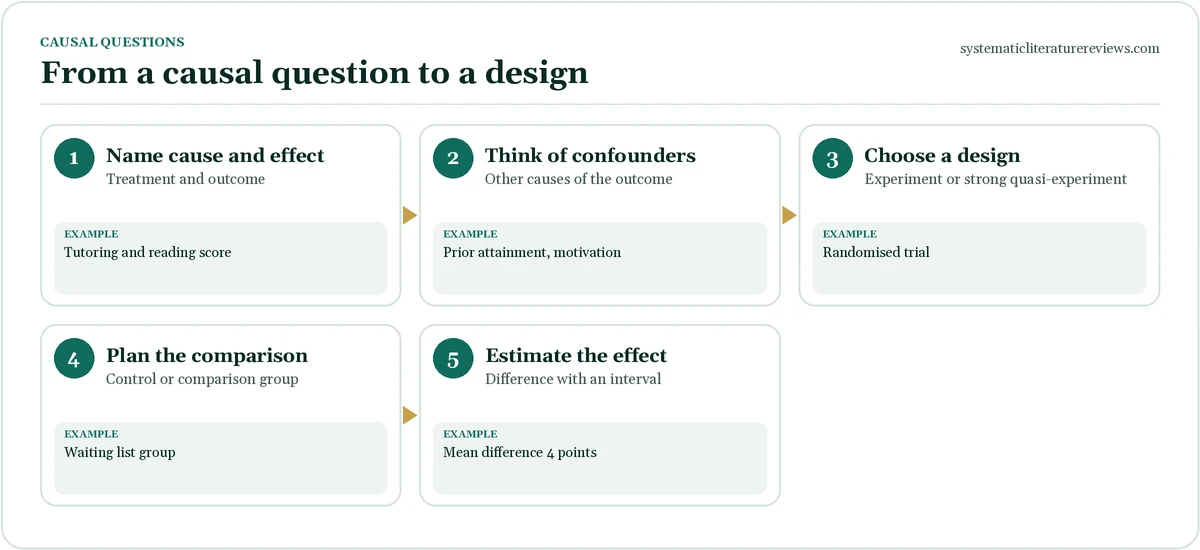
Follow these five steps. Each has an explanation and an example.
- Name the cause and the effect. Decide which variable is the exposure or intervention and which is the outcome. Define both clearly and say how they will be measured. Example: Cause: bedside handover. Effect: medication error rate.
- Name the population and the setting. Say who is studied and where. Example: Adult surgical wards in two hospitals.
- Name the comparison. A cause is judged against what would have happened otherwise. State the control or comparison condition. Example: Compared with usual handover at the nurses’ station.
- Write the question. Use effect wording with the cause, effect, population and comparison. Example: What is the effect of bedside handover, compared with usual handover, on medication error rates on adult surgical wards?
- Choose a design that can answer it. Match the question to a design that controls confounding, such as a randomised trial or a difference-in-differences study. Example: Cluster randomised trial of 20 wards.
20 examples of causal research questions
Use these as models and adapt them to your topic.
Health and nursing
- Q1: what is the effect of bedside handover on medication errors?
- Q2: does a nurse-led discharge programme reduce 30-day readmissions?
- Q3: what is the effect of hourly rounding on patient falls?
- Q4: does mindfulness training reduce stress in nursing students?
- Q5: what is the effect of a smoking cessation app on quit rates?
Education
- Q6: does a peer tutoring programme raise mathematics scores?
- Q7: what is the effect of smaller class sizes on reading attainment?
- Q8: does immediate feedback improve essay quality?
- Q9: what is the effect of a homework app on student engagement?
- Q10: does later school start time improve attendance?
Business and technology
- Q11: what is the effect of a loyalty scheme on repeat purchases?
- Q12: does a redesigned checkout page increase conversion rates?
- Q13: what is the effect of remote work on productivity?
- Q14: does security training reduce phishing click rates?
- Q15: what is the effect of code review on defect rates?
Social science and environment
- Q16: does a cash transfer programme reduce household food insecurity?
- Q17: what is the effect of a congestion charge on air pollution?
- Q18: does community policing reduce reported crime?
- Q19: what is the effect of green space on wellbeing?
- Q20: does a recycling incentive change household waste?
Designs for answering causal research questions
Stronger designs give stronger causal claims.
| Design | Idea | Strength |
|---|---|---|
| Randomised controlled trial | Random assignment to groups | Strongest |
| Cluster randomised trial | Groups such as wards are randomised | Strong, needs larger samples |
| Quasi-experiment | Groups are not randomised but compared | Moderate |
| Difference-in-differences | Compares change over time between groups | Moderate to strong |
| Regression discontinuity | Uses a cutoff for assignment | Strong near the cutoff |
| Cohort or case-control | Observational comparison with controls | Weaker, confounding risk |
For hypothesis wording see causal hypothesis.
Before and after: improving a causal research question
Compare weak and strong causal questions.
Causal research question: rewrite
Weak
Does technology help students?
Cause, effect, population and comparison are all vague.
Strong
What is the effect of a mathematics app, compared with standard homework, on Year 6 pupils’ test scores over one term?
Names the cause, comparison, effect and population.
Weak
Is exercise related to depression?
This is a relationship question, not a causal one.
Strong
What is the effect of a 12-week supervised exercise programme, compared with usual care, on depression scores in adults with mild depression?
Asks about effect and states the comparison.
Confounders and how to handle them
A confounder influences both cause and effect.
- Randomisation: balances known and unknown confounders on average.
- Matching: pair similar participants.
- Restriction: study only one group, such as one age band.
- Adjustment: include confounders in a regression model.
- Difference-in-differences: removes fixed differences between groups.
- Sensitivity analysis: test how strong a hidden confounder would need to be.
Equations for causal effects
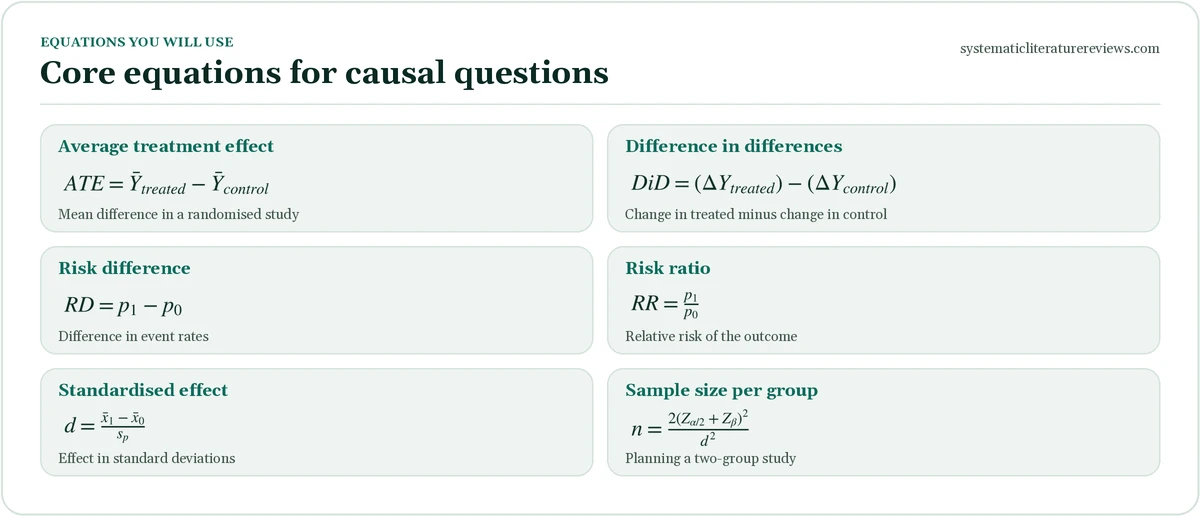
Four measures appear in most causal studies.
A worked example: bedside handover and a quality score
The data are invented to show the calculation.
- Question: what is the effect of a communication training programme on patient-rated care quality?
- Design: randomised trial with 100 nurses per group.
- Results: mean score 68.5 (trained) vs 64.2 (control); SD = 10 in each group.
- Difference: ATE = 68.5 − 64.2 = 4.3 points.
- Report: the trained group scored 4.3 points higher (95% CI 1.5 to 7.1, p = .003, d = 0.43).
- Interpretation: random assignment supports a causal reading, but check attrition and blinding.
Sample size for causal comparisons
Plan the sample before you recruit.
- Smaller effects: need larger samples.
- Clusters: multiply by a design effect when groups, such as wards, are randomised.
- Allow for loss: add 10 to 20 per cent for dropouts.
Ethical limits on causal designs
Some causes cannot be assigned.
- Harmful exposures: you cannot randomise people to smoking.
- Use observational designs: with strong adjustment.
- Equipoise: a trial is ethical only if the best treatment is unknown.
- Consent: participants must understand randomisation.
- Ethics approval: submit the design for review.
Common mistakes with causal research questions
Avoid these problems.
- Causal claims from correlational data: overclaiming. Example: use association wording or a causal design.
- No comparison group: nothing to compare with. Example: add a control.
- Vague outcomes: impact on wellbeing. Example: define and measure.
- Ignoring confounders: results are biased. Example: randomise or adjust.
- Too small a sample: effects cannot be detected. Example: calculate sample size.
See more models in sample research questions or order help.
Another example: a difference-in-differences question
Randomisation is not always possible, so quasi-experimental questions are common.
- Question: what is the effect of a new discharge programme on 30-day readmissions in two hospitals, compared with two similar hospitals?
- Design: difference-in-differences with data before and after the programme.
- Assumption: without the programme, trends would have been parallel.
- Check: compare trends before the programme.
- Result: readmissions fell by 3 percentage points more in the programme hospitals.
Threats to causal inference
Check these threats before claiming a cause.
| Threat | Meaning | Remedy |
|---|---|---|
| Selection | Groups differ at the start | Randomise or match |
| History | Other events change the outcome | Use a control group |
| Attrition | People drop out | Track and analyse by intention to treat |
| Measurement | Outcome measured differently | Use blinded assessment |
| Spillover | Control group is affected | Separate groups |
Reporting a causal result
State the effect and its limits clearly.
- Effect size: give the difference and confidence interval.
- Design: state randomisation, blinding and loss to follow-up.
- Assumptions: explain those behind a quasi-experiment.
- Limits: list threats and how you handled them.
- Use the right words: say the intervention led to or was associated with, depending on the design.
Choosing the statistical test for a causal question
The test depends on the outcome and the design.
| Outcome | Design | Test |
|---|---|---|
| Continuous | Two independent groups | t-test or regression adjusted for baseline |
| Continuous | Before and after, two groups | ANCOVA or difference-in-differences |
| Binary | Two groups | Chi-square test, risk difference, risk ratio, logistic regression |
| Time to event | Two groups | Kaplan-Meier curve and Cox regression |
| Clustered | Wards or schools randomised | Mixed model or cluster-adjusted analysis |
- Pre-register: state the primary outcome and the planned test before data collection.
Wording rules for causal research questions
Words signal the claim you are making, so choose them with care.
- Use effect words: effect, impact, reduces, increases and leads to signal a causal question and require a design to match.
- Name the comparison: compared with usual care, compared with no programme, or compared with a different dose.
- Define the outcome: state the measure and the time point, such as medication errors per 1,000 doses at six months.
- Name the population: adults on surgical wards, Year 6 pupils or small firms in one region.
- Keep one cause: if two interventions are bundled, you cannot separate their effects.
From causal question to causal hypothesis
A causal question leads to a hypothesis that can be tested.
| Question | Null hypothesis | Alternative hypothesis |
|---|---|---|
| What is the effect of bedside handover on medication errors? | H0: error rates are the same with and without bedside handover | H1: error rates differ with bedside handover |
Read more in the guide to the causal hypothesis.
Frequently asked questions about causal research questions
What are causal research questions?
Causal research questions ask whether a change in one variable produces a change in another, for example what is the effect of bedside handover on medication errors. They name the cause, the effect, the population and the comparison condition, and they need a design that rules out other explanations, such as a randomised trial, a quasi-experiment or a carefully controlled observational study. They differ from relationship questions, which ask only whether variables are associated and do not claim that one causes the other. Always state the comparison clearly in the question itself.
How do I write a causal research question?
Name the cause and the effect, define how each will be measured, and state the population and setting. Add the comparison condition, because a cause is judged against what would have happened otherwise. Then write one question, for example what is the effect of a mathematics app, compared with standard homework, on Year 6 pupils’ test scores over one term. Finally, choose a design, such as a randomised trial, that can control confounding and support a causal interpretation of the answer. Check the question with your supervisor before you design the study.
What is the difference between causal and correlational research questions?
A correlational question asks whether variables are related, and it can be answered with a survey or existing data, but it cannot show that one variable causes the other because of confounders and reverse causation. A causal question asks about the effect of a cause and needs a design that controls for other explanations, such as random assignment. The wording also differs: correlational questions use relationship or association, while causal questions use effect, impact or reduces, so choose the wording that matches your design. Match your conclusions to the strength of your design.
Which research design is best for causal questions?
A randomised controlled trial is usually the strongest design because random assignment balances known and unknown confounders on average. When randomisation is not possible, quasi-experimental designs such as difference-in-differences, regression discontinuity or matched comparisons can give reasonable causal estimates if their assumptions hold. Observational designs with careful adjustment are weaker. Choose the strongest design that is feasible and ethical, state its assumptions, report effect sizes with confidence intervals and discuss the remaining threats to a causal interpretation. Always report the limits of the design you choose openly.
Need expert help? Our experienced writers can handle the search, screening and write-up for you. Place your order in two minutes, or read how a systematic literature review works first.
Systematic Literature Reviews
Need strong research questions?
Research questions that fit your method and can be answered with your data.