
FINER Based Research Questions

FINER based research questions are questions that pass five tests: they are Feasible, Interesting, Novel, Ethical and Relevant. The FINER criteria were popularised by Hulley and colleagues in the textbook Designing Clinical Research, and they are now used in many fields to decide whether a question is worth a project.
This guide explains each criterion, gives a five-step method for testing and improving a question, shows a scoring table, lists 20 FINER example questions across fields and ends with templates, a checklist and common mistakes. FINER does not write the question for you; it tells you whether the question you have is a good one.
- The idea: what FINER stands for and how it differs from PICO.
- The method: five steps, a scoring table and 20 examples.
- The check: a checklist, templates and mistakes to avoid.
On this page
- What are the FINER criteria?
- FINER vs PICO and other question frameworks
- The five FINER criteria in detail
- Step-by-step guide to writing FINER based research questions
- A FINER scoring table you can copy
- 20 examples of FINER based research questions
- Frequently asked questions about FINER based research questions
Key takeaways
- FINER stands for Feasible, Interesting, Novel, Ethical and Relevant.
- FINER tests a question; frameworks such as PICO build one. Use both.
- Score each criterion, then revise the weakest one before you start.
- A question that fails Feasible or Ethical should be changed, however interesting it is.
What are the FINER criteria?
FINER is an acronym for five qualities of a good research question.
- Feasible: you have the time, skills, participants, data, money and access to answer it.
- Interesting: it matters to you and to people in your field, so you will stay motivated.
- Novel: it adds something: it confirms, refutes or extends what is known.
- Ethical: it can be done without unacceptable harm, and ethics committees will approve it.
- Relevant: the answer will matter to science, policy, practice or future research.
- Origin: the criteria are credited to Hulley and colleagues; see the overview of FINER criteria.
FINER vs PICO and other question frameworks
FINER and PICO do different jobs. One judges; the other builds.
| Tool | What it does | Example output |
|---|---|---|
| PICO / PICOT | Builds a structured clinical or intervention question | In adults with asthma, does an inhaler app reduce flare-ups compared with usual care? |
| PEO | Builds a question about exposure and outcome | Among nurses, is night work associated with burnout? |
| SMART objectives | Turns an aim into measurable steps | To recruit 120 nurses by March |
| FINER | Tests whether a question is worth doing | Is this feasible, interesting, novel, ethical and relevant? |
Read the guides to the PICO framework, the PEO framework and SMART objectives alongside this one.
The five FINER criteria in detail
Each criterion has its own test. Ask the question, then look for evidence.
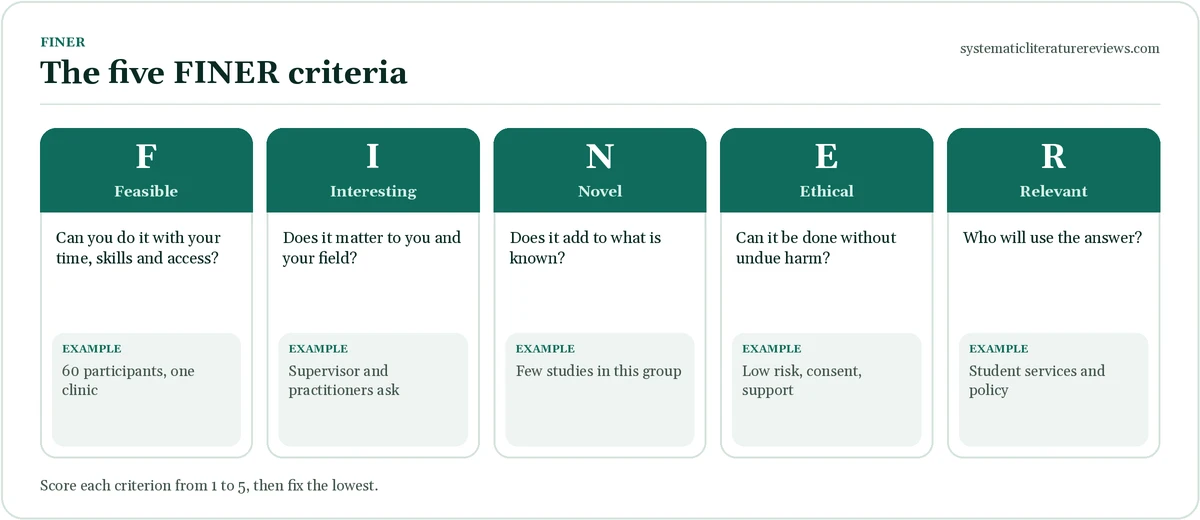
| Letter | Test question | Weak sign | Strong sign |
|---|---|---|---|
| F | Can I do this with my resources? | Needs 2,000 patients in three months | Needs 60 participants from one clinic |
| I | Do I and others care? | Topic chosen only because it was easy | Supervisor and practitioners ask about it |
| N | Is there a gap? | Many recent reviews already answer it | Few studies in this setting or group |
| E | Will an ethics committee approve? | Needs deception or high risk | Low risk with consent and support |
| R | Who will use the answer? | No clear audience | Changes practice, policy or future work |
Step-by-step guide to writing FINER based research questions
Follow these five steps. Each has an explanation and an example.
- Draft the question. Write the question in one sentence, using a framework such as PICO or PEO if it helps. Example: Does a peer mentoring programme reduce first-year dropout?
- Test feasibility. List what you need: participants, time, data, skills, money and access. Reduce the scope if you cannot meet the list. Example: One university, two cohorts, 12 months.
- Search for novelty. Run a quick search and read recent reviews. Decide whether your question confirms, extends or fills a gap. Example: Few studies in first-generation students.
- Check ethics and relevance. Ask what harm could occur, how you will manage it, and who will use the answer. Example: Low risk; student services will use the results.
- Score and revise. Rate each criterion from 1 to 5, find the lowest score and change the question to raise it. Example: Narrow the group to improve feasibility.
A FINER scoring table you can copy
Rate your question from 1 (poor) to 5 (strong). Aim for at least 3 on every row and a total of 18 or more.
| Criterion | Score (1 to 5) | Evidence | Action if low |
|---|---|---|---|
| Feasible | Resources, time, access | Narrow the scope | |
| Interesting | Supervisor and field interest | Link to a live debate | |
| Novel | Gap in recent literature | Change group, setting or method | |
| Ethical | Risks and safeguards | Change design or add safeguards | |
| Relevant | Named users of the answer | Name the audience |
20 examples of FINER based research questions
These examples pass the five tests for a small or medium project. Adapt them to your setting.
Health and nursing
- 1: Does bedside handover reduce medication errors on two surgical wards over six months?
- 2: How do night-shift nurses describe fatigue and its effect on patient safety?
- 3: Is a nurse-led telephone follow-up associated with fewer 30-day readmissions after heart failure admission?
- 4: What barriers do community nurses report when they screen older adults for loneliness?
- 5: Does a ten-minute hand hygiene prompt improve compliance among ward visitors?
Education
- 6: Does weekly formative quizzing improve end-of-term mathematics scores in Year 9 classes?
- 7: How do first-generation students describe the transition to university in their first term?
- 8: Is attendance at optional writing workshops associated with essay marks in first-year students?
- 9: What do secondary teachers say about marking workload after introducing digital feedback?
- 10: Does peer mentoring reduce first-year dropout in one faculty?
Business and technology
- 11: Is flexible working associated with job satisfaction among remote employees in small firms?
- 12: How do customers describe their experience of chatbot support in online retail?
- 13: Does a revised onboarding checklist shorten time to productivity in new software developers?
- 14: What factors do small firms report when they decide to adopt cloud accounting tools?
- 15: Is social media advertising spend associated with repeat purchases in local cafés?
Review and thesis work
- 16: What is the effect of mindfulness courses on anxiety in university students? A systematic review of randomised trials.
- 17: What outcomes do trials of telehealth for diabetes report? A scoping review.
- 18: Which statistical methods do meta-analyses of exercise and depression use for heterogeneity?
- 19: How do qualitative studies describe the experience of living with long COVID? A synthesis.
- 20: What is the association between sleep duration and academic performance in adolescents? A meta-analysis.
Before and after: improving a question with FINER
Compare a weak question with a stronger one.
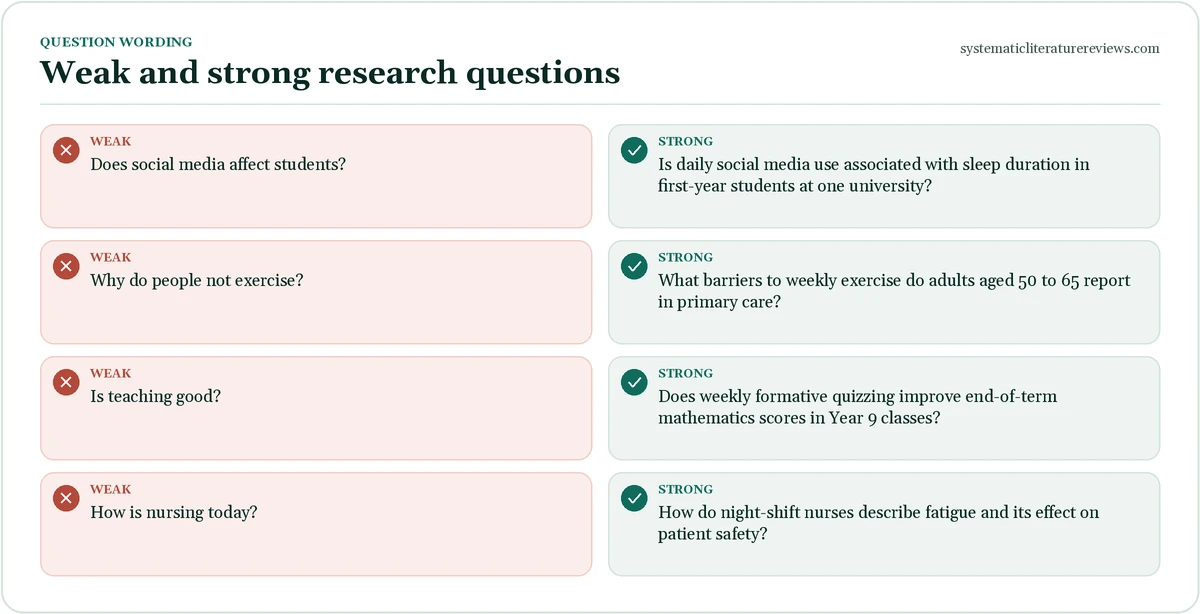
Research question: social media and students
Weak
Does social media affect students?
Not feasible, not specific, and the effect is unclear.
Strong
Is daily social media use associated with sleep duration in first-year students at one university?
Specific group, measures and setting; feasible with a survey.
Weak
Why do people not exercise?
Too broad; relevance is unclear.
Strong
What barriers to weekly exercise do adults aged 50 to 65 report in primary care?
Defines the group, the behaviour and the setting.
- What changed: each question now names a group, a variable and a place.
- Why it works: a supervisor can judge whether it is feasible, new and ethical.
Testing feasibility in more detail
Most weak questions fail here, so spend time on it.
- Participants: how many can you reach, and how many will agree to take part?
- Time: can you recruit, collect data and analyse within your deadline?
- Skills: do you know the method, or can you learn it in time?
- Data: do the records, scales or databases you need exist and are accessible?
- Money: do you need licences, travel or equipment?
- Pilot: run a small pilot or a quick search to test your assumptions.
Testing novelty and relevance
A question can be feasible and still add nothing.
- Search recent reviews: if three reviews from the last two years answer it, change the group, setting or method.
- Name the gap: write one sentence: previous work has studied X, but not Y.
- Replication: a close replication can still be novel if the setting or the sample differs and the result is needed.
- Relevance: name the user: practitioners, managers, policymakers or other researchers.
- Link to priorities: check research priority lists from your field or funder.
For literature searching, see the guide to the literature search strategy.
Testing ethics
An ethics committee will ask about risk, consent, privacy and fairness.
- Risk: what harm, distress or inconvenience could participants experience?
- Consent: how will you provide information and gain voluntary agreement?
- Privacy: how will you protect and store personal data?
- Fairness: are you including and excluding groups for good reasons?
- Benefit: is the possible benefit proportionate to the burden?
Tools and templates for FINER based questions
A template keeps each question complete.
Template
[Population] [intervention, exposure or phenomenon] [outcome or experience] in [setting] over [time]?
- Scoring sheet: copy the table above into a spreadsheet and score each draft.
- Supervisor review: ask your supervisor to score the same question and compare.
- Protocol: keep the final question and scores in your project log.
Common mistakes with FINER based research questions
Avoid these problems.
- Scoring without evidence: you rate everything 5. Example: write a sentence of evidence for each criterion.
- Ignoring feasibility: the project stalls. Example: reduce the group or the setting.
- Treating novelty as everything: you chase a gap that nobody needs. Example: check relevance as well.
- Leaving ethics to the end: the design must be changed late. Example: test ethics at the start.
- Using FINER as a framework: it does not build the question. Example: combine it with PICO or PEO.
Pair FINER with sample research questions and relationship-based research questions.
FINER checklist
Run your question through these checks.
- Feasible: can I finish with my time, skills and access?
- Interesting: do I care, and does my supervisor?
- Novel: have I named the gap in one sentence?
- Ethical: would a committee approve the design?
- Relevant: can I name who will use the answer?
- Clear: is it one sentence with a group, a variable and a setting?
Frequently asked questions about FINER based research questions
What are FINER based research questions?
FINER based research questions are questions that have been tested against five criteria: Feasible, Interesting, Novel, Ethical and Relevant. A feasible question can be answered with the time, skills, participants and money you have. An interesting question matters to you and to your field. A novel question adds to the evidence. An ethical question can be done without unacceptable harm. A relevant question will be used by practitioners, policymakers or other researchers. FINER does not write the question; it tells you whether a draft is worth carrying out.
What is the difference between FINER and PICO?
PICO builds a question. It breaks a clinical or intervention question into Population, Intervention, Comparison and Outcome, so that the question is precise and searchable. FINER judges a question. It asks whether the finished question is feasible, interesting, novel, ethical and relevant. Most researchers use both: write the question with PICO or PEO, then test it with FINER and revise the weakest criterion. A question can be perfectly structured by PICO and still fail FINER, for example if it needs more participants than you can recruit.
How do I score the FINER criteria?
Rate each criterion from 1 (poor) to 5 (strong), write one sentence of evidence for each rating, and look for the lowest score. For example, if feasibility scores 2 because you need 400 participants, reduce the scope to one site or use existing data. There is no official pass mark, but many people aim for at least 3 on every criterion. Use the score to compare drafts of the same question and to discuss them with your supervisor, not to compare projects that differ in size or field.
Can FINER be used for qualitative and review questions?
Yes. The criteria apply to any research question. For a qualitative study, feasibility means access to participants and time for interviews, novelty means a new group or setting, and ethics means consent and care for sensitive topics. For a systematic or scoping review, feasibility means the volume of literature you can screen, novelty means no recent review answers the same question, and relevance means that the answer will guide practice or future research. Check existing reviews first, then register the final question in your protocol.
Need expert help? Our experienced writers can handle the search, screening and write-up for you. Place your order in two minutes, or read how a systematic literature review works first.
Systematic Literature Reviews
Need strong research questions?
Research questions that fit your method and can be answered with your data.