
PIRD Framework: Population, Index Test, Reference Test, Diagnosis

The PIRD framework is a four-part structure for writing the question of a diagnostic test accuracy review: Population, Index test, Reference test and Diagnosis of interest. PICO does not fit these reviews, because there is no treatment and no comparison group. Instead, you compare the test you are studying, the index test, against the best available way to know the truth, the reference test. PIRD appears, for example, in guidance for diagnostic test accuracy reviews from the Joanna Briggs Institute.
This guide explains each PIRD element, gives a six-step method with an example at every step, works through a 2 by 2 table with sensitivity and specificity, shows how to build the search and set eligibility criteria, and compares PIRD with PICO and PICOS.
- The elements: Population, Index test, Reference test and Diagnosis explained.
- The method: six steps and a worked 2 by 2 example.
- The choice: when PIRD fits and when another framework is better.
On this page
- What is the PIRD framework?
- The PIRD framework elements
- Step-by-step guide to using the PIRD framework
- PIRD framework examples across fields
- Turning the PIRD framework into a search strategy
- From the PIRD framework to inclusion and exclusion criteria
- Frequently asked questions about the PIRD framework
Key takeaways
- PIRD stands for Population, Index test, Reference test and Diagnosis of interest.
- It is for questions about how accurately a test identifies a condition, not about treatment.
- Accuracy is measured with sensitivity, specificity, predictive values and likelihood ratios.
- The reference test is the best available standard for the condition; the index test is the one under study.
What is the PIRD framework?
A diagnostic question names who is tested, what test is studied, what it is checked against and which condition it should find.
- Definition: PIRD stands for Population, Index test, Reference test and Diagnosis of interest.
- Why not PICO: a diagnostic study compares a test with a reference standard, not an intervention with a control.
- Typical outcomes: sensitivity, specificity, predictive values and likelihood ratios.
- Where it is used: medicine, nursing, laboratory science, radiology and screening programmes.
The PIRD framework elements
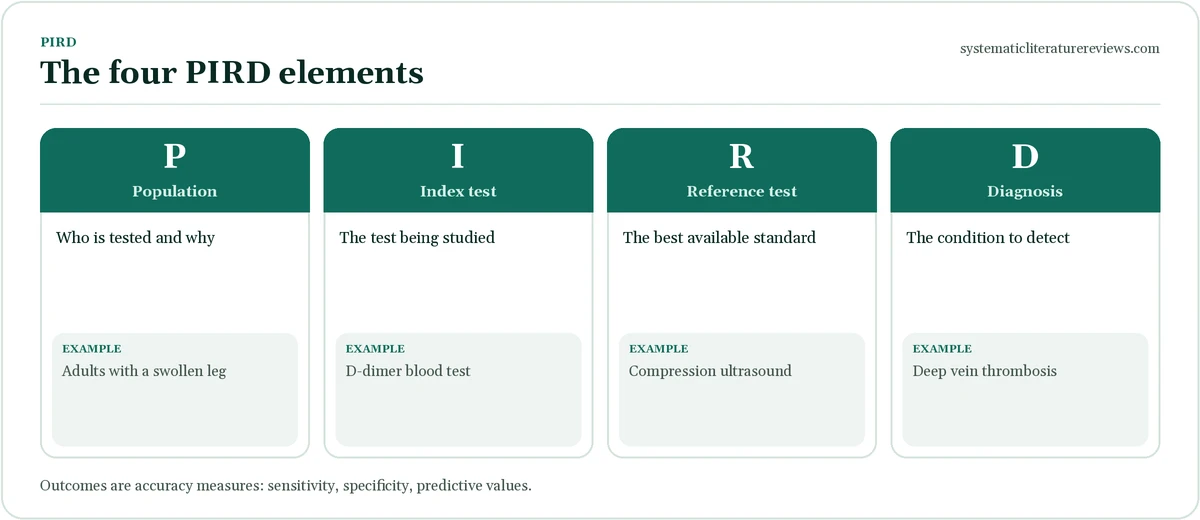
Each element answers one question about your study.
- P: Population: the people who are tested, with the setting and the reason for testing. Example: adults with suspected deep vein thrombosis in emergency departments.
- I: Index test: the test whose accuracy you want to know, including cut-offs. Example: D-dimer blood test at a set cut-off.
- R: Reference test: the best available way of knowing whether the condition is present. Example: compression ultrasound with follow-up.
- D: Diagnosis of interest: the target condition that the test should detect. Example: deep vein thrombosis of the leg.
If you are comparing two treatments, use PICO. PIRD is only for test accuracy.
Step-by-step guide to using the PIRD framework
These steps take you from a general interest to a precise question and a search you can run.
- Start with the problem. Write one plain sentence about the clinical need. Example: Can a blood test rule out leg vein clots quickly in the emergency department?
- Define the Population. State who is tested and why, including the setting. Example: Adults presenting to emergency departments with a suspected deep vein thrombosis.
- Name the Index test. State the test and any thresholds. Example: D-dimer at the manufacturer’s cut-off.
- Name the Reference test. Choose the best available standard and say how it is applied. Example: Compression ultrasound with three-month follow-up.
- Define the Diagnosis of interest. Name the condition the test should detect. Example: Deep vein thrombosis.
- Write the question and the outcomes. Combine the parts and name the accuracy measures. Example: In adults with suspected deep vein thrombosis, what is the sensitivity and specificity of D-dimer compared with ultrasound?
PIRD framework examples across fields
The table shows how the framework adapts to different disciplines. Each row becomes one question.
| Field | Population | Index test | Reference test | Diagnosis |
|---|---|---|---|---|
| Emergency care | Adults with a swollen leg | D-dimer | Compression ultrasound | Deep vein thrombosis |
| Cardiology | Adults with chest pain | High-sensitivity troponin | Final clinical diagnosis | Myocardial infarction |
| Public health | Pregnant women | Rapid syphilis test | Laboratory confirmation | Syphilis |
| Paediatrics | Children with cough | Pulse oximetry | Chest X-ray | Pneumonia |
| Mental health | Adults in primary care | PHQ-9 questionnaire | Structured clinical interview | Major depression |
Each row becomes a question about the accuracy of one test for one condition.
Turning the PIRD framework into a search strategy
List synonyms for each element, join them with OR, then join the blocks with AND.
- Population block: (adult* OR patient*) AND (“suspected thrombosis” OR “swollen leg”)
- Index test block: (“D-dimer” OR “d dimer” OR “fibrin degradation”)
- Target condition block: (“deep vein thrombosis” OR DVT OR “venous thromboembolism”)
- Accuracy block: (sensitivity OR specificity OR accuracy OR “predictive value”) — use with care
- Combine: join the blocks with AND and record the date and results.
Search on the index test and the target condition. Accuracy terms are used inconsistently, so avoid relying on them. See the guides to the literature search strategy and Boolean operators.
From the PIRD framework to inclusion and exclusion criteria
Each element becomes an eligibility rule, written before you screen.
- Population: adults with a suspected deep vein thrombosis. Example: Exclude people with a known diagnosis.
- Index test: D-dimer, any assay, with the cut-off reported. Example: Exclude tests with no threshold.
- Reference test: ultrasound or venography, with or without follow-up. Example: Exclude studies with no reference test.
- Diagnosis: deep vein thrombosis. Example: Exclude other conditions.
- Data: enough data to build a 2 by 2 table. Example: Exclude studies that report only correlation.
The guide to inclusion and exclusion criteria explains how to justify each rule.
PIRD framework vs other question frameworks
Pick the framework that matches the kind of question you ask.
| Framework | Elements | Best for |
|---|---|---|
| PIRD | Population, Index test, Reference test, Diagnosis | Diagnostic accuracy reviews |
| PICO | Population, Intervention, Comparison, Outcome | Treatment effectiveness |
| PICOS | PICO plus Study design | Reviews limiting designs |
| PEO | Population, Exposure, Outcome | Risk factors and experiences |
| PICOT | PICO plus Time | Clinical questions with follow-up |
PIRD is the right choice only for accuracy questions. For prognosis or risk questions, use PEO or PICOT.
Worked example: a 2 by 2 table
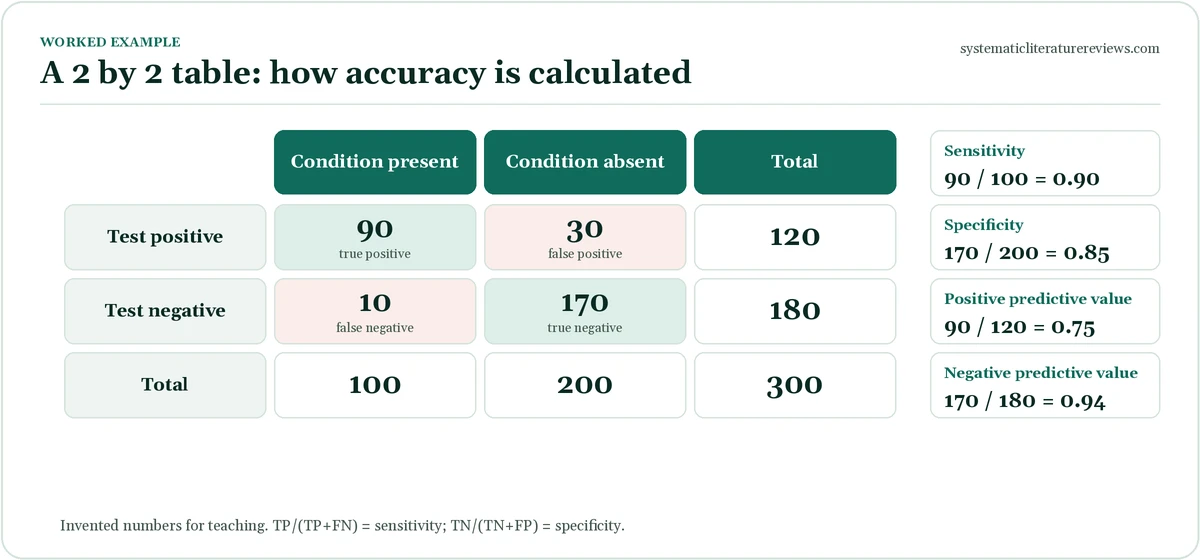
Accuracy studies report counts in a 2 by 2 table that compares the index test with the reference test. The numbers below are invented for teaching.
| Condition present | Condition absent | Total | |
|---|---|---|---|
| Test positive | 90 (true positive) | 30 (false positive) | 120 |
| Test negative | 10 (false negative) | 170 (true negative) | 180 |
| Total | 100 | 200 | 300 |
- Sensitivity: 90 / 100 = 0.90: 90% of people with the condition test positive.
- Specificity: 170 / 200 = 0.85: 85% of people without the condition test negative.
- Positive predictive value: 90 / 120 = 0.75.
- Negative predictive value: 170 / 180 = 0.94.
- Likelihood ratios: positive 0.90 / 0.15 = 6.0 and negative 0.10 / 0.85 = 0.12.
Quality and reporting in diagnostic reviews
Accuracy reviews have their own tools.
- Risk of bias: the QUADAS-2 tool assesses patient selection, index test, reference standard and flow and timing.
- Primary study reporting: the STARD statement guides reports of accuracy studies.
- Review reporting: PRISMA has an extension for diagnostic test accuracy reviews.
- Synthesis: bivariate or hierarchical models pool sensitivity and specificity together.
- Heterogeneity: threshold effects are common; study the cut-offs.
For general methods, see our guides to what is a meta-analysis and the EQUATOR Network.
When to choose PIRD
Use PIRD when the main question is how well a test performs.
- Screening and diagnosis: questions about finding a condition.
- Comparing tests: run one question per index test, or include several index tests.
- Not for treatment: use PICO.
- Not for prognosis: use a prognosis framework or PEO.
Check the finished question with the FINER criteria.
Weak and strong PIRD questions
Compare vague questions with focused ones.
PIRD question: tests and conditions
Weak
Is the test good?
No population, test, reference or condition.
Strong
In adults with suspected deep vein thrombosis, what is the sensitivity and specificity of D-dimer compared with compression ultrasound?
Names all four PIRD elements and the accuracy measures.
Weak
Does screening help?
A treatment question, not an accuracy question.
Strong
In adults with chest pain, how accurately does high-sensitivity troponin identify myocardial infarction compared with the final clinical diagnosis?
Defines the test, the reference and the condition.
Common mistakes with the PIRD framework
Avoid these problems.
- Using PICO for a test question: there is no comparison group. Example: use PIRD.
- Weak reference test: accuracy is overestimated. Example: use the best available standard.
- Ignoring cut-offs: results cannot be compared. Example: record every threshold.
- Mixing populations: accuracy varies with disease spectrum. Example: define the setting and reason for testing.
- Relying on accuracy words in the search: records are missed. Example: search on test and condition.
PIRD framework checklist
Run your question through these checks before you search.
- Population: who is tested and why?
- Index test: the test and its cut-off named?
- Reference test: the standard defined?
- Diagnosis: the target condition named?
- Data: enough for a 2 by 2 table?
- Quality: QUADAS-2 planned?
PIRD question template
Fill in the blanks to draft your question.
Template
In [population], what is the accuracy of [index test] for [diagnosis] compared with [reference test]?
Practical tips for using the PIRD framework
These habits make the framework easier to apply.
- Define the reference first: a weak standard weakens the whole review.
- Record thresholds: extract every cut-off for the index test.
- Pilot the 2 by 2 extraction: test the data form on three studies.
- Keep a decision log: record each change, with the date and reason.
When the question is ready, see how it fits into a full systematic literature review, and plan the search with the guides to the literature search strategy and Boolean operators. For background reading, see sensitivity and specificity.
Related question frameworks
Choose the framework that matches your question, not the one you met first. This table links to every question framework in our library.
| Framework | Elements | Best for |
|---|---|---|
| PICO framework | Population, Intervention, Comparison, Outcome | Treatment and effectiveness questions |
| PICOT framework | PICO plus Time | Clinical questions with a follow-up period |
| PICOS framework | PICO plus Study design | Reviews that limit eligible study designs |
| PICOC framework | PICO plus Context | Reviews where the setting changes the answer |
| PICOTT framework | PICO plus Time and Type | Nursing and evidence-based practice questions |
| PIO framework | Population, Intervention or Interest, Outcome | Descriptive questions without a comparison |
| PEO framework | Population, Exposure, Outcome | Risk factors and experiences |
| PICo framework | Population, phenomenon of Interest, Context | Qualitative review questions |
| SPIDER framework | Sample, Phenomenon of Interest, Design, Evaluation, Research type | Qualitative and mixed-methods evidence |
| SPICE framework | Setting, Perspective, Intervention or Interest, Comparison, Evaluation | Service and social science reviews |
| PCC framework | Population, Concept, Context | Scoping reviews |
| CIMO framework | Context, Intervention, Mechanisms, Outcomes | Management and organisational research |
| ECLIPSE framework | Expectation, Client group, Location, Impact, Professionals, Service | Health service and policy questions |
| CLIP framework | Client group, Location, Improvement or Innovation, Professionals | Short service and policy searches |
| BeHEMoTh framework | Behaviour, Health context, Exclusions, Models or Theories | Searching for theory in reviews |
To test a finished question, use the FINER criteria, and for example questions see sample research questions.
Frequently asked questions about the PIRD framework
What does PIRD stand for?
PIRD stands for Population, Index test, Reference test and Diagnosis of interest. It is a framework for writing the question of a diagnostic test accuracy review. The Population is the group of people who are tested, the Index test is the test under study, the Reference test is the best available way to know whether the condition is present, and the Diagnosis is the target condition. For example: in adults with suspected deep vein thrombosis, how accurate is D-dimer compared with ultrasound?
Why not use PICO for diagnostic accuracy?
PICO is built for interventions: you compare a treatment with an alternative and measure an outcome. A diagnostic accuracy study compares a test with a reference standard in the same people and reports how often the test is right. There is no intervention group and no comparison group in that sense, and the outcomes are sensitivity, specificity and related measures. PIRD gives each of these parts a name, which makes the search, the eligibility criteria and the data extraction clearer.
What are sensitivity and specificity?
Sensitivity is the proportion of people with the condition who test positive: true positives divided by all people with the condition. Specificity is the proportion of people without the condition who test negative: true negatives divided by all people without the condition. A very sensitive test is good for ruling a condition out, and a very specific test is good for ruling it in. Positive and negative predictive values depend on how common the condition is in the tested group.
How do I assess the quality of a diagnostic accuracy study?
Use a tool designed for these studies, most commonly QUADAS-2. It examines four areas: how patients were selected, how the index test was conducted and interpreted, how the reference standard was applied, and the flow and timing of testing. Each area is rated for risk of bias, and the first three are also rated for concerns about applicability to your question. Report the ratings in a table or figure, and consider them when you interpret the pooled results.
Need expert help? Our experienced writers can handle the search, screening and write-up for you. Place your order in two minutes, or read how a systematic literature review works first.
Systematic Literature Reviews
Need help framing your research question?
Get a PICO, SPIDER, SPICE or PCC question and matching search strategy from experienced review writers.