
BeHEMoTh Framework: Behaviour, Health Context, Exclusions, Models or Theories

The BeHEMoTh framework is a four-part structure for searching for theory to inform a systematic review: Behaviour of interest, Health context, Exclusions, and Models or Theories. It was proposed by Booth and Carroll in 2015 for reviewers who need to find the theories that explain a behaviour before they search for studies of an intervention. Unlike PICO, it does not describe a study question. It describes a search for ideas.
This guide explains each BeHEMoTh element, gives a six-step method with an example at every step, shows how to build a search for theory, lists common behaviour theories, and compares BeHEMoTh with PICO, CIMO and SPIDER.
- The elements: Behaviour, Health context, Exclusions, and Models or Theories explained.
- The method: six steps and a search for theory.
- The choice: when to look for theory and which framework to combine it with.
On this page
- What is the BeHEMoTh framework?
- The BeHEMoTh framework elements
- Step-by-step guide to using the BeHEMoTh framework
- BeHEMoTh framework examples across fields
- Turning the BeHEMoTh framework into a search strategy
- From the BeHEMoTh framework to inclusion and exclusion criteria
- Frequently asked questions about the BEHEMOTH framework
Key takeaways
- BeHEMoTh stands for Behaviour of interest, Health context, Exclusions, and Models or Theories.
- It is a framework for finding theory, not for framing an effectiveness question.
- Theory helps you explain why an intervention works and design a better one.
- Combine BeHEMoTh with PICO or CIMO: first find the theory, then search for studies.
What is the BeHEMoTh framework?
A BeHEMoTh search names the behaviour, the health setting, what to leave out and the kind of theory you want.
- Definition: BeHEMoTh stands for Behaviour of interest, Health context, Exclusions, and Models or Theories.
- Origin: Booth and Carroll proposed it in 2015 for systematic searching for theory.
- Purpose: to find models and theories that explain a behaviour, so that a review or an intervention rests on explanation.
- Where it is used: health psychology, public health, nursing and behaviour change reviews.
The BeHEMoTh framework elements
Each element answers one question about your study.
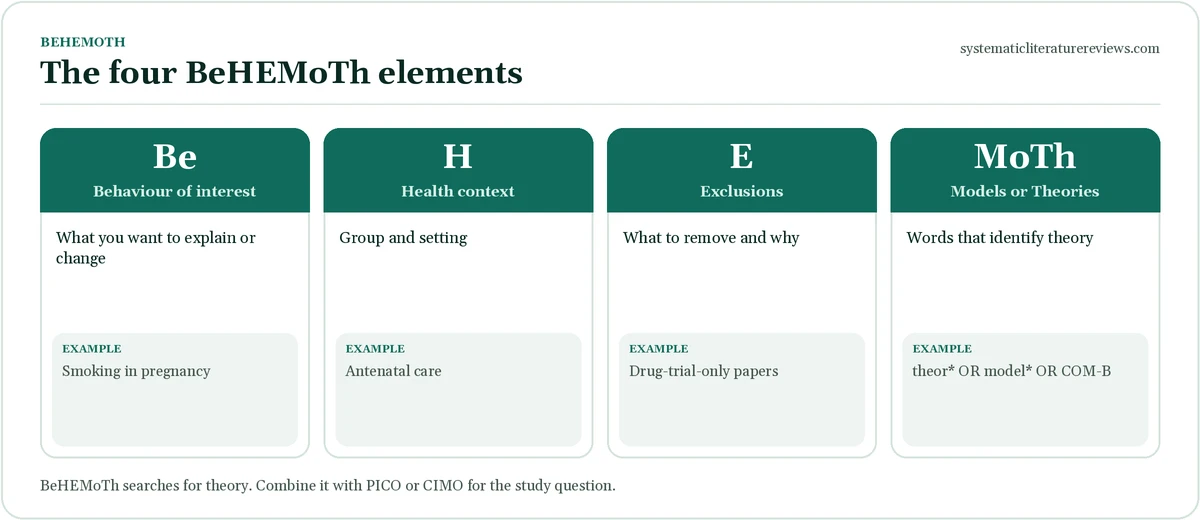
- Be: Behaviour of interest: the behaviour or practice you want to explain or change. Example: smoking cessation.
- H: Health context: the population, condition or setting. Example: pregnant women in antenatal care.
- E: Exclusions: what you want to remove to keep the search focused, such as study types or topics. Example: trial reports and drug-only studies.
- MoTh: Models or Theories: the words that identify theory, such as model, theory or framework, or the names of specific theories. Example: theor* OR model* OR framework*.
Exclusions are applied with care. Removing records can hide useful papers, so test the effect on known articles.
Step-by-step guide to using the BeHEMoTh framework
These steps take you from a general interest to a precise question and a search you can run.
- Start with the problem. Write one plain sentence about the behaviour you want to understand. Example: Why do some pregnant women keep smoking despite advice?
- Define the Behaviour. Name the behaviour precisely. Example: Smoking during pregnancy and quitting.
- Define the Health context. Name the group and setting. Example: Pregnant women in antenatal care.
- Decide the Exclusions. Choose what to remove, and why. Example: Studies that only report drug trial results.
- Add Models or Theories terms. List general words and specific theories you expect. Example: theor* OR model* OR “theory of planned behaviour” OR “COM-B”.
- Write the search question and run it. State what you want to find, then run the search and read the first results. Example: Which theories and models have been used to explain smoking in pregnancy?
BeHEMoTh framework examples across fields
The table shows how the framework adapts to different disciplines. Each row becomes one question.
| Field | Behaviour | Health context | Models or Theories |
|---|---|---|---|
| Public health | Smoking cessation | Pregnancy | Theory of planned behaviour |
| Nursing | Hand hygiene | Hospital wards | Health belief model |
| Chronic disease | Medication adherence | Type 2 diabetes | COM-B model |
| Mental health | Help-seeking | Young adults | Stages of change model |
| Education | Physical activity | Schools | Self-determination theory |
Each row is a request for the theories that explain a behaviour in a setting.
Turning the BeHEMoTh framework into a search strategy
List synonyms for each element, join them with OR, then join the blocks with AND.
- Behaviour block: (smok* OR “tobacco use” OR cessation OR quit*)
- Health context block: (pregnan* OR antenatal OR prenatal)
- Exclusions: NOT (randomi?ed controlled trial) — apply with care
- Models or Theories block: (theor* OR model* OR framework* OR “planned behaviour” OR “COM-B”)
- Combine: join the blocks with AND; use NOT sparingly; record the date and results.
The theory words are the heart of the search. Test the search on a few known theory papers. See the guides to the literature search strategy and Boolean operators.
From the BeHEMoTh framework to inclusion and exclusion criteria
Each element becomes an eligibility rule, written before you screen.
- Behaviour: papers about smoking or quitting. Example: Exclude other behaviours.
- Health context: pregnant women or antenatal care. Example: Exclude general adult smoking.
- Exclusions: trial reports with no theory. Example: Exclude papers with no theoretical content.
- Models or Theories: papers that name, test or develop a theory or model. Example: Exclude papers that only mention theory in passing.
- Design: any design, because theory appears in qualitative, quantitative and review studies.
The guide to inclusion and exclusion criteria explains how to justify each rule.
BeHEMoTh framework vs other question frameworks
Pick the framework that matches the kind of question you ask.
| Framework | Elements | Best for |
|---|---|---|
| BeHEMoTh | Behaviour, Health context, Exclusions, Models or Theories | Searching for theory |
| CIMO | Context, Intervention, Mechanisms, Outcomes | Why an intervention works |
| PICO | Population, Intervention, Comparison, Outcome | Treatment effectiveness |
| SPIDER | Sample, Phenomenon of Interest, Design, Evaluation, Research type | Qualitative evidence |
| PICo | Population, phenomenon of Interest, Context | Qualitative review questions |
BeHEMoTh finds theory; the other frameworks frame the study question. Use them together: first the theory, then PICO or CIMO for the intervention.
Common theories and models found with BeHEMoTh
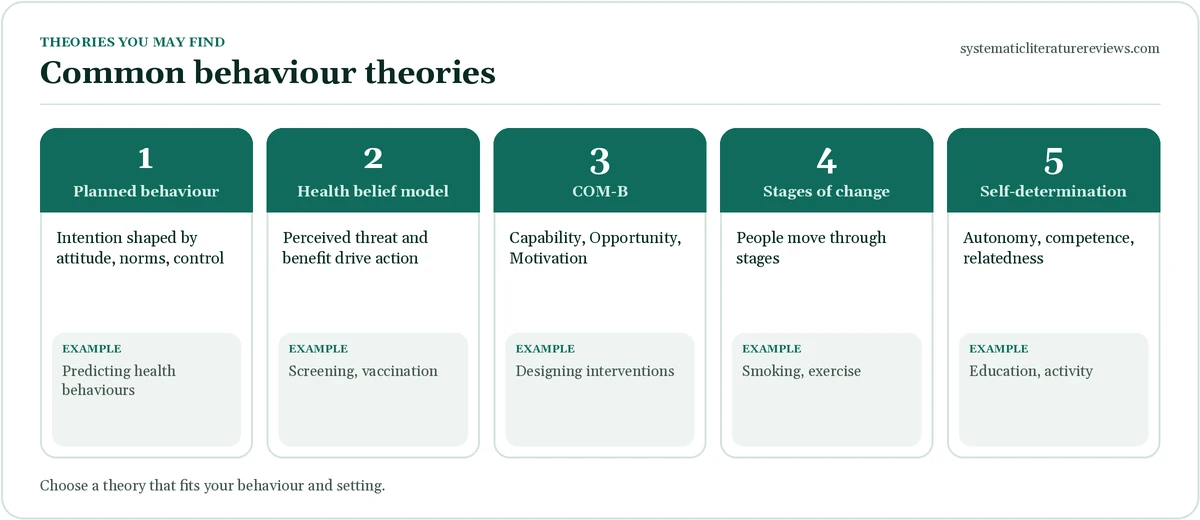
These examples show what a search may return. Choose a theory that fits your behaviour and setting.
| Theory or model | Main idea | Typical use |
|---|---|---|
| Theory of planned behaviour | Intention is shaped by attitudes, norms and perceived control | Predicting health behaviours |
| Health belief model | Perceived threat and benefits drive action | Screening and vaccination |
| COM-B model | Capability, Opportunity and Motivation produce Behaviour | Designing behaviour change interventions |
| Transtheoretical model | People move through stages of change | Smoking and exercise |
| Self-determination theory | Autonomy, competence and relatedness support motivation | Education and physical activity |
The Mechanisms in a CIMO question often come from theories like these.
What to do with the theories you find
A theory is useful only if you use it.
- Map: list the constructs of each theory in a table.
- Select: choose the theory that best explains your behaviour and setting.
- Frame: use its constructs to organise data extraction and synthesis.
- Design: use it to describe how an intervention should work.
- Report: state how the theory shaped the review and its findings.
For qualitative evidence, see the PICo framework and SPIDER.
When to choose BeHEMoTh
Use BeHEMoTh when you need explanation, not only effect.
- Complex interventions: where behaviour change is the aim.
- Theory-led reviews: you want to base the review on theory.
- Qualitative synthesis: where theory organises the themes.
- Not a question framework: add PICO, CIMO or SPIDER for the study question.
Check the finished question with the FINER criteria.
Weak and strong BeHEMoTh questions
Compare vague questions with focused ones.
BeHEMoTh question: behaviours and theory
Weak
What theories explain smoking?
No behaviour setting or search structure.
Strong
Which theories and models have been used to explain smoking cessation among pregnant women in antenatal care?
Names the behaviour, the context and the theory request.
Weak
How do people change?
Too broad to search.
Strong
Which behaviour change models have been applied to hand hygiene in hospital wards?
Defines the behaviour, setting and models.
Common mistakes with the BeHEMoTh framework
Avoid these problems.
- Using BeHEMoTh as a study question: it does not name a comparison or outcome. Example: combine it with PICO or CIMO.
- Over-strict Exclusions: useful papers are removed. Example: test exclusions on known papers.
- Only general theory words: results are too broad. Example: add named theories.
- Ignoring grey literature and books: theory often appears there. Example: search beyond journals.
- Skipping the use of theory: the review stays descriptive. Example: frame extraction with theory constructs.
BeHEMoTh framework checklist
Run your question through these checks before you search.
- Behaviour: defined precisely?
- Health context: group and setting named?
- Exclusions: justified and tested?
- Models or Theories: general and named terms listed?
- Search: tested on known papers?
- Use: plan for how theory will shape the review?
BeHEMoTh question template
Fill in the blanks to draft your question.
Template
Which [models or theories] have been used to explain [behaviour] in [health context]?
Practical tips for using the BeHEMoTh framework
These habits make the framework easier to apply.
- Write it on one page: put the four elements and the question on one sheet.
- Test known papers: check that the search finds theory papers you already know.
- Search beyond health databases: use psychology and education databases too.
- Keep a decision log: record each change, with the date and reason.
When the question is ready, see how it fits into a full systematic literature review, and plan the search with the guides to the literature search strategy and Boolean operators. For background reading, see health behaviour.
Related question frameworks
Choose the framework that matches your question, not the one you met first. This table links to every question framework in our library.
| Framework | Elements | Best for |
|---|---|---|
| PICO framework | Population, Intervention, Comparison, Outcome | Treatment and effectiveness questions |
| PICOT framework | PICO plus Time | Clinical questions with a follow-up period |
| PICOS framework | PICO plus Study design | Reviews that limit eligible study designs |
| PICOC framework | PICO plus Context | Reviews where the setting changes the answer |
| PICOTT framework | PICO plus Time and Type | Nursing and evidence-based practice questions |
| PIO framework | Population, Intervention or Interest, Outcome | Descriptive questions without a comparison |
| PEO framework | Population, Exposure, Outcome | Risk factors and experiences |
| PICo framework | Population, phenomenon of Interest, Context | Qualitative review questions |
| SPIDER framework | Sample, Phenomenon of Interest, Design, Evaluation, Research type | Qualitative and mixed-methods evidence |
| SPICE framework | Setting, Perspective, Intervention or Interest, Comparison, Evaluation | Service and social science reviews |
| PCC framework | Population, Concept, Context | Scoping reviews |
| CIMO framework | Context, Intervention, Mechanisms, Outcomes | Management and organisational research |
| ECLIPSE framework | Expectation, Client group, Location, Impact, Professionals, Service | Health service and policy questions |
| CLIP framework | Client group, Location, Improvement or Innovation, Professionals | Short service and policy searches |
| PIRD framework | Population, Index test, Reference test, Diagnosis | Diagnostic accuracy reviews |
To test a finished question, use the FINER criteria, and for example questions see sample research questions.
Frequently asked questions about the BEHEMOTH framework
What does BeHEMoTh stand for?
BeHEMoTh stands for Behaviour of interest, Health context, Exclusions, and Models or Theories. It is a framework for planning a systematic search for theory. The Behaviour is what you want to understand or change, the Health context is the group and setting, the Exclusions are the records you want to remove, and the Models or Theories element contains the words that identify theory, such as theory, model or framework, or the names of specific theories. It was proposed by Booth and Carroll in 2015.
How is BeHEMoTh different from PICO?
PICO structures a question about the effect of an intervention, with a population, an intervention, a comparison and an outcome. BeHEMoTh structures a search for theory. It asks which models and theories explain a behaviour in a health setting. The results are ideas, not effect estimates. Many projects use both: BeHEMoTh to find and choose a theory, and PICO or CIMO to frame the review of intervention studies that applies it. The two frameworks answer different questions and are complementary.
Why search for theory in a review?
Theory explains why an intervention should work and for whom. It helps you choose outcomes, interpret results and design better interventions. Reviews that use theory often explain differences between studies more clearly than reviews that only list effects. Searching for theory systematically, rather than choosing a favourite model, makes the choice transparent and reduces bias. It also shows where gaps exist, for example a behaviour for which no theory has been tested in a particular setting.
What are the limits of BeHEMoTh?
Theory is not indexed consistently, so a search can miss relevant papers or return many irrelevant ones. Words such as model and framework have many meanings, and the Exclusions element can remove useful records if you apply it too strictly. Test the search on papers you already know, use specific theory names as well as general words, and search beyond health databases. Report what you did, and acknowledge that a search for theory is rarely exhaustive in the way a search for trials aims to be.
Need expert help? Our experienced writers can handle the search, screening and write-up for you. Place your order in two minutes, or read how a systematic literature review works first.
Systematic Literature Reviews
Need help framing your research question?
Get a PICO, SPIDER, SPICE or PCC question and matching search strategy from experienced review writers.