
Blog
Types of Qualitative Research Designs with Examples

What is Qualitative Research Designs?
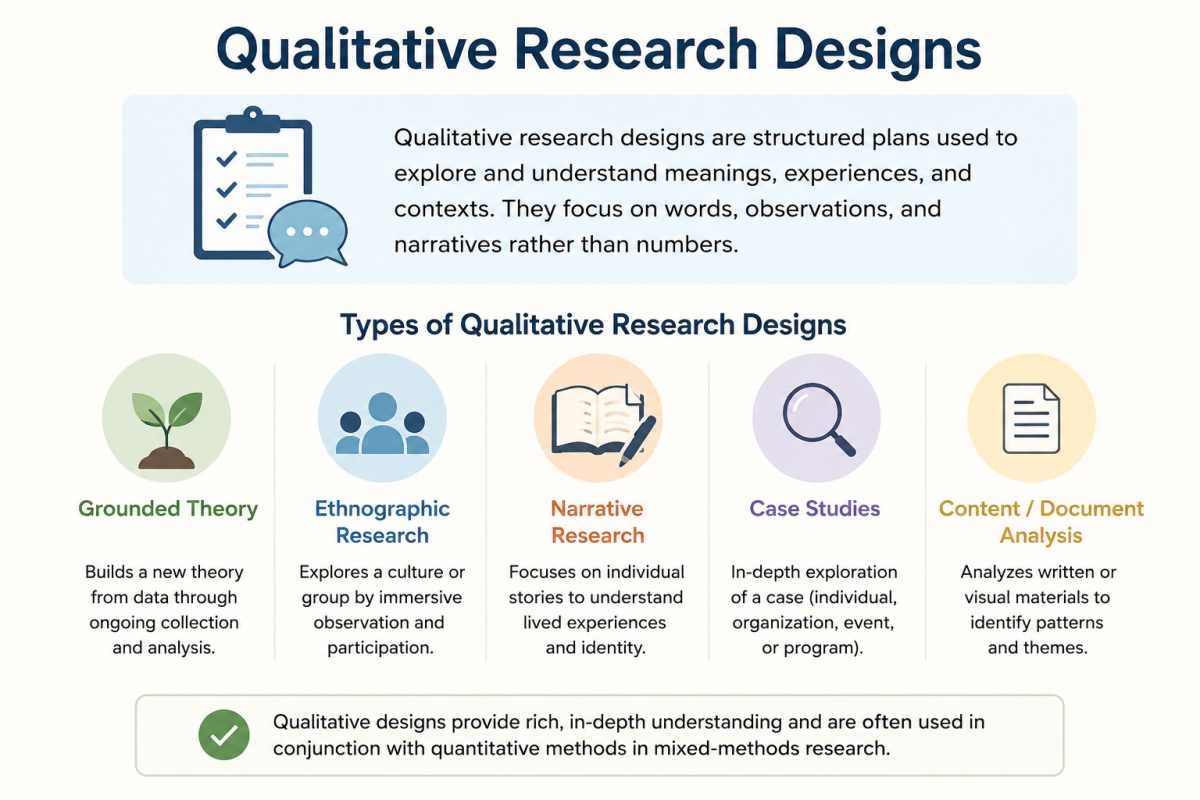
- Qualitative research designs refer to the structured plans and frameworks that guide how a study is carried out when the goal is to understand meaning, experience, and context rather than to measure numbers. In simple terms, a qualitative research design is the blueprint that tells a researcher how to collect, organize, and interpret non-numerical information in order to answer a specific research question.
- Unlike quantitative research, which relies on statistics, numbers, and measurable variables, qualitative research designs are built around words, observations, images, and narratives. This is one of the biggest differences between qualitative and quantitative research: while quantitative methods test hypotheses using numbers, qualitative methods explore the “why” and “how” behind human behavior, decisions, and social phenomena.
- At its core, a qualitative research design is a type of research that explores the depth and richness of human experience. It is less concerned with counting occurrences and more concerned with understanding the lived experience of participants, the context surrounding an event, or the meaning people attach to a particular situation.
- Qualitative research designs often involve small, purposefully selected samples rather than large random samples, because the goal is depth of understanding rather than statistical generalizability. This is why qualitative studies frequently rely on interviews, focus groups, observations, and document analysis as their primary data collection methods.
- Choosing the right qualitative research design depends heavily on the nature of the research questions being asked. A researcher exploring the culture of a community will lean toward ethnographic research, while a researcher trying to build a new theory from scratch may choose grounded theory instead.
- Qualitative research designs are inductive in nature. This means the research is inductive rather than deductive — researchers usually begin with an initial research question or a broad area of interest, then let themes and patterns emerge from the data itself rather than testing a predetermined hypothesis.
- It’s worth noting that qualitative research designs are not always used in isolation. Many studies today fall under mixed-methods research, which combines qualitative and quantitative data to provide a more complete picture. In fact, a mixed-methods study design that combines qualitative and quantitative research approaches is increasingly common in fields like health services research, education, and market research.
- Ultimately, qualitative research designs help generate hypotheses, provide context for numerical findings, and give a voice to the people or phenomena being studied. Whether used alone or as part of mixed-methods research, this type of research design remains one of the most powerful tools for understanding complex, real-world issues.
Types of Qualitative Research Designs
There are several types of qualitative research designs, each suited to different research goals, questions, and contexts. Understanding the different types of qualitative research design available will help you select the right research method for your study.
- Grounded Theory
- Grounded theory is a qualitative research design used when a researcher wants to build a new theory directly from the data, rather than testing an existing one.
- Data collection and analysis happen simultaneously, with researchers constantly comparing new data to previously collected data until no new themes emerge — a point known as theoretical saturation.
- This type of qualitative research design is especially useful in fields where little prior theory exists, such as emerging social behaviors or new organizational practices.
- Ethnographic Research
- Ethnographic research involves the researcher immersing themselves into the research setting, often living within or closely observing a community or culture over an extended period.
- The goal of ethnographic research is to understand the beliefs, practices, and social dynamics of a group from an insider’s perspective.
- Data collection methods typically include participant observation, informal interviews, and field notes, making this one of the most immersive qualitative research methods available.
- Narrative Research
- Narrative research focuses on the stories individuals tell about their lives, using these personal accounts to understand meaning, identity, and lived experience.
- This qualitative research design often involves in-depth interviews conducted over time, with researchers reconstructing a chronological account of events as experienced by the participant.
- Narrative research is particularly valuable in psychology, education, and health services research, where understanding a person’s journey provides insight that numbers alone cannot capture.
- Case Studies
- Case studies are an in-depth exploration of a single case, or a small number of cases, such as an individual, organization, event, or program.
- This type of qualitative research design allows researchers to explore complex issues within their real-world context, using multiple data collection methods including interviews, document analysis, and direct observation.
- Case studies are widely used in business, education, and health services research because they provide rich, contextual detail that broader studies often miss.
- Phenomenological Research
- Phenomenological research seeks to describe the lived experience of individuals who have gone through a particular event or phenomenon.
- Rather than explaining why something happened, this qualitative research design focuses on what the experience was like for the people involved.
- Data is typically gathered through detailed, open-ended interviews, and thematic analysis is often used to identify common threads across participants’ descriptions.
- Content Analysis and Document Analysis
- Content analysis involves systematically analyzing text, media, or other qualitative data to identify patterns, themes, or meanings.
- Document analysis, a closely related qualitative research method, involves reviewing existing documents — such as reports, policies, letters, or archival material — as a primary source of qualitative data.
- These research methods are especially useful when direct access to participants is limited, or when researchers want to understand how a topic has been represented over time.
- Historical Research
- Historical research is a type of qualitative research design that examines past events to understand their causes, context, and consequences.
- It relies heavily on document analysis, archival records, and other primary and secondary sources rather than direct interviews or observation.
- This design is valuable for tracing the development of ideas, institutions, or social movements over time.
- Focus Group Based Research
- A focus group is a qualitative research method where a small group of participants discusses a topic guided by a moderator.
- This approach allows researchers to observe group dynamics, shared opinions, and areas of disagreement, offering data collection that individual interviews might not reveal.
- Focus groups are commonly used in market research, health services research, and program evaluation because they generate rich qualitative data quickly.
- Each of these types of qualitative research design offers a different lens for exploring human experience, and the right choice depends on your research question, your research population, and your research objectives. Some studies even combine multiple qualitative research methods, or blend them with quantitative methods, to strengthen their findings.
Philosophical Assumptions of The Qualitative Research Designs
- Every qualitative research design is grounded in a set of philosophical assumptions that shape how researchers view reality, knowledge, and the research process itself. Understanding these assumptions is essential to grasping why qualitative and quantitative research differ so significantly in approach.
- Ontological Assumptions (the nature of reality)
- Qualitative researchers generally assume that reality is subjective and multiple, shaped by individual experiences and perspectives.
- This contrasts with quantitative research, which typically assumes a single, objective reality that can be measured and quantified.
- Because of this, qualitative research design allows for multiple interpretations of the same event or phenomenon, depending on who is experiencing it.
- Epistemological Assumptions (the nature of knowledge)
- Qualitative research assumes that knowledge is co-constructed between the researcher and participants, rather than existing independently and waiting to be “discovered.”
- Researchers aim to minimize distance between themselves and the subject of study, often engaging directly with participants through interviews or observation to understand their lived experience.
- This is a key reason qualitative researchers immerse themselves into the research setting rather than remaining detached observers.
- Axiological Assumptions (the role of values)
- Qualitative research design acknowledges that researcher values, background, and biases inevitably influence the research process.
- Rather than eliminating these influences, qualitative researchers are encouraged to be transparent about their positionality and how it may shape data collection and analysis.
- This is different from the quantitative research paradigm, which strives for researcher neutrality and objectivity.
- Methodological Assumptions (the research process)
- Qualitative research design assumes an inductive, flexible research process where the research question or focus may evolve as the study progresses.
- Data collection and analysis often occur simultaneously, allowing emerging themes to shape further data collection.
- This flexible research paradigm stands in contrast to quantitative studies, which typically follow a fixed, predetermined research process from start to finish.
- Understanding these philosophical assumptions helps researchers select an appropriate research method, justify their qualitative study design, and interpret research findings in a way that stays true to the underlying research paradigm guiding qualitative and quantitative research more broadly.
How To Conduct an Qualitative Research Designs In 4 Easy Steps?
Conducting qualitative research doesn’t have to be overwhelming. Following a structured research process makes it easier to stay organized while still allowing space for the flexible, exploratory nature of the research questions typical in qualitative studies.
- Step 1: Define Your Research Question and Choose a Research Design
- Every strong qualitative study begins with a clear, open-ended research question that explores a phenomenon, experience, or process rather than a simple yes/no outcome.
- Once the research question is defined, select the qualitative research design that best fits your research goals — whether that’s grounded theory for building new theory, case studies for in-depth exploration, or ethnographic research for understanding culture.
- At this stage, also consider whether your study will rely purely on qualitative data or whether it will be part of mixed-methods research that combines qualitative and quantitative data for a fuller picture.
- Step 2: Select Your Research Method and Plan Data Collection
- Choose the qualitative research methods best suited to your design, such as interviews, focus groups, observations, or document analysis.
- Identify your research population and determine an appropriate sampling strategy — qualitative research typically uses purposive or theoretical sampling rather than random sampling, since the goal is depth, not statistical representation.
- Develop your data collection tools in advance, such as interview guides or observation checklists, ensuring they align with the open-ended nature of the research questions you’re trying to answer.
- Step 3: Collect and Organize Your Qualitative Data
- Begin data collection using your chosen research method, whether that’s conducting interviews, running a focus group, or gathering documents for document analysis.
- Record data carefully — audio or video recordings, detailed field notes, and transcriptions are all common ways to preserve qualitative data collection accurately.
- Many qualitative researchers use qualitative data analysis software, such as NVivo or ATLAS.ti, to help organize large volumes of qualitative research data as it’s collected, making the later stages of data analysis far more manageable.
- Step 4: Analyze Data and Report Your Findings
- Once data collection and analysis begins, common approaches include thematic analysis, content analysis, or narrative analysis, depending on your qualitative research design.
- Thematic analysis involves identifying recurring patterns or themes across your qualitative data, while content analysis focuses on systematically categorizing and interpreting text or media.
- When reporting qualitative research, it’s best practice to follow established guidelines such as the Consolidated Criteria for Reporting Qualitative Research (COREQ), which offers standards for reporting qualitative research clearly and transparently.
- Present your research findings with supporting quotes, examples, or excerpts from your data, and be transparent about your research process, limitations, and any researcher bias that may have influenced the study.
- Finally, consider how your findings might inform future research — whether that means refining your research question further, expanding your research population, or transitioning into a mixed-methods study that adds quantitative methods to validate your qualitative findings.
- Following these four steps doesn’t mean the research process is rigid — one of the strengths of qualitative research is its adaptability. Researchers may revisit earlier steps as new insights emerge, refining their research question or adjusting their data collection methods along the way.
What are the Advantages and Disadvantages of Qualitative Research Designs?
Like any research approach, qualitative research design comes with distinct strengths and limitations. Weighing these advantages and disadvantages of qualitative research can help you decide whether it’s the right fit for your study, or whether a mixed-methods approach might serve you better.
Advantages of Qualitative Research
- Rich, in-depth understanding
- Qualitative research helps uncover the “why” behind behaviors and decisions, offering depth that quantitative data alone cannot provide.
- Because it captures lived experience directly from participants, it produces a more nuanced understanding of complex social phenomena.
- Flexibility in the research process
- Since qualitative research is inductive, researchers can adapt their research questions and data collection methods as new themes emerge, rather than being locked into a rigid research process.
- This flexibility is especially valuable for exploring new or poorly understood topics where a fixed quantitative approach might miss important context.
- Contextual and holistic insights
- Qualitative research methods like case studies and ethnographic research allow researchers to study phenomena within their natural context, capturing nuances that would be lost in a controlled, numbers-driven quantitative study.
- This makes qualitative research particularly valuable in fields like health services research, where patient experiences and social context significantly affect outcomes.
- Hypothesis generation
- One major strength of qualitative research is that qualitative research helps generate hypotheses that can later be tested using quantitative research methods.
- This makes qualitative research an excellent starting point for exploratory research, often laying the groundwork for larger-scale quantitative studies.
- Giving voice to participants
- Qualitative research methods, especially narrative research and focus groups, allow participants to express their perspectives in their own words, capturing nuance and meaning that structured surveys often miss.
- This human-centered approach strengthens the authenticity and relatability of research findings.
Disadvantages of Qualitative Research
- Limited generalizability
- Because qualitative studies typically involve small, purposefully selected samples, findings can’t always be generalized to a larger research population the way quantitative data can.
- This is a key trade-off when comparing qualitative and quantitative research — depth versus breadth.
- Time-intensive data collection and analysis
- Data collection and analysis in qualitative research, such as transcribing interviews or coding themes through thematic analysis, can be far more time-consuming than analyzing quantitative data.
- Researchers immersing themselves into the research setting, as required in ethnographic research, often need extended periods of time to gather sufficient qualitative data.
- Researcher subjectivity
- Because qualitative researchers are closely involved in data collection and interpretation, there’s a higher risk of researcher bias influencing the results.
- Transparent reporting qualitative research practices, including disclosing researcher positionality, are essential to help mitigate this risk.
- Difficulty in replication
- Unlike quantitative research, which follows standardized measurement tools, qualitative research designs are often unique to their context, making exact replication of a study difficult.
- This can make it harder to verify findings across different researchers or settings.
- Challenges with data analysis
- Analyzing qualitative data, whether through content analysis, thematic analysis, or narrative analysis, requires significant skill and can be more subjective than analyzing quantitative data.
- While qualitative data analysis software can help manage large datasets, interpretation still relies heavily on the researcher’s judgment.
- Understanding both the strengths of qualitative research and its limitations allows researchers to make informed decisions about study design — and often points toward mixed-methods research as a way to balance the depth of qualitative methods with the generalizability of quantitative methods.
Examples of Qualitative Research Designs
To better understand how qualitative research designs work in practice, here are some real-world style examples showing how different research methods are applied across various fields.
- Example 1: Grounded Theory in Workplace Studies
- A researcher studying how new employees adapt to remote work environments might use grounded theory, conducting interviews with employees across different companies.
- Instead of testing an existing theory, the researcher analyzes qualitative data collection as it comes in, allowing a new theory about remote onboarding to emerge directly from participant experiences.
- Example 2: Ethnographic Research in Cultural Studies
- A researcher interested in understanding workplace culture within a tech startup might spend several months observing daily operations, attending meetings, and conducting informal interviews.
- This ethnographic research approach allows the researcher to immerse themselves into the research environment, capturing nuances of communication style and decision-making that a survey could never reveal.
- Example 3: Narrative Research in Health Services Research
- A study exploring the lived experience of cancer survivors might use narrative research, asking participants to share their personal journeys from diagnosis through recovery.
- This qualitative research design captures rich detail about emotional, psychological, and social challenges — details that quantitative studies measuring only clinical outcomes would miss entirely.
- Example 4: Case Studies in Education Research
- A researcher evaluating a new teaching method might use case studies, focusing in depth on three classrooms over one semester.
- Data collection methods would include classroom observations, teacher interviews, and document analysis of lesson plans and student work, providing a comprehensive picture of how the method functions in a real-world context.
- Example 5: Focus Groups in Market Research
- A company launching a new product might conduct several focus groups with target customers to explore their opinions, concerns, and expectations.
- This qualitative research method generates rich qualitative data quickly, helping the company refine its product before a larger quantitative survey is deployed to a broader research population.
- Example 6: Mixed-Methods Research in Public Health
- A public health study on vaccine hesitancy might combine qualitative interviews (to understand underlying beliefs and fears) with a quantitative survey (to measure how widespread those beliefs are).
- This mixed-methods research approach that combines qualitative and quantitative data offers both the depth of personal experience and the breadth of statistical evidence, making it a powerful research approach for informing public health policy.
- These examples of qualitative research designs illustrate just how versatile this type of research can be. Whether used alone or as part of mixed-methods research, qualitative research design continues to be one of the most valuable tools available for exploring the complexity of human experience across virtually every field of study.
