
Blog
How to Conduct Grounded Theory Research Design with Example

What is Grounded Theory Research Design in Qualitative Research Designs?
- Grounded theory research design is a qualitative research methodology used to generate theory directly from data rather than testing an existing hypothesis. Instead of starting with a theory and looking for evidence to support or reject it, researchers using this approach let a theory emerge naturally through systematic data collection and analysis.
- The core idea behind grounded theory is right there in the name: the final theory is “grounded” in the data. This means every concept, category, and relationship in the theory can be traced back to the research data collected during the study, rather than being borrowed from existing theories or imposed by the researcher’s assumptions.
- Grounded theory research was first introduced by sociologists Barney Glaser and Anselm Strauss in their 1967 book, The Discovery of Grounded Theory. This discovery of grounded theory marked a turning point in social research, offering an alternative to the purely deductive methods that dominated research at the time.
- Within the broader landscape of qualitative research designs, grounded theory research stands out because it is inductive rather than deductive. While most traditional research methods begin with a research question and a hypothesis to test, grounded theory studies begin with a broad area of interest and allow the research question itself to be refined as data collection progresses.
- Here’s what makes this research method unique compared to other qualitative methods:
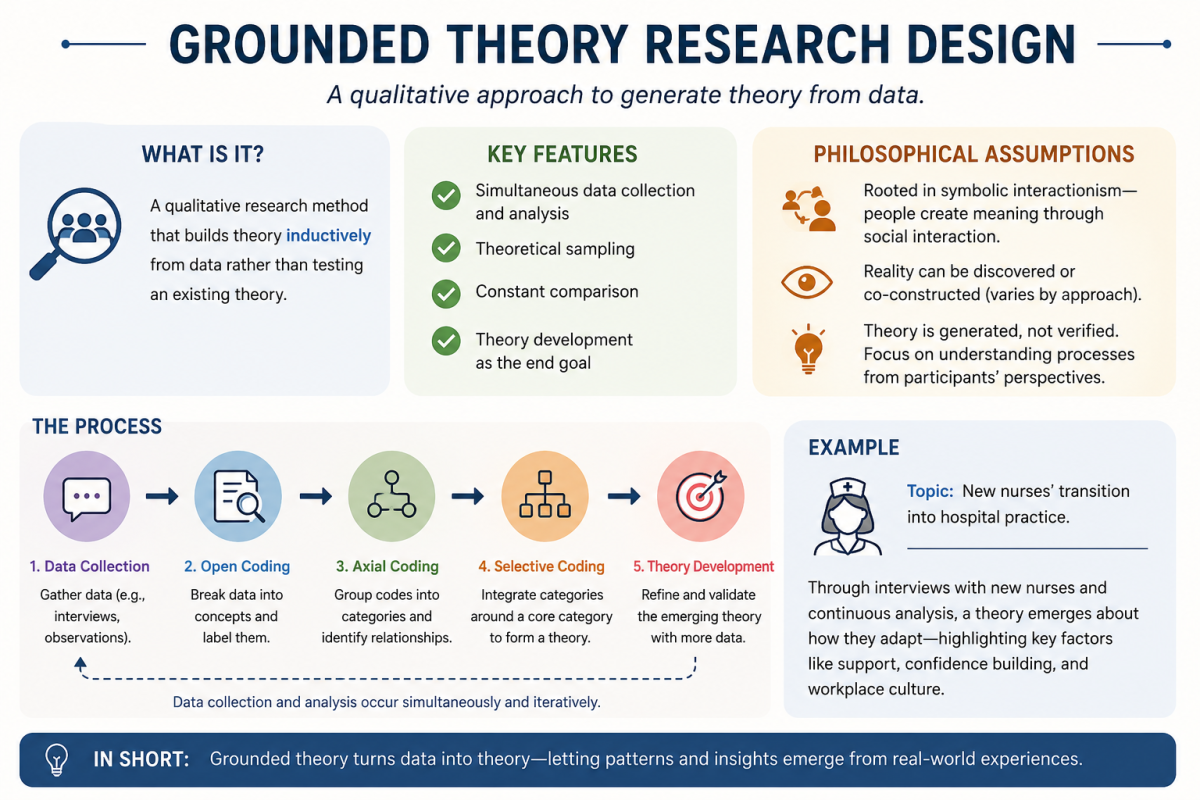
- Simultaneous data collection and analysis: Unlike many methodologies where these two phases happen separately, grounded theory research design requires researchers to analyze data as it’s collected, allowing early findings to shape subsequent data collection.
- Theoretical sampling: Rather than sampling all participants at once, researchers use theoretical sampling to select new participants or data sources based on gaps identified in the emerging theory.
- Constant comparison: Data is continuously compared against other data, codes, and categories to refine the emerging theory.
- Theory development as the end goal: The research process doesn’t stop at describing a phenomenon—it aims to produce an explanatory theory that accounts for how and why something happens.
- Grounded theory is particularly useful when little is known about a topic, when existing theories don’t adequately explain a phenomenon, or when researchers want to understand social processes from the perspective of the people experiencing them. This makes it a popular choice for qualitative social research in fields like sociology, nursing, education, and organizational studies.
- In short, grounded theory research design flips the traditional research process on its head—instead of theory guiding data collection, data collection and analysis guide theory development, resulting in a theory that is grounded firmly in real-world observations rather than abstract assumptions.
Philosophical Assumptions of The Grounded Theory Research Design
- Every research methodology rests on philosophical assumptions about the nature of reality (ontology) and how we come to know it (epistemology), and grounded theory research design is no exception. Understanding these assumptions helps researchers apply the grounded theory method consistently and defend their methodology choices.
- Symbolic interactionism and grounded theory are deeply connected. Symbolic interactionism holds that people act toward things based on the meanings those things hold for them, and that these meanings are shaped through social interaction. Glaser and Strauss drew heavily on this perspective, which is why interactionism and grounded theory methods are often discussed together in guide to grounded theory research texts. This philosophical root explains why grounded theory places so much emphasis on understanding participants’ own interpretations of their experiences.
- There are several distinct philosophical branches within grounded theory that reflect its evolution over time:
- Classic grounded theory (Glaserian approach): Rooted in a more objectivist, positivist stance, this version of grounded theory assumes that a single, discoverable reality exists and that the researcher’s role is to remain neutral and let the theory emerge without preconceived codes or frameworks.
- Straussian grounded theory: Developed by Strauss and Juliet Corbin, this approach introduces more structured coding procedures and acknowledges a degree of researcher interpretation, sitting somewhere between objectivism and constructivism.
- Constructivist grounded theory: Pioneered by Kathy Charmaz, this approach assumes that reality is co-constructed between the researcher and participants. Rather than “discovering” a theory that exists independently of the researcher, constructivist grounded theory views the final grounded theory as an interpretation shaped by the researcher’s position, values, and interactions with participants.
- These philosophical differences matter because they shape how researchers approach data collection and analysis:
- Objectivist approaches (classic grounded theory) treat data as a reality to be uncovered.
- Constructivist approaches treat data as something jointly created through the researcher-participant relationship, acknowledging that no two researchers would necessarily arrive at the same theory that explains a phenomenon.
- The methodological dynamism of grounded theory also reflects a pragmatist epistemology—the idea that knowledge should be useful and applicable to real-world problems, rather than purely abstract. This is why grounded theory studies are often praised for producing theories that practitioners can directly apply.
- Another key assumption is that theory is generated, not verified. This inductive logic contrasts with deductive traditional research, where researchers test theories against data. In grounded theory, the relationship is reversed: data comes first, and theory is constructed afterward based on patterns observed within it.
- Finally, grounded theory assumes that social processes are dynamic and context-dependent. This is why grounded theorists avoid rigid, predetermined frameworks and instead allow categories and concepts to evolve throughout the research process, ensuring the final theory remains sensitive to the nuances of the data.
How To Conduct a Grounded Theory Research Design In 4 Easy Steps?
Learning how to conduct research using this approach doesn’t have to be overwhelming. Below is a practical breakdown of the grounded theory procedures every researcher should follow.
Step 1: Define Your Research Question and Begin Initial Data Collection
- Start with a broad, open-ended research question rather than a specific hypothesis. Grounded theory works best when researchers approach a topic with genuine curiosity rather than fixed expectations.
- Choose your data collection methods. Common sources for grounded theory research include:
- In-depth interviews
- Focus groups
- Field observations
- Documents, diaries, or archival records
- Begin collecting data from an initial, small sample of participants or sources. Unlike traditional research, you don’t need to finalize your entire sample upfront—this will evolve as your analysis progresses.
- Keep a research journal or memos throughout this stage. Memo-writing is central to grounded theory analysis and helps track your evolving thoughts, questions, and hunches.
Step 2: Begin Coding the Data (Open Coding)
- As soon as you have your first batch of data, begin grounded theory coding. This is the analytical backbone of the grounded theory method and typically happens in stages:
- Open coding: Break the data down line-by-line or incident-by-incident, labeling concepts and ideas as they appear. At this stage, stay close to the participants’ own words.
- Axial coding: Start grouping related codes into broader categories, identifying relationships between them (causes, contexts, consequences).
- Selective coding: Identify a core category that ties all other categories together, forming the backbone of your emerging theory.
- Use constant comparison throughout this stage—compare new data against previously coded data to refine categories and identify patterns that are grounded in the data.
Step 3: Apply Theoretical Sampling and Continue Data Collection
- This step is what truly sets grounded theory apart from other qualitative research designs. Based on the categories and gaps identified during coding, use theoretical sampling to guide your next round of data collection.
- Instead of predetermining your full sample size, let your emerging categories tell you who or what to study next. For example, if your data suggests a specific subgroup behaves differently, seek out participants from that subgroup.
- Continue cycling between data collection and analysis until you reach theoretical saturation—the point where new data no longer reveals new categories, properties, or relationships.
- This iterative process is a defining feature of procedures for developing grounded theory, and it’s what allows the theory to emerge organically rather than being forced onto the data.
Step 4: Develop and Refine the Theory
- Once saturation is reached, focus on constructing grounded theory by integrating your categories into a coherent, cohesive framework.
- Write a theoretical narrative that explains how your core category relates to the other categories, and how these relationships explain the phenomenon under study.
- Compare your theory against existing theories and relevant literature—not to test it, but to situate it within the broader field and highlight its new theories contribution.
- Refine the theory through additional memo-writing, diagramming, and peer review until you arrive at a final theory that is clear, coherent, and genuinely grounded in data.
- Present the theory using explanatory statements, diagrams, or models that clearly show how concepts relate—this is often called developing a theory-based framework or model.
Following these four steps consistently is the most reliable guide to grounded theory research for anyone new to this research method.
What are the Advantages and Disadvantages of Grounded Theory Research Design in Qualitative Research Designs?
Like every research methodology, grounded theory research design comes with distinct strengths and limitations. Understanding both sides will help you decide whether to use grounded theory for your own research study.
Advantages of Grounded Theory
- Generates new, contextually relevant theory: One of the biggest advantages of grounded theory is its ability to produce new theories that are directly relevant to the population or context studied, rather than relying on frameworks developed elsewhere that may not fit.
- Flexibility throughout the research process: Because data collection and analysis happen simultaneously, researchers can adapt their approach as new insights emerge. This flexibility is rare in more rigid, traditional research designs.
- Rich, in-depth understanding: Grounded theory studies tend to produce highly detailed, nuanced insights into social processes because the theory emerges from real participant experiences rather than predetermined categories.
- Reduces researcher bias in theory formation: Since the theory is grounded in actual data rather than the researcher’s preconceptions, this approach helps minimize the risk of forcing data to fit an existing framework.
- Well-suited for under-researched areas: When existing theories are insufficient or absent, grounded theory provides a systematic way to generate theory from scratch, making it ideal for exploring new or emerging phenomena.
- Practical and applicable outcomes: Because grounded theory is rooted in pragmatism, the final grounded theory often has direct, practical applications for practitioners, policymakers, or organizations.
- Strong methodological rigor: Despite being inductive, grounded theory procedures—including theoretical sampling, constant comparison, and saturation—provide a structured, systematic approach to qualitative data analysis, lending credibility to the findings.
- Encourages deep engagement with data: The iterative coding process central to grounded theory analysis requires researchers to engage closely and repeatedly with their qualitative data, often revealing insights that a single-pass analysis would miss.
Disadvantages of Grounded Theory
- Time-intensive process: The cyclical nature of data collection and analysis, combined with the requirement to reach theoretical saturation, makes grounded theory projects considerably more time-consuming than many other types of research.
- Requires significant researcher skill: Successfully conducting qualitative research using grounded theory demands strong analytical and interpretive skills. Novice researchers may struggle with coding decisions or fail to reach a truly theory that is grounded in the data.
- Risk of researcher subjectivity: Especially in constructivist grounded theory, the researcher’s interpretations inevitably shape the final theory, which can raise questions about objectivity and reproducibility.
- Ambiguity around saturation: Determining when theoretical saturation has been reached is often subjective, and different researchers may reach different conclusions about when to stop data collection.
- Difficult to generalize findings: Because grounded theory typically involves smaller, non-random samples, the theory developed may not generalize well beyond the specific context studied, limiting broader applicability.
- Steep learning curve: Compared to more straightforward qualitative methods, understanding and correctly applying essential grounded theory methods—such as open, axial, and selective coding—can be challenging for those new to the methodology.
- Potential for inconsistent application: Because there are multiple versions of grounded theory (classic, Straussian, constructivist), researchers sometimes blend approaches inconsistently, which can weaken the methodological integrity of the study, a concern often raised in the sage handbook of grounded theory.
- Resource-heavy for large-scale studies: The need for continuous data collection and analysis, along with extensive memo-writing and coding, makes grounded theory less practical for large-scale or time-constrained research projects.
Weighing these advantages and disadvantages carefully will help determine whether grounded theory research design is the right fit for your specific research question and available resources.
Examples of Grounded Theory Research Design
Seeing grounded theory applied in real-world contexts helps clarify how the abstract steps translate into an actual research study. Below are several examples across different fields that illustrate grounded theory in practice.
- Healthcare and nursing example: A researcher wants to understand how patients cope with a new chronic illness diagnosis. Rather than starting with a fixed hypothesis, they interview a small group of patients, using grounded theory coding to identify recurring themes like denial, information-seeking, or reliance on support networks. Through theoretical sampling, they seek out patients at different stages of diagnosis to refine their emerging categories. Over time, a theory emerges explaining the stages patients typically move through—forming a coping model grounded in the data rather than borrowed from psychology textbooks.
- Workplace and organizational example: A researcher studying employee burnout in remote workplaces begins with open-ended interviews. Initial open coding reveals categories such as “boundary blurring” and “isolation.” As data collection continues, theoretical sampling leads the researcher to interview employees from different industries and seniority levels. Eventually, axial and selective coding produce a final theory describing how blurred work-life boundaries interact with a lack of social connection to drive burnout—an original contribution that didn’t previously exist in the literature.
- Education example: A study exploring why some first-generation college students persist while others drop out uses grounded theory research to explore student narratives. Through constant comparison of interview transcripts, the researcher identifies a core category: “navigating institutional unfamiliarity.” Related categories, such as mentorship and financial literacy, connect to this core, eventually forming an explanatory theory of persistence that’s directly useful to university support programs.
- Consumer behavior example: A marketing researcher wants to understand why customers abandon online shopping carts. Using a grounded theory approach, they collect data through customer interviews and behavioral logs, applying grounded theory analysis to identify recurring frustrations like hidden fees or complicated checkout processes. Theoretical sampling guides them to interview customers who abandoned carts at different stages, refining the theory until it explains the psychological triggers behind abandonment—theory development grounded entirely in customer experience data.
- Social work example: Researchers examining resilience among foster youth use grounded theory studies to interview young adults who aged out of the foster care system. Initial codes around “self-reliance” and “chosen family” evolve through theoretical sampling into a broader theory of resilience formation. This example demonstrates how grounded theory requires patience and iteration, but ultimately produces a theory that explains lived experience in ways existing theories couldn’t fully capture.
- What these examples have in common:
- They all begin with a broad research question, not a fixed hypothesis.
- They rely on iterative data collection and analysis cycles.
- Theoretical sampling plays a central role in refining categories.
- The final theory in each case is genuinely grounded in data, offering explanatory power that’s directly tied to participants’ real experiences.
- Each example reflects the broader purpose of grounded theory: forming a theory based on systematic observation rather than pre-existing assumptions.
These examples show that regardless of discipline, the underlying grounded theory procedures—open coding, theoretical sampling, constant comparison, and saturation—remain consistent, making this research method a versatile and powerful tool across the social sciences and beyond.
