
Interpretive Research Questions

Interpretive research questions explore how people understand, experience and give meaning to events in a particular context. They sit within an interpretivist paradigm and usually begin with how, what or in what ways.
This guide explains interpretivism, how interpretive research questions differ from positivist ones, gives five steps for writing one with an example at every step, lists 20 examples, matches questions to methods and shows how to demonstrate quality and avoid common mistakes.
- The paradigm: what interpretivism assumes and why it changes the question.
- The method: five steps and 20 examples.
- The quality: methods, trustworthiness and mistakes.
On this page
- What is interpretivism?
- Interpretive vs positivist research questions
- Features of good interpretive research questions
- Step-by-step guide to writing interpretive research questions
- 20 examples of interpretive research questions
- Before and after: making a question interpretive
- Frequently asked questions about interpretive research questions
Key takeaways
- Interpretive research questions explore meaning, experience and context rather than cause and effect.
- Use how, what or in what ways, and name the participants and setting.
- Avoid causal words, variables and predictions.
- Match the question to a method such as interviews, ethnography or case study, and show trustworthiness.
What is interpretivism?
Interpretivism is a research paradigm that holds that social reality is understood through the meanings people give it.
- Belief about reality: reality is socially constructed and can be understood in different ways.
- Belief about knowledge: knowledge comes from understanding people’s perspectives in context.
- Role of the researcher: the researcher is involved in interpreting and is open about their position.
- Roots: hermeneutics, phenomenology and symbolic interactionism; see interpretivism.
- Typical methods: interviews, observation, focus groups, documents and case studies.
Interpretive vs positivist research questions
The paradigm changes what the question looks like.
| Feature | Interpretive | Positivist |
|---|---|---|
| Aim | Understand meaning | Explain and predict |
| Wording | How do… experience…? | What is the effect of… on…? |
| Variables | None fixed in advance | Defined and measured |
| Sample | Small, purposive | Large, often random |
| Data | Words, observations | Numbers |
| Example | How do nurses make sense of moral distress in intensive care? | Does staffing level predict moral distress scores? |
Features of good interpretive research questions
A strong question has these features.
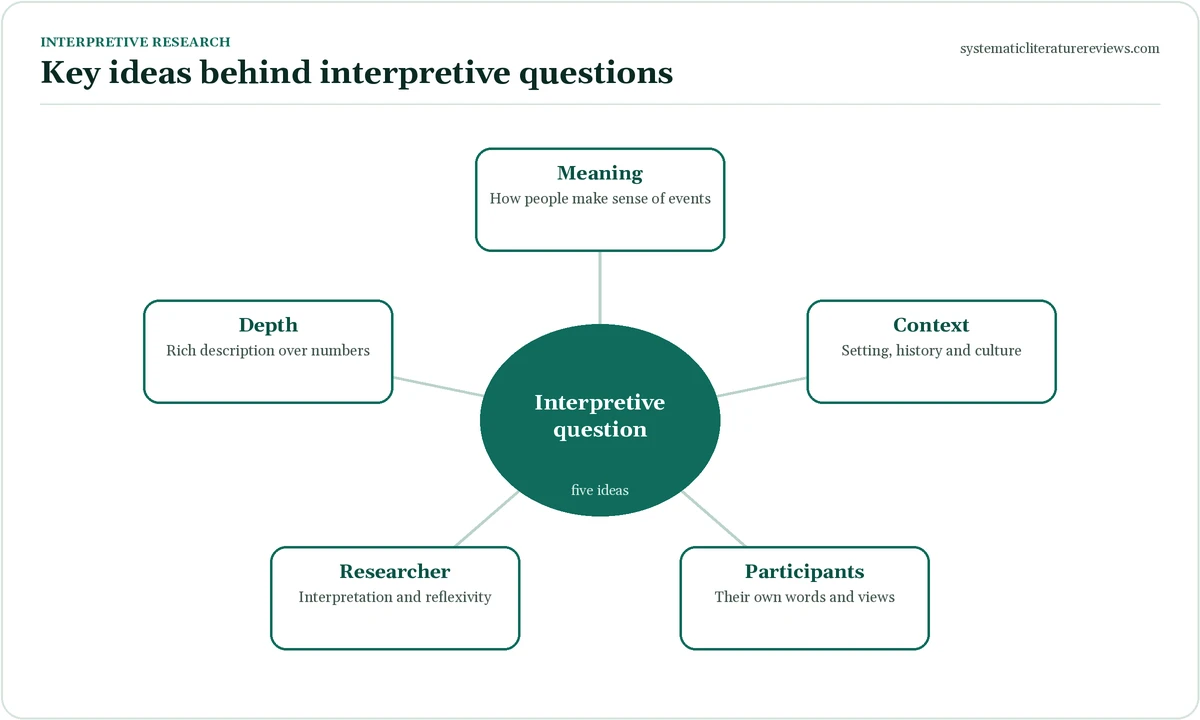
- Focus on meaning: asks how participants understand or experience something.
- Context: names the setting and group.
- Open wording: invites rich description.
- Single focus: one phenomenon at a time.
- Feasible: can be explored with the data you can collect.
- Consistent with the paradigm: no causal claims or hypotheses.
Step-by-step guide to writing interpretive research questions
Follow these five steps. Each has an explanation and an example.
- Choose the phenomenon. Pick a topic where meaning and context matter and where existing studies mostly use numbers or lack participants’ voices. Example: Nurses’ experience of moral distress.
- Name participants and setting. Say who will take part and where, because meaning is tied to context. Example: Registered nurses in adult intensive care units in one NHS trust.
- Choose an interpretive stem. Use how, what or in what ways, with a verb such as experience, understand, make sense of or describe. Example: How do… make sense of…
- Write the central question. Combine phenomenon, participants and setting in one open question. Example: How do intensive care nurses make sense of moral distress in their daily work?
- Add sub-questions and check the fit. Add two or three sub-questions on aspects of meaning, and make sure the method can answer them. Example: What situations trigger distress? How do nurses cope?
20 examples of interpretive research questions
Use these as models and adapt them to your topic.
Health and nursing
- Q1: how do intensive care nurses make sense of moral distress?
- Q2: how do patients with long-term conditions understand self-management?
- Q3: in what ways do families interpret end-of-life communication?
- Q4: how do student nurses understand professional identity during placements?
- Q5: what meaning do older adults give to independence at home?
Education
- Q6: how do teachers interpret curriculum change?
- Q7: how do students understand academic integrity?
- Q8: in what ways do pupils experience feedback?
- Q9: how do parents make sense of school choice?
- Q10: how do international students understand belonging?
Business and organisations
- Q11: how do employees interpret a new performance system?
- Q12: what does flexible work mean to staff in a hybrid organisation?
- Q13: how do managers make sense of ethical dilemmas?
- Q14: how do customers interpret sustainability claims?
- Q15: in what ways do teams experience digital transformation?
Social science and technology
- Q16: how do migrants interpret citizenship?
- Q17: what meanings do young people attach to social media use?
- Q18: how do developers understand code quality?
- Q19: how do communities interpret environmental change?
- Q20: how do users make sense of algorithmic decisions?
Before and after: making a question interpretive
Compare questions that fit a positivist study with interpretive rewrites.
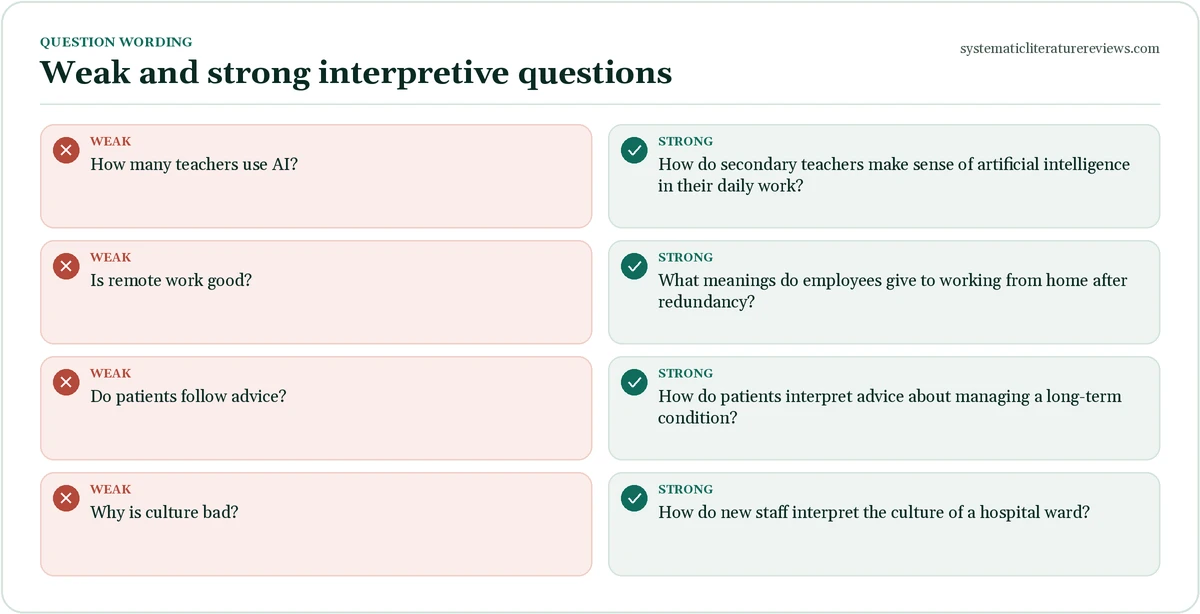
Interpretive research question: rewrite
Weak
Does social media use cause anxiety in teenagers?
Causal wording and fixed variables.
Strong
How do teenagers make sense of the role of social media in their emotional lives?
Asks about meaning and uses open wording.
Weak
How many nurses experience moral distress?
A counting question that suits a survey.
Strong
How do nurses describe and interpret moral distress in intensive care?
Asks for description and interpretation in context.
Methods that fit interpretive research questions
Choose a method that allows rich data.
| Method | When to use it | Example |
|---|---|---|
| Semi-structured interviews | To explore perspectives in depth | Interviews with 15 nurses |
| Focus groups | To see how meaning is built in discussion | Three groups of students |
| Ethnography | To see practices in their natural setting | Observation of handover on a ward |
| Case study | To study one case in depth | One hospital’s change programme |
| Document analysis | To interpret texts | Policy documents |
| Hermeneutic analysis | To interpret texts through parts and whole | Reflective diaries |
See also phenomenological research design.
Analysing data to answer interpretive research questions
Analysis is also interpretive.
- Read and re-read: become familiar with the data.
- Code: label meaningful segments.
- Develop themes: group codes into patterns of meaning.
- Return to the whole: check that themes reflect the whole account.
- Reflect: record how your own position shapes interpretation.
- Use quotes: show the voice of participants.
Trustworthiness in interpretive research
Lincoln and Guba proposed four criteria that parallel the standards used in quantitative research.
| Criterion | Meaning | How to show it |
|---|---|---|
| Credibility | Findings are believable | Member checking, prolonged engagement |
| Transferability | Findings may apply elsewhere | Thick description of context |
| Dependability | The process is consistent | Audit trail |
| Confirmability | Findings come from the data | Reflexive journal, quotes |
Reflexivity and the role of the researcher
Interpretive researchers acknowledge their own influence.
- Reflexive journal: write about assumptions and reactions.
- Position statement: state your background and relationship to the topic.
- Bracketing: set aside assumptions where appropriate.
- Supervision: discuss interpretations with a peer.
- Report: explain how reflexivity shaped decisions.
Common mistakes with interpretive research questions
Avoid these problems.
- Causal wording: affects and causes. Example: use how and what.
- Questions that suit a survey: how many. Example: ask about meaning.
- Too broad: all experiences of illness. Example: narrow to a group and setting.
- No method fit: a question about meaning but a closed survey. Example: choose interviews.
- Ignoring reflexivity: bias is hidden. Example: record your position.
Compare with grounded theory research questions and phenomenological research questions.
Choosing a paradigm for your study
Your research question should fit your paradigm.
| Paradigm | Core idea | Typical question |
|---|---|---|
| Positivism | Objective reality can be measured | Does X affect Y? |
| Interpretivism | Reality is understood through meaning | How do people experience X? |
| Critical theory | Research challenges power | How does X maintain inequality? |
| Pragmatism | Use what works for the question | What methods best answer this? |
An example from question to themes
This example shows how an interpretive question leads to themes.
- Question: how do intensive care nurses make sense of moral distress in their daily work?
- Method: semi-structured interviews with 14 nurses.
- Coding: codes such as feeling powerless, ignored voices and holding the family.
- Theme 1: carrying decisions that are not mine.
- Theme 2: finding ways to cope, including talking with peers.
- Theme 3: changing sense of professional identity.
- Reporting: each theme is shown with quotes and linked to the question.
Central and sub-questions for interpretive studies
One central question and two or three sub-questions are usually enough.
| Central question | Sub-questions |
|---|---|
| How do international students understand belonging at a UK university? | What helps them feel part of the university? What makes them feel excluded? How do they describe changes over time? |
| How do teachers interpret curriculum change? | How do they describe the change? What does it mean for their role? How do they respond? |
Sampling and sample size
Interpretive studies use purposive samples.
- Select information-rich cases: people who can speak about the topic.
- Seek variety: within the same group, to capture different views.
- Size: often 8 to 20 participants for interviews.
- Explain: why the sample fits the question.
- Stop: when new interviews add little new meaning.
Writing up an interpretive study
Combine description and interpretation.
- Present themes: with clear names and a short definition.
- Use quotes: to show participants’ words.
- Interpret: explain what the theme means for the question.
- Link: to the literature and theory.
- Be open: about alternative readings and limits.
Criteria for judging interpretive research questions
Check each question against these criteria.
- Is it open?: it should not be answerable with yes or no.
- Does it ask about meaning?: look for words such as experience, understand or make sense.
- Is it contextual?: it names a group and setting.
- Is it consistent with the method?: interviews can answer it.
- Is it ethical?: participants can speak freely without harm.
- Is it manageable?: one phenomenon, in the time you have.
Interpretive questions and the hermeneutic circle
Hermeneutics is a tradition of interpretation that moves between parts and whole.
- The circle: understand a passage by the whole account, and the whole account by its passages.
- Preunderstanding: you bring knowledge, which you should make explicit.
- Questions evolve: as you read, your question may become sharper.
- Application: read transcripts several times, noting how the meaning shifts.
- Reporting: explain how your interpretation developed.
Using interpretive questions in mixed studies
An interpretive strand can explain survey results.
- Explanatory sequential: interviews explain surprising survey results; see mixed methods research designs.
- Exploratory sequential: interviews identify issues to measure later.
- Keep the paradigms clear: state how you combine different assumptions.
- Pragmatism: many mixed studies adopt a pragmatic stance.
- Integrate: link the questions across strands.
Ethics in interpretive studies
Because interpretive studies involve close contact with participants, ethical care is central.
- Informed consent: explain the topic, the time needed and the right to withdraw at any point.
- Confidentiality: use pseudonyms and avoid details that could identify people in small settings.
- Power: be aware of the relationship between researcher and participants, especially in workplaces.
- Distress: offer support information when topics are sensitive.
- Approval: submit your interview guide and the central question to the ethics committee.
Frequently asked questions about interpretive research questions
What are interpretive research questions?
Interpretive research questions explore how people understand, experience and give meaning to a phenomenon in a particular context. They sit within an interpretivist paradigm, which assumes that reality is socially constructed, and they usually begin with how, what or in what ways. An example is how do intensive care nurses make sense of moral distress. They do not ask about cause and effect or use fixed variables, and they are usually answered with interviews, observation or document analysis. Make sure your method fits the paradigm you choose.
How do I write an interpretive research question?
Choose a phenomenon where meaning and context matter, and name the participants and the setting. Use an open stem such as how or in what ways, with a verb like experience, understand or make sense of, and combine these in one question, for example how do international students understand belonging at a UK university. Avoid causal words and variables, add two or three sub-questions on aspects of meaning, and check that your method, such as interviews, can answer them. Test the wording with your supervisor before collecting data.
How are interpretive and positivist research questions different?
Positivist questions ask about cause, prediction and measurement, using defined variables and large samples, for example does staffing level predict moral distress scores. Interpretive questions ask about meaning and experience in context, using open wording and small purposive samples, for example how do nurses make sense of moral distress. The first expects numbers and generalisation, while the second expects rich description and transferable insight. Your choice depends on what you want to know and on the paradigm you adopt. Choose the paradigm that fits your purpose and explain the choice.
How do I show quality in interpretive research?
Use the criteria of trustworthiness proposed by Lincoln and Guba: credibility, transferability, dependability and confirmability. You can show credibility with member checking and prolonged engagement, transferability with thick description of context, dependability with an audit trail, and confirmability with a reflexive journal and quotes that link findings to the data. Explain your sampling, your analysis steps and how your own position may have shaped the interpretation, so that readers can judge the study for themselves. Keep an audit trail of your decisions from the start of the study.
Need expert help? Our experienced writers can handle the search, screening and write-up for you. Place your order in two minutes, or read how a systematic literature review works first.
Systematic Literature Reviews
Need strong research questions?
Research questions that fit your method and can be answered with your data.