
Blog
How To Conduct Comparative Research Design with Examples

What is Comparative Research Design in Quantitative Research Designs?
- Comparative research design is a structured approach used in quantitative research to examine two or more groups, cases, or conditions by measuring and comparing specific variables across them. Rather than studying a single subject in isolation, this design involves placing multiple subjects side by side so that patterns, differences, and similarities can be identified through systematic analysis. In quantitative research, this process relies heavily on numerical data, statistical methods, and clearly defined variables to draw meaningful conclusions.
- At its core, comparative research design asks a fundamental research question: how do two or more groups differ — or align — on a specific outcome or characteristic? For example, a researcher in political science might want to compare voter participation rates across different geographical regions, or a sociologist might examine income inequality between two distinct demographic clusters. The goal of comparative research in these contexts is not just to describe what exists, but to explain why differences or similarities occur.
- In quantitative settings, comparative research design typically involves a dependent variable — the outcome being measured — and one or more independent variables that define the groups being compared. The design may be quasi-experimental or observational, meaning researchers do not always assign participants to groups as they would in a randomized design. Instead, they compare naturally occurring groups, which is what distinguishes this approach from a fully controlled experiment with randomized control groups.
- This research design is especially prominent across disciplines such as sociology, public policy, and political science, where it is rarely feasible or ethical to run randomized experiments. Researchers instead rely on comparative analysis to identify causal relationships or test a hypothesis using real-world data collected through surveys, questionnaires, or secondary data sources. The design is also frequently employed in cross-national studies, where researchers compare outcomes across different countries or cultural contexts.
- Comparative research design differs from purely descriptive research in that it goes beyond simply recording what exists. It is also explanatory in nature — it seeks to understand the relationship between variables, the role of context, and the conditions under which patterns hold true or break down. Whether using primary data or secondary data, this design gives researchers a rigorous framework for drawing valid, evidence-based comparisons.
Philosophical Assumptions of The Comparative Research Design
- Every research design rests on philosophical assumptions — underlying beliefs about the nature of knowledge, reality, and how research should be conducted — and comparative research design is no exception. Understanding these assumptions helps researchers make more deliberate methodological choices and ensures that the study design remains internally consistent from start to finish.
- The first major assumption is ontological, meaning it concerns beliefs about the nature of reality. Comparative research design generally operates from a realist ontological position — the belief that social phenomena, behaviors, and outcomes exist independently of the researcher’s perception and can be observed, measured, and compared across different cases. This is why the design is so well-suited to quantitative data and statistical methods, which treat reality as something that can be captured numerically.
- The second assumption is epistemological, relating to how knowledge is produced and validated. Comparative research design favors an objectivist epistemology, where the researcher maintains distance from the subject being studied to preserve validity. The goal is to produce findings that are systematic, replicable, and generalizable — not shaped by the researcher’s personal perspective. This is what separates it from more interpretive qualitative approaches, which prioritize meaning-making over measurement.
- A third assumption is that causality can be identified through careful comparison. Comparative research design assumes that by holding certain conditions constant and varying others — particularly across two groups or different contexts — it is possible to identify what causes a particular outcome. This is closely tied to the logic of control groups: if two groups are similar in every way except one variable, and their outcomes differ, that variable is likely responsible for the difference.
- A fourth philosophical assumption concerns the role of context. Unlike some purely experimental designs that try to strip context away, comparative research design acknowledges that context shapes outcomes. Researchers assume that the same intervention or condition may produce different results depending on the social, political, or geographical context in which it occurs. This is especially relevant in cross-national research and sociological studies, where local factors heavily influence the variables being measured.
- Finally, comparative research design assumes that case selection is a meaningful and deliberate process. Researchers do not randomly grab cases — they choose them because of what the comparison will reveal. Whether drawing on a small number of carefully selected cases or a large dataset, the assumption is that thoughtful case selection reduces selection bias and strengthens the validity of the conclusions drawn. This assumption is what makes comparative research design both rigorous and purposeful, serving as a cornerstone in the broader family of research methods.
How To Conduct a Comparative Research Design In 4 Easy Steps?
- Conducting a comparative research design requires a clear sequence of decisions, each building on the last. Below are the four essential steps researchers follow to carry out a credible and effective comparative study.
Step 1: Define Your Research Question and Identify the Variables
- The first step is to articulate a precise research question that is built around comparison. A strong research question in comparative research design will always make clear what is being compared, who or what the groups are, and what the expected outcome or dependent variable is. For example: “Do students in urban schools perform better on standardized tests than students in rural schools?” This question immediately signals two groups (urban vs. rural), a dependent variable (test performance), and a comparison as the core of the inquiry.
- Once the research question is set, the researcher identifies the key variables. This includes the dependent variable — what is being measured — and the independent variables or categorical variables that define the groups. It is also important at this stage to review of the literature to understand what prior comparative studies have found, what gaps exist, and what variables have already been confirmed as relevant. This literature review step ensures the study design is grounded in existing knowledge and avoids replicating work already done.
- The researcher should also formulate a hypothesis at this stage. A hypothesis gives the study direction and provides a testable claim that the comparative analysis will either support or challenge. In dissertation research, having a clearly stated hypothesis linked to your research question is essential for methodological coherence.
Step 2: Select Your Cases or Groups
- Case selection is one of the most critical decisions in comparative research design, and it must be made deliberately to avoid the common pitfall of selection bias. Researchers must decide which cases, groups, or units of analysis they will compare and why those particular comparisons are appropriate. The logic of case selection should be tied directly to the research question.
- There are two primary approaches to case selection. The first is the “most similar” approach, where researchers choose cases that are alike in most respects but differ on the key variable of interest — this allows for cleaner comparisons because extraneous factors are minimized. The second is the “most different” approach, where cases come from very different contexts, yet produce the same outcome — this helps establish whether a finding holds across different contexts, strengthening the generalizability of the results.
- Researchers must also determine how many cases are feasible to include. Some comparative studies work with a small number of deeply analyzed cases — similar to case studies — while others draw on large datasets covering dozens of countries or demographic groups. The number of cases affects which statistical methods are appropriate, how variance is handled, and whether regression analysis or simpler forms of quantitative data analysis will be used.
Step 3: Collect Your Data
- Once cases are selected, the researcher moves into data collection, which can draw on both primary and secondary sources. Primary data is gathered directly through surveys, questionnaires, interviews, or observational studies conducted with study participants. Secondary data is retrieved from existing sources such as government databases, academic repositories, published datasets, or institutional records — this is especially common in cross-national research, where collecting original data from multiple countries would not be feasible.
- The data collection method must be consistent across all groups being compared. If one group’s data is collected through a questionnaire and another group’s data comes from a retrospective record review, the comparison becomes problematic because differences in data quality could distort the results. Consistency in data collection is what keeps the comparative research design valid and trustworthy.
- Researchers should also plan for how they will handle missing data, outliers, and potential confounding variables — all of which can affect the integrity of the comparison. Having a clear data collection protocol before the study begins reduces the risk of errors that could undermine the final analysis.
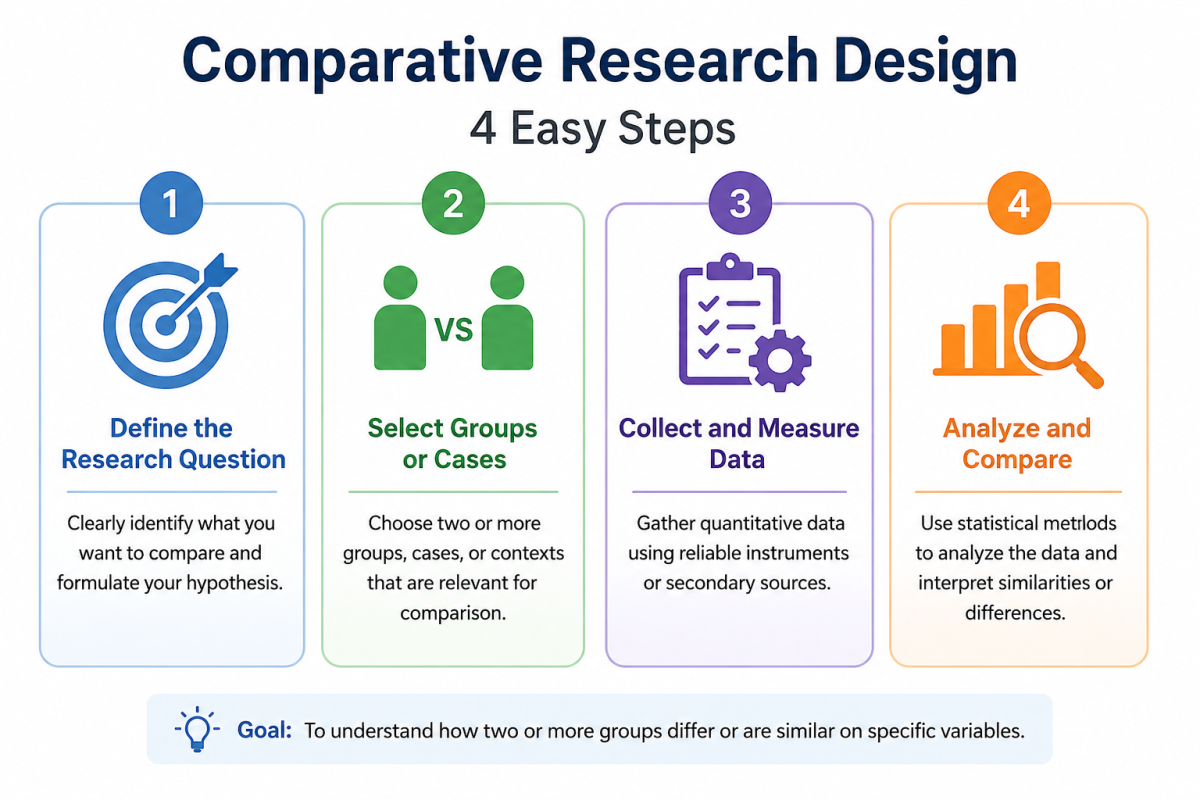
Step 4: Analyze and Interpret the Findings
- The final step is to apply appropriate statistical methods to analyze the data and interpret what the comparison reveals. Common approaches include regression analysis, analysis of variance, and cluster analysis, depending on the nature of the variables and the number of groups being compared. For categorical variables, chi-square tests or logistic regression may be used instead.
- The analysis should always circle back to the original research question and hypothesis. Researchers interpret their findings in light of what they expected to find, noting where the data confirms or challenges their hypothesis. Equally important is acknowledging the limitations of the comparison — particularly any issues with context, case selection, or data quality that may affect validity.
What are the Advantages and Disadvantages of Comparative Research Design in Quantitative Research Designs?
Advantages
- One of the most significant advantages of comparative research design is that it allows researchers to identify patterns across different contexts that would be invisible in a single-case study. By placing two or more groups side by side, researchers can detect similarities and differences that reveal something meaningful about the underlying forces shaping outcomes. This is especially powerful in disciplines like public policy, where understanding what works in one context and whether it transfers to another is critical for evidence-based decision-making.
- Comparative research design is highly flexible and can be applied across a wide range of disciplines and research questions. Whether a researcher is working in political science, sociology, education, or public health, the logic of comparison can be adapted to fit the study design. This versatility means it appears in everything from large-scale cross-national surveys to small qualitative approaches involving a handful of carefully selected cases.
- The design is particularly well-suited to situations where randomized design is not feasible or ethical. In many real-world research contexts, researchers cannot randomly assign people to groups — they must work with groups that already exist. Comparative research design provides a rigorous, systematic framework for drawing conclusions from these naturally occurring groups, making it one of the most practical research methods available.
- When executed well, comparative research design has strong explanatory power. Rather than simply describing what exists (as purely descriptive research does), it can shed light on causality — why outcomes differ, what conditions produce certain results, and what variables are most influential. This explanatory strength is amplified when researchers combine comparative analysis with a thorough review of the literature and careful hypothesis testing.
- The use of secondary data in comparative research design is a major practical advantage. Researchers can draw on enormous existing datasets — census records, international surveys, institutional databases — without having to collect all their own data. This reduces cost, saves time, and makes it feasible to conduct large-scale comparisons that would otherwise be impossible. For dissertation research in particular, this is a valuable efficiency.
- Comparative research design also strengthens validity when used across different contexts. If a finding holds true across multiple different cases drawn from varied geographical or sociological settings, that consistency increases confidence in the result. Findings that survive comparison across diverse contexts are more likely to reflect genuine patterns rather than artifacts of a specific local condition.
Disadvantages
- One of the most significant disadvantages of comparative research design is the risk of selection bias. Because researchers choose which cases to compare — rather than randomly assigning them — there is always a risk that the chosen cases are not representative of the broader population. If a researcher unconsciously selects cases that support a particular conclusion, the findings may not be valid or generalizable. This is a common pitfall that must be actively guarded against through transparent and theoretically grounded case selection.
- Establishing causality in comparative research design is difficult. Even when two groups differ on an outcome, it is not always clear that the variable being compared is truly responsible for that difference. There may be confounding variables — unmeasured factors that explain the outcome just as well — that the researcher has not accounted for. Unlike a randomized design with true control groups, comparative research design cannot fully eliminate alternative explanations, which limits how confidently researchers can claim to have identified a cause.
- The design can struggle with equivalence — ensuring that what is being measured means the same thing across different groups or contexts. In cross-national comparative studies, for example, a concept like “civic engagement” or “educational achievement” may be defined and measured differently in different countries. If the variables are not truly equivalent across groups, the comparison loses its meaning and validity is compromised.
- When working with a small number of cases, generalizability becomes a serious concern. A study comparing only two countries, two schools, or two demographic groups may produce findings that are highly specific to those cases and difficult to apply elsewhere. The smaller the number of cases, the more cautious researchers must be about drawing broad conclusions from the comparative analysis.
- Retrospective comparative studies — those that look back at historical data — face particular challenges with data quality. Records may be incomplete, inconsistently collected, or unavailable for certain groups. This introduces variance in data quality that can distort comparisons and make it difficult to draw reliable conclusions. Researchers relying on secondary data must carefully assess the quality and consistency of their sources before proceeding.
- Finally, comparative research design requires significant methodological expertise to execute correctly. Choosing the right statistical methods, managing variance, handling categorical variables appropriately, and avoiding selection bias all demand a strong command of both research methods and quantitative analysis. Researchers who are new to comparative study design may underestimate the complexity involved, which can lead to methodological errors that undermine the entire study.
Examples of Comparative Research Design
- Comparative research design appears across a wide range of fields, and looking at concrete examples helps illustrate how the approach works in practice.
- Example 1 — Education and Achievement Gaps: A researcher in the field of educational sociology wants to understand whether class size affects student performance. Using comparative research design, they identify two groups of students: those in classes of 15 or fewer, and those in classes of 30 or more. The dependent variable is end-of-year academic performance. The researcher collects quantitative data through standardized test scores, controls for income level and school type, and applies regression analysis to determine whether class size is a statistically significant predictor of performance. This is a classic application of comparative research — two groups, a clearly defined variable, and a systematic comparison.
- Example 2 — Public Policy and Healthcare Systems: A team of policy researchers wants to compare health outcomes in countries with universal healthcare versus those with privatized systems. Using secondary data from international health databases, they identify countries in each category and compare outcomes across variables such as infant mortality rate, life expectancy, and access to preventive care. This cross-national study is a strong example of comparative research design operating at a macro level, where context is critical and direct intervention is impossible. The researchers must be careful to account for confounding factors like GDP, urbanization, and demographic composition.
- Example 3 — Political Science and Voter Behavior: A political science researcher uses comparative research design to examine voter turnout in two demographically similar cities — one with mandatory voting laws and one without. The research question is whether mandatory voting laws significantly increase civic participation. Using a survey administered to study participants in both cities, the researcher collects primary data on voting behavior, political interest, and awareness of civic rights. The comparison between these two groups — differing only in one key policy variable — allows the researcher to test their hypothesis about the effect of voting laws on participation.
- Example 4 — Sociology and Gender Wage Gap: A sociologist conducts a comparative study examining the wage gap between men and women in three different industries: finance, education, and healthcare. Using secondary data from national employment records, the researcher compares median salaries across gender within each industry, controlling for experience, education level, and job title. Statistical methods including analysis of variance help identify whether the gap is consistent across all three sectors or whether it is more pronounced in some industries than others. This type of comparative analysis produces findings that are far richer than a single-industry study would allow.
- Example 5 — Psychology and Intervention Effectiveness: A researcher in clinical psychology wants to evaluate whether cognitive behavioral therapy (CBT) produces better outcomes than mindfulness-based therapy for patients with generalized anxiety disorder. Using a quasi-experimental comparative research design, they identify two groups of patients — one receiving CBT and one receiving mindfulness-based therapy — and measure anxiety levels before and after the intervention using a validated questionnaire. Because patients were not randomly assigned to groups (they self-selected their preferred treatment), this is not a randomized design, but the systematic comparison of outcomes across two groups still allows the researcher to draw meaningful, evidence-grounded conclusions.
- What all of these examples share is the core logic of comparative research design: identify two or more groups, define a clear dependent variable, collect data consistently, and apply systematic analysis to understand what the comparison reveals. Whether the study is large or small, cross-national or local, quantitative or incorporating some qualitative approaches, the fundamental goal of comparative research remains the same — to learn more by comparing than would ever be possible by studying any single case alone.
