
Blog
How To Conduct Quasi-Experimental Research Design

What is Quasi-Experimental Research Design in Quantitative Research Designs?
- Quasi-experimental research design is a type of quantitative research design that examines the relationship between an independent variable and a dependent variable without relying on full random assignment of participants to groups. Unlike a true experimental design, where random assignment of participants to a treatment group and a control group is the defining feature, quasi-experimental studies use existing or naturally occurring groups, making them a practical middle ground between experimental design and purely observational studies.
- At its core, a quasi-experimental design still involves the manipulation of the independent variable — meaning researchers introduce some form of intervention or treatment — but they cannot fully control who receives it. This is what separates it from a true experiment, where every condition, including group assignment, can be controlled by the researcher.
- Within the broader landscape of quantitative research, quasi-experimental research designs sit between randomized controlled trials and purely descriptive or correlational types of studies. They allow researchers to study the effects of an intervention while working within real-world limitations, such as when it isn’t feasible or ethical to randomly assign people to groups.
- A typical quasi-experimental research design involves comparing an experimental group that receives the intervention against a comparison group that does not, even though group membership wasn’t randomly determined. This structure helps researchers infer a cause-and-effect relationship, although with less certainty than a true experimental design.
- Common scenarios where quasi-experimental design is used include:
- Evaluating a new teaching method in one school while using another school as a control group, since students can’t be randomly reassigned between schools.
- Assessing the impact of a policy change on a population before and after implementation.
- Studying the effects of a natural disaster or other uncontrollable event on community health outcomes.
- The research question in quasi-experimental research typically asks whether an intervention causes a measurable change in an outcome, but the methodology acknowledges that confounding variables may also play a role, since participants weren’t randomly placed into groups.
- Because quasi-experimental research design is so adaptable, it is widely used across disciplines, including education, public health research, nursing research, clinical research, and business and market research, wherever randomized controlled trials are difficult to implement.
- In short, quasi-experimental research design offers a structured research method for studying cause-and-effect relationships in real-world settings, even when the gold standard of random assignment isn’t achievable.
Philosophical Assumptions of The Quasi-Experimental Research Design
- Quasi-experimental research design is grounded in a post-positivist philosophical stance, which assumes that an objective reality exists and can be studied, but acknowledges that human measurement and observation are imperfect. This is a softer version of the strict positivism that underlies true experimental design.
- Researchers using a quasi-experimental design accept that absolute certainty about a cause-and-effect relationship is unattainable. Instead, they aim to build a reasonable, evidence-based case for causality by carefully managing study design elements like timing, measurement, and comparison groups.
- A core assumption is that variables can be quantified and that independent and dependent variables can be operationalized into measurable indicators. This belief in measurable, observable phenomena is what allows quasi-experimental studies to remain firmly within the quantitative research tradition rather than drifting into purely qualitative inquiry.
- Another foundational assumption is that, while random assignment isn’t always possible, careful study design can still minimize bias. This reflects a pragmatic philosophy: researchers don’t abandon rigor just because true experimental conditions can’t be met — they adapt their methodology to preserve as much internal validity as possible.
- Quasi-experimental research also rests on the assumption that pre-existing group differences can be identified, measured, and statistically controlled for. This is critical because, without random assignment of participants, groups may differ in ways that introduce confounding variables, and researchers must account for these differences analytically.
- A determinism assumption underlies this research design as well — the belief that events, including human behavior and outcomes, have identifiable causes that can be traced through systematic data collection and analysis, even if the research design itself is less controlled than a randomized controlled trial.
- There’s also an assumption of probabilistic causality rather than deterministic certainty. Researchers using quasi-experimental design generally accept that an intervention increases the likelihood of an outcome rather than guaranteeing it, which aligns with the broader uncertainty embedded in social and behavioral research.
- Finally, quasi-experimental research design assumes that real-world constraints — ethical, logistical, financial — are legitimate reasons to depart from a true experimental design, provided the researcher transparently addresses the resulting limitations in validity during critical appraisal. This pragmatic philosophy is what makes quasi-experimental design so valuable in applied research contexts where strict experimental control simply isn’t realistic.
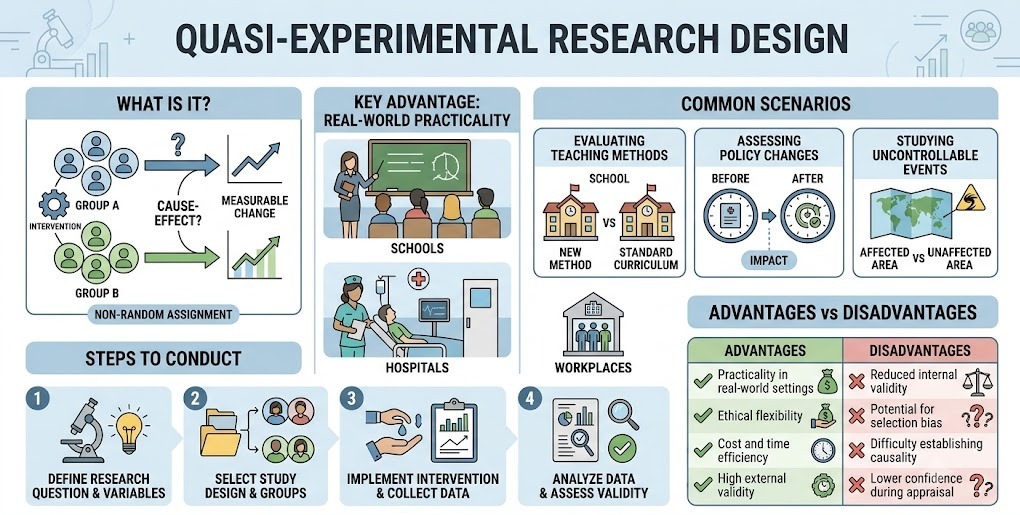
How To Conduct a Quasi-Experimental Research Design In 4 Easy Steps?
Conducting a quasi-experimental research design doesn’t have to be complicated if you break the process down into manageable stages. Here are four steps to guide your study design and analysis:
Step 1: Define Your Research Question and Identify Variables
- Start by clearly articulating your research question or hypothesis. What relationship are you trying to test? For example, “Does a new onboarding program improve employee retention?”
- Identify your independent variable (the intervention or treatment, such as the onboarding program) and your dependent variable (the outcome you’re measuring, such as retention rate).
- Decide which types of quasi-experimental designs best fit your situation. Common options include:
- Non-equivalent groups design, where you compare a treatment group to a similar but not randomly assigned comparison group.
- Interrupted time series design, where you collect data at multiple time points before and after an intervention to observe trends.
- Regression discontinuity design, where participants are assigned to groups based on a cutoff score on a pre-existing variable.
- One-group pretest-posttest design, where a single group is measured before and after an intervention, without a separate control group.
- This step sets the foundation for everything that follows, so take time to ensure your variables are clearly defined and measurable.
Step 2: Select Your Study Design and Groups
- Choose the specific quasi-experimental method that aligns with your research question and available resources. Since random assignment isn’t possible, think carefully about how you’ll form your treatment and control groups (or comparison groups) using naturally occurring or pre-existing populations.
- Consider feasibility: is it feasible or ethical to introduce the intervention to one group and withhold it from another? If not, a time series or pretest-posttest approach without a true control group might be more appropriate.
- Try to select comparison groups that are as similar as possible to your treatment group on key characteristics (age, location, baseline performance, etc.) to reduce the influence of confounding variables and strengthen your study’s credibility.
- Document your rationale for group selection thoroughly, since this will be scrutinized during critical appraisal of your research study.
Step 3: Implement the Intervention and Collect Data
- Roll out the intervention or treatment to your experimental group according to your study design, and begin systematic data collection for both groups (if applicable).
- Use standardized instruments and consistent procedures across all data collection points to maintain experimental control as much as possible, even though full control isn’t achievable in a quasi-experimental design.
- For designs involving multiple time points, such as an interrupted time series design, ensure you collect data at evenly spaced and clearly defined intervals before, during, and after the intervention.
- Keep detailed records of any external events or changes occurring during the study period, since these could act as confounding variables that affect your dependent variable independently of your intervention.
Step 4: Analyze Data and Assess Validity
- Use appropriate statistical techniques to assess the impact of the intervention on your dependent variable, comparing the treatment group against the control group (or comparing pre- and post-intervention data).
- Apply statistical controls, such as covariate adjustment or matching techniques, to account for known differences between groups and reduce the risk of confounding variables skewing your results.
- Evaluate the internal validity of your findings by considering alternative explanations for your results, such as regression to the mean, maturation effects, or historical events that coincided with your intervention.
- Consider the external validity of your findings — how well do your results generalize beyond your specific sample and real-world settings?
- Conclude with a transparent discussion of your study’s limitations, since acknowledging the absence of random assignment is essential to a credible critical appraisal of any quasi-experimental research design.
Following these four steps provides a clear, systematic pathway for conducting rigorous quasi-experimental research, even when a true experimental design isn’t possible.
What are the Advantages and Disadvantages of Quasi-Experimental Research Design in Quantitative Research Designs?
Understanding the advantages and disadvantages of quasi-experimental research is essential for researchers deciding whether this research design suits their research question.
Advantages of Quasi-Experimental Research Design
- Practicality in real-world settings: One of the biggest strengths of quasi-experimental design is that it allows researchers to study the effects of an intervention in real-world settings where random assignment is impossible or unethical, such as schools, hospitals, or workplaces.
- Ethical flexibility: In situations where withholding a beneficial intervention from a control group would be unethical, quasi-experimental studies allow researchers to still gather meaningful data without denying anyone access to treatment.
- Cost and time efficiency: Because quasi-experimental research often uses existing groups or naturally occurring events, it tends to be less expensive and time-consuming than setting up a full randomized controlled trial.
- Useful for natural experiments: When a natural disaster, policy change, or other uncontrollable event occurs, a quasi-experimental design lets researchers capitalize on these situations to study the effects of the event as a natural experiment, something a true experiment could never ethically replicate.
- Greater external validity: Because quasi-experimental studies often take place in real-world settings rather than artificial laboratory conditions, findings may generalize better to actual populations and contexts, improving external validity compared to some tightly controlled true experimental designs.
- Broad applicability across fields: Quasi-experimental research designs are widely used in nursing research, clinical research, public health research, education, and business and market research, making this methodology versatile across many research contexts.
- Foundation for further research: Even though quasi-experimental design can’t establish causality as firmly as a true experimental design, it can still provide strong preliminary evidence that justifies more rigorous follow-up studies, including randomized controlled trials.
- Useful when randomization is impossible: In cases where assignment of participants to groups simply cannot be randomized — such as comparing existing classrooms, communities, or organizations — quasi-experimental method remains one of the only viable options for examining cause-and-effect relationships.
Disadvantages of Quasi-Experimental Design
- Reduced internal validity: Without random assignment of participants, it’s harder to rule out confounding variables, which weakens the internal validity of quasi-experimental research compared to a true experiment.
- Selection bias: Since groups are not randomly assigned, pre-existing differences between the treatment group and control group may influence results, making it difficult to confidently attribute changes in the dependent variable solely to the intervention.
- Difficulty establishing causality: Because quasi-experimental studies lack full experimental control, researchers must be cautious about claiming a definitive cause-and-effect relationship, often qualifying their conclusions more than they would in a true experimental design.
- Vulnerability to regression to the mean: Groups selected based on extreme scores may naturally shift toward average values over time, and this regression to the mean can be mistaken for an effect of the intervention if not properly accounted for.
- Limited generalizability in some designs: While many quasi-experimental designs offer strong external validity, others — particularly those using very specific or non-representative comparison groups — may struggle to generalize findings beyond the original research study.
- Greater analytical complexity: Because quasi-experimental research requires statistical techniques to control for confounding variables and group differences, the data analysis stage can be more complex than in studies using random assignment.
- Risk of researcher bias in group selection: Without randomization, researchers must make subjective decisions about which comparison groups to use, which opens the door to unintentional bias affecting assignment of participants and, ultimately, the study’s conclusions.
- Lower confidence during critical appraisal: When conducting a critical appraisal of quasi-experimental research designs, reviewers often weigh findings less heavily than those from randomized controlled trials, since the absence of random assignment introduces more uncertainty into the results.
Weighing these advantages and disadvantages of quasi-experimental research helps researchers determine whether this study design is the right fit, or whether a true experimental design or different research method would better answer their research question.
Examples of Quasi-Experimental Research Design
Seeing quasi-experimental research design applied in real research contexts makes the concept much easier to grasp. Below are several practical examples illustrating different types of quasi-experimental designs.
Example 1: Non-Equivalent Groups Design in Education
- A school district wants to assess the impact of a new reading curriculum on student performance. Since students can’t be randomly reassigned to different schools, researchers compare a school that adopted the new curriculum (experimental group) with a similar school that didn’t (control group).
- This is a classic non-equivalent groups design, a common type within quasi-experimental research, where pre-existing groups are compared because random assignment isn’t feasible or ethical.
Example 2: Interrupted Time Series Design in Public Health
- A city implements a new seatbelt law and wants to study the effects on traffic fatality rates. Researchers collect data at multiple time points — monthly fatality rates for several years before and after the law’s implementation.
- This interrupted time series design allows researchers to observe whether there’s a meaningful shift in the dependent variable (fatalities) coinciding with the intervention (the new law), without needing a separate control group.
Example 3: Regression Discontinuity Design in Scholarship Programs
- A university offers a scholarship to students who score above a certain GPA cutoff. Researchers compare outcomes for students just above and just below that cutoff to assess the impact of the scholarship on graduation rates.
- This regression discontinuity design is a sophisticated quasi-experimental method because the cutoff creates groups that are statistically similar except for their intervention status, mimicking some benefits of random assignment without true randomization.
Example 4: Natural Experiment Following a Natural Disaster
- After a natural disaster like a hurricane, researchers might compare mental health outcomes between residents of affected and unaffected neighboring towns. Because the disaster wasn’t something researchers could control or randomize, this is a clear example of a natural experiment within quasi-experimental research.
- These situations are valuable precisely because they let researchers study the effects of major events on populations in ways a true experiment never could, given the obvious ethical impossibility of deliberately causing harm to a treatment group.
Example 5: One-Group Pretest-Posttest Design in Clinical Research
- A hospital introduces a new pain management protocol and measures patient-reported pain levels before and after implementation, without a separate control group.
- While this one-group pretest-posttest design is one of the weaker types of quasi-experimental designs in terms of internal validity (since there’s no comparison group to rule out other explanations), it’s still useful for initial clinical research when resources are limited.
Example 6: Posttest-Only Design in Business Research
- A company rolls out a new customer service training program to one branch and compares customer satisfaction scores at that branch to another branch that didn’t receive training, measuring only after the intervention.
- This posttest-only design is common in business and market research when baseline data isn’t available, though it carries more risk of confounding since there’s no pretest to confirm the groups were comparable beforehand.
These examples highlight the practical distinctions between quasi-experimental designs and true experimental design, and demonstrate how quasi-experimental studies are applied across nursing research, public health research, education, clinical research, and business and market research. Each example reflects the same underlying goal: to assess the impact of an intervention on a research question, using a study design that works within real-world constraints while still aiming for credible, defensible cause-and-effect conclusions.
