
Blog
How To Conduct Experimental Research Design with Examples

What is Experimental Research Design in Quantitative Research Designs?
- Experimental research design is a structured method used in quantitative research to test a cause-and-effect relationship between two or more variables. Unlike observational studies, where researchers simply watch and record what happens, an experimental research design actively involves the researcher manipulating one or more independent variables to observe the resulting changes in the dependent variable.
- At its core, experimental research design is built on the principle of control. A well-designed experiment isolates the variable being tested while keeping all other conditions as constant as possible, which allows researchers to confidently say that any observed changes are the result of the manipulation and not some outside influence.
- In quantitative research, experimental research design stands apart from other study design types because it provides the strongest evidence for causality. Other research methods, such as correlational or observational studies, can only show that two variables are related — they cannot prove that one causes the other. A true experimental design, on the other hand, is purpose-built to establish this cause-and-effect relationship with a high degree of confidence.
- The basic structure of an experimental research design typically includes:
- An independent variable — the factor the researcher deliberately changes or manipulates.
- A dependent variable — the outcome that is measured to see if it was affected by the manipulation.
- A control group — participants who do not receive the treatment or manipulation, used as a baseline for comparison.
- An experimental group (also called the treatment group) — participants who do receive the manipulation or treatment.
- Random assignment — a process where research subjects are randomly assigned to either the control group or the experimental group to reduce bias.
- This type of research design is widely used across many fields, including medical research, academic research, science research, market research, and social science research. Whether testing a new drug, a marketing strategy, or a teaching method, experimental research design allows researchers to draw reliable conclusions about what actually works.
- Because experimental research design relies on manipulating independent variables under controlled conditions, it is considered one of the most rigorous and respected forms of research within quantitative research. It is especially valuable when researchers need definitive answers rather than just patterns or associations, making it a cornerstone of modern research methods used in both academic research and applied research projects.
- Ultimately, experimental research design exists to answer a specific research question with precision — by controlling extraneous variables and confounding variables, researchers can be far more confident that their research findings reflect a genuine relationship between the variables rather than coincidence or outside interference.
Philosophical Assumptions of The Experimental Research Design
- Every experimental research design is grounded in a set of philosophical assumptions that shape how researchers approach their research study. Understanding these assumptions helps explain why experimental research design is structured the way it is, and why it remains one of the most trusted forms of research in quantitative research.
- Positivism — Experimental research design is rooted in the positivist worldview, which holds that reality is objective, measurable, and can be studied through observation and experimentation. Positivism assumes that truth exists independently of the researcher and can be uncovered through systematic, repeatable experiments.
- Determinism — This assumption holds that events, including human behavior and natural phenomena, have identifiable causes. Experimental research design assumes that by manipulating independent variables, researchers can produce predictable changes in the dependent variable, reflecting an underlying cause-and-effect relationship.
- Empiricism — Experimental research design assumes that knowledge should be derived from direct observation and measurable evidence rather than theory alone. This is why statistical analysis plays such a central role — conclusions must be backed by data collected through the experiment itself.
- Objectivity — Researchers are expected to remain neutral and detached from the subject of study. The use of control groups, random assignment, and standardized procedures helps minimize researcher bias, ensuring that the experimental research design produces results that reflect reality rather than personal expectations.
- Generalizability (External Validity) — A key philosophical assumption is that findings from a sample of research subjects can be generalized to a larger population. This assumption underlies the importance of external validity in experimental studies — if an experiment lacks external validity, its findings may not apply beyond the specific research subjects studied.
- Replicability — Experimental research design assumes that if an experiment is conducted properly, it should be able to be repeated by other researchers under the same conditions and yield similar results. This assumption strengthens the reliability of the research and the validity of the research findings.
- Reductionism — This philosophical assumption suggests that complex phenomena can be studied by breaking them down into simpler components, such as isolating one independent variable at a time to understand its specific effect on the dependent variable, while controlling for extraneous variables.
- Parsimony — Experimental research design favors the simplest explanation that fits the data. Researchers aim to design experiments that test one relationship between the variables at a time, rather than overcomplicating the study design with too many uncontrolled factors.
- Together, these philosophical assumptions explain why a true experimental research design places such heavy emphasis on control, randomization, and measurement. They form the backbone of proper experimental design and distinguish it from quasi-experimental design or pre-experimental research design, which relax some of these assumptions due to practical or ethical constraints.
How To Conduct an Experimental Research Design In 4 Easy Steps?
Conducting experimental research design doesn’t have to be overwhelming once you break it down into manageable steps. Below are the four core steps to conduct experimental research effectively.
Step 1: Formulate a Clear Research Question and Hypothesis
- Every experimental research design begins with a well-defined research question. This question should clearly identify what relationship between the variables you intend to investigate.
- From this research question, develop a testable hypothesis that predicts how the independent variable will affect the dependent variable.
- A strong research question is specific, measurable, and grounded in existing literature, whether for academic research, market research, or science research.
- At this stage, also consider what type of experimental design best suits your research question — will you use a true experimental design, a quasi-experimental design, or a pre-experimental research design? This decision depends on your ability to randomly assign participants and control extraneous variables.
Step 2: Identify and Operationalize Your Variables
- Clearly define your independent and dependent variables. The independent variable is what you will manipulate, while the dependent variable is what you will measure.
- Operationalize each variable — meaning you must specify exactly how each one will be measured or manipulated in practical terms. For example, “stress levels” needs to be defined using a specific scale or physiological measure.
- Identify potential extraneous variables and confounding variables that could interfere with your results, and plan how you will control for them. This step is critical to protecting the internal validity of your experiment.
- Decide on your study design — will this be a between-subjects design, where different groups experience different conditions, or a repeated-measures design, where the same participants are tested under multiple conditions?
Step 3: Design and Structure the Experiment
- Choose your experimental design type based on your research question and available resources. This includes deciding how research subjects will be divided into groups.
- Establish your control group and experimental group (treatment group). The control group should not receive the manipulation, while the treatment group does, allowing for direct comparison.
- Use random assignment to place participants into the control group or experimental group. When participants are randomly assigned, this significantly reduces selection bias and strengthens the internal validity of your experimental research design.
- Standardize your procedures so that every participant in the same group experiences identical conditions except for the manipulated independent variable. This consistency is what gives true experimental research design its strength compared to quasi-experimental or pre-experimental approaches.
- Plan your sample size carefully, since statistical analysis later in the process depends on having enough research subjects to detect meaningful effects.
Step 4: Conduct the Experiment, Collect Data, and Analyze Results
- Carry out the experiment exactly as designed, manipulating the independent variable for the experimental group while keeping the control group’s conditions unchanged.
- Carefully record data on the dependent variable across both groups throughout the experiment.
- Once data collection is complete, perform statistical analysis to determine whether the observed changes in the dependent variable are statistically significant or simply due to chance.
- Interpret your research findings in the context of your original research question, and assess whether your hypothesis was supported.
- Finally, evaluate the internal validity and external validity of your study — internal validity tells you how confident you can be in the cause-and-effect relationship, while external validity tells you how well your findings generalize beyond your specific research subjects.
- By following these four steps, researchers across academic research, medical research, and market research can conduct experimental research design with confidence, producing reliable, statistically sound conclusions about the relationship between the variables under study.
What are the Advantages and Disadvantages of Experimental Research Design in Quantitative Research Designs?
Like any research method, experimental research design comes with a distinct set of strengths and limitations. Understanding both sides helps researchers choose the most effective research design for their specific research projects.
Advantages of Experimental Research Design
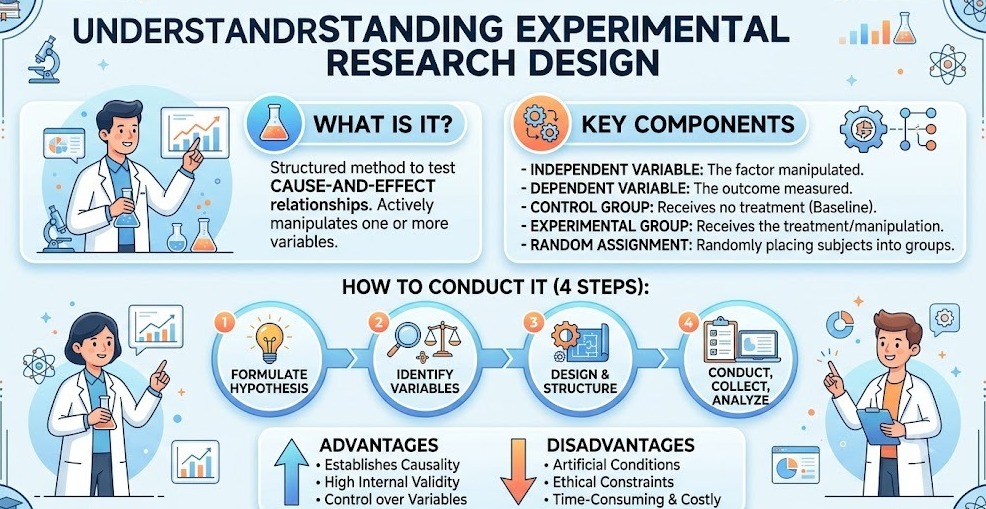
- Establishes Cause-and-Effect Relationships — Perhaps the greatest advantage of experimental research design is that it is uniquely equipped to demonstrate a true cause-and-effect relationship. By manipulating independent variables and observing changes in the dependent variable, experimental research establishes causality in a way that observational studies simply cannot.
- High Internal Validity — Because researchers can control extraneous variables and confounding variables, well-designed experiments have high internal validity. This means researchers can be confident that the manipulation, not some other factor, caused the observed changes.
- Control Over Variables — A defining strength of experimental research design is the ability to control conditions tightly. Using control groups and treatment groups allows for direct comparisons, isolating the effect of the independent variable from outside influences.
- Replicability — A properly conducted experiment, especially a true experimental design, can be repeated by other researchers. This replicability strengthens confidence in the research findings and supports the broader scientific process.
- Strong Statistical Foundation — Experimental research design lends itself well to statistical analysis, allowing researchers to quantify the strength and significance of relationships between variables. This makes findings more objective and easier to validate.
- Versatility Across Fields — From medical research testing new treatments, to market research evaluating consumer responses, to social science research exploring human behavior, experimental research design is one of the most widely applicable research methods available.
- Random Assignment Reduces Bias — When participants are randomly assigned to different groups, the risk of pre-existing differences skewing results is minimized, which improves the overall reliability of the results.
- Clear, Structured Process — Compared to some other forms of research, experimental research design follows a logical, step-by-step study design, making it easier to plan, execute, and evaluate research projects with measurable outcomes.
Disadvantages of Experimental Research Design
- Artificial Conditions May Limit External Validity — Because experiments are often conducted in controlled, sometimes artificial environments (such as a lab), results may not always reflect real-world behavior. This can reduce external validity, meaning findings may not generalize well to natural settings.
- Ethical Constraints — Not all independent variables can be ethically manipulated. For example, researchers cannot expose human research subjects to genuine harm, which limits the types of experimental research designs that can be used in certain medical research or psychological studies.
- Time-Consuming and Costly — Designing experiments, recruiting research subjects, randomly assigning them to treatment groups, and running a controlled experiment can require significant time, funding, and resources, especially compared to simpler observational studies.
- Difficulty Controlling All Extraneous Variables — Despite best efforts, it’s nearly impossible to control every confounding variable. Unaccounted-for extraneous variables can still confound results, weakening the internal validity of even a carefully designed experiment.
- Limited Feasibility for Some Research Questions — Certain research questions simply cannot be studied experimentally, particularly when manipulating the independent variable is impossible or unethical, forcing researchers toward quasi-experimental or pre-experimental research design instead.
- Sample Size and Generalizability Concerns — Many design experiments use relatively small or specific groups of research subjects, which can limit how confidently findings can be generalized to a broader population, affecting external validity.
- Demand Characteristics — Participants who are aware they are part of an experiment may change their behavior simply because they know they’re being observed, introducing bias that’s difficult to fully eliminate even with a control group in place.
- Not Always the Most Practical Type of Design — For some research projects, a quasi-experimental design or other type of research design may be more practical when full control over random assignment and extraneous variables isn’t possible, even though this comes at the cost of weaker internal validity.
- Ultimately, weighing the advantages of experimental research against its limitations helps researchers determine whether a true experimental research design, a quasi-experimental design, or another type of experimental design is the right fit for their specific research question, balancing the trade-off between internal validity and external validity.
Examples of Experimental Research Design
To better understand how experimental research design works in practice, it helps to look at real examples across different fields. These examples highlight the different types of experimental research designs and how each is applied to answer a unique research question.
True Experimental Design Example
- A pharmaceutical company wants to test whether a new medication lowers blood pressure. Researchers randomly assign participants into two groups: one experimental group receives the new medication (the independent variable), and one control group receives a placebo.
- Blood pressure (the dependent variable) is measured before and after the treatment period.
- Because participants are randomly assigned and a control group and treatment group are used, this qualifies as a true experimental design — the gold standard in medical research for establishing a cause-and-effect relationship between the medication and changes in blood pressure.
Quasi-Experimental Design Example
- A school district wants to study whether a new teaching method improves student test scores, but it isn’t ethical or practical to randomly assign students to different classrooms.
- Instead, researchers compare two existing classrooms — one using the new teaching method and one using the traditional method — without random assignment.
- Since this experiment lacks true random assignment of research subjects, it is considered a quasi-experimental design. It still allows researchers to observe a relationship between the variables, but with somewhat weaker internal validity compared to a true experimental research design.
Pre-Experimental Research Design Example
- A company tests a new employee training program by measuring productivity before the training, implementing the training, and then measuring productivity again afterward — without using a control group at all.
- Because there’s no comparison group and no random assignment, this is classified as pre-experimental research design. While simple and low-cost, it offers the weakest evidence for a true cause-and-effect relationship, since other extraneous variables could explain the observed changes in productivity.
Between-Subjects Design Example
- A market research team wants to know which of two advertisements is more persuasive. They randomly assign participants into two different groups: one group views Advertisement A, and the other views Advertisement B.
- Each participant only experiences one condition, making this a between-subjects design, commonly used in market research and social science research to compare two groups without one influencing the other.
Repeated-Measures Design Example
- A psychology researcher studying memory wants to see if caffeine improves recall. Instead of using two separate groups, the same participants are tested once without caffeine and once after consuming caffeine.
- Because the same research subjects are measured across multiple conditions, this is a repeated-measures design — useful for reducing variability between participants, although researchers must control for order effects as a potential confound.
Social Science Research Example
- A researcher investigates whether listening to music while studying affects test performance. Participants are randomly assigned to study either in silence (control group) or with background music (experimental group), and their test scores are compared.
- This example illustrates how experimental research design is applied beyond clinical settings, demonstrating its value across academic research and broader social science research.
- These examples show that experimental research design isn’t a single, rigid method — it includes a range of types of experimental research designs, from true experimental research design to quasi-experimental and pre-experimental approaches, each suited to different research questions, resources, and ethical considerations. Whether used in medical research, market research, or academic research, choosing the right type of design ultimately determines the strength and reliability of the research findings.
