
Blog
How To Write Declarative Hypothesis With Examples

What Is a Declarative Hypothesis? Definition, Meaning, and Importance in Research
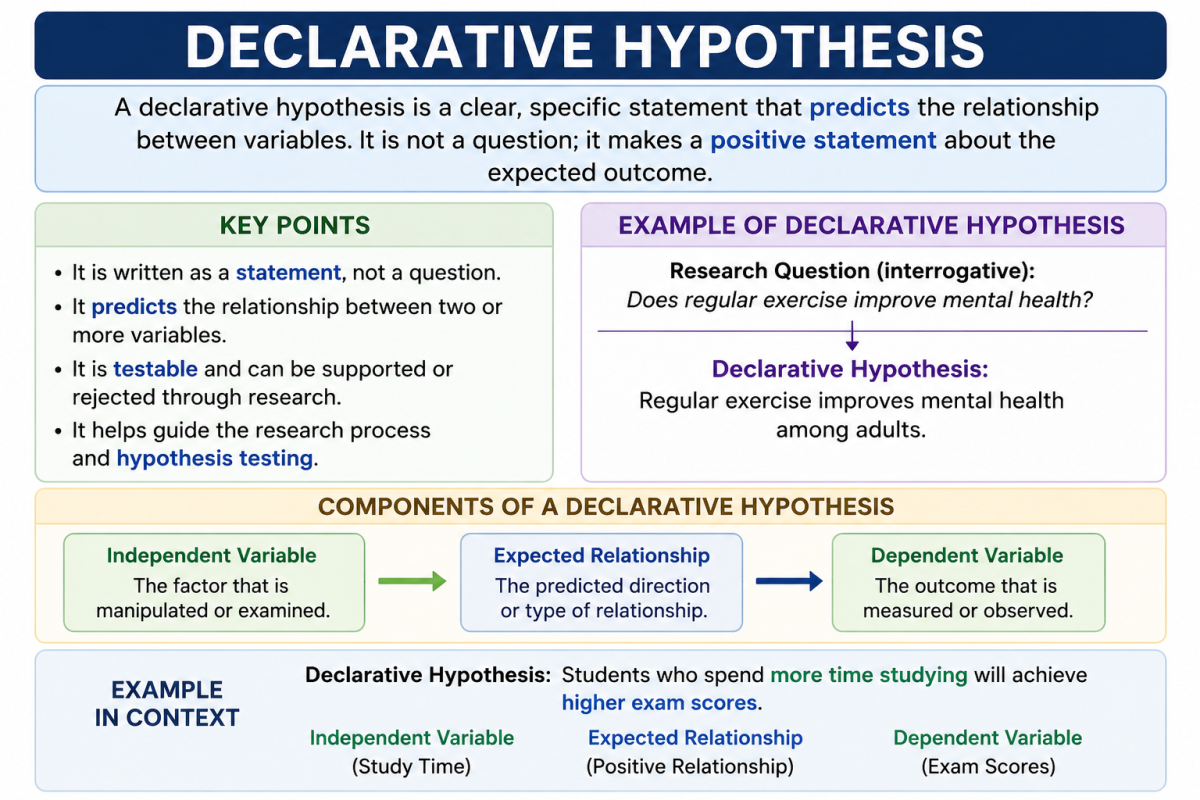
- A Declarative Hypothesis is a clear statement that predicts the outcome of a study without asking a question.
- In research, a hypothesis takes the declarative form because the researcher makes a positive statement about the outcome that is expected to occur.
- Unlike an interrogative hypothesis, which is written as a question, declarative hypotheses are expressed as statements that can later be examined through hypothesis testing.
- A Declarative Hypothesis is a testable proposition because it can be supported or rejected using collected data and statistical analysis.
- Simply put, a hypothesis is a predictive statement that explains what the researcher expects to happen between two variables or among two or more variables.
- A research hypothesis is a predictive explanation based on logical reasoning, existing knowledge, and previous research studies.
- In many cases, the researcher claims that a relationship exists between the variables being examined.
- For example:
- Research Question: Does study time affect academic performance?
- Declarative Hypothesis: Students who spend more time studying achieve higher academic performance.
- In this example:
- Study time represents the independent variable.
- Academic performance represents the dependent variable.
- The statement predicts a positive relationship between the variables.
Meaning of a Declarative Hypothesis
- A Declarative Hypothesis serves as a foundation for the entire research process.
- It helps the researcher:
- Define the direction of the investigation.
- Develop an appropriate experimental design.
- Select suitable research methodology.
- Identify the independent variable and dependent variable.
- Determine how testing hypotheses will be conducted.
- A strong research hypothesis is logically derived from theory, literature, and existing knowledge.
- Because a hypothesis is a testable statement, researchers can determine whether it is true or false through hypothesis testing.
- During testing a hypothesis, the statement is often tested statistically by converting it into a null form known as null hypotheses.
Importance of Declarative Hypotheses in Research
- Declarative hypotheses are important because they:
- Provide structure to the research framework.
- Guide the research methodology.
- Help researchers refine their study objectives.
- Make quantitative research more focused.
- Support hypothesis testing and statistical analysis.
- Assist in identifying evidence in favor of the proposed claim.
- Allow researchers to gather collected data systematically.
- Within the scientific method, researchers formulate hypotheses before data collection begins.
- Since a hypothesis is a predictive statement, it helps researchers predict future outcomes or associations.
- Declarative hypotheses are widely used in quantitative research because variables can be measured and tested statistically.
- In directional research, the hypothesis stipulates the direction of the expected differences or expected relationship between variables.
- In non-directional research, the researcher only states that a relationship exists without specifying the expected direction.
Characteristics of a Good Research Hypothesis
A good research hypothesis should possess several important qualities:
- Clear
- The statement should be easy to understand.
- Specific
- It should identify the variables clearly.
- Testable
- The hypothesis is a testable statement that can be verified using collected data.
- Logical
- It should be logically derived from previous studies and theoretical foundations.
- Measurable
- Variables should be capable of statistical measurement.
- Relevant
- The statement should address the research question directly.
- Predictive
- The hypothesis should predict possible outcomes or associations.
- Feasible
- Researchers should be able to test it using available resources.
These characteristics of a good hypothesis help researchers create strong research hypotheses that improve the quality of research studies.
How To Write Declarative Hypothesis With Examples: A 7-Step Process to Formulate a Good Research Hypothesis
Step 1: Begin With a Clear Research Question
- Every hypothesis begins with a research question.
- The research question identifies the issue that the researcher intends to investigate.
- Examples:
- Does social media usage influence academic performance?
- Does exercise reduce stress levels?
- A clear research question makes it easier to formulate a strong research hypothesis.
Step 2: Review Existing Knowledge
- Researchers examine:
- Previous research studies.
- Published literature.
- Existing theories.
- Existing knowledge helps researchers refine their ideas and establish logical reasoning.
- A hypothesis should always be logically derived from evidence and theory rather than assumptions.
Step 3: Identify the Variables
- Most hypotheses involve two variables:
- Independent variable.
- Dependent variable.
- Example:
- Independent variable: Exercise frequency.
- Dependent variable: Stress level.
- Some studies may include two or more variables, but beginners often focus on a single independent and single dependent variable.
Step 4: Determine the Expected Relationship
- The researcher decides whether:
- A positive relationship is expected.
- A significant difference between groups is expected.
- An association between variables is expected.
- The relationship between the variables should reflect the study objectives.
Step 5: Decide Whether the Hypothesis Is Directional or Non-Directional
- Directional hypotheses specify the expected direction.
Example:
- Employees receiving training will perform better than employees who do not receive training.
- Directional hypotheses stipulate the direction of the expected differences.
- Non-directional hypotheses do not indicate the expected direction.
Example:
- Employee training affects job performance.
- Non-directional hypotheses simply state that a relationship exists.
Step 6: Write the Declarative Statement
- The researcher makes a positive statement about the outcome.
- The statement should:
- Be clear.
- Be testable.
- Be predictive.
- Be measurable.
Example:
- Increased physical activity leads to lower stress levels among university students.
This demonstrates that a hypothesis is a predictive statement rather than a question.
Step 7: Refine and Evaluate the Statement
Before finalizing the statement, ask:
- Is the hypothesis testable?
- Does it answer the research question?
- Is it logically derived?
- Does it identify the variables clearly?
- Can it be examined using statistical analysis?
- Is an appropriate experimental design available?
Example of the Complete Process
Research Question:
- Does sleep duration affect academic performance?
Independent Variable:
- Sleep duration.
Dependent Variable:
- Academic performance.
Expected Relationship:
- Positive relationship.
Declarative Hypothesis:
- Students who sleep at least eight hours per night achieve higher academic performance than students who sleep fewer hours.
Null Hypothesis:
- There is no significant difference in academic performance based on sleep duration.
During hypothesis testing, researchers may reject the null hypothesis if evidence to reject the null form is found.
How To Write Declarative Hypothesis With Examples for Different Research Questions
Example 1: Education Research
Research Question:
- Does class attendance influence academic achievement?
Declarative Hypothesis:
- Students with higher attendance rates achieve better academic results.
Null Hypothesis:
- Attendance has no effect on academic achievement.
Example 2: Health Research
Research Question:
- Does exercise reduce stress?
Declarative Hypothesis:
- Individuals who exercise regularly experience lower stress levels.
Alternative Hypothesis:
- Exercise significantly influences stress levels.
Example 3: Business Research
Research Question:
- Does employee training improve productivity?
Declarative Hypothesis:
- Employee training improves organizational productivity.
Example 4: Marketing Research
Research Question:
- Does social media advertising increase sales?
Declarative Hypothesis:
- Social media advertising increases product sales.
Example 5: Technology Research
Research Question:
- Does artificial intelligence improve customer service efficiency?
Declarative Hypothesis:
- Artificial intelligence improves customer service efficiency.
Example 6: Associative Hypothesis Example
- A positive relationship exists between study habits and examination performance.
This is termed as statistical because it can be examined using statistical analysis.
Example 7: Causal Hypothesis Example
- Increased training causes higher employee productivity.
Causal hypothesis examples focus on cause-and-effect relationships.
Associative and Causal Relationships
Researchers commonly distinguish between:
- Associative hypothesis.
- Causal hypothesis.
Associative and causal hypotheses differ because:
- Associative hypothesis examines association between variables.
- Causal hypothesis attempts to explain why changes occur.
Both associative and causal approaches are common in research methodology.
Directional vs Non-Directional Hypotheses: Key Differences and When to Use Each
- Among the major types of hypotheses used in research, directional hypotheses and non-directional hypotheses are two of the most common.
- Both forms are considered declarative because the researcher makes a positive statement about the outcome rather than writing an interrogative question.
- A Declarative Hypothesis helps the researcher predict the relationship between the variables and provides direction for the research process.
What Are Directional Hypotheses?
- Directional hypotheses specify the expected direction of the outcome.
- In directional research, the researcher predicts whether the relationship will be positive, negative, higher, lower, greater, or smaller.
- A directional hypothesis stipulates the direction and clearly identifies the direction of the expected differences.
- These research hypotheses are usually developed when previous research studies and existing knowledge provide evidence in favor of a specific outcome.
Example:
- Students who attend revision classes will achieve higher examination scores than students who do not attend.
In this example:
- Independent variable: Attendance in revision classes.
- Dependent variable: Examination scores.
- Expected relationship: Positive relationship.
What Are Non-Directional Hypotheses?
- Non-directional hypotheses state that a relationship exists but do not predict the expected direction.
- The researcher only claims that an association between variables or a significant difference between groups exists.
- Non-directional hypotheses are useful when there is limited evidence in favor of a particular outcome.
Example:
- Revision classes significantly affect examination scores.
Here:
- The relationship between the variables is acknowledged.
- No expected direction is specified.
Key Differences Between Directional and Non-Directional Hypotheses
Directional Hypotheses
- Specify the expected direction.
- Predict the outcome.
- Stipulate the direction of the expected differences.
- Usually rely on existing knowledge and previous research studies.
- Common in directional research.
Non-Directional Hypotheses
- State only that a relationship exists.
- Do not predict whether the effect is positive or negative.
- Focus on determining whether a significant difference exists.
- Useful when evidence is insufficient.
When to Use Directional Hypotheses
Use directional hypotheses when:
- Previous research studies support a specific prediction.
- The researcher uses logical reasoning to predict outcomes.
- The expected relationship is already known.
- The research framework is based on established theories.
When to Use Non-Directional Hypotheses
Use non-directional hypotheses when:
- Findings from previous studies are inconsistent.
- Limited evidence is available.
- The researcher cannot predict the expected direction confidently.
- The goal is simply to determine whether a relationship exists.
Relationship With Null Hypotheses
- During hypothesis testing, declarative hypotheses are tested statistically by converting them into a null form.
- Null hypotheses assume no association between variables.
- Researchers collect evidence to reject the null hypothesis.
- If sufficient evidence to reject the null hypothesis is obtained, support is provided for the alternative hypothesis.
Example:
Alternative Hypothesis:
- Employee training improves productivity.
Null Hypothesis:
- Employee training does not significantly affect productivity.
Characteristics of a Good Research Hypothesis and Why They Matter
- A good research hypothesis improves the quality of the research methodology and strengthens the entire scientific method.
- Strong research hypotheses guide data collection, statistical analysis, and experimental design.
Characteristics of a Good Hypothesis
1. It Is Clear
- The statement should be easy to understand.
- Readers should immediately recognize the expected relationship.
2. It Is Testable
- A hypothesis is a testable statement.
- Testing a hypothesis requires collected data and statistical analysis.
- Because the hypothesis is a testable proposition, researchers can determine whether it is true or false.
3. It Is Predictive
- A research hypothesis is a predictive statement.
- Researchers formulate hypotheses to predict future outcomes.
- The hypothesis should explain what the researcher expects to occur.
4. It Is Logically Derived
- Good research hypotheses are logically derived from existing knowledge.
- Logical reasoning ensures that predictions are scientifically supported.
- The statement should emerge from previous research studies and theory.
5. It Identifies Variables Clearly
- The relationship between the variables should be obvious.
- Most studies involve two variables:
- Independent variable.
- Dependent variable.
- Beginners often work with a single independent and single dependent variable.
6. It Is Measurable
- Variables must be capable of quantitative measurement.
- Quantitative research relies on statistical analysis and hypothesis testing.
7. It Is Relevant to the Research Question
- Every hypothesis should address the research question directly.
- A mismatch between the research question and hypothesis weakens the study.
8. It Is Feasible
- Researchers should have access to an appropriate experimental design.
- Available resources should support testing hypotheses effectively.
Why These Characteristics Matter
These characteristics of a good hypothesis help researchers:
- Refine the research process.
- Strengthen the research framework.
- Improve research methodology.
- Produce reliable collected data.
- Support accurate statistical analysis.
- Increase confidence in research findings.
Common Mistakes to Avoid When You Formulate a Declarative Hypothesis
- Although writing a Declarative Hypothesis appears simple, many researchers make avoidable mistakes.
- Understanding these errors helps create a strong research hypothesis.
Mistake 1: Writing an Interrogative Statement
Incorrect:
- Does exercise improve mental health?
Correct:
- Regular exercise improves mental health.
- A hypothesis takes the declarative form because the researcher makes a positive statement about the outcome.
Mistake 2: Failing to Identify Variables
- Some statements fail to specify the independent variable and dependent variable.
- Without clear variables, hypothesis testing becomes difficult.
Mistake 3: Writing a Non-Testable Statement
Incorrect:
- Good leadership creates happiness.
- Concepts such as happiness may be difficult to measure.
Correct:
- Participative leadership increases employee job satisfaction scores.
Mistake 4: Making Vague Predictions
Incorrect:
- Social media affects people.
Correct:
- Daily social media use influences academic performance among university students.
Mistake 5: Ignoring Existing Knowledge
- Research hypotheses should be logically derived from previous findings.
- Existing knowledge strengthens the credibility of predictions.
Mistake 6: Including Too Many Variables
- Studies involving two or more variables are acceptable.
- However, beginners should avoid unnecessary complexity.
- Using a single dependent variable often simplifies analysis.
Mistake 7: Confusing Associative and Causal Relationships
- Associative hypothesis focuses on association between variables.
- Causal hypothesis attempts to explain cause-and-effect relationships.
- Researchers should understand associative and causal differences before writing hypotheses.
Mistake 8: Forgetting the Null Hypothesis
- Every statistical hypothesis should have corresponding null hypotheses.
- During testing hypotheses, researchers attempt to obtain evidence to reject the null hypothesis.
Mistake 9: Writing Statements Without Logical Reasoning
- Predictions should not be based on personal opinions.
- Strong research hypotheses rely on evidence and theory.
How To Write Declarative Hypothesis With Examples and Best Practices for Strong Research Hypotheses
- A Declarative Hypothesis remains one of the most important tools in the scientific method.
- Because a research hypothesis is a predictive statement, researchers should follow best practices to improve research quality.
Best Practice 1: Start With a Clear Research Question
Example:
Research Question:
- Does employee motivation affect productivity?
Declarative Hypothesis:
- Employee motivation positively influences productivity.
Best Practice 2: Identify the Variables
Example:
- Independent variable: Employee motivation.
- Dependent variable: Productivity.
The relationship between the variables should be clearly visible.
Best Practice 3: Base Predictions on Existing Knowledge
- Strong research hypotheses are logically derived from previous research studies.
- Evidence in favor of a relationship increases confidence in predictions.
Best Practice 4: Ensure the Hypothesis Is Testable
- A hypothesis is a testable statement.
- Researchers should be able to collect data and conduct statistical analysis.
Best Practice 5: Choose the Appropriate Type
Common types and examples include:
- Directional hypotheses.
- Non-directional hypotheses.
- Null hypotheses.
- Alternative hypothesis.
- Associative hypothesis.
- Causal hypothesis.
- Statistical hypothesis.
Best Practice 6: Keep the Statement Specific
Example:
Weak:
- Technology affects education.
Strong:
- Online learning platforms improve student academic performance.
Best Practice 7: Use Quantitative Measures
- Quantitative studies require measurable variables.
- Measurable variables improve hypothesis testing.
Best Practice 8: Refine the Statement Before Data Collection
Ask the following questions:
- Is the hypothesis testable?
- Does it answer the research question?
- Is it logically derived?
- Can it be examined statistically?
- Does an appropriate experimental design exist?
Example of a Complete Declarative Hypothesis
Research Question:
- Does sleep duration influence academic performance?
Declarative Hypothesis:
- Students who sleep at least eight hours per night achieve higher academic performance than students who sleep fewer hours.
Null Hypothesis:
- Sleep duration has no significant effect on academic performance.
Alternative Hypothesis:
- Sleep duration significantly influences academic performance.
During hypothesis testing, collected data may provide evidence to reject the null hypothesis. If enough evidence to reject the null form exists, the researcher may conclude that the null hypothesis is false and support the alternative hypothesis.
Ultimately, Declarative Hypothesis writing allows researchers to predict outcomes, organize the research process, strengthen the research framework, and produce reliable findings. Well-written declarative hypotheses are essential components of research methodology and play a critical role in testing hypotheses within modern quantitative research.
Research Hypotheses
Types of Research Hypotheses
Explore key hypothesis categories used in academic research and studies.
Types of Hypotheses
Overview
→
Research Hypotheses
Basics
→
Alternative
H1
→
Null
H0
→
Directional
One-tailed
→
Non-Directional
Two-tailed
→
Simple
One variable
→
Complex
Multiple variables
→
Causal
Cause-effect
→
Associative
Relationship
→
Statistical
Testing
→
Working
Temporary
→
Declarative
Statement form
→
Question Form
Question-based
→
Empirical
Observed data
→
Logical
Reasoned
→
Value
Business focus
→
