
Blog
How To Write Question-form Hypothesis With Examples

What Is a Question-form Hypothesis? Definition, Purpose, and Role in the Scientific Method
- A Question-form Hypothesis is a hypothesis written as a question rather than a declarative statement. Instead of stating a prediction directly, it asks whether a specific relationship exists between two or more variables.
- In scientific research, a hypothesis is a statement or prediction that can be tested. A Question-form Hypothesis presents the same idea in interrogative form, making it easier for some researchers to connect it with the original research question.
- For example:
- Research question: Does social media usage affect academic performance among university students?
- Question-form Hypothesis: Is there a relationship between social media usage and academic performance among university students?
- A Question-form Hypothesis is often used during the early stages of the research process, especially when a researcher is still exploring what is already known about the topic.
- Since scientific investigation begins with a research question, many researchers use a Question-form Hypothesis as a bridge between developing a research question and creating a formal prediction.
- The concept is based on the principles of the scientific method, which requires ideas to be:
- Observable.
- Measurable.
- Researchable.
- Reproducible.
- Falsifiable.
- Philosopher Karl Popper emphasized the importance of falsifiability, arguing that scientific claims should be capable of being disproved. Therefore, a good Question-form Hypothesis must allow researchers to confirm or disprove the proposed relationship.
- A Question-form Hypothesis serves several purposes in a research study:
- Provides Direction
- It helps the researcher focus on a particular subject of interest.
- It prevents unnecessary data collection.
- It creates coherence throughout the research project.
- Guides Research Design
- It helps researchers select suitable research methods.
- It influences sample size decisions.
- It determines how data collection and data analysis will be conducted.
- Clarifies Variables
- It encourages clearly defining the independent variable and dependent variable.
- It improves understanding of the relationship between variables.
- Supports Statistical Analysis
- It prepares the study for statistical hypothesis testing.
- It enables researchers to evaluate statistical significance.
- Generates New Insights
- It allows scientific research to build on knowledge already known.
- It creates opportunities for discovering new insights with collected data.
- Provides Direction
- In many discussions, the terms research question and hypothesis are often used interchangeably. However, they perform different functions within a conceptual framework.
- A Question-form Hypothesis can be used in:
- Quantitative research.
- Qualitative studies.
- Mixed-method research.
- Basic types of research including descriptive, explanatory, and experimental studies.
- In academic writing, a Question-form Hypothesis should be:
- Concise.
- Testable.
- Outcome based.
- Based on existing knowledge.
- Aligned with the research design.
- Relevant to the potential impact of the study.
How To Write Question-form Hypothesis With Examples: A 7-Step Process for Academic Writing
Step 1: Identify Your Subject of Interest
- Every research project starts with selecting a subject of interest.
- A researcher should brainstorm topics that are:
- Meaningful.
- Researchable.
- Feasible.
- Related to scientific research.
- Examples include:
- Social media use.
- Employee motivation.
- Climate change.
- Online learning.
- Customer satisfaction.
- Choosing the right topic increases the feasibility of the entire research process.
Step 2: Conduct a Literature Review
- Before writing a Question-form Hypothesis, researchers should review what is already known about the topic.
- A literature review helps:
- Discover gaps in previous studies.
- Build a conceptual framework.
- Understand existing theories.
- Refine ideas.
- Since good hypotheses are based on existing evidence, this step is essential.
Step 3: Develop the Research Question
- Scientific research begins with a research question.
- While developing a research question, consider:
- Is it measurable?
- Is it observable?
- Is it researchable?
- Does it address a real problem?
- Example: Research Question Does employee recognition improve job satisfaction?
- Open-ended questions are common in qualitative research, whereas quantitative research usually requires more focused questions.
Step 4: Identify the Independent Variable and Dependent Variable
- A Question-form Hypothesis examines the relationship between two variables.
- The:
- Independent variable is the factor expected to influence change.
- Dependent variable is the outcome being measured.
- Example:
- Independent variable: Employee recognition.
- Dependent variable: Job satisfaction.
- Clearly defining variables improves coherence and strengthens the framework of the study.
Step 5: Formulate the Question-form Hypothesis
- After identifying variables, formulate the hypothesis in question form.
- Example: Is there a relationship between employee recognition and job satisfaction?
- Another example: Does study time influence examination performance among college students?
- A strong Question-form Hypothesis should:
- Be concise.
- Be measurable.
- Be falsifiable.
- Be testable.
- Align with the research design.
- Writing a hypothesis becomes easier when variables are clearly identified.
Step 6: Create Related Statistical Hypotheses
- Most quantitative research includes: Null Hypothesis (H₀)
- States that no relationship exists.
- Suggests that a relationship exists.
- These hypotheses support statistical hypothesis testing.
- If statistical analysis shows sufficient evidence, the null hypothesis is rejected.
- Researchers then evaluate statistical significance using collected data.
Step 7: Refine and Evaluate the Hypothesis
- Before beginning data collection, researchers should refine their hypothesis.
- Ask the following questions:
- Is it testable?
- Is it measurable?
- Is it based on existing knowledge?
- Is the sample size realistic?
- Does it align with the research design?
- Can findings confirm or disprove the prediction?
- Practical tips for refinement include:
- Removing unnecessary words.
- Improving clarity.
- Ensuring falsifiability.
- Seeking feedback from peers.
- Using generative AI tools responsibly for idea development.
Examples of a Question-form Hypothesis
- Is there a relationship between exercise frequency and stress levels?
- Does online learning affect academic performance?
- Is customer satisfaction influenced by service quality?
- Does advertising expenditure predict sales growth?
- Is employee training associated with productivity levels?
A well-written Question-form Hypothesis helps researchers predict possible outcomes while maintaining scientific rigor.
Question-form Hypothesis vs Research Question: Understanding the Key Differences
- Many people assume a Question-form Hypothesis and a research question are identical because both appear as questions.
- Although they are closely connected, they have different purposes.
Research Question
- Explores a problem.
- Guides the research process.
- May include broad or open-ended questions.
- Common in qualitative studies.
Example:
How do university students perceive online learning?
Question-form Hypothesis
- Predicts a possible outcome.
- Focuses on the relationship between variables.
- Supports statistical analysis.
- Common in quantitative research.
Example:
Does online learning influence student performance?
Main Differences
| Feature | Research Question | Question-form Hypothesis |
|---|---|---|
| Purpose | Explore issues | Predict outcomes |
| Scope | Broad | Specific |
| Variables | May not specify variables | Usually involves two or more variables |
| Statistical Testing | Not always required | Supports statistical hypothesis testing |
| Format | Open-ended questions possible | Usually asks about relationships |
- The research question comes first.
- The hypothesis is developed afterward.
- Together, they strengthen the research project and improve academic writing quality.
Common Formats and Structures Used in a Question-form Hypothesis
- There is no single format for writing a Question-form Hypothesis, but several structures are commonly used.
1. Relationship Format
Structure:
Is there a relationship between X and Y?
Example:
Is there a relationship between sleep duration and academic achievement?
This format focuses on the relationship between two variables.
2. Influence Format
Structure:
Does X affect Y?
Example:
Does exercise frequency affect stress levels?
This structure emphasizes cause-and-effect relationships.
3. Association Format
Structure:
Is X associated with Y?
Example:
Is employee training associated with productivity?
This format is widely used in statistical hypothesis studies.
4. Prediction Format
Structure:
Can X predict Y?
Example:
Can advertising expenditure predict sales growth?
This type focuses on prediction and outcome based analysis.
5. Comparative Format
Structure:
Is there a difference between X and Y regarding Z?
Example:
Is there a difference between online and traditional learning regarding student performance?
This structure is useful for comparative research studies.
Characteristics of a Good Format
A Question-form Hypothesis should:
- Be concise.
- Include measurable variables.
- Reflect the relationship between variables.
- Support data analysis.
- Align with research methods.
- Be scientifically testable.
- Enable researchers to test the hypothesis objectively.
By using these structures, researchers can write a good hypothesis that strengthens scientific research and contributes to reliable, reproducible findings.
Examples of Question-form Hypothesis for Different Types of Research Studies
- A Question-form Hypothesis can be applied across many fields of scientific research and different research methods.
- Although a hypothesis is a statement in its traditional form, some researchers prefer using a Question-form Hypothesis because it directly connects the research question and hypothesis during the research process.
- Since every research project begins with a research question, choosing the correct hypothesis format helps maintain coherence throughout the study.
- The examples below show how a Question-form Hypothesis can be used in various research studies.
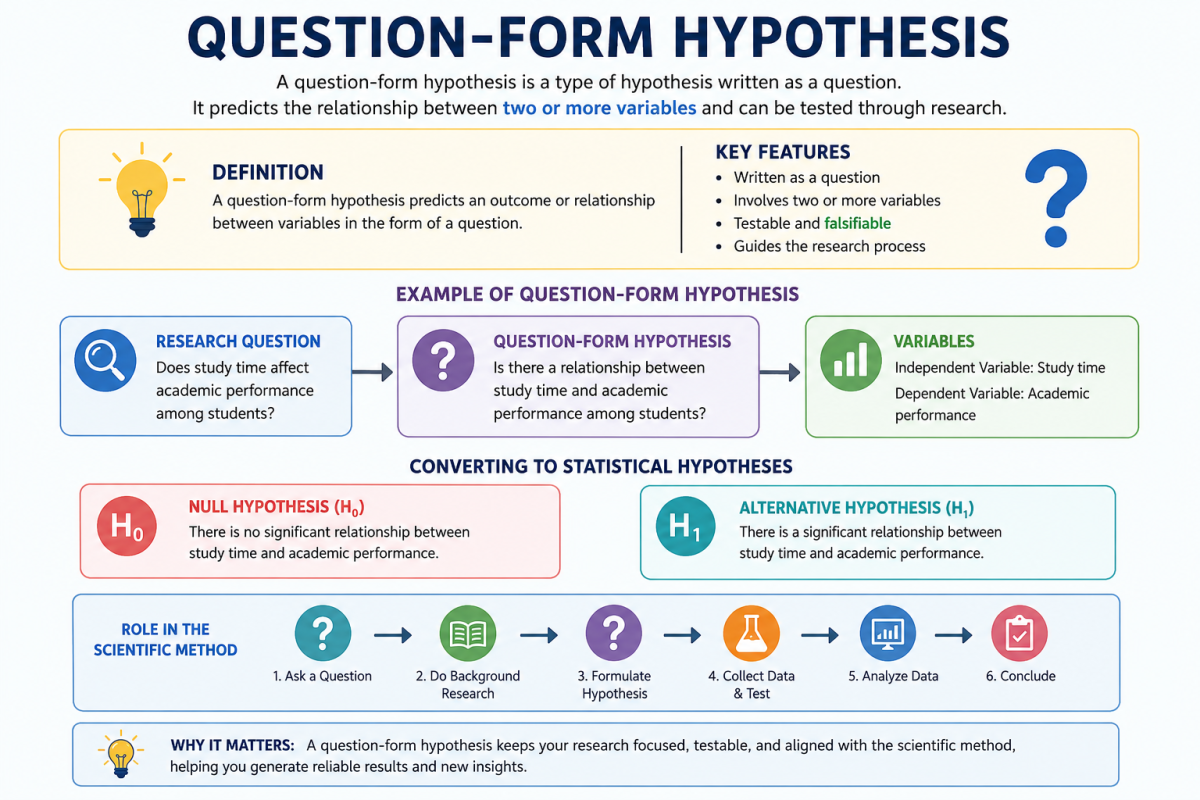
Quantitative Research Examples
- Quantitative research focuses on measurable variables and statistical analysis.
- Researchers collect numerical data and use statistical hypothesis testing to confirm or disprove predictions.
Education Research Study
- Research Question:
- Does study time influence student academic performance?
- Question-form Hypothesis:
- Is there a relationship between study time and academic performance among university students?
- Independent Variable:
- Study time.
- Dependent Variable:
- Academic performance.
- Null Hypothesis:
- There is no significant relationship between study time and academic performance.
- Alternative Hypothesis:
- There is a significant relationship between study time and academic performance.
- If statistical significance is achieved, the null hypothesis is rejected.
Healthcare Research Study
- Research Question:
- Does physical exercise affect blood pressure?
- Question-form Hypothesis:
- Does regular physical exercise influence blood pressure levels among adults?
- Relationship between two variables:
- Exercise frequency and blood pressure.
- Statistical analysis helps test the hypothesis using collected data.
Business Research Study
- Research Question:
- Does employee training improve productivity?
- Question-form Hypothesis:
- Is employee training associated with employee productivity?
- Researchers can predict possible outcomes and perform data analysis to evaluate the results.
Qualitative Research Examples
- Qualitative studies often rely on open-ended questions.
- However, some researchers still use a Question-form Hypothesis to establish a framework for investigation.
Social Media Research
- Research Question:
- How do students perceive social media use in learning?
- Question-form Hypothesis:
- Does social media use influence students’ learning experiences?
- Although qualitative research focuses more on experiences than statistical analysis, this approach can generate new insights.
Experimental Research Examples
- Experimental studies examine cause-and-effect relationships.
Psychology Research Study
- Question-form Hypothesis:
- Does sleep deprivation affect stress levels among working adults?
- Independent Variable:
- Sleep deprivation.
- Dependent Variable:
- Stress level.
- Because variables are observable and measurable, the study can produce reproducible findings.
Comparative Research Examples
- Comparative studies investigate differences between groups.
Online Learning Research
- Question-form Hypothesis:
- Is there a difference between online learning and face-to-face learning regarding academic achievement?
- Researchers may use several hypotheses when comparing multiple groups.
Marketing Research Examples
- Question-form Hypothesis:
- Can advertising expenditure predict sales growth?
- This outcome based approach helps researchers identify the potential impact of marketing strategies.
Environmental Research Examples
- Question-form Hypothesis:
- Does urban tree coverage influence air quality?
- The study may contribute new insights that improve environmental policies.
Practical Tips for Creating Examples
- Brainstorm several possible topics before selecting one.
- Ensure the topic is researchable and feasible.
- Build examples based on existing knowledge and information already known about the topic.
- Align the hypothesis with the research design.
- Consider sample size requirements before beginning data collection.
- Use generative AI tools responsibly to refine ideas rather than replacing critical thinking.
How Variables, Falsifiability, and the Scientific Method Strengthen a Question-form Hypothesis
- A strong Question-form Hypothesis depends on three major elements:
- Variables.
- Falsifiability.
- The scientific method.
The Importance of Variables
- A Question-form Hypothesis usually investigates the relationship between variables.
- Most studies involve two or more variables.
- These variables must be clearly defining and easy to measure.
Independent Variable
- The independent variable is the factor expected to cause change.
- Examples include:
- Training programs.
- Advertising expenditure.
- Exercise frequency.
- Social media usage.
Dependent Variable
- The dependent variable represents the outcome being measured.
- Examples include:
- Productivity.
- Sales growth.
- Academic achievement.
- Stress levels.
- Clearly defining variables improves the conceptual framework and strengthens the research design.
Why Falsifiability Matters
- Karl Popper introduced the principle of falsifiability as a foundation of scientific research.
- According to Karl Popper, scientific claims must be falsifiable.
- This means researchers must be able to confirm or disprove their ideas through evidence.
- A Question-form Hypothesis should never be vague or impossible to test.
Example of a Weak Hypothesis
- Does positive energy improve success?
- Problems:
- Not measurable.
- Not observable.
- Difficult to test.
Example of a Strong Hypothesis
- Does weekly exercise improve cardiovascular health among adults?
- Advantages:
- Measurable.
- Observable.
- Testable.
- Reproducible.
Role of the Scientific Method
- The scientific method provides a systematic framework for the research process.
- Typical stages include:
- Developing a research question.
- Conducting a literature review.
- Writing a hypothesis.
- Selecting research methods.
- Performing data collection.
- Conducting statistical analysis.
- Interpreting findings.
- Because a research study begins with a research question, the hypothesis acts as an educated guess regarding expected outcomes.
- Statistical hypothesis testing allows researchers to test the hypothesis objectively.
- During statistical analysis, researchers determine whether statistical significance exists.
- If sufficient evidence is found, the null hypothesis is rejected in favor of the alternative hypothesis.
- This process helps produce reliable and reproducible scientific findings.
Common Mistakes to Avoid When Writing a Question-form Hypothesis
- Even experienced researchers can make mistakes while writing a hypothesis.
Mistake 1: Using Vague Language
Poor Example:
- Does technology improve life?
Problems:
- Too broad.
- Lacks measurable variables.
Better Example:
- Does online learning improve examination scores among college students?
Mistake 2: Ignoring the Relationship Between Variables
- A good Question-form Hypothesis should focus on the relationship between two variables.
- Failure to specify variables weakens the framework.
Mistake 3: Creating Non-Testable Statements
- A testable hypothesis requires observable and measurable concepts.
- If ideas cannot be verified through collected data, the study loses scientific value.
Mistake 4: Failing to Align With Research Design
- The hypothesis should align with:
- Research methods.
- Data collection procedures.
- Sample size.
- Data analysis plans.
- Lack of alignment reduces feasibility.
Mistake 5: Skipping the Literature Review
- Researchers should understand what is already known about the topic.
- A literature review prevents duplication and supports hypotheses based on existing evidence.
Mistake 6: Writing Overly Long Questions
- A good Question-form Hypothesis should be concise.
- Long and complicated wording reduces clarity.
Mistake 7: Confusing a Research Question With a Hypothesis
- These terms are often used interchangeably, but they perform different functions.
- The research question explores the issue.
- The hypothesis provides a prediction.
Mistake 8: Forgetting Statistical Requirements
- Statistical hypotheses are important in quantitative research.
- Researchers should prepare:
- A null hypothesis.
- An alternative hypothesis.
- These hypotheses support statistical hypothesis testing and help determine statistical significance.
Why a Strong Question-form Hypothesis Improves Academic Writing and Research Quality
- A strong Question-form Hypothesis improves every stage of academic writing and scientific research.
It Provides Direction
- Researchers stay focused on their subject of interest.
- It prevents unnecessary data collection.
- It improves coherence across the entire research project.
It Strengthens Research Design
- A clear hypothesis helps researchers formulate effective research methods.
- It ensures all components align properly.
It Improves Data Analysis
- Statistical analysis becomes easier when variables are clearly identified.
- Researchers can interpret collected data more effectively.
It Supports Better Predictions
- A hypothesis is an educated guess regarding future outcomes.
- Researchers can predict possible relationships before conducting the study.
It Enhances Academic Writing Quality
- Strong hypotheses make reports more organized.
- They improve clarity and logical flow.
- They create a professional format for research papers.
It Produces Reliable Findings
- Testable hypotheses encourage reproducible results.
- Reliable findings increase confidence in scientific research.
It Encourages Discovery
- Researchers may uncover new insights that contribute to knowledge development.
- Findings may have significant practical applications and potential impact.
It Builds a Strong Foundation for Scientific Research
- The relationship between the research question and hypothesis creates a solid framework for investigation.
- A well-developed Question-form Hypothesis helps researchers write a good hypothesis, conduct meaningful research studies, and contribute valuable knowledge to their fields.
- Ultimately, a carefully designed Question-form Hypothesis transforms ideas into structured scientific inquiry and improves both research quality and academic writing standards.
Research Hypotheses
Types of Research Hypotheses
Explore key hypothesis categories used in academic research and studies.
Types of Hypotheses
Overview
→
Research Hypotheses
Basics
→
Alternative
H1
→
Null
H0
→
Directional
One-tailed
→
Non-Directional
Two-tailed
→
Simple
One variable
→
Complex
Multiple variables
→
Causal
Cause-effect
→
Associative
Relationship
→
Statistical
Testing
→
Working
Temporary
→
Declarative
Statement form
→
Question Form
Question-based
→
Empirical
Observed data
→
Logical
Reasoned
→
Value
Business focus
→
