
Blog
How To Write Logical Hypothesis With Examples

Introduction to Logical Hypothesis: Definitions and Key Concepts
- Definition of a Logical Hypothesis
- A logical hypothesis is a proposed explanation for a phenomenon that is formulated based on observations, existing knowledge, or theoretical frameworks.
- It is a testable hypothesis, meaning it can be evaluated empirically through scientific research.
- Unlike vague conjectures, a logical hypothesis is structured so that it can be confirmed or disproved through statistical analysis or other research methods.
- Key Components of a Logical Hypothesis
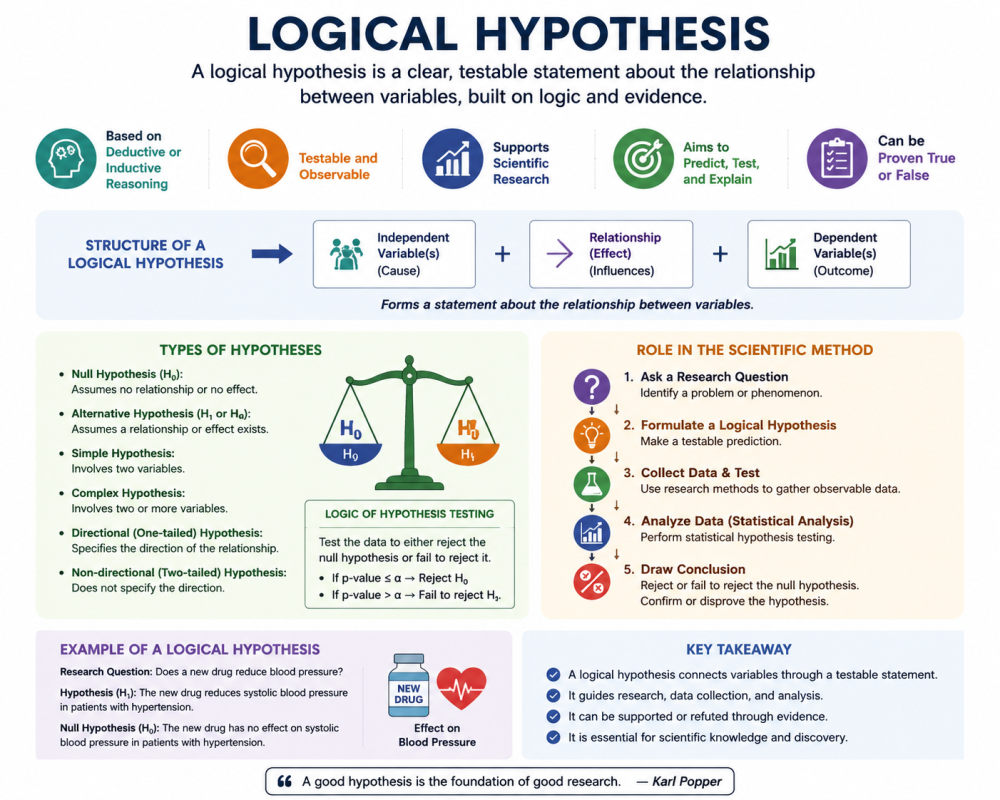
- Independent variable: The factor that is manipulated or observed to determine its effect.
- Dependent variable: The outcome or effect measured to see the relationship with the independent variable.
- Statement about the relationship: The hypothesis clearly predicts how the independent variable influences the dependent variable.
- Falsifiability: Following Karl Popper’s philosophy of science, a hypothesis must be observable and capable of being proven false.
- Deductive reasoning and inductive reasoning: A logical hypothesis can arise from deductive reasoning (general principles to specific predictions) or inductive reasoning (observations leading to general conclusions).
- Importance in the Scientific Method
- Logical hypotheses are central to the scientific method because they provide a framework for experiments.
- They guide the research process, helping scientists generate testable hypotheses and design studies that yield meaningful statistical results.
- They also allow for the formulation of null and alternative hypotheses, which are essential for hypothesis testing.
- Connection to Philosophers of Science
- Karl Popper: Emphasized that hypotheses must be falsifiable to be scientific.
- David Hume: Highlighted that hypotheses should avoid assumptions of causality without evidence.
- The philosophy of science ensures that the logic of hypothesis testing is grounded in reason, empirical data, and systematic observation.
Step-by-Step Process for Formulating a Logical Hypothesis
Formulating a logical hypothesis involves several precise steps. Following these ensures that your hypothesis is good, testable, and scientifically sound.
- Identify the Research Question
- Begin by clearly stating the research question that guides your study.
- Example: “Does the use of a new drug affect the recovery rate in patients?”
- This forms the foundation for hypotheses in scientific research.
- Conduct Background Research
- Gather information from existing studies, scientific literature, and observations.
- This helps generate possible hypotheses and ensures that your hypothesis is not vague or redundant.
- Use conceptual frameworks to structure your ideas logically.
- Define Variables
- Identify independent and dependent variables clearly.
- Specify two or more variables if testing complex hypotheses.
- Ensure each variable is observable and measurable, which allows the hypothesis to be tested statistically.
- Generate Hypotheses
- Formulate several hypotheses that address the research question.
- Distinguish between null and alternative hypotheses:
- Null hypothesis (H₀): Assumes no relationship or effect. Example: “The drug has no effect on recovery.”
- Alternative hypothesis (H₁): Predicts a relationship or effect. Example: “The drug improves recovery rates.”
- Decide whether a one-tailed hypothesis or two-tailed hypothesis is appropriate depending on the expected direction of effect.
- Check for Testability and Falsifiability
- Ensure that the hypothesis is testable through experiments or observations.
- Apply Karl Popper’s principle of falsifiability: the hypothesis should allow the null hypothesis to be rejected if evidence contradicts it.
- Refine the Hypothesis Using Deductive or Inductive Reasoning
- Use deductive reasoning to derive specific predictions from general principles.
- Use inductive reasoning to build general conclusions from specific observations.
- Example of deductive approach: “If a drug inhibits viral replication, then patients receiving the drug will recover faster.”
- Example of inductive approach: Observing faster recovery in treated patients and forming a hypothesis for testing.
- Finalize the Hypothesis
- Ensure clarity: the hypothesis suggests a clear relationship between variables.
- Check that it is specific, observable, and measurable.
- Confirm alignment with the research process and the scientific method.
Types of Hypotheses in Scientific Research
Understanding the types of hypotheses ensures appropriate application in scientific research.
- Null and Alternative Hypotheses
- Null hypothesis (H₀): Predicts no effect or relationship.
- Alternative hypothesis (H₁): Predicts the presence of an effect or a specific relationship.
- Testing the hypothesis involves statistical hypothesis testing, where you either reject the null hypothesis or fail to reject it based on data.
- Simple vs. Complex Hypotheses
- Simple hypothesis: Examines the relationship between two variables.
- Complex hypothesis: Involves two or more variables, often requiring more sophisticated statistical analysis.
- Directional vs. Non-directional Hypotheses
- Directional hypothesis: Predicts the direction of the effect (e.g., increase or decrease).
- Non-directional hypothesis: Predicts that a relationship exists without specifying the direction.
- Working Hypotheses and Research Hypotheses
- Working hypotheses: Provisional hypotheses used to guide early stages of scientific research.
- Research hypotheses: Formulated for formal testing, often through hypothesis tests.
- Empirical Hypotheses
- Directly based on observations or experiments.
- Must be observable and measurable, allowing scientists to confirm or disprove their predictions.
- Specific Hypotheses
- Narrowly focused on particular effects or relationships.
- Easier to test and analyze statistically, increasing confidence in results.
The Role of Logical Hypothesis in Hypothesis Testing
- Connecting Logical Hypothesis to Statistical Hypothesis Testing
- A logical hypothesis provides a framework for testing hypotheses using statistical methods.
- Hypothesis test evaluates whether the null hypothesis is true or should be rejected based on sample data.
- Hypothesis Testing Process
- Define null and alternative hypotheses.
- Choose appropriate statistical tests based on dependent and independent variables and sample size.
- Calculate test statistics and determine significance levels.
- Decide to reject a null hypothesis or fail to reject the null.
- Logic of Hypothesis Testing
- If the null hypothesis is rejected, the logical hypothesis may be accepted.
- If evidence is insufficient, you fail to reject the null, prompting further investigation or refinement.
- This approach ensures that hypotheses are evaluated objectively and science progresses based on evidence.
- Applications in Scientific Research
- Testing the effects of a particular drug on patients’ outcomes.
- Exploring relationships between two variables in social or natural sciences.
- Evaluating complex hypotheses involving multiple independent and dependent variables.
- Ensuring Good Hypothesis Practice
- A good hypothesis is clear, testable, specific, and falsifiable.
- It must predict observable outcomes that can be statistically analyzed.
- Helps the researcher confirm or disprove conjectures using scientific methods.
- Examples
- Logical Hypothesis Example 1: “If students sleep at least 8 hours, then their academic performance improves, as measured by test scores.”
- Logical Hypothesis Example 2: “If a new fertilizer is applied to crops, then crop yield increases compared to untreated crops.”
- Both examples demonstrate independent and dependent variables, testability, and alignment with the scientific method.
How To Write Logical Hypothesis With Examples
Good Hypothesis Characteristics: Ensuring Clarity and Scientific Rigor
- Clarity and Specificity
- A good hypothesis is precise, avoiding vague statements.
- It clearly defines the independent and dependent variables, making it testable and measurable.
- Example: “If students study for at least two hours daily (independent variable), then their test scores (dependent variable) will improve.”
- Avoid vague hypotheses that do not provide a statement about the relationship.
- Testability and Falsifiability
- Following Karl Popper’s philosophy of science, a hypothesis must be falsifiable, meaning it can be disproved through observation or experiment.
- Testable hypotheses allow scientists to confirm or disprove a prediction, forming the basis for statistical hypothesis testing.
- Null hypothesis (H₀) and alternative hypothesis (H₁) provide a framework for testing hypotheses:
- Example: Null hypothesis: “The drug has no effect on blood pressure.”
- Alternative hypothesis: “The drug reduces blood pressure.”
- Logical Structure
- A logical hypothesis is structured using deductive reasoning (general theory → specific prediction) or inductive reasoning (specific observations → general conclusion).
- The structure supports the logic of hypothesis testing, guiding the research process systematically.
- Alignment with the Scientific Method
- The hypothesis integrates into the scientific method by guiding experimental design, observations, and statistical analysis.
- Ensures that the research process follows a coherent conceptual framework, from generating hypotheses to evaluating results against the null hypothesis.
- Predictive Capability
- A good hypothesis predicts observable outcomes in a way that the hypothesis can be tested.
- Example: “If temperature increases, the rate of chemical reaction will increase.”
- Predictive hypotheses help researchers conduct empirical research and generate research hypotheses that can be verified.
- Simplicity vs. Complexity
- Simple hypotheses examine the relationship between two variables, suitable for straightforward statistical tests.
- Complex hypotheses involve two or more variables, requiring more sophisticated statistical analysis.
- Both types must remain testable and observable for meaningful scientific research outcomes.
- Consistency with Existing Knowledge
- A well-formed hypothesis should align with prior scientific knowledge while offering a new prediction or insight.
- Serves as a proposed explanation for a phenomenon that can be explored further through experimentation.
Integrating Deductive and Inductive Reasoning in Hypothesis Formulation
- Deductive Reasoning in Logical Hypothesis
- Begins with a general theory or principle.
- Uses logic to generate a specific hypothesis: “If all metals expand when heated (general principle), then a steel rod will expand when heated (specific hypothesis).”
- Deductive reasoning ensures that the hypothesis is aligned with scientific theories and predicts outcomes that can be verified.
- Inductive Reasoning in Logical Hypothesis
- Begins with observations or empirical data.
- Forms a general hypothesis based on patterns: “Observing that plants in sunlight grow faster, we hypothesize that sunlight affects plant growth.”
- Useful in qualitative research or when generating hypotheses from initial exploratory studies.
- Combining Deductive and Inductive Reasoning
- Strong logical hypotheses often use both reasoning methods:
- Inductive reasoning generates a conjecture or possible hypothesis.
- Deductive reasoning refines it into a specific, testable prediction.
- Enhances the falsifiability and scientific rigor of the hypothesis.
- Strong logical hypotheses often use both reasoning methods:
- Benefits in Scientific Research
- Supports empirical hypothesis testing.
- Provides a systematic approach to formulating the hypothesis and designing experiments.
- Ensures that both specific and complex hypotheses are logically grounded and measurable.
Applying Logical Hypothesis in Scientific Research Projects
- Guiding the Research Process
- A logical hypothesis provides direction for the research methods, whether quantitative or qualitative research.
- Helps identify dependent and independent variables and determine sample size requirements for statistical hypothesis testing.
- Integration with Hypothesis Testing
- Enables the design of experiments that generate observable results.
- The logic of hypothesis testing allows researchers to:
- Reject a null hypothesis if evidence shows it is false.
- Fail to reject the null if data is insufficient.
- Confirm or disprove research hypotheses using statistical analysis.
- Examples in Scientific Research
- Effects of a particular drug: Logical hypothesis predicts how a drug affects health outcomes, leading to null and alternative hypotheses.
- Relationship between two variables: Example: “Increased study hours (independent variable) improve test performance (dependent variable).”
- Complex research projects: Multiple variables can be evaluated, such as the relationship between diet, exercise, and blood pressure, using statistical hypothesis testing to confirm effects.
- Framework for Scientific Hypotheses
- Provides a conceptual framework for generating several hypotheses and hypotheses to be tested.
- Ensures each hypothesis is specific, observable, and aligned with the philosophy of science, including the ideas of David Hume and Karl Popper.
- Predicting Outcomes and Confirming Conjectures
- A logical hypothesis predicts measurable outcomes that help researchers confirm or disprove conjectures.
- Examples include testing one-tailed or two-tailed hypotheses to see if independent and dependent variables interact as predicted.
- Practical Application Tips
- Use clear statistical hypotheses for empirical evaluation.
- Ensure hypotheses are aligned with research questions and conceptual frameworks.
- Apply both deductive and inductive reasoning to refine the proposed explanation for a phenomenon.
Common Mistakes and Best Practices When Writing Logical Hypothesis With Examples
- Common Mistakes
- Vague hypotheses: Unclear predictions make it impossible to test your hypothesis effectively.
- Non-falsifiable hypotheses: Cannot be disproved, violating Popper’s principle of falsifiability.
- Ignoring variables: Failing to define independent and dependent variables creates ambiguity in testing.
- Confusing correlation with causation: Hypotheses must propose testable relationships, not assumptions.
- Poorly structured null and alternative hypotheses: Misalignment leads to errors in statistical analysis and hypothesis testing.
- Best Practices
- Ensure clarity: Clearly state what the hypothesis predicts about observable effects.
- Make it testable: Use quantitative or qualitative research methods to measure outcomes.
- Align with the scientific method: Integrate with deductive and inductive reasoning to enhance scientific rigor.
- Consider falsifiability: A good hypothesis can be confirmed or disproved through experiment.
- Check simplicity vs. complexity: Start with simple hypotheses, then develop complex hypotheses if necessary.
- Use appropriate statistical tests: Determine whether null hypothesis should be rejected using statistical hypothesis testing and sample size considerations.
- Practical Examples of Correct Practices
- Example 1: “If the new teaching method is applied (independent variable), then students’ performance improves (dependent variable).”
- Example 2: “If exercise frequency increases, then cholesterol levels decrease.”
- Both examples are specific, testable, and measurable, demonstrating a logical hypothesis grounded in the scientific method.
- Continuous Refinement
- Researchers should revisit hypotheses after preliminary testing.
- Adjust based on empirical findings to improve accuracy and relevance.
- Supports a framework for iterative scientific research, where hypotheses evolve alongside new evidence.
- Final Tips
- Keep hypotheses aligned with research questions and the philosophy of science.
- Avoid unnecessary complexity unless testing multiple variables.
- Always ensure a good hypothesis is measurable, observable, and contributes meaningfully to scientific knowledge.
Research Hypotheses
Types of Research Hypotheses
Explore key hypothesis categories used in academic research and studies.
Types of Hypotheses
Overview
→
Research Hypotheses
Basics
→
Alternative
H1
→
Null
H0
→
Directional
One-tailed
→
Non-Directional
Two-tailed
→
Simple
One variable
→
Complex
Multiple variables
→
Causal
Cause-effect
→
Associative
Relationship
→
Statistical
Testing
→
Working
Temporary
→
Declarative
Statement form
→
Question Form
Question-based
→
Empirical
Observed data
→
Logical
Reasoned
→
Value
Business focus
→
