
Relationship-Based Research Questions

Relationship-based research questions ask how two or more variables are related, for example how sleep duration relates to exam scores. They describe the strength and direction of an association without claiming that one variable causes the other.
This guide explains the wording and design of relationship-based research questions, gives five steps for writing one with an example at every step, lists 25 examples by field, links each question to a statistical test, works through a correlation with equations and shows common mistakes.
- The idea: what these questions ask and how they differ from causal questions.
- The method: five steps, 25 examples and wording rules.
- The analysis: tests, equations, a worked example and mistakes.
On this page
- What are relationship-based research questions?
- Types of relationship in a research question
- Step-by-step guide to writing relationship-based research questions
- 25 examples of relationship-based research questions
- Wording rules for relationship-based research questions
- Matching the question to a statistical test
- Frequently asked questions about relationship-based research questions
Key takeaways
- Relationship-based research questions ask how variables are associated, not whether one causes the other.
- Use words such as relationship, association, correlation or predict.
- Name both variables, the population and how each is measured.
- Match the question to a test, such as correlation, regression or chi-square.
What are relationship-based research questions?
They ask whether and how variables are related.
- Focus: the link between two or more variables.
- Design: usually correlational or regression studies, often with surveys or existing data.
- Claim: association, not cause; see the overview of correlation.
- Typical words: relationship, association, correlation, predict, related to.
- Contrast: a causal question asks whether a change in one variable produces a change in another; see causal research questions.
Types of relationship in a research question
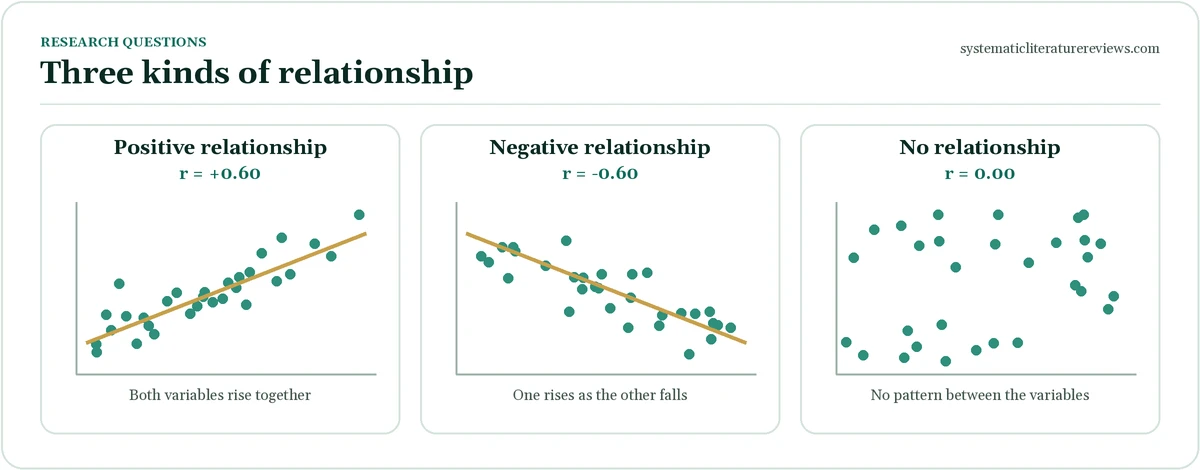
The figure shows three patterns. The table shows what each means for your wording.
| Pattern | Meaning | Example wording |
|---|---|---|
| Positive | Both variables rise together | Is study time positively related to exam score? |
| Negative | One rises as the other falls | Is stress negatively related to sleep duration? |
| None | No pattern | Is shoe size related to reading score? |
| Curved | The relationship changes with level | Is anxiety related to performance in an inverted-U pattern? |
Step-by-step guide to writing relationship-based research questions
Follow these five steps. Each has an explanation and an example.
- Choose two or more variables. Pick variables that theory or earlier studies suggest are linked. Decide which one you think predicts the other, if either. Example: Weeknight sleep duration and exam score.
- Define how each is measured. Say whether each variable is continuous, ordinal or categorical, and name the measure or scale. Example: Hours of sleep from a diary; exam score out of 100.
- Name the population and setting. State who is studied and where, so that results can be interpreted. Example: First-year university students in one UK university.
- Write the question. Use relationship or association wording and avoid causal words such as affects. Example: What is the relationship between weeknight sleep duration and exam scores in first-year university students?
- Add sub-questions and controls. Break the question into parts and name variables you will control for. Example: Does the relationship remain after controlling for prior attainment?
25 examples of relationship-based research questions
Use these as models and adapt them to your own variables.
Health and nursing
- Q1: what is the relationship between nurse staffing levels and patient falls?
- Q2: is perceived stress associated with weekly exercise hours in nurses?
- Q3: what is the relationship between hospital length of stay and readmission within 30 days?
- Q4: is medication adherence related to health literacy in adults with hypertension?
- Q5: what is the association between sleep quality and pain scores in older adults?
Education
- Q6: what is the relationship between homework time and mathematics attainment?
- Q7: is reading for pleasure associated with vocabulary scores in Year 6 pupils?
- Q8: what is the relationship between class size and pupil engagement?
- Q9: is attendance related to final grades in first-year students?
- Q10: what is the association between teacher feedback frequency and pupil confidence?
Business
- Q11: what is the relationship between leadership style and team performance?
- Q12: is employee engagement associated with staff turnover?
- Q13: what is the relationship between website load time and conversion rate?
- Q14: is customer satisfaction related to repeat purchases?
- Q15: what is the association between training hours and productivity?
Psychology and social science
- Q16: what is the relationship between daily social media use and anxiety in adolescents?
- Q17: is loneliness associated with physical activity in older adults?
- Q18: what is the relationship between household income and self-rated health?
- Q19: is screen time related to attention in children?
- Q20: what is the association between social support and resilience in students?
Technology and the environment
- Q21: what is the relationship between code review time and defect rates?
- Q22: is cybersecurity training associated with phishing click rates?
- Q23: what is the relationship between green space and wellbeing in cities?
- Q24: is energy use related to household income?
- Q25: what is the association between temperature and hospital admissions?
Wording rules for relationship-based research questions
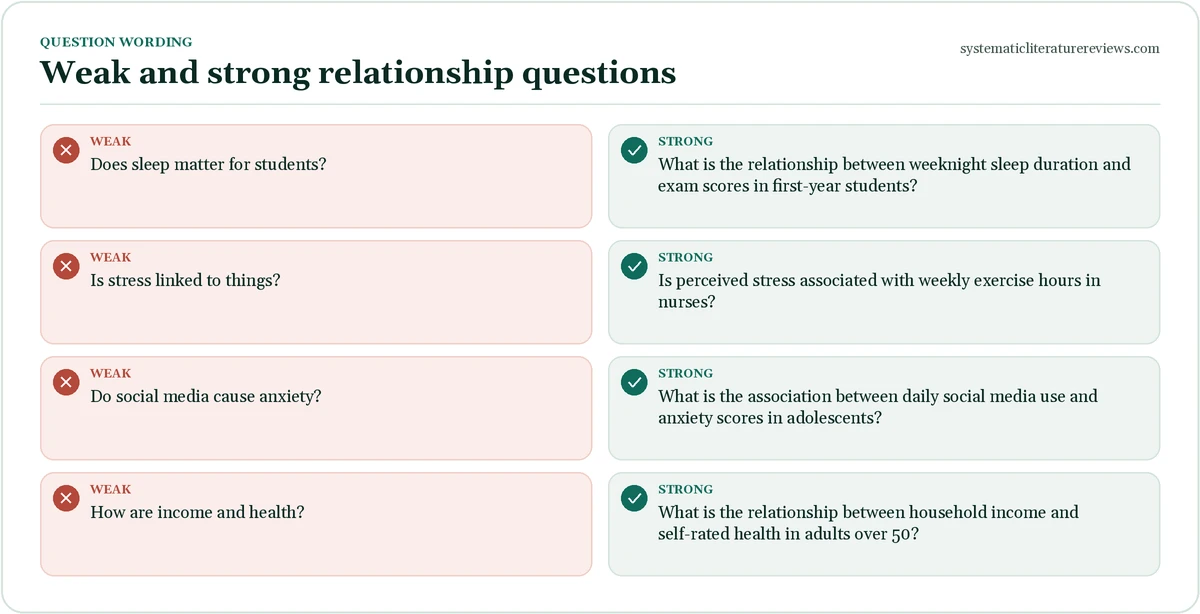
The figure shows weak and strong wording. Apply these rules.
- Use relationship words: relationship, association, correlation, related to, predict.
- Avoid causal words: affect, cause, impact and influence imply cause.
- Name both variables: and how each is measured.
- Name the population: who is studied.
- Keep one relationship: split questions with several relationships.
- Avoid yes or no: what is the relationship is richer than is there a relationship.
Matching the question to a statistical test
The variable types decide the test.
| Variables | Test | Example |
|---|---|---|
| Two continuous | Pearson correlation | Sleep hours and exam score |
| Ordinal or skewed | Spearman correlation | Pain rank and sleep quality rank |
| Two categories | Chi-square test of association | Smoking and chronic cough |
| One outcome, several predictors | Multiple regression | Exam score from sleep, study time and prior grade |
| Binary outcome | Logistic regression | Readmission from age and length of stay |
See the associative hypothesis guide for hypothesis wording.
Correlation and regression equations
Two equations summarise most relationship-based studies.
A worked example: sleep and exam scores
The numbers are invented to show the calculation.
- Question: what is the relationship between weeknight sleep duration and exam scores in first-year students?
- Hypotheses: H0: ρ = 0; H1: ρ ≠ 0.
- Data: n = 80 students; Pearson r = 0.35.
- Test: t-test for a correlation, two-tailed, α = 0.05.
- Report: r(78) = .35, p = .001, 95% CI [.14, .53].
- Interpretation: more sleep is associated with higher scores, a moderate relationship.
- Caution: this does not show that sleep causes higher scores; motivation or health could explain both.
Sample size for a relationship-based study
Plan the sample before you collect data.
| Expected r | Sample needed (80% power, α = 0.05, two-tailed) |
|---|---|
| 0.10 (small) | About 782 |
| 0.20 | About 194 |
| 0.30 (medium) | About 85 |
| 0.50 (large) | About 29 |
- Smaller effects: need larger samples.
- Use software: G*Power or R can calculate it.
- Report: alpha, power and the effect you wanted to detect.
Checking the assumptions
Tests are reliable only when assumptions hold.
- Linearity: a scatter plot should show a roughly straight pattern.
- Outliers: extreme points can create or hide a relationship.
- Normality: Pearson is fairly robust in large samples; use Spearman for skewed data.
- Independence: each participant appears once.
- Range: a narrow range of scores can weaken a correlation.
Confounders and the limits of association
A relationship does not show cause.
- Confounders: a third variable may cause both. Example: ice cream sales and drowning both rise in summer.
- Reverse direction: y may influence x. Example: poor sleep may raise stress, and stress may reduce sleep.
- Control: add confounders as covariates in a regression.
- Design: to test cause, use an experiment; see causal hypothesis.
- Language: write associated with, not caused by.
Common mistakes with relationship-based research questions
Check your question against this list.
- Using causal wording: affect and cause. Example: use relationship and association.
- Vague variables: wellbeing without a measure. Example: name the scale.
- Several relationships in one question: hard to test. Example: split into sub-questions.
- Ignoring confounders: results are misread. Example: measure and control them.
- Too small a sample: the relationship cannot be detected. Example: plan sample size.
See more models in sample research questions or order help.
Relationship questions with categorical and ordinal variables
Not every relationship question uses continuous data. The wording stays the same, but the test changes.
- Two categories: is smoking status associated with chronic cough in adults? Example: chi-square test or Fisher exact test.
- Ordinal ranks: is pain rank associated with sleep quality rank? Example: Spearman correlation.
- Category and number: is mean exam score related to course type? Example: t-test or ANOVA, which compare group means.
- Several predictors: which factors predict exam score? Example: multiple regression.
- Binary outcome: which factors predict readmission? Example: logistic regression, reporting odds ratios.
Adding control variables to the question
Control variables make the relationship more credible. Name them in a sub-question.
Relationship question with controls
Weak
What is the relationship between sleep and exam scores?
Ignores prior attainment, age and course.
Strong
What is the relationship between weeknight sleep duration and exam scores in first-year students, after controlling for prior attainment and course?
States the control variables and makes the model clearer.
- Choose controls from theory: not just because the data are available.
- Do not over-control: a variable on the causal path can hide a real relationship.
- Report both models: the simple and the adjusted result.
Reporting the answer to a relationship question
Report the answer in a fixed order so that readers can judge the result.
- Descriptives: mean and standard deviation of each variable.
- Test result: r(78) = .35, p = .001.
- Confidence interval: 95% CI [.14, .53].
- Effect size: r² = .12, a moderate relationship.
- Plot: include a scatter plot with a fitted line.
- Interpretation: state the direction and strength and give an honest limit, such as the cross-sectional design.
Ethics and measurement for relationship studies
Even simple surveys need planning.
- Consent and privacy: explain how the data will be used and stored.
- Valid measures: use published scales with known reliability. Example: the Pittsburgh Sleep Quality Index.
- Pilot: test the questionnaire on a few people.
- Missing data: plan how you will handle it, and report it.
- Sensitive topics: offer support information, for example when asking about mental health.
Frequently asked questions about relationship-based research questions
What are relationship-based research questions?
Relationship-based research questions ask how two or more variables are related, for example what is the relationship between sleep duration and exam scores. They describe the strength and direction of an association, but they do not claim that one variable causes the other. They usually need a correlational or regression design with variables that can be measured, and they are tested with methods such as Pearson correlation, chi-square tests or multiple regression. Words such as relationship, association and predict signal this type of question.
How do I write a relationship-based research question?
Choose two or more variables that theory or earlier studies suggest are linked, and decide how each will be measured. Name the population and the setting, then write one question using relationship or association wording, such as what is the relationship between weeknight sleep duration and exam scores in first-year university students. Avoid causal words such as affects, and add sub-questions for controls. Check that you can measure both variables and that your sample is large enough to detect the relationship you expect.
What is the difference between a relationship question and a causal question?
A relationship question asks whether and how variables are associated, and it can be answered with a survey or existing data. A causal question asks whether a change in one variable produces a change in another, and it needs a design that rules out other explanations, such as a randomised experiment or a strong quasi-experiment. A correlation can arise because of confounders or reverse causation, so the wording and conclusions of a relationship study must stay at the level of association unless the design supports more.
Which statistical test should I use for a relationship question?
The test depends on the types of variables. For two continuous variables use Pearson correlation, or Spearman if the data are ordinal or skewed. For two categorical variables use a chi-square test of association. For one outcome and several predictors use multiple regression, and for a binary outcome use logistic regression. Check the assumptions, such as linearity and independence, report the effect size with a confidence interval and plan your sample size before collecting data so that you can detect the relationship you expect.
Need expert help? Our experienced writers can handle the search, screening and write-up for you. Place your order in two minutes, or read how a systematic literature review works first.
Systematic Literature Reviews
Need strong research questions?
Research questions that fit your method and can be answered with your data.