
PICo for Qualitative Research Questions

The PICo framework is a three-part structure for writing a qualitative research or review question: Population, phenomenon of Interest and Context. The lower-case o in the name shows that it is not PICO. There is no intervention and no comparison. Instead, the question asks about an experience, a view or a process in a given setting. It is used, for example, in guidance for qualitative evidence reviews from the Joanna Briggs Institute.
This guide explains PICo for qualitative research: each element, a six-step method with an example at every step, how to build the search and the eligibility criteria, and how PICo compares with PICO, PEO and SPIDER.
- The elements: the three elements of PICo for qualitative research explained.
- The method: six steps from a topic to a searchable question.
- The choice: when to use PICo and when another framework fits better.
On this page
- What is the PICo framework?
- The PICo framework elements
- Step-by-step guide to using the PICo framework
- PICo framework examples across fields
- Turning the PICo framework into a search strategy
- From the PICo framework to inclusion and exclusion criteria
- Frequently asked questions about PICO for qualitative research
Key takeaways
- PICo for qualitative research stands for Population, phenomenon of Interest and Context.
- It is built for qualitative questions about experiences, views and processes, not for comparing treatments.
- The phenomenon of Interest is the experience or process, such as coping, decision making or barriers.
- Context is the setting in which the experience occurs.
What is the PICo framework?
PICo for qualitative research starts from a question that names who you want to hear from, what they have experienced and where.
- Definition: PICo stands for Population, phenomenon of Interest and Context.
- No comparison: there is no intervention to compare, so the framework fits studies of meaning and experience.
- Typical stems: what are the experiences of, how do, or what are the perceptions of.
- Where it is used: nursing, social care, education and any review of qualitative evidence.
- Spelling: the small o in PICo separates it from PICO, which is for interventions.
The PICo framework elements
Each element answers one question about your study.
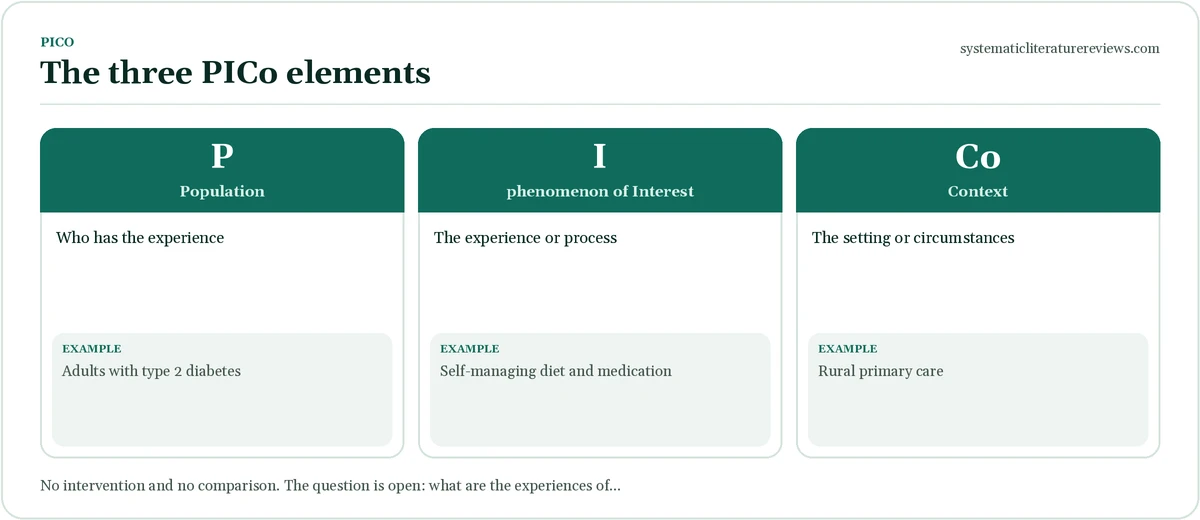
- P: Population: who has the experience, with the details that matter. Example: adults living with type 2 diabetes.
- I: phenomenon of Interest: the experience, event, process or perception you want to understand. Example: self-management of their condition.
- Co: Context: the setting or circumstances. Example: primary care in rural areas.
The phenomenon of Interest replaces the Intervention. If you test a treatment, use PICO.
Step-by-step guide to using the PICo framework
These steps take you from a general interest to a precise question and a search you can run.
- Start with the problem. Write one plain sentence about what you want to understand. Example: I want to understand how people manage diabetes in everyday life.
- Define the Population. Name the group whose experience you want, as precisely as the literature allows. Example: Adults aged 40 to 70 with type 2 diabetes.
- Name the phenomenon of Interest. State one experience or process. Use a noun phrase, not a treatment. Example: Experiences of self-managing diet and medication.
- Define the Context. Say where or in what circumstances the experience occurs. Example: Primary care and community settings in rural areas.
- Write the question. Combine the three parts into one open question. Example: What are the experiences of adults with type 2 diabetes in rural primary care when they self-manage diet and medication?
- Plan the search. List synonyms for each element, then test in one database, adding qualitative terms if needed. Example: (diabet*) AND (experienc* OR perception* OR view*) AND (rural) AND (“self-manage*” OR “self-care”).
PICo framework examples across fields
The table shows how the framework adapts to different disciplines. Each row becomes one question.
| Field | Population | phenomenon of Interest | Context |
|---|---|---|---|
| Nursing | Newly qualified nurses | Experiences of preceptorship | Acute hospital wards |
| Education | First-generation students | Transition to university | Large urban universities |
| Mental health | Young adults | Help-seeking for anxiety | Primary care |
| Social care | Family carers | Experiences of respite care | Community services |
| Business | Remote employees | Perceptions of isolation | Technology firms |
Each row becomes an open question such as: what are the experiences of newly qualified nurses of preceptorship on acute hospital wards?
Turning the PICo framework into a search strategy
List synonyms for each element, join them with OR, then join the blocks with AND.
- Population block: (nurs* OR “newly qualified” OR graduate*)
- Interest block: (preceptor* OR mentor* OR induction) AND (experienc* OR perception* OR view*)
- Context block: (hospital* OR ward* OR acute)
- Qualitative terms: (qualitative OR interview* OR “focus group*” OR “thematic analysis”) — optional
- Combine: join the blocks with AND and record the date and the results.
Qualitative studies are indexed inconsistently, so test the search on known papers. Where the database has a qualitative filter, record which one you used. See the guides to the literature search strategy and Boolean operators.
From the PICo framework to inclusion and exclusion criteria
Each element becomes an eligibility rule, written before you screen.
- Population: newly qualified nurses within two years of registration. Example: Exclude student nurses.
- Interest: experiences of preceptorship described by the nurses. Example: Exclude studies of programme cost only.
- Context: acute hospital wards. Example: Exclude community settings.
- Design: qualitative or mixed-methods studies with a clear qualitative component.
- Other limits: English language, published since 2010.
The guide to inclusion and exclusion criteria explains how to justify each rule.
PICo framework vs other question frameworks
Pick the framework that matches the kind of question you ask.
| Framework | Elements | Best for |
|---|---|---|
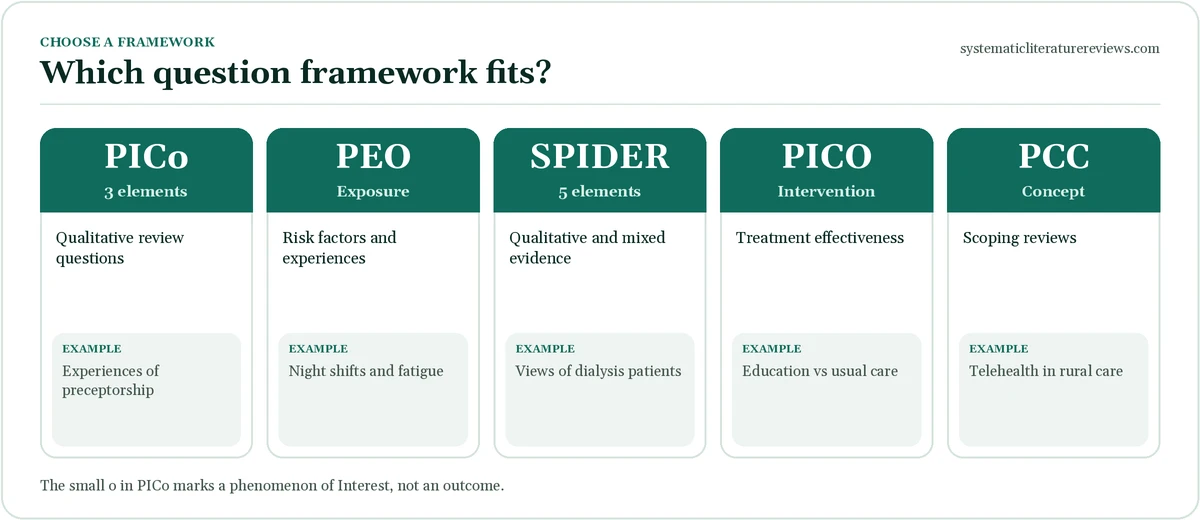
| PICo | Population, phenomenon of Interest, Context | Qualitative review questions |
| PEO | Population, Exposure, Outcome | Risk factors and experiences |
| SPIDER | Sample, Phenomenon of Interest, Design, Evaluation, Research type | Qualitative and mixed-methods evidence |
| PICO | Population, Intervention, Comparison, Outcome | Treatment effectiveness |
| PCC | Population, Concept, Context | Scoping reviews |
PICo and PCC are similar: both have a Population and a Context. PICo asks about an experience in a qualitative review, while PCC maps a concept in a scoping review. For a broader qualitative structure, see SPIDER.
Writing the question in PICo for qualitative research
PICo for qualitative research uses open stems and avoids words that imply cause or measurement.
- Use: what are the experiences of, how do, what are the perceptions of.
- Avoid: does, effect of, relationship between, and other causal or numerical wording.
- Keep it open: do not predict what participants will say.
- Link to design: phenomenology, grounded theory and thematic analysis all fit these stems.
See the guides to phenomenological research questions and grounded theory research questions.
Using PICo for qualitative research in an evidence synthesis
PICo for qualitative research helps you plan a review of qualitative studies.
- Question: write it with the three elements.
- Search: use the three blocks and qualitative terms.
- Appraise: assess the quality of each qualitative study with a recognised checklist.
- Synthesise: combine themes across studies, for example by thematic synthesis.
- Report: follow reporting guidance such as ENTREQ; see the EQUATOR Network guide.
PICo for qualitative research in mixed-methods work
PICo for qualitative research can write the qualitative question in a mixed-methods study.
- Quantitative question: write it with PICO or PEO.
- Qualitative question: write it with PICo.
- Integration question: ask how the findings relate.
See the guides to mixed methods research questions and mixed methods research designs.
Weak and strong PICo questions
Compare vague questions with focused ones.
PICo for qualitative research: questions about experiences
Weak
What do patients think about care?
No population, no specific phenomenon and no setting.
Strong
What are the experiences of adults with type 2 diabetes in rural primary care when they self-manage diet and medication?
Names the group, the experience and the setting.
Weak
Does mentoring work for nurses?
A causal question that PICo cannot answer.
Strong
How do newly qualified nurses describe their experience of preceptorship on acute wards?
Open question about experience.
Common mistakes with the PICo framework
Avoid these problems.
- Using PICo for effectiveness: the framework has no comparison. Example: use PICO.
- Causal wording: qualitative data cannot show effect sizes. Example: use how and what are the experiences.
- Vague Interest: too many topics at once. Example: choose one phenomenon.
- Over-narrow Context: few studies exist. Example: relax the setting.
- Skipping qualitative terms: search misses qualitative papers. Example: add experience and view terms with care.
PICo framework checklist
Run your question through these checks before you search.
- Population: who has the experience?
- phenomenon of Interest: one experience or process?
- Context: setting named?
- Question: open wording, no cause or effect?
- Search: synonyms and qualitative terms listed?
- Criteria: each element written as a rule?
PICo question template
Fill in the blanks to draft your question.
Template
What are the [experiences, views or perceptions] of [population] of [phenomenon of interest] in [context]?
Practical tips for using the PICo framework
These habits make the framework easier to apply.
- Write it on one page: put the three elements and the question on one sheet.
- Pilot the search: read the first twenty titles and check for known studies.
- Keep a decision log: record each change, with the date and reason.
- Match the design: PICo for qualitative research works best with a qualitative method that fits the question, such as thematic analysis or phenomenology.
When the question is ready, see how it fits into a full systematic literature review, and plan the search with the guides to the literature search strategy and Boolean operators. For background reading, see qualitative research.
Related question frameworks
Choose the framework that matches your question, not the one you met first. This table links to every question framework in our library.
| Framework | Elements | Best for |
|---|---|---|
| PICO framework | Population, Intervention, Comparison, Outcome | Treatment and effectiveness questions |
| PICOT framework | PICO plus Time | Clinical questions with a follow-up period |
| PICOS framework | PICO plus Study design | Reviews that limit eligible study designs |
| PICOC framework | PICO plus Context | Reviews where the setting changes the answer |
| PICOTT framework | PICO plus Time and Type | Nursing and evidence-based practice questions |
| PIO framework | Population, Intervention or Interest, Outcome | Descriptive questions without a comparison |
| PEO framework | Population, Exposure, Outcome | Risk factors and experiences |
| SPIDER framework | Sample, Phenomenon of Interest, Design, Evaluation, Research type | Qualitative and mixed-methods evidence |
| SPICE framework | Setting, Perspective, Intervention or Interest, Comparison, Evaluation | Service and social science reviews |
| PCC framework | Population, Concept, Context | Scoping reviews |
| CIMO framework | Context, Intervention, Mechanisms, Outcomes | Management and organisational research |
| ECLIPSE framework | Expectation, Client group, Location, Impact, Professionals, Service | Health service and policy questions |
| CLIP framework | Client group, Location, Improvement or Innovation, Professionals | Short service and policy searches |
| PIRD framework | Population, Index test, Reference test, Diagnosis | Diagnostic accuracy reviews |
| BeHEMoTh framework | Behaviour, Health context, Exclusions, Models or Theories | Searching for theory in reviews |
To test a finished question, use the FINER criteria, and for example questions see sample research questions.
Frequently asked questions about PICO for qualitative research
What does PICo stand for?
PICo for qualitative research stands for Population, phenomenon of Interest and Context. It is a framework for writing a qualitative research or review question. The Population is the group whose experience you want to understand, the phenomenon of Interest is the experience, process or perception, and the Context is the setting. For example: what are the experiences of adults with type 2 diabetes in rural primary care when they self-manage diet and medication? There is no intervention and no comparison.
What is the difference between PICO and PICo?
PICO, with a capital O, has four elements: Population, Intervention, Comparison and Outcome. It is for questions about the effectiveness of an intervention. PICo, with a small o, has three: Population, phenomenon of Interest and Context. It is for qualitative questions about experiences, views and processes. The names look similar, but the questions are different. If you want to compare treatments, use PICO; if you want to understand how people experience something, use PICo, PEO or SPIDER.
Can I use PICo for a systematic review?
Yes. PICo for qualitative research is often used for systematic reviews of qualitative evidence, sometimes called qualitative evidence syntheses. Write the question with the three elements, build a search with blocks for each, and write the elements as inclusion and exclusion criteria. Appraise the quality of the qualitative studies with a recognised checklist, synthesise the themes, and report the review with suitable guidance. Register the protocol where possible, and describe how you handled the Context when you screened studies.
When should I use PICo instead of SPIDER or PEO?
PICo for qualitative research is the simplest of the three, with only three elements, so it suits a first draft of a qualitative question or a small review. SPIDER adds Design, Evaluation and Research type, which helps when you want to limit by qualitative method or by outcome of the evaluation. PEO adds an Exposure and an Outcome, which fits questions about risk factors or life events. Try each on your topic and choose the one that fits your question most naturally.
Need expert help? Our experienced writers can handle the search, screening and write-up for you. Place your order in two minutes, or read how a systematic literature review works first.
Systematic Literature Reviews
Need help framing your research question?
Get a PICO, SPIDER, SPICE or PCC question and matching search strategy from experienced review writers.