
Blog
Types of hypotheses With Examples

Introduction to Types of Hypotheses: Definitions and Key Concepts
- Definition of a Hypothesis
- A hypothesis is a testable statement or assumption about the relationship between variables in a research study.
- It expresses an expected outcome and can be evaluated as true or false through data collection and analysis.
- In the scientific method, a hypothesis guides the research process by providing focus and clarity to the study.
- Role in Research
- The hypothesis serves as the foundation for research studies, helping define research objectives and informing research design.
- It transforms a research question into a specific, testable statement that predicts outcomes.
- A good hypothesis must be precise, clear, and directly related to the research topic.
- Types of Hypotheses
- There are three main types of hypotheses commonly used in research:
- Null hypotheses (H₀): Assume no effect or no relationship between variables.
- Alternative hypotheses (H₁): Suggest a specific effect or relationship exists.
- Directional and Non-directional hypotheses: Specify the expected direction of the relationship or leave it unspecified.
- Understanding these types of research hypotheses is critical for designing experimental research and quantitative research studies.
- There are three main types of hypotheses commonly used in research:
- Importance of Hypotheses in Effective Research
- Hypotheses guide the research process, allowing researchers to focus on the relationship between independent and dependent variables.
- They help predict outcomes and provide a framework for testing theories.
- A strong hypothesis ensures research remains focused and testable, enhancing the reliability of research findings.
- Characteristics of a Good Hypothesis
- Testable prediction: Can be evaluated through observation or experimentation.
- Specific: Clearly identifies the independent variable and dependent variable.
- Logical hypothesis: Based on prior knowledge, theory, or previous research.
- Focused research question: Avoids ambiguity and aligns with research objectives.
- Strong hypothesis: Expresses a clear, measurable relationship between variables.
How to Write a Hypothesis: 7-Step Process for Effective Research Hypotheses
- Select a Research Topic
- Begin with a focused research question.
- Identify the area of study and determine whether the relationship between variables can be tested.
- Conduct background research to understand what is already known and identify gaps.
- Review Previous Research
- Study previous research to refine your research objectives.
- Ensure your original hypothesis builds on prior studies while remaining unique.
- Identify types of research used in related studies to guide your methodology.
- Define Variables
- Identify independent and dependent variables.
- Determine whether your study will include one variable, two variables, or two or more variables.
- Clarify the expected relationship between independent and dependent variables.
- Formulate a Testable Hypothesis
- A testable hypothesis predicts a measurable outcome and can be evaluated through research methods.
- Decide whether to write a simple hypothesis (one independent and one dependent variable) or a complex hypothesis (two or more independent variables affecting a dependent variable).
- Ensure the hypothesis is specific and can affect the research process positively.
- Specify the Type of Hypothesis
- Determine whether your hypothesis is:
- Null hypothesis (H₀): Assumes no effect or relationship.
- Alternative hypothesis (H₁): Suggests a relationship exists.
- Directional hypothesis: Predicts the exact direction of the relationship.
- Non-directional hypothesis: States a relationship exists without specifying direction.
- Consider whether the hypothesis is causal (predicting change in one variable causes change in another) or associative (predicting a relationship between two variables without assuming causality).
- Determine whether your hypothesis is:
- Write the Hypothesis Clearly
- The hypothesis should state a clear, testable prediction.
- Use phrases like:
- “The dependent variable is affected by the independent variable.”
- “There is a relationship between two variables in such a way that…”
- Ensure your hypothesis expresses an expected outcome and is strong and logical.
- Evaluate and Refine Your Hypothesis
- Confirm the hypothesis is testable through your planned research design.
- Check that it aligns with research objectives and prior research findings.
- Make sure it qualifies as a good hypothesis, providing a guide for the research process and supporting effective research outcomes.
Exploring Null and Alternative Hypotheses with Examples
- Null Hypothesis (H₀)
- States that no relationship exists between the independent variable and the dependent variable.
- Serves as the default position in statistical hypothesis testing.
- Often written as: “There is no effect of X on Y.”
- Example: In a study on caffeine and concentration, the null hypothesis states:
- “Caffeine intake has no effect on concentration levels.”
- The null hypothesis is tested statistically and may be rejected if evidence supports the alternative hypothesis.
- Alternative Hypothesis (H₁)
- States that a relationship exists between variables.
- Can be directional (predicts exact direction) or non-directional (simply predicts a relationship exists).
- Example (Directional): “Increased caffeine intake improves concentration levels.”
- Example (Non-Directional): “Caffeine intake affects concentration levels, but the direction is unspecified.”
- Alternative hypotheses are central to experimental research, guiding data collection and interpretation.
- Why Null and Alternative Hypotheses Matter
- Together, they ensure the research process remains objective and testable.
- Provide a basis for statistical testing and help researchers determine whether research findings are significant.
- Enable researchers to predict the exact relationship between independent and dependent variables in both associative and causal hypotheses.
Directional vs Non-Directional Hypotheses: Understanding Types of Research Hypotheses
- Directional Hypotheses
- Predict the exact direction of the relationship between variables.
- Typically used when previous research or theory indicates a likely outcome.
- Example: “Higher study hours lead to higher test scores.”
- Characteristics:
- Specifies the dependent variable and independent variable.
- Expresses expected increase or decrease.
- Useful in experimental research where causality is tested.
- Non-Directional Hypotheses
- Predict a relationship exists but do not specify the direction.
- Often used in exploratory or quantitative research.
- Example: “Study hours affect test scores” (relationship exists, but the effect could be positive or negative).
- Characteristics:
- Focuses on relationship between two variables.
- Ensures flexibility when prior evidence is limited.
- Allows researchers to observe associative relationships without assuming directionality.
- Other Types of Research Hypotheses
- Simple hypothesis: Tests the relationship between one independent variable and one dependent variable.
- Complex hypothesis: Tests the effect of two or more independent variables on one dependent variable, or multiple outcomes.
- Causal hypothesis: Specifies a cause-and-effect relationship, predicting how a change in one variable influences another.
- Associative hypothesis: Predicts a relationship between variables without implying causation.
- Key Takeaways
- Understanding these types of hypotheses is crucial for designing effective research.
- They guide the selection of research methods and statistical analysis.
- A hypothesis based on prior research increases the reliability of the study and ensures a testable hypothesis for meaningful results.
Characteristics of a Good Hypothesis for Scientific Method Applications
- Definition of a Good Hypothesis
- A hypothesis is a testable statement that predicts the relationship between independent and dependent variables.
- A good hypothesis provides a foundation for effective research, guiding the research process and informing the research design.
- It must be based on background research and prior research to ensure logical consistency and relevance.
- Core Characteristics
- Testable Hypothesis
- Must be measurable through experimental research or quantitative research methods.
- Should allow researchers to test the hypothesis and determine whether it is true or false.
- Example: “Increasing study hours (independent variable) improves test scores (dependent variable).”
- Specificity
- Clearly identifies the independent and dependent variables.
- Specifies the relationship between variables to predict the outcome accurately.
- Avoids vague terms; a strong hypothesis predicts the exact direction in directional hypotheses or indicates a relationship in non-directional hypotheses.
- Logical Basis
- Derived from previous research, scientific theory, or observations.
- Ensures the hypothesis predicts the relationship in a way that aligns with known facts.
- Example: An associative hypothesis predicts interdependency between variables based on prior studies.
- Focused and Clear
- Addresses a focused research question or research topic.
- Avoids ambiguity to provide a roadmap for effective research.
- Helps researchers write a hypothesis that is manageable and actionable.
- Relates to Research Objectives
- Connects directly to the research objectives.
- Guides experimental research, statistical hypothesis testing, and research findings interpretation.
- Original Hypothesis
- While based on prior research, it introduces novel insights or tests new relationships between variables.
- Ensures your hypothesis may be used to expand the knowledge base in your field.
- Predictive Nature
- Expresses an expectation about the relationship between two or more variables.
- Can be causal hypothesis, predicting change in one variable affects another, or associative hypothesis, predicting interdependency between variables.
- Testable Hypothesis
- Practical Tips for a Good Hypothesis
- Ensure it is testable through research methods appropriate for the study.
- Align the hypothesis with your research design to guide the collection and analysis of data.
- Formulate both null and alternative hypotheses to maintain objectivity and statistical rigor.
- Review types of hypotheses to select the most suitable type of hypothesis for your study.
Common Mistakes to Avoid When Writing a Hypothesis
- Vague or Ambiguous Statements
- Avoid writing a hypothesis that does not clearly define independent and dependent variables.
- Example of poor statement: “Study habits affect students.”
- Better: “Increasing daily study hours (independent variable) improves students’ exam scores (dependent variable).”
- Non-Testable Hypotheses
- A hypothesis must be testable through data collection or experimentation.
- Avoid assumptions that cannot be verified through research methods or scientific method.
- Example: “Students feel happier when studying.” – “Happiness” is subjective and difficult to measure.
- Overly Broad Scope
- A hypothesis for your research should be focused on a single independent variable and dependent variable, or clearly define a complex hypothesis with two or more independent variables.
- Example: Avoid: “All educational interventions improve student outcomes.”
- Better: “Interactive learning modules (independent variable) improve math test scores (dependent variable) in high school students.”
- Ignoring Prior Research
- Failing to conduct background research may result in a hypothesis that duplicates previous studies unnecessarily.
- Use prior research to ensure your hypothesis predicts the relationship based on solid evidence.
- Confusing Directional and Non-Directional Hypotheses
- Ensure you specify whether your hypothesis predicts the exact direction (directional hypothesis) or simply predicts a relationship (non-directional hypotheses).
- Example: “Caffeine intake increases alertness” (directional) vs. “Caffeine intake affects alertness” (non-directional).
- Assuming Causality in Associative Hypotheses
- An associative hypothesis predicts a relationship between variables but does not assume causation.
- Avoid phrasing that implies cause without evidence.
- Ignoring Research Objectives
- A hypothesis that does not align with research objectives or research questions may fail to guide the research process effectively.
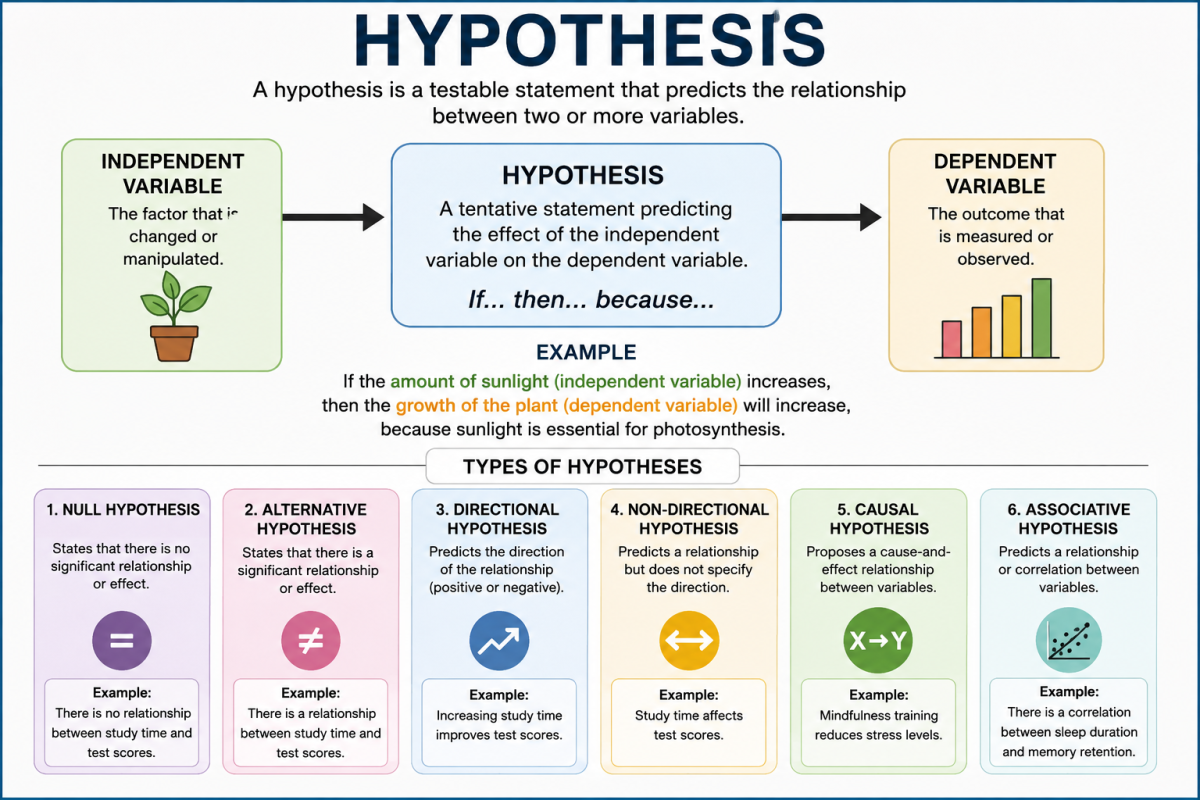
Testable Hypotheses: Strengthening Your Research with Practical Examples
- Definition of a Testable Hypothesis
- A testable hypothesis can be empirically verified through research methods such as experiments, surveys, or statistical analysis.
- Example: “Exposure to sunlight (independent variable) increases vitamin D levels (dependent variable).”
- Characteristics of a Testable Hypothesis
- Specifies independent and dependent variables.
- Predicts a relationship between variables that can be observed or measured.
- Based on prior research or scientific theory.
- Provides a strong hypothesis that guides the research process and data collection.
- Practical Examples Across Types of Hypotheses
- Null Hypothesis Example:
- “There is no relationship between daily exercise (independent variable) and blood pressure (dependent variable).”
- Alternative Hypothesis Example:
- “Daily exercise decreases blood pressure in adults.”
- Directional Hypothesis Example:
- “Increased study hours (independent variable) improve students’ test scores (dependent variable).”
- Non-Directional Hypothesis Example:
- “Study hours affect students’ test scores, but the effect may be positive or negative.”
- Causal Hypothesis Example:
- “Implementing mindfulness training reduces stress levels in employees.”
- Associative Hypothesis Example:
- “There is a correlation between sleep duration and memory retention in adults.”
- Null Hypothesis Example:
- Guidelines to Ensure Testability
- Ensure the hypothesis can be tested using appropriate research methods.
- Limit scope to one variable and a single independent variable for simple hypotheses.
- Clearly specify relationship between independent and dependent variables.
- Confirm statistical hypothesis can be formulated for data analysis.
Advanced Insights: Types of Hypotheses in Effective Research and Types of Research
- Seven Different Types of Hypotheses
- Simple Hypothesis – Predicts a relationship between a single independent variable and a dependent variable.
- Complex Hypothesis – Predicts the effect of two or more independent variables on one or more dependent variables.
- Null Hypothesis (H₀) – Assumes no relationship exists.
- Alternative Hypothesis (H₁) – Suggests a relationship exists; can be directional or non-directional.
- Directional Hypothesis – Predicts the exact direction of a relationship.
- Non-Directional Hypothesis – Predicts a relationship exists but not the direction.
- Associative Hypothesis – Defines a correlation or interdependency without implying causation.
- Role in Effective Research
- Hypothesis predicts how variables interact, guiding the research process.
- Helps determine the research methods and research design suitable for the study.
- Ensures the research is focused and provides testable predictions.
- Link to Types of Research
- Quantitative research often uses directional, non-directional, null, and alternative hypotheses.
- Experimental research may employ causal hypotheses to test change in one variable on another.
- Associative hypotheses are used in correlational studies to explore relationship between two or more variables.
- Best Practices for Using Different Types of Hypotheses
- Conduct background research to ensure hypotheses are based on your research and not assumptions.
- Select the type of hypothesis that aligns with your research question and objectives.
- Use null and alternative hypotheses for statistical testing and to objectively test the hypothesis.
- Ensure each hypothesis is logical, strong, and testable, enhancing effective research outcomes.
- Practical Application Tips
- When designing a study, define the relationship between the variables before writing the hypothesis.
- Identify independent and dependent variables, and specify whether the hypothesis is directional or non-directional.
- Combine prior research with your original hypothesis to strengthen validity.
- Ensure the hypothesis can predict the exact outcome for quantitative research and experimental research studies.
- Summary
- Understanding types of hypotheses ensures researchers write good hypotheses that are testable, logical, and aligned with research objectives.
- Properly constructed hypotheses guide the research process, support meaningful research findings, and improve the quality of effective research.
- Incorporating null, alternative, directional, and non-directional hypotheses ensures comprehensive coverage and stronger research design.
Research Hypotheses
Types of Research Hypotheses
Explore key hypothesis categories used in academic research and studies.
Types of Hypotheses
Overview
→
Research Hypotheses
Basics
→
Alternative
H1
→
Null
H0
→
Directional
One-tailed
→
Non-Directional
Two-tailed
→
Simple
One variable
→
Complex
Multiple variables
→
Causal
Cause-effect
→
Associative
Relationship
→
Statistical
Testing
→
Working
Temporary
→
Declarative
Statement form
→
Question Form
Question-based
→
Empirical
Observed data
→
Logical
Reasoned
→
Value
Business focus
→
