
Blog
How To Write Alternative Hypothesis With Best Examples

What Is an Alternative Hypothesis? Definition, Purpose, and Role in a Hypothesis Test
- An Alternative Hypothesis is a statement that proposes there is an effect, difference, association, or relationship between variables in a study.
- In statistical hypothesis testing, the Alternative Hypothesis represents what the researcher is trying to demonstrate or discover through the analysis of sample data.
- The Alternative Hypothesis is often denoted as H₁ or Ha.
- It is formulated as the opposite of the null hypothesis and is considered when the observed data are inconsistent with the null hypothesis.
Definition of an Alternative Hypothesis
- An Alternative Hypothesis states that a specific claim about a population parameter differs from the value stated in the null hypothesis.
- It suggests that the status quo or default assumption may not be correct.
- The hypothesis states that there is enough evidence to indicate a meaningful effect, difference, or relationship between variables.
- In simple terms, the Alternative Hypothesis provides the answer to your research question that the researcher is trying to investigate.
Purpose of an Alternative Hypothesis
The goal of hypothesis testing is to determine whether the available sample data provide enough evidence to support a claim.
The Alternative Hypothesis serves several important purposes:
- Guides the direction of the study.
- Helps researchers frame research questions.
- Identifies the expected relationship between variables.
- Provides a basis for selecting appropriate statistical tests.
- Allows researchers to make statistical inference about a population parameter.
- Helps determine whether observed findings are likely due to chance or represent a real effect.
The Relationship Between the Null and Alternative Hypothesis
- The null hypothesis and alternative hypothesis work together as two rival hypotheses.
- These are mutually exclusive statements.
- They are also contradictory because both cannot be true simultaneously.
- If one hypothesis is true, the other cannot be true.
- Together, they form the foundation of inferential statistics.
For example:
- Null Hypothesis (H₀): The average test score equals 75.
- Alternative Hypothesis (H₁): The average test score ≠ 75.
In this example:
- The null hypothesis assumes equality.
- The Alternative Hypothesis suggests a difference.
- The two statements are mutually exclusive.
- One serves as the complement of the other.
An Easy Courtroom Analogy
Many statisticians use an analogy involving a courtroom to explain hypothesis testing.
- The null hypothesis is analogous to the assumption that a defendant is innocent.
- The Alternative Hypothesis is analogous to the claim that the defendant is guilty.
- The defendant is presumed innocent until proven guilty.
- Similarly, the null hypothesis is assumed to be true unless evidence suggests otherwise.
Under this analogy:
- Null Hypothesis = Innocent until proven guilty.
- Alternative Hypothesis = Defendant is guilty.
- Sample data = Evidence presented in court.
- Statistical tests = Evaluation of evidence.
- Rejection of the null hypothesis = Guilty verdict.
This analogy helps explain why researchers never say they have proven a hypothesis is true.
Important Principle: Never Say a Hypothesis Is Proven
In statistics, researchers should never say:
- The null hypothesis is true.
- The Alternative Hypothesis is true.
- The hypothesis has been proven.
Instead, researchers should say:
- There is enough evidence to reject the null hypothesis.
- There is enough evidence to support the alternative hypothesis.
- There is insufficient evidence to reject the null.
This distinction exists because all statistical conclusions are based on probability rather than absolute certainty.
Role of the Alternative Hypothesis in a Hypothesis Test
During a hypothesis test:
- The researcher develops the null and alternative hypotheses.
- Sample data are collected.
- A statistical test is performed.
- A p-value is calculated.
- The p-value is compared to the significance level (alpha).
- A conclusion is reached.
Possible outcomes include:
- Reject the null hypothesis.
- Fail to reject the null.
If researchers reject the null hypothesis:
- There is enough evidence supporting the Alternative Hypothesis.
- Results are statistically significant.
If researchers fail to reject the null:
- There is insufficient evidence supporting the Alternative Hypothesis.
- The findings are not statistically significant.
How To Write Alternative Hypothesis With Best Examples: A 7-Step Process for Research Questions and Statistical Studies
Writing a strong Alternative Hypothesis requires careful planning and proper formulation.
Step 1: Clearly Identify the Research Question
- Begin by defining the research questions.
- Determine exactly what issue you want to investigate.
- Review the literature review and previous studies.
- Identify the variables involved.
Example:
Research Question:
- Does exercise improve academic performance among college students?
Step 2: Identify the Variables
Every research hypothesis involves at least one variable.
Determine:
- Independent variable.
- Dependent variable.
Example:
- Independent Variable: Exercise frequency.
- Dependent Variable: Academic performance.
Understanding the relationship between variables helps create a focused hypothesis.
Step 3: Determine the Population Parameter
Before writing hypotheses, identify the population parameter of interest.
Examples include:
- Population mean.
- Population proportion.
- Population variance.
Ask:
- What characteristic of the population am I studying?
- What parameter will be tested?
Step 4: Write the Null Hypothesis First
Many statisticians recommend writing the null hypothesis before writing the Alternative Hypothesis.
The null hypothesis typically contains:
- Equality (=)
- Less than or equal to (≤)
- Greater than or equal to (≥)
Example:
H₀: Exercise has no effect on academic performance.
Or
H₀: μ = 75
The null hypothesis represents the status quo.
Step 5: Write the Alternative Hypothesis
Next, write the Alternative Hypothesis.
The Alternative Hypothesis should directly oppose the null hypothesis.
Examples:
- H₁: Exercise improves academic performance.
- H₁: μ ≠ 75
When you write null and alternative hypotheses, ensure they are contradictory and mutually exclusive statements.
Step 6: Choose the Appropriate Direction
Determine whether your Alternative Hypothesis should be:
- Two-tailed.
- One-tailed.
- Directional.
Examples:
Two-tailed:
- H₁: μ ≠ 75
Right-tailed:
- H₁: μ > 75
Left-tailed:
- H₁: μ < 75
The choice depends on the research question and study objectives.
Step 7: Verify Logical Consistency
Before finalizing the hypothesis:
- Ensure the null and alternative hypotheses cover all possibilities.
- Confirm they are contradictory.
- Verify that they address the research question.
- Check that they can be evaluated using statistical tests.
- Make sure the wording is clear and measurable.
Complete Example
Research Question:
- Does a new teaching method improve student performance?
Null Hypothesis:
- H₀: The new teaching method does not improve student performance.
Alternative Hypothesis:
- H₁: The new teaching method improves student performance.
This pair creates a valid framework for statistical hypothesis testing.
How To Write Alternative Hypothesis With Best Examples for Different Types of Alternative Hypotheses
There are several types of alternative hypotheses used in statistics.
Understanding them helps researchers select the most appropriate format.
1. Two-Tailed Alternative Hypothesis
A two-tailed Alternative Hypothesis tests whether a parameter differs from a specific value.
Symbol:
- ≠
Example:
H₀: μ = 50
H₁: μ ≠ 50
Characteristics:
- Tests for any difference.
- Does not specify direction.
- Commonly used when researchers simply want to determine whether a difference exists.
2. Right-Tailed Alternative Hypothesis
A right-tailed Alternative Hypothesis predicts an increase.
Symbol:
Example:
H₀: μ ≤ 100
H₁: μ > 100
Characteristics:
- Directional hypothesis.
- Used when theory suggests improvement or growth.
- Focuses on values above the benchmark.
3. Left-Tailed Alternative Hypothesis
A left-tailed Alternative Hypothesis predicts a decrease.
Symbol:
- <
Example:
H₀: μ ≥ 100
H₁: μ < 100
Characteristics:
- Directional.
- Used when researchers expect lower outcomes.
- Evaluates values below the benchmark.
Examples of Alternative Hypotheses in Different Fields
Education
Research Question:
- Does tutoring improve mathematics scores?
Alternative Hypothesis:
- Students receiving tutoring achieve higher mathematics scores.
Healthcare
Research Question:
- Does a new medication reduce blood pressure?
Alternative Hypothesis:
- The medication lowers blood pressure.
Marketing
Research Question:
- Does social media advertising increase sales?
Alternative Hypothesis:
- Social media advertising increases sales.
Psychology
Research Question:
- Does stress affect memory performance?
Alternative Hypothesis:
- Stress significantly affects memory performance.
Common Mistakes When Writing Alternative Hypotheses
Avoid these errors:
Making the Hypothesis Vague
Poor Example:
- The program helps students.
Better Example:
- The program increases student test scores.
Forgetting the Direction
When a directional prediction exists, clearly indicate it.
Using Unmeasurable Terms
Avoid words like:
- Better
- Worse
- Successful
Unless they are operationally defined.
Not Matching the Null Hypothesis
The null hypothesis and alternative hypothesis must align perfectly.
Writing Multiple Ideas in One Statement
Focus on a single relationship whenever possible.
Understanding the Relationship Between the Null Hypothesis and Alternative Hypothesis
The relationship between the null hypothesis and alternative hypothesis is central to statistical inference.
Why Both Hypotheses Are Necessary
The two types of hypotheses create a framework for decision-making.
Without both statements:
- Researchers cannot conduct a valid hypothesis test.
- Statistical conclusions become unclear.
- Interpretation becomes difficult.
Key Differences Between Null and Alternative
The differences between null and alternative hypotheses include:
- The null hypothesis assumes no effect.
- The Alternative Hypothesis suggests an effect exists.
- The null hypothesis represents the status quo.
- The Alternative Hypothesis represents the researcher’s expectation.
- The null hypothesis contains equality.
- The Alternative Hypothesis contains inequality or directional claims.
Decision-Making in Statistical Testing
After analyzing sample data:
When the p-value Is Less Than Alpha
- There is enough evidence to reject the null hypothesis.
- Results are statistically significant.
- Researchers may support the alternative hypothesis.
When the p-value Is Greater Than Alpha
- Researchers fail to reject the null.
- Evidence supporting the Alternative Hypothesis is insufficient.
- No statistically significant result is found.
Understanding Type I and Type II Errors
Every hypothesis test involves risk.
Type I Error
A Type I Error occurs when researchers reject the null hypothesis even though it is actually true.
This is known as:
- False positive.
- Incorrect rejection.
The probability of a Type I Error equals alpha.
Type II Error
A Type II Error occurs when researchers fail to reject the null even though the alternative hypothesis is true.
This is known as:
- False negative.
- Missed discovery.
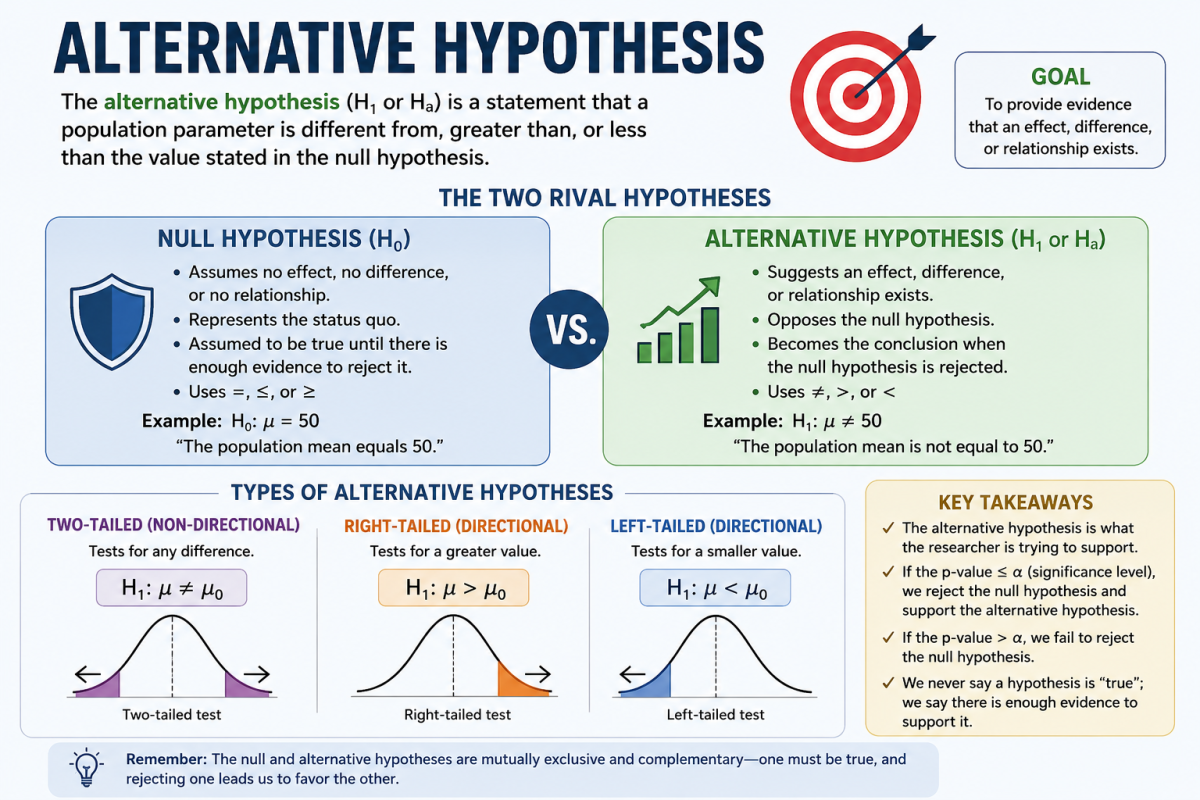
Differences Between Null and Alternative Hypotheses in Statistics
Understanding the differences between null and alternative hypotheses is one of the most important concepts in statistics. These two types of hypotheses form the foundation of statistical hypothesis testing and help researchers determine whether the observed data provide enough evidence to support a claim.
What Are Null and Alternative Hypotheses?
- The null hypothesis (H₀) is a statement that assumes no effect, no difference, or no relationship between variables.
- The Alternative Hypothesis (H₁ or Ha) is a statement that suggests an effect, difference, or relationship exists.
- Together, the null and alternative hypotheses are known as two rival hypotheses.
- They are mutually exclusive statements because both cannot be true at the same time.
- They are also contradictory, meaning one serves as the complement of the other.
Why Are Both Hypotheses Needed?
- In inferential statistics, researchers rarely have access to an entire population.
- Instead, they collect a sample and use sample data to make an inference about a population parameter.
- The null hypothesis and alternative hypothesis provide a structured framework for making statistical inference.
- Without these hypotheses, researchers would have no objective way to determine whether results occurred by chance.
Major Differences Between Null and Alternative
1. Purpose
Null Hypothesis
- Represents the status quo.
- Assumes no effect exists.
- Is assumed to be true until evidence suggests otherwise.
Alternative Hypothesis
- Represents the research hypothesis.
- Suggests that an effect or relationship exists.
- Provides the answer to your research question that the researcher is trying to investigate.
2. Mathematical Symbols
The null hypothesis typically contains equality symbols:
- =
- ≤
- ≥
Examples:
- H₀: μ = 100
- H₀: μ ≤ 100
- H₀: μ ≥ 100
The Alternative Hypothesis contains inequality symbols:
- ≠
- <
Examples:
- H₁: μ ≠ 100
- H₁: μ > 100
- H₁: μ < 100
3. Role During Statistical Testing
- The null hypothesis is the claim tested directly.
- Statistical tests evaluate whether the observed data are inconsistent with the null hypothesis.
- The Alternative Hypothesis gains support only when researchers reject the null hypothesis.
4. Decision Outcomes
After conducting a hypothesis test, researchers can:
Reject the null hypothesis
- There is enough evidence to support the alternative hypothesis.
- Results are statistically significant.
Fail to reject the null
- There is insufficient evidence supporting the Alternative Hypothesis.
- Researchers cannot conclude that the alternative hypothesis is true.
The Courtroom Analogy
A common analogy used by every statistician compares hypothesis testing to a criminal trial.
- The null hypothesis is analogous to the assumption that a defendant is innocent.
- The Alternative Hypothesis is analogous to the claim that the defendant is guilty.
- The defendant is considered innocent until proven guilty.
- Likewise, the null hypothesis is assumed to be true until enough evidence to reject it exists.
In this analogy:
- Null Hypothesis = Innocent until proven guilty.
- Alternative Hypothesis = Defendant is guilty.
- Sample data = Court evidence.
- Rejection = Guilty verdict.
This analogy helps explain why researchers never say a hypothesis is true.
Important Rules Researchers Should Remember
Always write hypotheses so they are:
- Mutually exclusive.
- Contradictory.
- Based on measurable variables.
- Relevant to the research questions.
Researchers should never say:
- The null hypothesis is true.
- The Alternative Hypothesis is true.
- The claim has been proven.
Instead, conclude:
- There is enough evidence to reject the null hypothesis.
- There is enough evidence to support the alternative hypothesis.
- There is insufficient evidence to reject the null.
Because all conclusions are based on probability, certainty is impossible.
How To Write Alternative Hypothesis With Best Examples and Avoid Common Mistakes
Writing an effective Alternative Hypothesis requires more than simply creating a statement opposite to the null hypothesis. Proper formulation ensures that statistical hypothesis testing produces meaningful results.
Common Mistake #1: Writing a Vague Hypothesis
Many beginners create hypotheses that are too broad.
Poor Example:
- Social media affects students.
Better Example:
- Increased social media use reduces academic performance among university students.
Why It Matters:
- Statistical tests require measurable variables.
- Vague statements cannot be tested properly.
Common Mistake #2: Not Linking the Hypothesis to Research Questions
Every Alternative Hypothesis should directly relate to the research questions.
Poor Example:
- Students perform differently.
Better Example:
- Students receiving tutoring score higher than students who do not receive tutoring.
The goal of hypothesis development is to answer a specific question.
Common Mistake #3: Using Unmeasurable Terms
Avoid words such as:
- Better
- Successful
- Effective
- Strong
Unless they are clearly defined.
Always write measurable outcomes.
Example:
Instead of:
- The program is successful.
Use:
- The program increases graduation rates by improving student retention.
Common Mistake #4: Creating Non-Contradictory Hypotheses
The null and alternative hypotheses must be mutually exclusive.
Incorrect:
- H₀: Average income is $50,000.
- H₁: Average income is greater than $45,000.
These statements overlap.
Correct:
- H₀: μ = $50,000
- H₁: μ ≠ $50,000
Common Mistake #5: Choosing the Wrong Direction
Researchers must determine whether a one-tailed or two-tailed hypothesis is appropriate.
Use a directional hypothesis when theory or prior research suggests a specific outcome.
Example:
- H₁: Customer satisfaction increases after training.
Use a two-tailed hypothesis when any change matters.
Example:
- H₁: Customer satisfaction changes after training.
Common Mistake #6: Ignoring the Literature Review
A literature review helps researchers:
- Identify gaps in knowledge.
- Understand previous findings.
- Develop stronger alternative hypotheses.
The Alternative Hypothesis should not be based on guesses.
Instead, it should be supported by evidence supporting previous research.
Common Mistake #7: Trying to Prove a Hypothesis
One of the biggest misconceptions in statistics is trying to prove a claim.
Researchers are not trying to prove that a hypothesis is true.
Instead, they are trying to determine whether sample data provide enough evidence to support a claim.
Remember:
- Statistical conclusions are based on probability.
- Researchers can support the alternative hypothesis.
- Researchers cannot prove the alternative hypothesis is true.
Checklist Before Finalizing an Alternative Hypothesis
Before conducting a hypothesis test, verify that the Alternative Hypothesis:
- Answers the research question.
- Includes measurable variables.
- Opposes the null hypothesis.
- Can be tested statistically.
- Uses clear language.
- Matches the selected statistical tests.
- Is logically consistent.
How To Write Alternative Hypothesis With Best Examples for Real-World Statistical Research
An Alternative Hypothesis becomes most useful when applied to real-world research situations.
Example 1: Education Research
Research Question:
- Does online tutoring improve student performance?
Null Hypothesis:
- Online tutoring has no effect on student performance.
Alternative Hypothesis:
- Online tutoring improves student performance.
Variable:
- Tutoring participation.
- Test scores.
Possible Conclusion:
- If the p-value is less than the significance level alpha, researchers may reject the null hypothesis.
Example 2: Healthcare Research
Research Question:
- Does a new medication reduce blood pressure?
Null Hypothesis:
- The medication does not reduce blood pressure.
Alternative Hypothesis:
- The medication reduces blood pressure.
Population Parameter:
- Mean blood pressure level.
Inference:
- Researchers use sample data to determine whether results are statistically significant.
Example 3: Marketing Research
Research Question:
- Does influencer marketing increase sales?
Null Hypothesis:
- Influencer marketing does not affect sales.
Alternative Hypothesis:
- Influencer marketing increases sales.
Possible Outcome:
- Statistical inference may indicate enough evidence to support the alternative hypothesis.
Example 4: Human Resources Research
Research Question:
- Does employee training increase productivity?
Null Hypothesis:
- Training has no effect on productivity.
Alternative Hypothesis:
- Training increases productivity.
This is a directional, one-tailed hypothesis.
Example 5: Environmental Research
Research Question:
- Does air pollution affect respiratory health?
Null Hypothesis:
- Air pollution has no effect on respiratory health.
Alternative Hypothesis:
- Air pollution affects respiratory health.
This example uses a two-tailed approach because researchers seek to determine whether a relationship exists.
Why Real-World Examples Matter
Real-world examples help researchers:
- Understand proper formulation.
- Identify the relationship between variables.
- Develop stronger research hypotheses.
- Select appropriate statistical tests.
- Interpret results correctly.
Examples of Null and Alternative Hypotheses and How to Write Null and Alternative Hypotheses Correctly
Learning from examples is one of the easiest ways to understand how to write null and alternative hypotheses.
Example 1: Student Test Scores
Research Question:
- Does a new teaching method affect student scores?
Null Hypothesis:
- H₀: The teaching method has no effect on student scores.
Alternative Hypothesis:
- H₁: The teaching method affects student scores.
This is a two-tailed Alternative Hypothesis because any difference is important.
Example 2: Customer Satisfaction
Research Question:
- Does customer service training improve satisfaction?
Null Hypothesis:
- H₀: Customer service training does not improve satisfaction.
Alternative Hypothesis:
- H₁: Customer service training improves satisfaction.
This is a directional hypothesis.
Example 3: Exercise and Weight Loss
Research Question:
- Does exercise reduce body weight?
Null Hypothesis:
- H₀: Exercise does not reduce body weight.
Alternative Hypothesis:
- H₁: Exercise reduces body weight.
Example 4: Product Quality
Research Question:
- Has a manufacturing change altered product quality?
Null Hypothesis:
- H₀: Product quality remains unchanged.
Alternative Hypothesis:
- H₁: Product quality has changed.
Example 5: Website Design
Research Question:
- Does a redesigned website increase conversion rates?
Null Hypothesis:
- H₀: The redesign does not affect conversion rates.
Alternative Hypothesis:
- H₁: The redesign increases conversion rates.
Understanding P-Values and Conclusions
After conducting statistical hypothesis testing:
If P-Value < Alpha
- There is enough evidence to reject the null hypothesis.
- Results are statistically significant.
- Findings favor the Alternative Hypothesis.
If P-Value > Alpha
- Researchers fail to reject the null.
- Evidence supporting the Alternative Hypothesis is insufficient.
- Results do not support rejection of the status quo.
Understanding Type I and Type II Errors
Type I Error
- Rejecting a true null hypothesis.
- Also called a false positive.
- Occurs with probability equal to alpha.
Type II Error
- Failing to reject a false null hypothesis.
- Also called a false negative.
Both errors are important considerations in statistical hypothesis testing.
Final Summary
- The Alternative Hypothesis represents the claim a researcher is trying to investigate.
- It works alongside the null hypothesis as one of two rival hypotheses.
- Both hypotheses are mutually exclusive and contradictory.
- Researchers use sample data, p-values, and statistical tests to determine whether enough evidence exists.
- Statistical conclusions are always based on probability rather than certainty.
- Researchers conclude either that there is enough evidence to reject the null hypothesis or that they fail to reject the null.
- Understanding how to formulate an Alternative Hypothesis correctly improves the quality of research, strengthens statistical inference, and helps answer research questions with confidence.
- The null hypothesis and alternative hypothesis are the foundation of inferential statistics.
- They are two rival hypotheses that guide statistical inference.
- The Alternative Hypothesis represents the claim that a researcher is trying to investigate.
- Researchers use sample data, p-values, and statistical tests to determine whether enough evidence exists.
- A properly written Alternative Hypothesis helps frame research questions, identify relationships between variables, and support reliable conclusions.
- By understanding the differences between null and alternative hypotheses and learning how to write null and alternative hypotheses correctly, researchers can conduct stronger studies and make more accurate statistical decisions.
Research Hypotheses
Types of Research Hypotheses
Explore key hypothesis categories used in academic research and studies.
Types of Hypotheses
Overview
→
Research Hypotheses
Basics
→
Alternative
H1
→
Null
H0
→
Directional
One-tailed
→
Non-Directional
Two-tailed
→
Simple
One variable
→
Complex
Multiple variables
→
Causal
Cause-effect
→
Associative
Relationship
→
Statistical
Testing
→
Working
Temporary
→
Declarative
Statement form
→
Question Form
Question-based
→
Empirical
Observed data
→
Logical
Reasoned
→
Value
Business focus
→
