
Blog
How To Write Directional Hypothesis With Best Example

What Is a Directional Hypothesis? Definition, Purpose, and Importance in Research
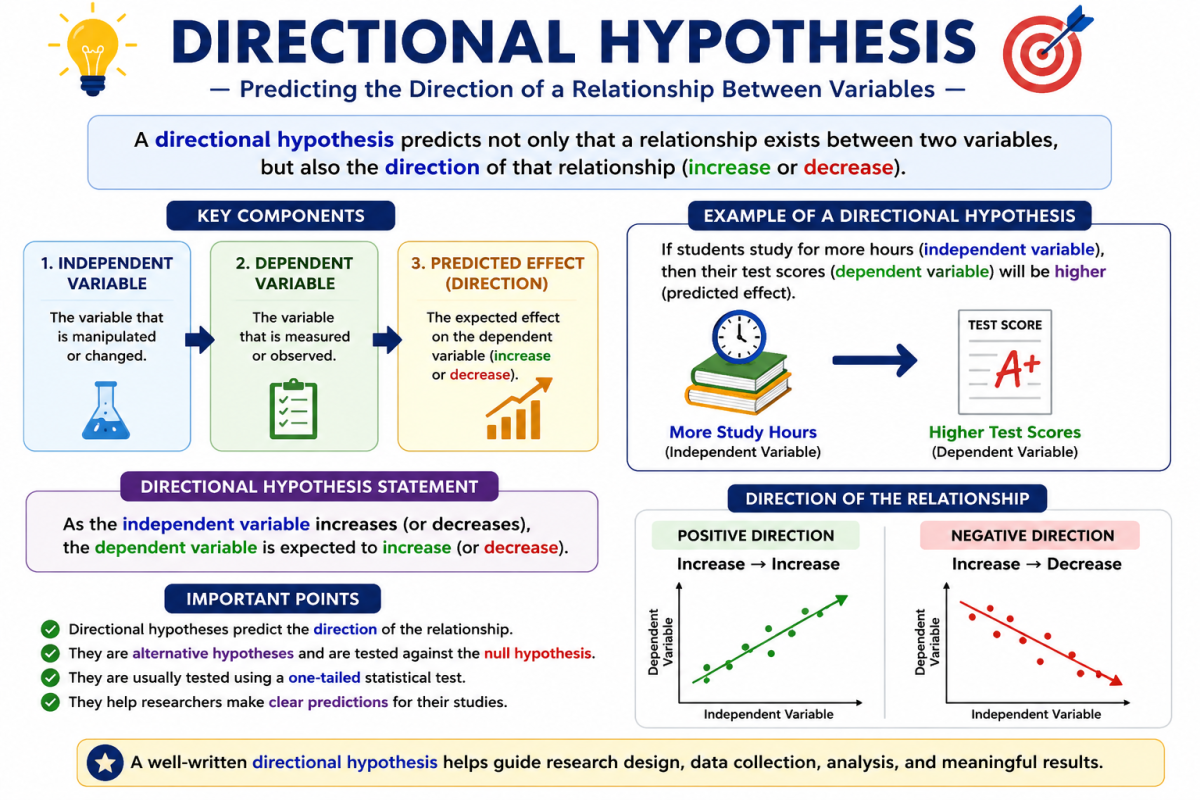
- A Directional Hypothesis is a type of hypothesis that predicts not only that a relationship exists between variables but also the specific direction of that relationship.
- Unlike a general prediction, a directional hypothesis specifies the expected outcome before data collection begins.
- It tells the researcher whether they expect an increase, decrease, higher value, lower value, positive effect, or negative effect in the dependent variable.
Definition of a Directional Hypothesis
- A directional hypothesis is a statement that predicts the direction of the relationship between two variables.
- The hypothesis specifies the expected effect of the independent variable on the dependent variable.
- It is often referred to as a one-tailed hypothesis because the prediction focuses on one specific direction.
- Researchers use directional hypotheses when previous theory, evidence, or experience supports a clear prediction.
Key Characteristics of a Directional Hypothesis
- States a clear prediction.
- Identifies the independent and dependent variables.
- Predicts the direction of the relationship.
- Can indicate an increase or decrease.
- May predict higher or lower scores.
- Is commonly tested using a one-tailed statistical test.
- Is based on theory, previous studies, or scientific understanding.
Purpose of a Directional Hypothesis
- Helps researchers predict the direction of the relationship between variables.
- Provides a focused framework for research design.
- Guides data collection and analysis.
- Helps determine which statistical test may be appropriate.
- Allows researchers to test a specific expectation rather than a general possibility.
- Improves the clarity and precision of hypothesis testing.
Why Directional Hypotheses Are Important in Research
- They provide a clear understanding of what the researcher expects to happen.
- They help organize the research process from beginning to end.
- They support stronger theoretical reasoning.
- They assist in identifying the expected relationship between the two variables.
- They help researchers interpret results more effectively.
- They are widely used in psychology, science, management, marketing, education, and health studies.
Example of a Directional Hypothesis
- Independent Variable: Study time
- Dependent Variable: Test scores
Directional Hypothesis:
- Students who spend more time studying will achieve higher test scores than students who spend less time studying.
This example predicts:
- A relationship between variables.
- The direction of the relationship.
- An increase in one variable leading to an increase in another variable.
Relationship with Other Types of Hypotheses
- A directional hypothesis is often paired with a null hypothesis.
- The null hypothesis states that no significant relationship or effect exists.
- The alternative hypothesis may be directional or non-directional.
- Directional and non-directional hypotheses serve different research purposes depending on the available evidence.
How To Write Directional Hypothesis: A Simple 7-Step Process for Research Studies
Writing a Directional Hypothesis becomes easier when you follow a structured process.
Step 1: Identify the Research Topic
- Begin with a clear research topic.
- Determine the area you want to investigate.
- Examples include psychology, education, science, management, or marketing.
Example:
- The effect of social media use on academic performance.
Step 2: Define the Research Question
- Convert the topic into a specific question.
- Focus on the relationship between variables.
Example:
- Does social media use affect academic performance among college students?
Step 3: Identify the Independent Variable
- Determine the variable that may influence change.
- This variable may involve manipulation or naturally occurring differences.
Example:
- Social media use.
Step 4: Identify the Dependent Variable
- Determine the outcome being measured.
- This variable reflects the effect on the dependent variable.
Example:
- Academic performance.
Step 5: Review Theory and Previous Research
- Examine existing studies.
- Look for patterns and findings.
- Determine whether previous evidence suggests a positive or negative relationship.
- Use theory to support your prediction.
Step 6: Predict the Direction
- Decide whether the relationship is expected to increase or decrease.
- Predict whether scores will be higher or lower.
- Determine whether the effect is positive or negative.
Questions to ask:
- Will a change in one variable increase the other?
- Will a change in one variable decrease the other?
- Is the expected outcome greater or lower?
Step 7: Write the Directional Hypothesis Statement
- State the relationship clearly.
- Include both variables.
- Predict the direction.
- Avoid vague wording.
Formula:
- As the independent variable increases, the dependent variable will increase.
- As the independent variable increases, the dependent variable will decrease.
Example:
- Students who spend more hours studying will earn higher test scores than students who study fewer hours.
Checklist for Writing a Strong Directional Hypothesis
- Clearly identifies the independent variable.
- Clearly identifies the dependent variable.
- Predicts the direction.
- Is measurable.
- Is based on theory or previous findings.
- Supports statistical analysis.
- Can be tested through research.
How To Write Directional Hypothesis With Best Example for Different Research Topics
The best way to understand a Directional Hypothesis is through examples from different fields.
Psychology Example
Research Topic:
- Sleep and memory performance.
Directional Hypothesis:
- Individuals who receive eight hours of sleep will score higher on memory tests than individuals who receive four hours of sleep.
Prediction:
- More sleep leads to higher scores.
Education Example
Research Topic:
- Study time and academic achievement.
Directional Hypothesis:
- Students who study for longer periods will achieve higher examination scores than students who study for shorter periods.
Prediction:
- Increased study time leads to increased performance.
Marketing Example
Research Topic:
- Advertising expenditure and sales.
Directional Hypothesis:
- Companies that increase advertising expenditure will experience greater sales growth than companies that maintain lower advertising expenditure.
Prediction:
- Increased advertising leads to increased sales.
Management Example
Research Topic:
- Employee training and productivity.
Directional Hypothesis:
- Employees who receive additional training will demonstrate higher productivity levels than employees who do not receive additional training.
Prediction:
- Training increases productivity.
Health Science Example
Research Topic:
- Exercise and body weight.
Directional Hypothesis:
- Individuals who engage in regular exercise will have lower body weight than individuals who do not exercise regularly.
Prediction:
- Exercise leads to reduced weight.
Experimental Research Example
Research Topic:
- Caffeine and reaction time.
Directional Hypothesis:
- Participants who consume caffeine will demonstrate faster reaction times than participants who do not consume caffeine.
Prediction:
- Caffeine improves performance.
Examples of Directional Hypotheses Using Different Directions
Positive Direction Example:
- Increased employee motivation will result in higher job performance.
Negative Direction Example:
- Increased stress levels will result in lower job satisfaction.
Higher Outcome Example:
- Students using interactive learning software will achieve higher test scores than students using traditional learning methods.
Lower Outcome Example:
- Participants who receive stress-management training will report lower anxiety scores than those who do not receive training.
Why These Examples Work
- They identify the independent and dependent variables.
- They predict the direction of the relationship.
- They are specific and measurable.
- They can be tested using statistical analysis.
- They support clear hypothesis testing.
Directional Hypothesis vs Non-Directional Hypothesis: Understanding the Direction of the Relationship
Researchers often compare directional and non-directional hypotheses when planning a study.
What Is a Non-Directional Hypothesis?
- A non-directional hypothesis predicts that a relationship exists.
- However, it does not predict the direction of the relationship.
- It simply states that the variables are related.
Example:
- There is a relationship between study time and academic performance.
The researcher does not state whether scores will be higher or lower.
What Is a Directional Hypothesis?
- A directional hypothesis predicts both the existence and direction of a relationship.
- It specifies whether the outcome will increase or decrease.
Example:
- Students who study longer will achieve higher academic performance.
Main Difference Between Directional and Non-Directional Hypotheses
Directional Hypothesis:
- Predicts a specific direction.
- Uses previous theory and evidence.
- Often uses a one-tailed hypothesis test.
- States whether results will be higher, lower, positive, or negative.
Non-Directional Hypothesis:
- Does not predict a specific direction.
- Focuses only on whether a relationship exists.
- Often uses a two-tailed statistical test.
- Leaves both possible directions open.
Comparison Example
Research Question:
- Does exercise affect stress levels?
Directional Hypothesis:
- Individuals who exercise regularly will report lower stress levels than individuals who do not exercise regularly.
Non-Directional Hypothesis:
- There is a relationship between exercise and stress levels.
The first statement predicts the direction of the relationship, while the second does not.
When to Use a Directional Hypothesis
Use a Directional Hypothesis when:
- Previous research supports a specific prediction.
- Strong theory exists.
- The expected outcome is clear.
- The researcher can confidently predict the direction.
- The study aims to test a directional hypothesis.
When to Use Non-Directional Hypotheses
Use non-directional hypotheses when:
- Limited previous evidence exists.
- The researcher cannot predict the outcome.
- The topic is new or exploratory.
- Multiple possible outcomes are equally reasonable.
Relationship Between Null Hypothesis and Alternative Hypothesis
Null Hypothesis:
- States that no significant relationship exists.
- States that no effect exists.
Alternative Hypothesis:
- Suggests that a relationship or effect exists.
- May be directional or non-directional.
Example:
Null Hypothesis:
- Study time has no effect on test scores.
Directional Alternative Hypothesis:
- Increased study time results in higher test scores.
Non-Directional Alternative Hypothesis:
- Study time affects test scores.
Key Components of a Directional Hypothesis: Independent Variable, Dependent Variable, and Predicted Effect
A strong Directional Hypothesis contains several essential components. Understanding these elements helps researchers create a clear, testable, and meaningful hypothesis for their study.
Why Understanding the Components Matters
- Every Directional Hypothesis is built around a specific prediction.
- The researcher must identify the variables involved before making that prediction.
- A well-written hypothesis helps guide research design, data collection, statistical analysis, and hypothesis testing.
- Understanding the relationship between variables improves the quality of the research process.
- The hypothesis specifies the expected outcome before the study begins.
Component 1: The Independent Variable
- The independent variable is the factor that is expected to influence another variable.
- It is often called the predictor variable.
- In experimental research, this variable may be manipulated by the researcher.
- In non-experimental studies, the independent variable may simply be observed or measured.
Characteristics of an Independent Variable
- Causes or influences change.
- Exists before the outcome occurs.
- Helps explain variation in results.
- Is often central to the research question.
Examples of Independent Variables
- Study hours.
- Exercise frequency.
- Employee training.
- Advertising expenditure.
- Sleep duration.
- Stress-management programs.
Example
Research Topic:
- The effect of study time on academic performance.
Independent Variable:
- Study time.
In this example, the researcher expects study time to affect performance outcomes.
Component 2: The Dependent Variable
- The dependent variable is the outcome that is measured.
- It changes as a result of the independent variable.
- Researchers observe whether the dependent variable increases, decreases, or remains unchanged.
- The effect on the dependent variable is the main focus of many studies.
Characteristics of a Dependent Variable
- Represents the outcome.
- Is measured during data collection.
- Depends on changes in the independent variable.
- Helps determine whether the prediction is supported.
Examples of Dependent Variables
- Test scores.
- Job performance.
- Sales revenue.
- Customer satisfaction.
- Anxiety levels.
- Productivity ratings.
Example
Research Topic:
- The effect of exercise on body weight.
Dependent Variable:
- Body weight.
Researchers measure whether exercise causes a higher or lower value in body weight.
Component 3: The Predicted Effect
- The predicted effect is what makes a Directional Hypothesis different from many other forms of hypotheses.
- The researcher does not simply state that a relationship exists.
- Instead, the researcher predicts the direction of the relationship.
Types of Predicted Effects
Positive Effect
- An increase in one variable leads to an increase in another variable.
- The relationship between variables moves in the same direction.
Example:
- Increased study time leads to higher test scores.
Negative Effect
- An increase in one variable leads to a decrease in another variable.
- The variables move in opposite directions.
Example:
- Increased stress leads to lower job satisfaction.
Understanding the Relationship Between the Two Variables
A complete Directional Hypothesis should:
- Identify the independent variable.
- Identify the dependent variable.
- Predict the direction.
- State whether the effect is positive or negative.
- Describe the relationship between the two variables clearly.
Example:
- Employees who receive advanced training will achieve higher productivity scores than employees who do not receive advanced training.
This statement includes:
- Independent Variable: Advanced training.
- Dependent Variable: Productivity scores.
- Predicted Effect: Higher productivity.
- Direction of the Relationship: Positive.
How These Components Work Together
When combined correctly, the independent and dependent variables create a clear prediction.
Formula:
- Independent Variable → Predicted Effect → Dependent Variable
Example:
- Increased exercise → Lower stress levels.
- More study hours → Higher test scores.
- Greater advertising investment → Higher sales revenue.
Understanding these components helps researchers fully develop a Directional Hypothesis that can be tested through statistical analysis and research.
Common Mistakes Researchers Make When Writing Directional Hypotheses and How to Avoid Them
Even experienced researchers sometimes make mistakes when creating directional hypotheses. Identifying these errors can improve research quality and lead to more accurate results.
Mistake 1: Failing to Predict the Direction
One of the most common errors is writing a hypothesis that only states a relationship exists.
Incorrect Example:
- There is a relationship between study time and academic performance.
Why It Is Wrong:
- This is a non-directional statement.
- It does not predict the direction of the relationship.
Correct Example:
- Students who study longer will achieve higher academic scores.
Mistake 2: Confusing Independent and Dependent Variables
Many beginners incorrectly identify the independent and dependent variables.
Why It Happens:
- Lack of understanding of variable roles.
- Poor research design.
How to Avoid It:
- Determine which variable is expected to cause change.
- Determine which variable is expected to be affected.
Mistake 3: Writing Vague Statements
Weak Example:
- Better teaching affects students.
Problems:
- “Better” is unclear.
- “Affects” does not specify how.
- No measurable outcome exists.
Improved Example:
- Students taught using interactive learning methods will achieve higher test scores than students taught using traditional methods.
Mistake 4: Ignoring Existing Theory and Research
A Directional Hypothesis should not be based on guessing.
Researchers should:
- Review previous studies.
- Examine theory.
- Consider existing evidence.
- Use prior findings to support their prediction.
Mistake 5: Making Unrealistic Predictions
Poor Example:
- All employees who receive training will become top performers.
Problems:
- Too absolute.
- Difficult to support statistically.
- Ignores natural variation within a population.
Better Example:
- Employees who receive additional training will demonstrate higher productivity scores than employees who do not receive training.
Mistake 6: Creating an Untestable Hypothesis
A hypothesis must be measurable.
Weak Example:
- Happy employees are better workers.
Problems:
- Happiness is undefined.
- Better performance is not measured.
Improved Example:
- Employees with higher job satisfaction scores will achieve higher productivity ratings.
Mistake 7: Confusing Directional and Non-Directional Hypotheses
Researchers sometimes mix directional and non-directional approaches.
Directional Statement:
- Students who attend tutoring sessions will achieve higher grades.
Non-Directional Statement:
- There is a relationship between tutoring attendance and grades.
Understanding the difference between directional and non-directional hypotheses helps researchers choose the appropriate statistical test.
Tips for Avoiding These Mistakes
- Clearly identify variables.
- Use measurable outcomes.
- Predict the direction.
- Base predictions on theory.
- Review examples of directional hypotheses.
- Ensure the hypothesis aligns with the research question.
- Use precise language.
How To Write Directional Hypothesis for Statistical Analysis, Data Collection, and Hypothesis Testing
A Directional Hypothesis plays an important role throughout the entire research process. It influences study design, data collection procedures, and statistical analysis decisions.
Step 1: Begin with a Clear Research Question
A good hypothesis starts with a focused question.
Example:
- Does employee training improve productivity?
The question establishes the foundation for the research.
Step 2: Identify the Variables
Determine:
- Independent variable.
- Dependent variable.
Example:
Independent Variable:
- Employee training.
Dependent Variable:
- Productivity.
Step 3: Predict the Direction
The researcher must predict the direction of the relationship.
Possible predictions include:
- Higher.
- Lower.
- Greater.
- Less.
- Increase.
- Decrease.
Example:
- Employees who receive training will demonstrate higher productivity levels.
Step 4: Connect the Hypothesis to Data Collection
Data collection should directly measure both variables.
For example:
Independent Variable Data:
- Number of training sessions completed.
Dependent Variable Data:
- Productivity score.
The collected information must allow researchers to determine whether the prediction is supported.
Step 5: Link the Hypothesis to Statistical Analysis
A Directional Hypothesis often leads to a one-tailed hypothesis test.
Why?
- The researcher expects a specific outcome.
- The prediction focuses on one direction.
Example:
Prediction:
- Training increases productivity.
The statistical test evaluates whether the increase is significant.
Step 6: Compare the Alternative Hypothesis and Null Hypothesis
Alternative Hypothesis:
- Employees receiving training will achieve higher productivity scores.
Null Hypothesis:
- Training has no significant effect on productivity.
The purpose of hypothesis testing is to determine whether the null hypothesis should be rejected.
Step 7: Interpret the Results
Researchers examine:
- Statistical significance.
- Direction of results.
- Strength of the effect.
Questions include:
- Did the outcome match the prediction?
- Was the effect significant?
- Was the direction positive or negative?
Why Directional Hypotheses Improve Statistical Analysis
- They create focused predictions.
- They support efficient research design.
- They help researchers select appropriate statistical tests.
- They improve interpretation of findings.
- They create a clear link between theory and evidence.
How To Write Directional Hypothesis With Best Example: Practical Examples of Directional Hypotheses in Science and Experimental Research
The best way to master a Directional Hypothesis is by examining practical examples from different fields.
Science Example
Research Topic:
- Fertilizer use and plant growth.
Directional Hypothesis:
- Plants receiving fertilizer will grow taller than plants not receiving fertilizer.
Predicted Direction:
- Fertilizer increases growth.
Psychology Example
Research Topic:
- Sleep quality and memory performance.
Directional Hypothesis:
- Individuals who obtain eight hours of sleep will score higher on memory tests than individuals who obtain four hours of sleep.
Predicted Direction:
- More sleep produces higher scores.
Education Example
Research Topic:
- Homework completion and academic performance.
Directional Hypothesis:
- Students who consistently complete homework assignments will achieve higher test scores than students who do not.
Predicted Direction:
- Homework completion increases academic performance.
Marketing Example
Research Topic:
- Social media advertising and sales.
Directional Hypothesis:
- Businesses that increase social media advertising expenditure will generate greater sales revenue than businesses that maintain lower advertising budgets.
Predicted Direction:
- Advertising increases sales.
Management Example
Research Topic:
- Leadership training and employee performance.
Directional Hypothesis:
- Employees supervised by managers who receive leadership training will report higher job satisfaction levels than employees supervised by untrained managers.
Predicted Direction:
- Leadership training improves satisfaction.
Health Research Example
Research Topic:
- Physical activity and stress.
Directional Hypothesis:
- Individuals who exercise regularly will report lower stress scores than individuals who exercise infrequently.
Predicted Direction:
- Exercise reduces stress.
Experimental Research Example
Research Topic:
- Caffeine consumption and reaction time.
Directional Hypothesis:
- Participants who consume caffeine before testing will demonstrate faster reaction times than participants who do not consume caffeine.
Predicted Direction:
- Caffeine improves performance.
What Makes These Examples Strong?
These examples:
- Clearly identify the independent variable.
- Clearly identify the dependent variable.
- Predict the direction.
- Use measurable outcomes.
- Support hypothesis testing.
- Can be evaluated through statistical analysis.
- Align with theory and previous research.
Final Takeaway
- Directional hypotheses provide a clear prediction about the relationship between variables.
- They specify whether a change in one variable will lead to an increase or decrease in another variable.
- Non directional, nondirectional hypotheses, and non-directional hypotheses do not predict the direction of the relationship.
- Understanding directional and non-directional approaches helps researchers choose the most appropriate research design, statistical test, and hypothesis testing strategy for their study.
- A strong Directional Hypothesis does more than state that a relationship exists. It predicts the direction of the relationship between two variables and specifies the expected effect on the dependent variable. Whether conducting research in psychology, science, education, management, marketing, or experimental settings, researchers who can predict the direction clearly are better prepared to design studies, collect data, perform statistical analysis, and interpret meaningful results.
Research Hypotheses
Types of Research Hypotheses
Explore key hypothesis categories used in academic research and studies.
Types of Hypotheses
Overview
→
Research Hypotheses
Basics
→
Alternative
H1
→
Null
H0
→
Directional
One-tailed
→
Non-Directional
Two-tailed
→
Simple
One variable
→
Complex
Multiple variables
→
Causal
Cause-effect
→
Associative
Relationship
→
Statistical
Testing
→
Working
Temporary
→
Declarative
Statement form
→
Question Form
Question-based
→
Empirical
Observed data
→
Logical
Reasoned
→
Value
Business focus
→
