
Blog
How To Write Non-Directional Hypothesis With Examples

What Is a Non-Directional Hypothesis? Definition, Purpose, and Role in Hypothesis Testing
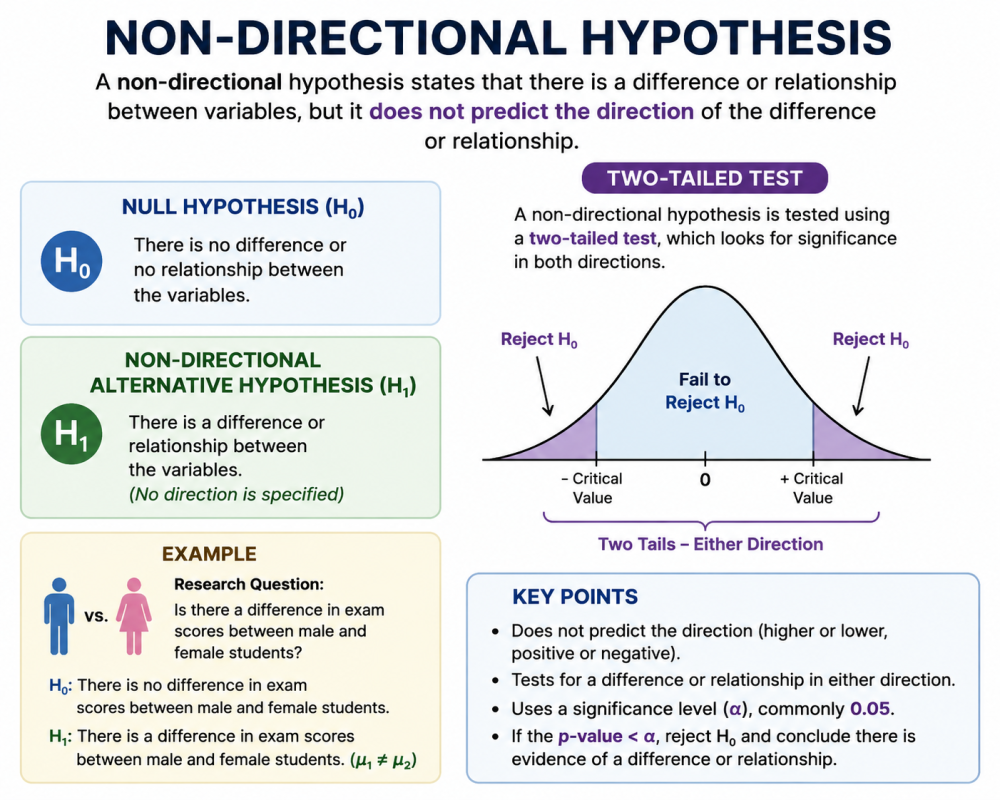
A Non-Directional Hypothesis is a type of hypothesis that states there is a relationship or difference between variables but does not predict the direction of the relationship or difference.
Definition of a Non-Directional Hypothesis
- A Non-Directional Hypothesis suggests that a change, association, correlation, or difference exists.
- However, it does not specify whether one variable will be higher or lower than another.
- It is commonly expressed using the symbol ≠ when comparing groups.
- The researcher expects a relationship or difference but remains open to results occurring in either direction.
- This form of prediction is often referred to as a two-tailed hypothesis because the statistical analysis examines both tails of the distribution.
Example of a Non-Directional Hypothesis
- Research question: Is there a difference in exam performance between male and female students?
- Non-directional hypothesis: There is a statistically significant difference in exam performance between male and female students.
- Notice that the hypothesis does not predict whether males will score higher or lower than females.
Purpose of a Non-Directional Hypothesis
A Non-Directional Hypothesis serves several important purposes in quantitative research:
- Allows researchers to investigate a possible relationship or difference without assuming the outcome.
- Reduces the risk of making unsupported predictions.
- Provides flexibility when previous research findings are inconsistent.
- Supports objective hypothesis testing.
- Helps determine whether evidence of a difference exists regardless of direction.
When Researchers Use Non-Directional Hypotheses
Researchers typically use non-directional hypotheses when:
- There is limited previous research on the topic.
- Existing findings contradict one another.
- Theoretical evidence is insufficient to predict the direction of the relationship.
- The researcher wants to avoid bias in making predictions.
- The nature of the relationship remains uncertain.
The Role of a Non-Directional Hypothesis in Research
The non-directional hypothesis in research plays a critical role in the scientific process.
- It guides data collection.
- It helps identify relevant variables.
- It determines the appropriate statistical method used.
- It provides a framework for testing assumptions.
- It assists researchers in evaluating whether findings are statistically significant.
Relationship with the Null Hypothesis
Every hypothesis test involves both a research hypothesis and a null hypothesis.
- The null hypothesis (H0) states that no relationship or difference exists.
- The Non-Directional Hypothesis serves as one of the alternative hypotheses.
- H0 example: H0: There is no difference in exam scores between male and female students.
- Alternative hypothesis example: H1: There is a difference in exam scores between male and female students.
Role in Hypothesis Testing
During hypothesis testing, researchers:
- Collect data from a sample.
- Calculate a statistic.
- Determine a p-value.
- Compare the p-value with the significance level, often 0.05.
- Decide whether the null hypothesis is rejected.
If the p-value is less than 0.05:
- The null hypothesis is rejected.
- Researchers conclude that the observed results are unlikely due to chance alone.
- There is strong evidence supporting the alternative hypothesis.
If the p-value is greater than 0.05:
- Researchers fail to reject H0.
- The evidence is insufficient to support the proposed relationship or difference.
How To Write Non-Directional Hypothesis With Example: A 7-Step Process for Formulating Non-Directional Hypotheses
Writing a Non-Directional Hypothesis becomes easier when a structured process is followed.
Step 1: Identify the Research Problem
- Begin with a clear research problem.
- Determine what issue requires investigation.
- Define the main objective of the study.
Example:
- Does social media usage affect academic performance?
Step 2: Identify the Variables
Every hypothesis involves at least one variable.
- Independent variable: social media usage.
- Dependent variable: academic performance.
For studies involving two variables:
- Clearly identify both variables before writing the hypothesis.
- Ensure they can be measured objectively.
Step 3: Review Previous Research
- Examine existing literature.
- Identify established findings.
- Determine whether previous research supports a particular direction.
Use a non-directional approach when:
- Findings are mixed.
- Results are inconsistent.
- Evidence is limited.
Step 4: Determine Whether Direction Can Be Predicted
Ask yourself:
- Can I confidently predict the direction of the relationship?
- Do theories support a specific outcome?
If the answer is no:
- A Non-Directional Hypothesis is more suitable than directional hypotheses.
Step 5: State the Relationship or Difference
Focus on whether variables are related.
Do not predict:
- Higher or lower outcomes.
- Positive or negative effects.
- The direction of the relationship.
Example:
- There is a relationship between social media use and academic performance.
Step 6: Write the Alternative Hypothesis
Develop the hypothesis using neutral wording.
Examples:
- There is a significant relationship between exercise frequency and stress levels.
- There is a significant difference in customer satisfaction between two service models.
- There is a relationship between study time and examination performance.
Step 7: Formulate the Corresponding Null Hypothesis
Every alternative hypothesis requires a matching H0.
Example:
Alternative hypothesis:
- There is a relationship between exercise frequency and stress levels.
Null hypothesis:
- There is no relationship between exercise frequency and stress levels.
This completes the process of creating a statistically testable hypothesis.
Complete Example
Research topic:
- Effects of remote work on productivity.
Alternative hypothesis:
- There is a significant difference in productivity between employees who work remotely and employees who work on-site.
Null hypothesis:
- There is no significant difference in productivity between employees who work remotely and employees who work on-site.
Because the researcher does not predict the direction of the difference, this is a Non-Directional Hypothesis.
How To Write Non-Directional Hypothesis With Example for Quantitative Research Studies
A Non-Directional Hypothesis is particularly useful in quantitative research because numerical data can be analyzed objectively using statistical procedures.
Why Quantitative Research Uses Non-Directional Hypotheses
- Quantitative research focuses on measurement.
- Researchers collect numerical data.
- Statistical tests determine whether observed patterns are significant.
- Findings can be generalized when a random sample is used.
Example 1: Gender Differences
Research question:
- Is there a difference in leadership scores between male and female employees?
Non-directional hypothesis:
- There is a statistically significant difference in leadership scores between male and female employees.
This hypothesis does not specify which group scores higher.
Example 2: New Drug Study
Research question:
- Does a new drug affect blood pressure?
Non-directional hypothesis:
- There is a significant difference in blood pressure among participants who receive the new drug compared with those who do not.
The researcher does not predict whether blood pressure will increase or decrease.
Example 3: Correlation Study
Research question:
- Is there a relationship between sleep duration and productivity?
Non-directional hypothesis:
- There is a significant relationship between sleep duration and productivity.
The hypothesis does not specify whether the correlation will be positive or negative.
Example 4: Education Research
Research question:
- Is there a relationship between study habits and academic achievement?
Non-directional hypothesis:
- There is a significant relationship between study habits and academic achievement.
Again, the direction of the relationship remains unspecified.
Statistical Testing in Quantitative Studies
After writing the Non-Directional Hypothesis, researchers:
- Collect data.
- Apply a two-tailed test.
- Calculate the relevant statistic.
- Examine the p-value.
- Evaluate statistical significance.
The goal is to determine whether the observed relationship or difference is large enough that it is unlikely due to chance alone.
Importance of Sampling
Good sampling practices strengthen findings.
Researchers should:
- Use a random sample whenever possible.
- Minimize bias.
- Ensure adequate sample size.
- Improve generalizability.
Strong sampling procedures help increase confidence in hypothesis testing results.
Non-Directional Hypothesis vs Directional Hypothesis: Key Differences Explained
Understanding the distinction between directional and non-directional hypotheses is essential for selecting the correct statistical test.
What Is a Directional Hypothesis?
A directional hypothesis predicts the direction of an outcome.
Examples:
- Students who study longer will achieve higher examination scores.
- Increased exercise will reduce stress levels.
- Employee training will increase productivity.
In each case, the hypothesis predicts the direction of the relationship.
What Is a Non-Directional Hypothesis?
A Non-Directional Hypothesis states that a relationship or difference exists but does not predict the direction.
Examples:
- There is a relationship between study time and examination scores.
- There is a difference in productivity between trained and untrained employees.
Major Differences
1. Prediction
Directional hypothesis:
- Predicts the direction.
Non-directional hypothesis:
- Does not predict the direction.
2. Statistical Test
Directional hypothesis:
- Uses a one-tailed hypothesis and often a one-tailed test.
Non-directional hypothesis:
- Uses a two-tailed hypothesis and a two-tailed test.
3. Research Evidence
Directional hypothesis:
- Requires strong evidence from theory or previous research.
Non-directional hypothesis:
- Suitable when evidence is limited or conflicting.
4. Focus
Directional hypothesis:
- Focuses on whether one variable is higher, lower, positive, or negative.
Non-directional hypothesis:
- Focuses only on whether a relationship or difference exists.
Directional and Non-Directional Example
Research question:
- Is there a relationship between stress and productivity?
Directional hypothesis:
- Increased stress decreases productivity.
Non-directional hypothesis:
- There is a relationship between stress and productivity.
The first predicts the direction of the relationship, while the second allows either direction.
Correlation Example
Directional hypothesis:
- There is a positive correlation between study time and grades.
or
- There is a negative correlation between stress and productivity.
Non-directional hypothesis:
- There is a correlation between study time and grades.
The researcher does not specify whether the association will be positive or negative.
Choosing Between the Two
Use a directional hypothesis when:
- Previous research consistently supports one outcome.
- Strong theoretical arguments exist.
- You can confidently predict the direction.
Use a Non-Directional Hypothesis when:
- Findings are inconsistent.
- Theoretical support is weak.
- The researcher wants to remain neutral.
- The direction of the relationship cannot be determined beforehand.
The Relationship Between H0, Alternative Hypotheses, and Non-Directional Hypotheses
Understanding the relationship between H0, alternative hypotheses, and a Non-Directional Hypothesis is one of the most important aspects of hypothesis testing. These concepts work together to help researchers determine whether observed findings are meaningful or simply occurred due to chance alone.
What Is H0 (Null Hypothesis)?
- The null hypothesis, commonly represented as H0, is the default assumption in statistical analysis.
- H0 states that there is no relationship or difference between the variables being studied.
- It assumes that any observed variation in the data occurred due to random chance.
- During hypothesis testing, researchers attempt to determine whether enough evidence exists to reject H0.
- The null hypothesis provides the baseline against which all statistical tests are evaluated.
Examples of H0
Example 1: Gender Differences
Research question:
- Is there a difference in leadership scores between male and female employees?
Null hypothesis:
- H0: There is no statistically significant difference between male and female leadership scores.
Example 2: Correlation Study
Research question:
- Is there a relationship between exercise and stress levels?
Null hypothesis:
- H0: There is no relationship between exercise frequency and stress levels.
Example 3: New Drug Study
Research question:
- Does a new drug affect blood pressure?
Null hypothesis:
- H0: The new drug has no effect on blood pressure.
What Are Alternative Hypotheses?
- Alternative hypotheses represent the researcher’s expectation that a relationship or difference exists.
- They challenge the assumptions made by H0.
- Alternative hypotheses are accepted only when sufficient statistical evidence exists.
- The researcher develops the alternative hypothesis before collecting data.
- The goal is to test the hypothesis using objective procedures.
Types of Alternative Hypotheses
There are two primary categories of alternative hypotheses:
1. Directional Hypotheses
- Predict the direction of the relationship.
- Specify whether one group will score higher or lower.
- Predict whether a correlation will be positive or negative.
- Often use a one-tailed hypothesis.
Example:
- Male employees will score higher than female employees on leadership assessments.
2. Non-Directional Hypotheses
- State that a relationship or difference exists.
- Do not predict the direction.
- Allow results to occur in either direction.
- Usually require a two-tailed hypothesis.
Example:
- There is a difference between male and female leadership scores.
How H0 and a Non-Directional Hypothesis Work Together
A Non-Directional Hypothesis serves as one of the alternative hypotheses used in statistical testing.
For example:
Research topic:
- Relationship between study time and academic performance.
Null hypothesis:
- H0: There is no relationship between study time and academic performance.
Alternative hypothesis:
- H1: There is a relationship between study time and academic performance.
Notice that the Non-Directional Hypothesis does not specify whether the relationship is a positive correlation or a negative correlation.
The Decision-Making Process
Researchers follow a structured process:
- State H0 and the alternative hypothesis.
- Collect data from a random sample.
- Calculate the appropriate statistic.
- Determine the p-value.
- Compare the p-value to the significance level.
- Decide whether to reject H0.
Role of Statistical Significance
Most studies use a significance level of 0.05.
- If the p-value is less than 0.05, the results are considered statistically significant.
- If the p-value exceeds 0.05, researchers fail to reject H0.
When the null hypothesis is rejected:
- Strong evidence supports the alternative hypothesis.
- Researchers conclude that the observed findings are unlikely due to chance alone.
Why This Relationship Matters
Understanding the connection between H0 and a Non-Directional Hypothesis helps researchers:
- Conduct valid hypothesis testing.
- Select suitable statistical procedures.
- Avoid unsupported assumptions.
- Determine whether a relationship or difference truly exists.
- Produce objective findings in quantitative research.
How To Write Non-Directional Hypothesis With Example for Two-Tailed Hypothesis Testing
A Non-Directional Hypothesis is closely connected to two-tailed hypothesis testing because both focus on detecting a relationship or difference without predicting a particular direction.
What Is a Two-Tailed Hypothesis?
- A two-tailed hypothesis allows results to fall into either tail of a statistical distribution.
- It examines both positive and negative outcomes.
- It does not assume whether the effect will be higher or lower.
- It is the standard approach when researchers cannot confidently predict the direction of the relationship.
Mathematically:
- Alternative hypothesis: μ₁ ≠ μ₂
The symbol ≠ indicates that the values are different but does not indicate which is larger.
Why a Non-Directional Hypothesis Uses a Two-Tailed Test
A Non-Directional Hypothesis does not predict the direction.
Because of this:
- The researcher must examine both tails of the distribution.
- Differences can occur in either direction.
- Relationships can be positive or negative.
Therefore:
- A two-tailed hypothesis requires a two-tailed test.
Step-by-Step Guide
Step 1: Define the Research Question
Example:
- Is there a difference in productivity between remote workers and office workers?
Step 2: Identify the Variables
Independent variable:
- Work arrangement.
Dependent variable:
- Productivity score.
Step 3: Write the Null Hypothesis
- H0: There is no difference in productivity between remote and office workers.
Step 4: Write the Non-Directional Hypothesis
- There is a statistically significant difference in productivity between remote and office workers.
Notice that the hypothesis does not predict whether productivity will be higher or lower.
Step 5: Choose a Two-Tailed Test
The statistical method used depends on the data.
Common examples include:
- Independent t-test.
- Paired t-test.
- Pearson correlation.
- Chi-square test.
- Analysis of variance (ANOVA).
Step 6: Collect Data
Researchers:
- Use appropriate sampling procedures.
- Prefer a random sample when possible.
- Ensure adequate sample size.
Step 7: Calculate the Test Statistic
The statistical software produces:
- Test statistic.
- Probability value.
- Confidence intervals.
Step 8: Compare the P-Value
Using a significance level of 0.05:
- p-value < 0.05 = reject H0.
- p-value > 0.05 = fail to reject H0.
Example Using Correlation
Research question:
- Is there a relationship between sleep quality and work performance?
Non-directional hypothesis:
- There is a significant relationship between sleep quality and work performance.
The hypothesis allows:
- Positive correlation.
- Negative correlation.
The researcher does not predict the direction of the relationship.
Difference Between One-Tailed and Two-Tailed Testing
One-Tailed Hypothesis
- Predicts the direction.
- Uses a one-sided test.
- Looks at only one tail.
Example:
- Increased exercise reduces stress.
Two-Tailed Hypothesis
- Does not predict the direction.
- Uses both tails.
- Examines either direction.
Example:
- Exercise is related to stress levels.
A Non-Directional Hypothesis is therefore most suitable when researchers cannot predict the direction based on previous research or theoretical evidence.
Common Mistakes to Avoid When Writing a Non-Directional Hypothesis
Many students and researchers make errors when formulating a Non-Directional Hypothesis. Understanding these mistakes improves the quality of research design and hypothesis testing.
Mistake 1: Predicting the Direction
Incorrect:
- Female employees will perform better than male employees.
Why it is wrong:
- This is a directional hypothesis.
- It predicts the direction of the difference.
Correct:
- There is a difference between male and female employee performance.
Mistake 2: Forgetting to Include Variables
Incorrect:
- There is a relationship.
Why it is wrong:
- The variables are missing.
Correct:
- There is a relationship between social media usage and academic performance.
Mistake 3: Confusing Correlation With Causation
Incorrect:
- Social media causes poor academic performance.
Why it is wrong:
- Causal claims require stronger evidence.
- Correlation does not automatically indicate causation.
Correct:
- There is an association between social media usage and academic performance.
Mistake 4: Writing a Vague Hypothesis
Incorrect:
- Something will change.
Why it is wrong:
- The statement lacks clarity.
Correct:
- There is a significant relationship between exercise frequency and stress levels.
Mistake 5: Contradicting the Research Question
Researchers should ensure the hypothesis aligns with the research objective.
A hypothesis should:
- Address the study purpose.
- Reflect the research question.
- Support the intended statistical analysis.
Mistake 6: Ignoring Previous Research
Even though a Non-Directional Hypothesis does not predict the direction, researchers should still review previous research.
Literature reviews help:
- Derive meaningful hypotheses.
- Identify research gaps.
- Strengthen theoretical foundations.
Mistake 7: Using Complex Language
Good hypotheses should be:
- Clear.
- Simple.
- Direct.
- Testable.
A simple hypothesis is often stronger than an overly complicated statement.
Mistake 8: Forgetting the Null Hypothesis
Every Non-Directional Hypothesis requires a corresponding null hypothesis.
Without H0:
- Statistical testing cannot proceed properly.
- Interpretation becomes difficult.
Mistake 9: Choosing the Wrong Statistical Test
Directional and non-directional hypotheses require different approaches.
Selecting a one-tailed test for a non-directional hypothesis can produce misleading results.
Researchers should ensure the statistical method used matches the hypothesis structure.
How To Write Non-Directional Hypothesis With Example: Practical Examples and Applications in Research
A Non-Directional Hypothesis can be applied across many fields of quantitative research. The following examples demonstrate how researchers use non-directional hypotheses in real-world studies.
Example 1: Education Research
Research question:
- Is there a relationship between study habits and academic achievement?
Non-directional hypothesis:
- There is a significant relationship between study habits and academic achievement.
Application:
- Researchers determine whether the two variables correlate.
- The relationship may be positive or negative.
Example 2: Health Research
Research question:
- Does a new drug affect patient recovery time?
Non-directional hypothesis:
- There is a significant difference in recovery time between patients receiving the new drug and those receiving standard treatment.
Application:
- The study examines whether a difference exists.
- The researcher does not predict whether recovery is faster or slower.
Example 3: Workplace Research
Research question:
- Is there a relationship between employee engagement and productivity?
Non-directional hypothesis:
- There is a significant relationship between employee engagement and productivity.
Application:
- The researcher investigates the relationship between two variables.
- The direction of the relationship remains unspecified.
Example 4: Marketing Research
Research question:
- Does advertising influence customer purchasing behavior?
Non-directional hypothesis:
- There is a significant relationship between advertising exposure and purchasing behavior.
Application:
- The researcher tests whether an association exists.
- The magnitude and direction are determined after analysis.
Example 5: Psychology Research
Research question:
- Is there a relationship between stress and sleep quality?
Non-directional hypothesis:
- There is a significant relationship between stress levels and sleep quality.
Application:
- The variables may correlate in either direction.
- Statistical analysis determines the nature of the relationship.
Example 6: Gender Differences Research
Research question:
- Is there a difference in job satisfaction between male and female employees?
Non-directional hypothesis:
- There is a statistically significant difference in job satisfaction between male and female employees.
Application:
- Researchers test for evidence of a difference.
- No prediction is made regarding which group scores higher.
Why Researchers Frequently Use a Non-Directional Hypothesis
A Non-Directional Hypothesis is widely used because it:
- Supports objective investigation.
- Avoids unsupported assumptions.
- Works well when findings are inconsistent.
- Is suitable when previous research does not provide strong evidence.
- Allows outcomes in either direction.
- Aligns naturally with two-tailed hypothesis testing.
- Helps determine whether a relationship or difference exists before examining its direction.
For these reasons, the Non-Directional Hypothesis remains one of the most valuable tools in quantitative research, enabling researchers to test the hypothesis fairly, evaluate statistical significance accurately, and determine whether observed findings reflect genuine effects rather than random variation.
Research Hypotheses
Types of Research Hypotheses
Explore key hypothesis categories used in academic research and studies.
Types of Hypotheses
Overview
→
Research Hypotheses
Basics
→
Alternative
H1
→
Null
H0
→
Directional
One-tailed
→
Non-Directional
Two-tailed
→
Simple
One variable
→
Complex
Multiple variables
→
Causal
Cause-effect
→
Associative
Relationship
→
Statistical
Testing
→
Working
Temporary
→
Declarative
Statement form
→
Question Form
Question-based
→
Empirical
Observed data
→
Logical
Reasoned
→
Value
Business focus
→
