
Blog
How To Write Causal Hypothesis With Examples

What Is a Causal Hypothesis? Understanding Causation, Causal Inference, and Scientific Prediction
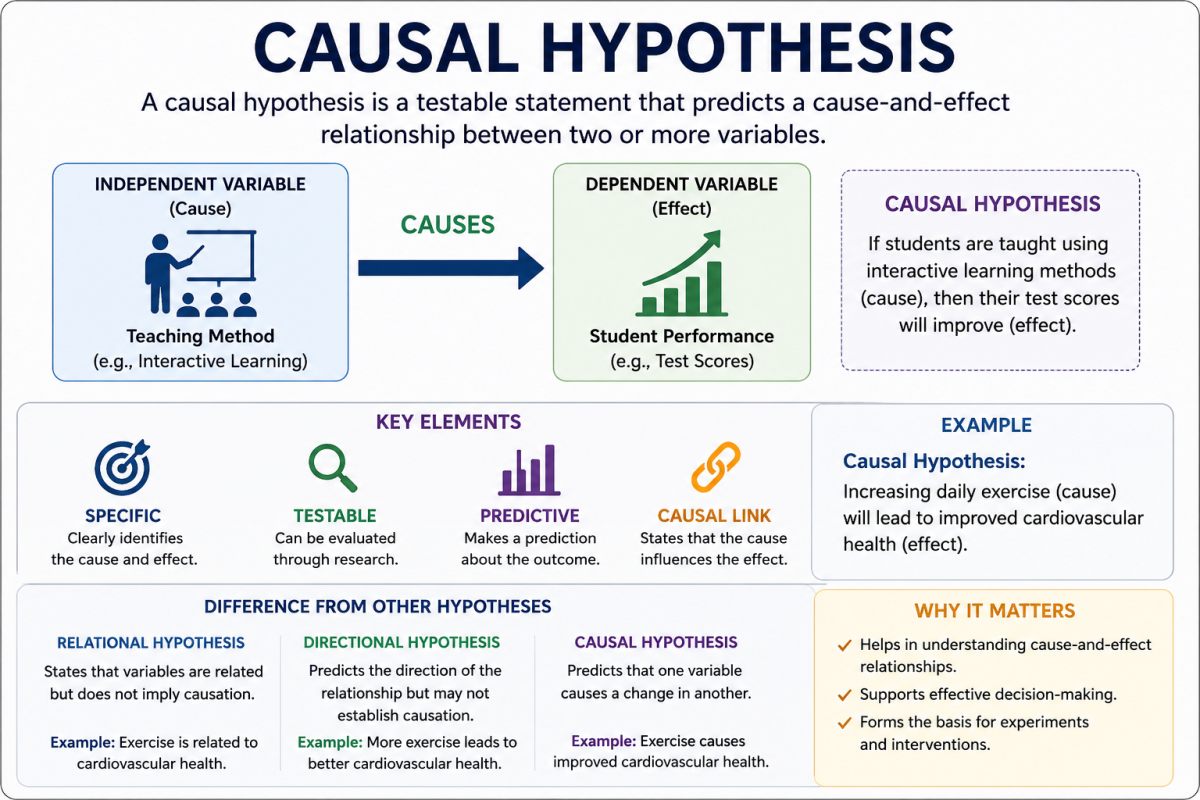
- A Causal Hypothesis is a specific type of scientific hypothesis that proposes a cause-and-effect relationship between two or more variables.
- Unlike a simple observational statement, a Causal Hypothesis predicts that one variable directly influences or produces changes in another variable.
- In research, a Causal Hypothesis helps researchers move beyond identifying a correlation and toward understanding causality and the underlying causal processes involved.
- The primary purpose of a Causal Hypothesis is to determine whether a particular causal agent produces a measurable causal effect.
- A well-developed Causal Hypothesis serves as a foundation for conducting hypothesis testing and making scientific predictions.
Understanding Causation
- Causation refers to a situation where one factor directly influences another factor.
- When researchers investigate causation, they seek evidence that a cause-and-effect relationship exists rather than merely observing an association.
- For example:
- Increased study time causes higher academic performance.
- Regular exercise causes improved cardiovascular health.
- Employee training causes greater workplace productivity.
- These examples suggest a causal relationship rather than simply describing the relationship between variables.
- Understanding causal relationships is essential because researchers often need to know whether A causes B rather than merely determining whether A and B occur together.
Understanding Causal Inference
- Causal inference is the process of determining whether a causal connection exists between variables.
- Researchers use an approach to causal inference to evaluate whether observed outcomes are the result of a genuine causal relation.
- Causal inference methods help researchers:
- Identify possible causal explanations.
- Evaluate underlying causal mechanisms.
- Estimate causal effects.
- Test causal hypotheses.
- Make valid causal conclusions.
- Modern causal inference often uses:
- Statistical analysis.
- Experimental research design.
- Causal diagrams.
- Laboratory research.
- Field experiments.
Correlation vs Causation
- One of the most important principles in research is that correlation does not imply causation.
- Correlation occurs when two variables change together.
- However, a statistical association does not automatically mean a relationship is causal.
- Example:
- Ice cream sales increase during summer.
- Drowning incidents also increase during summer.
- While these variables are correlated, one does not cause the other.
- Instead, a third factor, warm weather, influences both.
- This is why researchers must carefully examine causal assumptions before making a causal claim.
Components of a Causal Hypothesis
A strong Causal Hypothesis generally contains:
- An independent variable that acts as the cause.
- A dependent variable that represents the effect.
- A directional prediction.
- A specific causal relationship.
Example:
- Employees who receive leadership training will demonstrate higher job performance than employees who do not receive training.
In this example:
- Leadership training is the causal agent.
- Job performance is the dependent variable.
- The hypothesis predicts a directional causal effect.
Importance of Scientific Prediction
- Scientific research relies heavily on prediction.
- A Causal Hypothesis allows researchers to:
- Formalize expectations.
- Test hypotheses systematically.
- Evaluate causal theories.
- Generate causal knowledge.
- Build reliable causal explanations.
- Because of this, the use of hypothesis development remains central in virtually every field of research, including:
- Epidemiological research.
- Education.
- Psychology.
- Sociology.
- Business research.
- Healthcare.
How to Write a Causal Hypothesis: A 7-Step Process for Defining Causal Relationships
Step 1: Identify the Research Problem
- Begin by identifying a problem or phenomenon that requires explanation.
- Ask questions such as:
- Why does employee turnover increase?
- What factors improve academic achievement?
- How can customer satisfaction be enhanced?
- Defining causal questions helps establish the foundation for identifying causal relationships.
Step 2: Review Existing Literature
- Examine prior causal research and existing studies.
- Look for:
- Established causal theories.
- Previous findings.
- Known causal interactions.
- Potential gaps in knowledge.
- Literature reviews help researchers develop a stronger understanding of causal structures.
Step 3: Identify the Cause and Effect Variables
- Determine the two variables involved.
- The independent variable represents the cause.
- The dependent variable represents the effect.
Example:
- Independent variable: Training hours.
- Dependent variable: Employee productivity.
- Clearly defining these variables is critical when attempting to make causal predictions.
Step 4: Establish a Theoretical Explanation
- Explain why the relationship is causal.
- Identify possible causal mechanisms connecting the variables.
- Ask:
- How does the cause create the effect?
- What underlying causal processes are involved?
- This step strengthens the theoretical basis of the hypothesis.
Step 5: Determine Directionality
- Decide whether the hypothesis predicts a directional outcome.
- Most causal hypotheses are directional because they specify how one variable affects another.
Example:
- Increased training will improve productivity.
- Directional statements are often easier to evaluate through hypothesis testing.
Step 6: Write the Causal Hypothesis Statement
- Form causal statements that clearly predict cause and effect.
Formula:
- Independent Variable + Causes + Dependent Variable
Example:
- Increased employee training causes higher workplace productivity.
- The statement should be:
- Specific.
- Measurable.
- Testable.
- Focused.
Step 7: Develop Null and Alternative Hypotheses
- Every statistical hypothesis should have accompanying null hypotheses and alternative hypotheses.
Null hypothesis:
- Employee training has no effect on productivity.
Alternative hypothesis:
- Employee training increases productivity.
- During hypothesis testing, researchers evaluate evidence for rejecting the hypothesis of no effect.
How To Write Causal Hypothesis With Examples for Research and Hypothesis Testing
- Writing a Causal Hypothesis becomes easier when practical examples are used.
Example 1: Education Research
Research Question:
- Does study time influence academic performance?
Causal Hypothesis:
- Students who spend more hours studying will achieve higher examination scores.
Variables:
- Independent variable: Study time.
- Dependent variable: Examination scores.
Example 2: Healthcare Research
Research Question:
- Does exercise improve heart health?
Causal Hypothesis:
- Regular physical exercise reduces the risk of cardiovascular disease.
Variables:
- Independent variable: Exercise frequency.
- Dependent variable: Cardiovascular health.
Example 3: Business Research
Research Question:
- Does training improve employee performance?
Causal Hypothesis:
- Employees receiving professional training will demonstrate higher productivity levels.
Example 4: Marketing Research
Research Question:
- Does social media advertising increase sales?
Causal Hypothesis:
- Increased social media advertising expenditure leads to higher product sales.
Example 5: Epidemiological Research
Research Question:
- Does smoking increase the likelihood of lung disease?
Causal Hypothesis:
- Long-term smoking significantly increases the risk of developing lung disease.
Example of a Complex Causal Hypothesis
- Some situations involve multiple variables and complex causal interactions.
Example:
- Increased employee training improves productivity by enhancing job knowledge and workplace confidence.
- This example includes multiple underlying causal mechanisms.
Using Hypothesis Testing
Researchers test causal hypotheses through:
- Experimental studies.
- Quasi-experimental studies.
- Laboratory research.
- Field studies.
- Statistical modeling.
The process typically includes:
- Forming a scientific hypothesis.
- Collecting data.
- Conducting statistical analysis.
- Comparing results against null hypotheses.
- Evaluating whether sufficient evidence exists.
- Drawing a causal conclusion.
Key Characteristics of Strong Causal Hypotheses and Effective Causal Theory
1. Specific and Precise
- Strong causal hypotheses clearly define variables.
- Ambiguous statements weaken research quality.
Weak Example:
- Technology affects learning.
Strong Example:
- Interactive educational software increases student test scores.
2. Testable
- Researchers must be able to collect data to evaluate the hypothesis.
- If a statement cannot be tested, it lacks scientific value.
3. Based on Theory
- Every Causal Hypothesis should be supported by a causal theory.
- Theory explains why the proposed causal connection should occur.
4. Clearly Identifies Cause and Effect
- The cause-and-effect relationship should be obvious.
- Readers should immediately understand whether a causes b.
5. Includes a Directional Prediction
- Effective causal hypotheses often specify expected outcomes.
Example:
- Increased sleep improves concentration.
6. Supported by a Strong Research Design
- Reliable causal findings depend on appropriate research design.
- Good designs reduce bias and strengthen causal inference.
7. Distinguishes Between Correlation and Causation
- Researchers must avoid assuming that correlation automatically indicates causality.
- Careful analysis is required before concluding that a causal relationship exists.
8. Produces Valid and Reliable Results
- Strong hypotheses support valid causal and reliable causal findings.
- Results should be reproducible across studies.
9. Aligns with Existing Knowledge
- New hypotheses should build upon prior causal knowledge whenever possible.
- This strengthens the credibility of the proposed causal model.
10. Contributes to Scientific Understanding
- The ultimate goal of a Causal Hypothesis is to improve understanding causal relationships and generate meaningful explanations.
Limitations and Disadvantages of Causal Research
Although researchers frequently use causal research, several challenges exist:
- Establishing causality can be difficult.
- Hidden variables may influence results.
- Some causal assumptions cannot be directly observed.
- Ethical limitations may restrict experimentation.
- Complex causal structures may be difficult to measure.
- Certain fields cannot easily conduct causal research through controlled experiments.
Despite these disadvantages of causal research, carefully designed studies remain one of the most effective ways to identify causal links, test causal hypotheses, evaluate causal theories, and develop reliable scientific knowledge about the relationship between variables.
Causal Hypothesis vs Relational Hypothesis vs Directional Hypothesis: Understanding the Differences
- In research, different types of hypotheses serve different purposes.
- Researchers often encounter a Causal Hypothesis, a relational hypothesis, and a directional hypothesis when attempting to explain or predict the relationship between variables.
- Understanding the differences between these forms of hypothesis development is essential for selecting the appropriate research design and conducting accurate hypothesis testing.
What Is a Causal Hypothesis?
- A Causal Hypothesis predicts a cause-and-effect relationship between two variables or two or more variables.
- It proposes that one factor directly influences another factor.
- The primary goal of a Causal Hypothesis is to determine whether a causal relationship exists.
- A Causal Hypothesis focuses on causation rather than simple association.
Example:
- Increased employee training causes higher workplace productivity.
In this example:
- Employee training is the causal agent.
- Productivity is the dependent variable.
- A specific causal relationship is proposed.
What Is a Relational Hypothesis?
- A relational hypothesis predicts that a relationship between variables exists but does not necessarily indicate causality.
- It simply suggests that two variables are connected.
Example:
- Employee training is associated with employee productivity.
- This statement identifies a relationship between variables but does not claim that training directly causes productivity.
- A relational hypothesis is often used during exploratory research and descriptive research when researchers are examining patterns before attempting causal discovery.
What Is a Directional Hypothesis?
- A directional hypothesis predicts the direction of an expected relationship.
- It specifies whether one variable will increase, decrease, improve, or worsen another variable.
Example:
- Increased exercise leads to improved cardiovascular health.
- The prediction clearly identifies the expected direction of change.
- Many causal hypotheses are also directional because they describe how a causal effect is expected to occur.
Comparing the Three Types of Hypotheses
Causal Hypothesis
- Focuses on cause and effect.
- Attempts to establish causality.
- Requires stronger evidence.
- Often uses experimental or quasi-experimental research design.
- Supports causal explanations and causal conclusions.
Relational Hypothesis
- Focuses on correlation.
- Does not automatically imply causation.
- Often used in descriptive research.
- Useful for identifying possible causal relationships that require further study.
Directional Hypothesis
- Specifies the expected direction of change.
- Can be causal or non-causal.
- Helps researchers make precise predictions.
Directional vs Non-Directional Hypotheses
- A directional hypothesis predicts how variables will be related.
Example:
- Increased study time improves examination performance.
- A non-directional hypothesis predicts that a relationship exists without specifying the direction.
Example:
- Study time is related to examination performance.
- Researchers often begin with a non-directional hypothesis when prior causal knowledge is limited.
Why Understanding These Differences Matters
- Selecting the correct hypothesis helps researchers:
- Form causal explanations.
- Build a suitable causal model.
- Test hypotheses effectively.
- Improve understanding causal processes.
- Develop stronger scientific predictions.
- A Causal Hypothesis is particularly valuable when researchers want to determine whether A causes B rather than simply identifying a correlation.
How To Write Causal Hypothesis With Examples Using Statistical Evidence and Causal Inference
- Writing a Causal Hypothesis requires more than making assumptions.
- Researchers must rely on statistical evidence, causal inference, and theoretical reasoning to create meaningful predictions.
Step 1: Identify the Variables
- Begin by identifying the two variables involved.
- One variable functions as the cause.
- The second variable functions as the dependent variable.
Example:
- Cause: Training hours.
- Effect: Employee productivity.
- Clearly identifying variables helps define the potential causal relation.
Step 2: Examine Existing Evidence
- Review previous studies and prior causal findings.
- Look for:
- Existing causal theory.
- Established causal mechanisms.
- Previous statistical findings.
- Reliable causal information.
- Prior evidence helps determine whether a possible causal connection may exist.
Step 3: Develop a Theoretical Explanation
- Explain why the relationship is causal.
- Identify underlying causal processes that connect the variables.
Example:
- Training increases employee knowledge.
- Increased knowledge improves job performance.
- This explanation provides a logical causal structure.
Step 4: Use Statistical Evidence
- Statistical evidence helps researchers evaluate whether observed patterns are meaningful.
- Common statistical techniques include:
- Regression analysis.
- Experimental comparisons.
- Longitudinal studies.
- Statistical hypothesis testing.
- These methods help researchers evaluate whether observed relationships may reflect a genuine causal effect.
Step 5: Apply Causal Inference
- Causal inference is the process of determining whether a causal relationship exists.
- Researchers use an approach to causal inference to distinguish between simple correlation and actual causation.
- Common causal inference methods include:
- Randomized experiments.
- Matching techniques.
- Instrumental variable analysis.
- Longitudinal research.
- These methods strengthen identifying causal relationships.
Step 6: Write the Hypothesis
Formula:
- Independent Variable + Causes + Dependent Variable
Example of a causal statement:
- Increased employee training causes higher workplace productivity.
Example of a causal hypothesis:
- Employees who receive professional training will demonstrate significantly greater productivity than employees who do not receive training.
Step 7: Create Statistical Hypotheses
Null hypothesis:
- Training has no effect on productivity.
- This serves as the hypothesis of no effect.
Alternative hypothesis:
- Training increases productivity.
- Researchers use statistical testing to determine whether evidence supports rejecting the hypothesis.
Using Causal Diagrams
- Causal diagrams help visualize causal assumptions.
- They illustrate:
- Causal links.
- Causal interactions.
- Underlying causal structures.
- Potential confounding variables.
- Causal diagrams are widely used in epidemiological research, economics, healthcare research, and social sciences.
Important Reminder
- Correlation does not imply causation.
- Even strong statistical relationships require careful evaluation before researchers can make causal claims.
- Statistical evidence alone cannot guarantee that a relationship is causal without considering research design and causal inference.
Benefits, Limitations, and Disadvantages of Causal Research When You Conduct Causal Research
- Researchers frequently use causal research to understand cause-and-effect relationships and develop scientific explanations.
- However, while causal research offers significant advantages, it also presents several limitations.
Benefits of Causal Research
1. Identifies Cause-and-Effect Relationships
- The primary benefit is the ability to determine whether a cause-and-effect relationship exists.
- Researchers can evaluate whether a specific causal agent produces a measurable causal effect.
2. Supports Better Decision-Making
- Understanding causality allows organizations to make evidence-based decisions.
Examples:
- Businesses improve employee performance.
- Healthcare organizations improve patient outcomes.
- Schools enhance educational achievement.
3. Strengthens Scientific Knowledge
- Causal studies contribute to causal knowledge by identifying reliable patterns and causal laws.
- Researchers can build stronger causal theories and causal models.
4. Improves Prediction Accuracy
- A Causal Hypothesis allows researchers to make more accurate predictions about future outcomes.
- Understanding underlying causal mechanisms improves forecasting capabilities.
5. Provides Actionable Insights
- When researchers identify a valid causal connection, interventions can be developed to create desired outcomes.
Limitations of Causal Research
1. Difficult to Establish Causality
- Demonstrating causality is often more difficult than identifying correlation.
- Many variables interact simultaneously.
- Complex causal interactions may obscure the true cause.
2. Confounding Variables
- Hidden factors may influence both variables being studied.
- This can create misleading results and false causal conclusions.
3. Ethical Constraints
- Some experiments cannot be conducted due to ethical concerns.
Example:
- Researchers cannot deliberately expose individuals to harmful substances simply to test hypotheses.
4. Time and Cost Requirements
- High-quality causal studies often require:
- Large samples.
- Long observation periods.
- Extensive data collection.
Disadvantages of Causal Research
1. Results May Depend on Assumptions
- Many studies rely on causal assumptions that cannot be directly verified.
2. Limited Generalizability
- Findings from laboratory research may not always apply to real-world environments.
3. Complex Causal Structures
- Some fields involve multiple interacting variables and complex causal processes.
- Establishing a singular causal explanation may be impossible.
4. Potential Research Bias
- Poor research design can create inaccurate results.
- Weak designs may produce unreliable causal conclusions.
When Researchers Should Use Causal Research
- Researchers should use causal research when:
- They need to determine whether a causes b.
- A specific causal claim must be tested.
- Existing theory predicts a causal effect.
- Intervention outcomes need evaluation.
How To Write Causal Hypothesis With Examples: Practical Examples and Best Practices for Causal Research
- Developing a strong Causal Hypothesis requires careful planning, evidence gathering, and logical reasoning.
- The following examples and best practices can help researchers create effective hypotheses.
Practical Example 1: Education Research
Research Question:
- Does study time affect academic performance?
Causal Hypothesis:
- Students who spend more time studying achieve higher examination scores.
Variables:
- Independent variable: Study time.
- Dependent variable: Examination scores.
Practical Example 2: Healthcare Research
Research Question:
- Does regular exercise improve cardiovascular health?
Causal Hypothesis:
- Regular physical activity reduces the risk of cardiovascular disease.
Practical Example 3: Business Research
Research Question:
- Does leadership training improve employee productivity?
Causal Hypothesis:
- Employees receiving leadership training demonstrate higher productivity than employees without training.
Practical Example 4: Marketing Research
Research Question:
- Does advertising influence product sales?
Causal Hypothesis:
- Increased advertising expenditure causes higher product sales.
Practical Example 5: Epidemiological Research
Research Question:
- Does smoking increase lung disease risk?
Causal Hypothesis:
- Long-term smoking significantly increases the likelihood of developing lung disease.
Best Practices for Writing a Strong Causal Hypothesis
Clearly Define Variables
- Define all variables before writing the hypothesis.
- Avoid vague concepts whenever possible.
Base the Hypothesis on Theory
- Strong hypotheses should be supported by a hypothesis or theory explaining the expected relationship.
Focus on Specific Causal Relationships
- Avoid broad statements.
- Form causal predictions that can be measured and tested.
Ensure Testability
- Researchers should be able to collect data and evaluate the prediction objectively.
Identify the Expected Direction
- Most strong causal hypotheses are directional.
- Specify whether the effect is expected to increase, decrease, improve, or worsen outcomes.
Consider Alternative Explanations
- Evaluate whether other factors may explain observed patterns.
- This improves valid causal interpretation.
Use Appropriate Research Design
- Strong research design strengthens causal inference and supports reliable causal findings.
Distinguish Correlation from Causation
- Always remember that correlation does not imply causation.
- Additional evidence is necessary before concluding that a causal relationship exists.
Final Thoughts
- A Causal Hypothesis is one of the most powerful tools in scientific investigation because it helps researchers move beyond simple observation toward understanding causal relationships.
- By combining statistical evidence, causal inference methods, sound research design, and strong theoretical foundations, researchers can create effective causal hypotheses that support reliable scientific conclusions.
- Whether working in business, healthcare, education, psychology, or epidemiological research, a well-developed Causal Hypothesis helps researchers test causal hypotheses, generate meaningful causal knowledge, and improve understanding of the causal mechanisms that shape real-world outcomes.
Research Hypotheses
Types of Research Hypotheses
Explore key hypothesis categories used in academic research and studies.
Types of Hypotheses
Overview
→
Research Hypotheses
Basics
→
Alternative
H1
→
Null
H0
→
Directional
One-tailed
→
Non-Directional
Two-tailed
→
Simple
One variable
→
Complex
Multiple variables
→
Causal
Cause-effect
→
Associative
Relationship
→
Statistical
Testing
→
Working
Temporary
→
Declarative
Statement form
→
Question Form
Question-based
→
Empirical
Observed data
→
Logical
Reasoned
→
Value
Business focus
→
