
Blog
How To Write Research Hypothesis With Examples

What Is a Research Hypothesis? Definition, Importance, and Key Characteristics
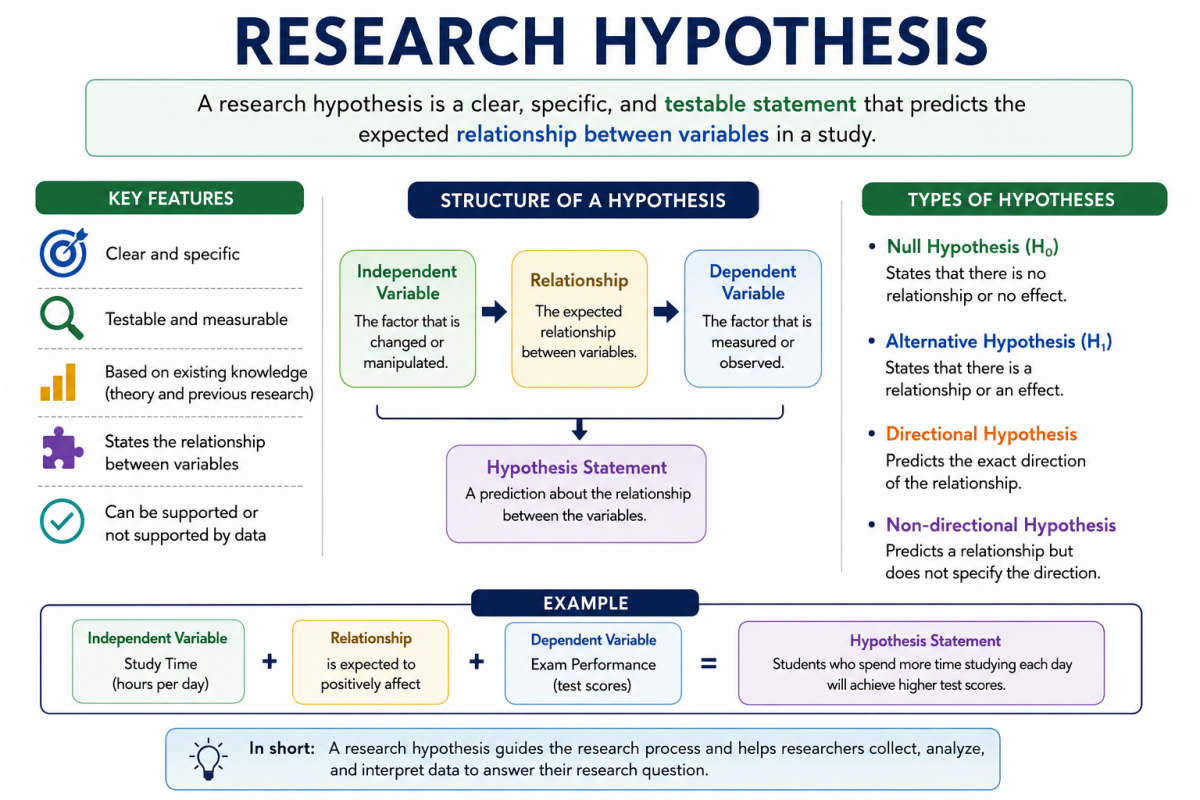
- A Research Hypothesis is a clear, focused, and testable statement that predicts an expected outcome, pattern, or relationship between variables in a research study.
- In academic research, a hypothesis serves as a proposed explanation that can be examined through observation, experimentation, and statistical analysis.
- Simply put, a hypothesis is a statement about what a researcher expects to find during the research process.
- A Research Hypothesis usually begins with a research question and is derived from the research question after reviewing previous research and identifying a research problem.
- The hypothesis predicts what may happen between one variable, two variables, or even two or more variables within a specific context.
- For example:
- Research Question: Does social media use affect student academic performance?
- Research Hypothesis: Increased social media use negatively affects student academic performance.
Why a Research Hypothesis Is Important
- Provides direction for the entire research project.
- Helps researchers focus on specific research objectives and research aims.
- Guides the selection of research methods and research design.
- Identifies the independent variable and dependent variable being studied.
- Supports effective data collection and statistical testing procedures.
- Creates a framework for hypothesis testing and interpreting research findings.
- Allows researchers to make inferences about the population based on collected evidence.
- Improves the quality of good research by ensuring that investigations remain focused and purposeful.
Key Characteristics of a Good Research Hypothesis
- Testable
- A good research hypothesis is a testable statement that can be evaluated using evidence.
- The hypothesis is a testable proposition rather than an opinion.
- Clear and Specific
- The researcher should clearly define variables and expected outcomes.
- Ambiguous language should be avoided.
- Based on Previous Research
- Strong research hypotheses are supported by literature, theories, and previous research findings.
- Focused on Variables
- The hypothesis should identify independent and dependent variables whenever possible.
- It should explain the expected relationship between variables.
- Measurable
- Variables should be capable of observation and measurement.
- Relevant
- The hypothesis must address a meaningful research topic and research problem.
- Predictive
- A scientific hypothesis predicts potential outcomes that can later be confirmed or rejected.
Elements of a Research Hypothesis
- Research problem
- Research question
- Independent variable
- Dependent variable
- Expected relationship between variables
- Research objectives
- Research methodology
A well-developed Research Hypothesis strengthens the entire research process because it transforms a broad idea into a focused, testable statement that can be examined systematically.
How To Write Research Hypothesis With Examples: A 7-Step Process for Creating a Testable and Effective Research Hypothesis
Step 1: Identify the Research Problem
- Every hypothesis begins with a research question and a clearly defined research problem.
- Determine what issue, gap, or phenomenon requires investigation.
- Focus on a problem that is relevant to your field and supported by previous research.
Example:
- Research Problem: Employee productivity appears to vary significantly among remote workers.
Step 2: Conduct Background Research
- Review academic journals, books, reports, and existing studies.
- Examine previous research to identify trends and gaps.
- Understand what other researchers have discovered.
Example:
- Previous studies suggest flexible schedules may improve productivity.
Step 3: Formulate the Research Question
- Formulating the research question helps narrow the study’s focus.
- The research question should be specific and answerable.
Example:
- Does schedule flexibility improve employee productivity among remote workers?
Step 4: Identify the Variables
- Determine the independent variable and dependent variable.
Example:
- Independent Variable: Schedule flexibility
- Dependent Variable: Employee productivity
Understanding independent and dependent variables is critical because a change in the dependent variable is often expected when the independent variable changes.
Step 5: Predict the Expected Relationship
- Determine the nature of the relationship you expect.
- Consider whether the hypothesis predicts a positive, negative, or neutral relationship between two variables.
Example:
- Greater flexibility may lead to higher productivity.
Step 6: Write the Research Hypothesis
- Convert the prediction into a formal testable statement.
Example:
- Employees with flexible work schedules demonstrate higher productivity than employees with fixed schedules.
This Research Hypothesis clearly identifies variables and predicts the expected relationship.
Step 7: Evaluate and Refine the Hypothesis
Before finalizing the hypothesis, verify that it is:
- Specific
- Testable
- Logical
- Measurable
- Related to the research objectives
- Consistent with the research design
Complete Hypothesis Example
Research Question:
- Does sleep duration affect academic performance?
Research Hypothesis:
- Students who sleep at least eight hours per night achieve higher academic performance than students who sleep fewer than eight hours.
This effective research hypothesis identifies variables, predicts outcomes, and provides a foundation for statistical hypothesis testing.
Types of Research Hypothesis: Understanding Directional, Non-Directional, Statistical, and Other Types of Hypotheses
Different types of research hypothesis are used depending on the research design, research methodology, and study objectives.
1. Simple Hypothesis
- A simple hypothesis examines the relationship between two variables.
- It typically includes one independent variable and one dependent variable.
Example:
- Increased exercise improves cardiovascular health.
2. Complex Hypothesis
- A complex hypothesis involves two or more variables.
- It may include multiple independent and dependent variables.
Example:
- Exercise frequency and diet quality influence weight loss and cardiovascular health.
3. Directional Hypothesis
- A directional hypothesis predicts the exact direction or nature of the relationship.
- The researcher expects a specific outcome.
Example:
- Students receiving tutoring will score higher than students not receiving tutoring.
Here, the hypothesis predicts the exact direction of the effect.
4. Non-Directional Hypotheses
- Non-directional hypotheses indicate that a relationship exists but do not predict the exact direction.
- The researcher expects a difference but remains uncertain about whether outcomes will increase or decrease.
Example:
- There is a significant difference in academic performance between students who receive tutoring and those who do not.
Non-directional hypotheses are useful when previous evidence is limited.
5. Null Hypothesis
- The null hypothesis states that no significant relationship exists between variables.
- It assumes observed differences are due to chance.
Example:
- There is no relationship between sleep duration and academic performance.
In statistical testing, researchers often attempt to reject the null hypothesis.
6. Alternative Hypothesis
- The alternative hypothesis states that a meaningful relationship exists.
- It directly opposes the null hypothesis.
Example:
- Sleep duration significantly affects academic performance.
The null and alternative framework forms the foundation of statistical hypothesis testing.
7. Statistical Hypothesis
- A statistical hypothesis is specifically designed for quantitative research and statistical analysis.
- It allows researchers to make inferences about the population.
Example:
- Mean test scores differ significantly between two student groups.
8. Associative Hypothesis
- An associative hypothesis defines a relationship between variables without claiming causation.
Example:
- Higher stress levels are associated with lower job satisfaction.
Associative hypothesis defines connections rather than direct cause-and-effect relationships.
9. Causal Hypothesis
- A causal hypothesis predicts that one variable directly causes changes in another.
Example:
- Increased study time causes improved examination performance.
Understanding these types of hypotheses helps researchers choose the most appropriate approach for their research study.
How To Write Research Hypothesis With Examples for Different Types of Research and Research Questions
Different types of research require different approaches to developing research questions and hypotheses.
For Quantitative Research
- Quantitative research relies on measurable data and statistical analysis.
- The hypothesis should clearly identify variables and expected outcomes.
Example Research Question:
- Does online learning affect student achievement?
Research Hypothesis:
- Students participating in online learning achieve higher academic scores than students in traditional classrooms.
This format works well for quantitative studies because variables can be measured objectively.
For Qualitative Research
- Qualitative research often focuses on experiences, perceptions, and meanings.
- Some qualitative studies may not require formal hypotheses.
- However, researchers can still develop tentative expectations.
Example:
- Employees working remotely may report greater work-life balance satisfaction.
Qualitative data can later help refine the original hypothesis.
For Experimental Research
- Experimental studies examine cause-and-effect relationships.
- Causal hypothesis statements are commonly used.
Example:
- Providing weekly feedback increases employee performance.
For Correlational Research
- These studies examine the relationship between variables without establishing causation.
Example:
- There is a positive relationship between physical activity and mental well-being.
For Clinical Research
- Designing clinical research often requires highly specific research hypotheses.
Example:
- Patients receiving Drug A experience lower blood pressure than patients receiving a placebo.
For Educational Research
Research Question:
- Does classroom technology improve learning outcomes?
Research Hypothesis:
- Students using interactive classroom technology achieve higher test scores.
For Business Research
Research Question:
- Does employee training improve productivity?
Research Hypothesis:
- Employees who receive professional training demonstrate higher productivity levels.
For Social Science Research
Research Question:
- Does community participation influence civic engagement?
Research Hypothesis:
- Individuals who participate in community programs exhibit higher levels of civic engagement.
Tips for Writing Specific Research Hypotheses
- Ensure the hypothesis is a statement rather than a question.
- Make sure the hypothesis is a testable statement.
- Align the hypothesis with research questions and hypotheses.
- Clearly identify independent and dependent variables.
- Define the expected relationship between variables.
- Avoid vague language.
- Support predictions with previous research.
- Ensure consistency with the research methodology.
- Confirm that the hypothesis may be examined through data collection and statistical testing.
A strong Research Hypothesis transforms a broad research topic into a focused investigation. Whether conducting quantitative research, qualitative research, experimental studies, or designing clinical research, an effective research hypothesis provides direction, supports hypothesis testing, and improves the overall quality of good research. By understanding the various types of research hypothesis and following a structured process, researchers can develop specific research hypotheses that produce meaningful and statistically significant research findings.
Good Research Hypothesis Characteristics: What Makes a Hypothesis Clear, Testable, and Scientifically Valid?
A strong Research Hypothesis serves as the foundation of a successful research study. Whether conducting quantitative research, qualitative research, or designing clinical research, researchers need a hypothesis that is clear, logical, and capable of being tested through evidence.
1. A Good Research Hypothesis Begins with a Research Question
- Every effective Research Hypothesis begins with a research question.
- The hypothesis should be derived from the research question rather than created randomly.
- Formulating the research question helps identify the research problem and the direction of the investigation.
- The research question should align with the research aims, research objectives, and overall research methodology.
Example:
- Research Question: Does employee training improve workplace productivity?
- Research Hypothesis: Employees who receive training demonstrate higher productivity than employees who do not receive training.
2. A Research Hypothesis Must Be Clear and Specific
- A hypothesis is a statement that clearly communicates what the researcher expects to observe.
- Readers should immediately understand the variables being examined.
- Avoid vague words such as “better,” “good,” or “successful” unless they can be measured.
- Specific research hypotheses improve the quality of data collection and statistical analysis.
Weak Example:
- Technology helps students learn.
Strong Example:
- Students who use educational software for at least five hours weekly achieve higher mathematics scores than students who do not use educational software.
3. A Good Research Hypothesis Is Testable
- A hypothesis is a testable statement that can be supported or rejected through evidence.
- The hypothesis is a testable proposition rather than a personal belief.
- Researchers must be able to collect data and evaluate results objectively.
- Testable hypotheses are essential for hypothesis testing and statistical testing.
Example:
- Daily exercise reduces resting heart rate among adults.
This statement can be tested through observation and measurement.
4. A Research Hypothesis Should Identify Variables
- Most research hypotheses involve independent and dependent variables.
- The independent variable represents the factor being manipulated or examined.
- The dependent variable represents the outcome being measured.
- A change in the dependent variable is expected when the independent variable changes.
Example:
- Independent Variable: Study time
- Dependent Variable: Examination scores
Hypothesis:
- Increased study time leads to higher examination scores.
5. A Research Hypothesis Should Predict Relationships
- A scientific hypothesis predicts the expected relationship between variables.
- The hypothesis predicts what the researcher expects to observe.
- It may focus on a relationship between two variables or two or more variables.
Examples include:
- Positive relationship
- Negative relationship
- Cause-and-effect relationship
- Comparative relationship
6. A Good Research Hypothesis Is Based on Previous Research
- Strong research hypotheses are supported by literature reviews and previous research.
- Academic research should not rely on assumptions alone.
- Existing theories and research findings help strengthen the original hypothesis.
- Evidence from previous research improves the credibility of the research project.
7. A Research Hypothesis Must Be Scientifically Valid
To be scientifically valid, the hypothesis should:
- Be logical
- Be measurable
- Be objective
- Be consistent with research methods
- Support statistical hypothesis testing
- Allow researchers to make inferences about the population
8. A Good Research Hypothesis Aligns with Research Design
- The hypothesis should fit the selected research design.
- Quantitative studies often require precise and measurable hypotheses.
- Qualitative research may use exploratory propositions rather than highly statistical statements.
- Different types of research require different types of hypotheses.
Summary of Good Research Hypothesis Characteristics
A good research hypothesis should be:
- Clear
- Specific
- Testable
- Measurable
- Research-based
- Scientifically valid
- Relevant to the research problem
- Consistent with research objectives
- Aligned with the research process
These characteristics help ensure that a Research Hypothesis contributes to good research and meaningful research findings.
Research Hypothesis Examples: Practical Hypothesis Examples for Quantitative, Qualitative, and Statistical Research
Understanding hypothesis examples is one of the best ways to learn how different types of research hypothesis are written.
Quantitative Research Hypothesis Examples
Quantitative research focuses on measurable variables and numerical data.
Example 1: Education
Research Question:
- Does tutoring improve academic performance?
Research Hypothesis:
- Students who receive weekly tutoring achieve higher test scores than students who do not receive tutoring.
Example 2: Healthcare
Research Question:
- Does regular exercise affect blood pressure?
Research Hypothesis:
- Adults who exercise at least four times per week have lower blood pressure than adults who do not exercise regularly.
Example 3: Workplace Studies
Research Question:
- Does remote work improve productivity?
Research Hypothesis:
- Employees working remotely demonstrate higher productivity levels than employees working in traditional office environments.
Qualitative Research Hypothesis Examples
Qualitative research often focuses on experiences, attitudes, and perceptions.
Example 1
Research Question:
- How do employees perceive remote work?
Research Hypothesis:
- Employees may report greater job satisfaction when working remotely due to increased flexibility.
Example 2
Research Question:
- How do patients experience telemedicine services?
Research Hypothesis:
- Patients may perceive telemedicine as a convenient alternative to in-person consultations.
These examples may later be refined through qualitative data collection.
Statistical Hypothesis Examples
Statistical hypotheses are commonly used in quantitative studies.
Null Hypothesis Example
Null Hypothesis (H₀):
- There is no relationship between study time and examination performance.
The null hypothesis assumes observed differences are due to chance.
Alternative Hypothesis Example
Alternative Hypothesis (H₁):
- There is a significant relationship between study time and examination performance.
The alternative hypothesis states that a meaningful relationship exists.
Researchers conduct statistical hypothesis testing to determine whether they can reject the null hypothesis.
Directional Hypothesis Example
A directional hypothesis allows the researcher to predict the exact direction of an effect.
Example:
- Students who attend review sessions will achieve higher examination scores than students who do not attend review sessions.
This hypothesis predicts the exact direction or nature of the relationship.
Non-Directional Hypotheses Example
Non-directional hypotheses identify a relationship but do not predict the exact direction.
Example:
- There is a significant difference in examination performance between students who attend review sessions and those who do not.
Associative Hypothesis Example
An associative hypothesis defines a relationship without claiming causation.
Example:
- Higher employee engagement is associated with greater job satisfaction.
Causal Hypothesis Example
A causal hypothesis predicts cause-and-effect relationships.
Example:
- Increased employee training causes higher workplace productivity.
Simple Hypothesis Example
A simple hypothesis involves one variable affecting another variable.
Example:
- Increased water consumption improves hydration levels.
Complex Hypothesis Example
A complex hypothesis includes two or more variables.
Example:
- Exercise frequency and dietary habits influence body weight and cardiovascular health.
These hypothesis examples demonstrate how researchers develop research hypotheses for different research topics and research questions and hypotheses.
Common Mistakes Researchers Make When Writing Research Hypotheses and How to Avoid Them
Even experienced researchers sometimes make mistakes when developing a Research Hypothesis.
Mistake 1: Writing a Hypothesis That Is Too Broad
Poor Example:
- Technology affects education.
Why It Is a Problem:
- Variables are unclear.
- The statement lacks focus.
Solution:
- Define specific variables and outcomes.
Mistake 2: Creating a Non-Testable Statement
Poor Example:
- Students should study harder.
Why It Is a Problem:
- The statement is opinion-based.
- It cannot be objectively measured.
Solution:
- Create a testable statement supported by measurable outcomes.
Mistake 3: Ignoring Previous Research
- Developing hypotheses without reviewing previous research weakens the study.
- Researchers may duplicate existing work or overlook important evidence.
Solution:
- Conduct a thorough literature review before creating the original hypothesis.
Mistake 4: Confusing Research Questions and Hypotheses
Many beginners treat a research question as a hypothesis.
Incorrect:
- Does exercise improve health?
Correct:
- Individuals who exercise regularly experience better health outcomes than individuals who do not exercise regularly.
Mistake 5: Failing to Identify Variables
- A hypothesis should clearly identify independent and dependent variables.
- Failure to define variables creates confusion during data collection.
Mistake 6: Predicting Impossible Outcomes
- Hypotheses should be realistic and supported by evidence.
- Researchers should avoid assumptions that cannot be tested.
Mistake 7: Choosing the Wrong Type of Hypothesis
- Different research projects require different types of hypotheses.
- Researchers should select appropriate types of research hypothesis based on their research design and research methods.
Mistake 8: Using Ambiguous Language
Avoid terms such as:
- Better
- Stronger
- Effective
- Improved
Unless they are clearly defined and measurable.
Avoiding these mistakes helps researchers develop a stronger and more effective Research Hypothesis.
How To Write Research Hypothesis With Examples: Best Practices for Statistical Testing, Data Analysis, and Good Research Outcomes
A well-developed Research Hypothesis plays a critical role in statistical testing, statistical analysis, and overall research success.
Start with a Clearly Defined Research Problem
- Every hypothesis should address a meaningful research problem.
- The problem should connect directly to the research topic and research objectives.
Ensure the Hypothesis Matches the Research Design
- Different types of research require different approaches.
- Quantitative research often relies on statistical hypotheses.
- Qualitative research may emphasize exploratory relationships.
Define Independent and Dependent Variables
- Clearly identify independent and dependent variables before beginning data collection.
- Understanding the relationship between variables improves the accuracy of analysis.
Use the Null and Alternative Approach
The null and alternative framework remains central to hypothesis testing.
Null Hypothesis
- Assumes no effect exists.
- Assumes differences are due to chance.
Alternative Hypothesis
- Suggests a meaningful effect exists.
- Predicts an expected relationship between variables.
Researchers attempt to reject the null hypothesis through statistical analysis.
Align the Hypothesis with Research Objectives
- The hypothesis should support the study’s hypotheses and objectives.
- It should directly contribute to answering the research question.
Collect High-Quality Data
Good research outcomes depend on:
- Reliable data collection
- Appropriate measurement tools
- Consistent procedures
- Accurate documentation
Apply Appropriate Statistical Analysis
Statistical analysis helps determine whether findings are statistically significant.
Researchers use statistical testing to:
- Evaluate evidence
- Compare groups
- Examine relationships
- Test causal claims
- Make inferences about the population
Interpret Results Carefully
After statistical hypothesis testing:
- Evaluate whether evidence supports the alternative hypotheses.
- Determine whether differences are due to chance.
- Assess whether findings support the expected relationship between variables.
- Compare outcomes with previous research.
Revise When Necessary
A hypothesis may require modification if:
- New evidence emerges.
- Research findings contradict expectations.
- Additional variables become relevant.
Final Best Practices Checklist
Before finalizing your Research Hypothesis, confirm that it:
- Begins with a research question
- Is derived from the research question
- Addresses the research problem
- Is a testable statement
- Identifies independent and dependent variables
- Supports hypothesis testing
- Fits the research methodology
- Aligns with research objectives
- Allows statistical analysis
- Contributes to good research outcomes
Following these best practices will help researchers create an effective research hypothesis that supports rigorous academic research, reliable data collection, meaningful statistical testing, and high-quality research findings.
Research Hypotheses
Types of Research Hypotheses
Explore key hypothesis categories used in academic research and studies.
Types of Hypotheses
Overview
→
Research Hypotheses
Basics
→
Alternative
H1
→
Null
H0
→
Directional
One-tailed
→
Non-Directional
Two-tailed
→
Simple
One variable
→
Complex
Multiple variables
→
Causal
Cause-effect
→
Associative
Relationship
→
Statistical
Testing
→
Working
Temporary
→
Declarative
Statement form
→
Question Form
Question-based
→
Empirical
Observed data
→
Logical
Reasoned
→
Value
Business focus
→
