
Blog
How To Write Relationship-Based Research Questions.

Introduction to Relationship-Based Research Questions: Definition, Purpose, and Role in Quantitative Research
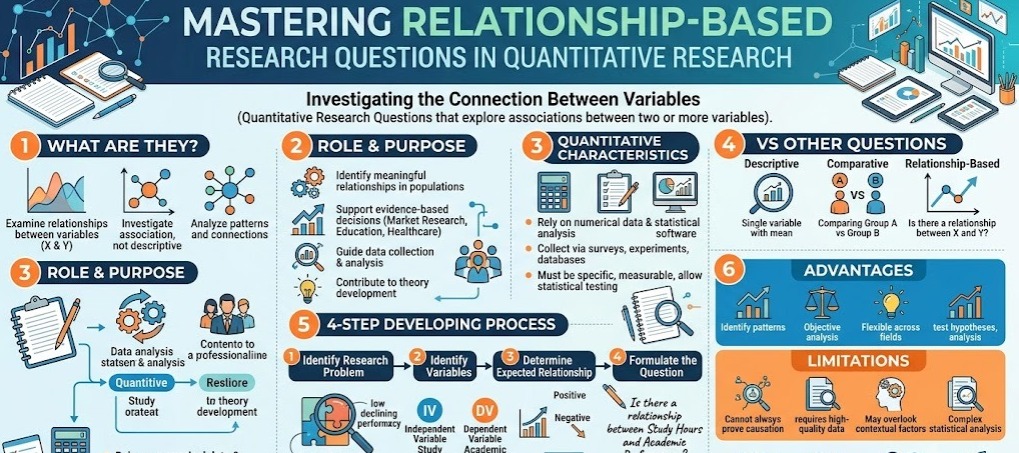
What Are Relationship-Based Research Questions?
- Relationship-Based Research Questions are a type of quantitative research question that examine whether a relationship exists between two or more variables.
- Unlike descriptive research questions that focus on only one variable, relationship-based questions investigate how one factor is associated with another factor.
- These questions are central to relationship-based quantitative research because they help researchers understand patterns, trends, and connections within a population.
- A relationship-based research question does not necessarily prove cause and effect. Instead, it explores whether relationships between two variables exist and how strong those relationships may be.
- Researchers often use statistical techniques during data analysis to determine whether the observed relationship is significant.
Example
- Research Question: Is there a relationship between study hours and academic performance among university students?
- Independent Variable: Study hours.
- Dependent Variable: Academic performance.
- The question focuses on the connection between the two variables rather than describing only one variable.
Purpose of Relationship-Based Research Questions
Relationship-Based Research Questions serve several important purposes in conducting research:
Identify Relationships Between Variables
- They help determine whether relationships between two factors exist.
- They allow researchers to examine patterns within quantitative data.
- They contribute to a deeper understanding of research outcomes.
Support Decision-Making
- Organizations use relationship research questions in market research to identify customer behaviors.
- Educational institutions use them to understand factors affecting student success.
- Healthcare professionals use them to explore factors associated with health outcomes.
Guide Data Collection and Analysis
- A well-formulated research question provides direction for data collection methods.
- Researchers know exactly what information to collect data on.
- It ensures the research design aligns with the research objective.
Contribute to Theory Development
- Findings from relationship-based studies often support existing theories.
- They may also challenge assumptions and generate new research hypotheses.
Relationship-Based Research Questions and Quantitative Research
- Relationship-Based Research Questions are among the main types of quantitative research questions.
- They rely on numerical data and statistical analysis.
- Researchers collect data through surveys, questionnaires, experiments, databases, and observational studies.
- Most relationship-based studies use close-ended questions because responses can be measured quantitatively.
Characteristics of a Quantitative Research Question
A good quantitative research question should:
- Be clear and specific.
- Involve measurable variables.
- Allow statistical testing.
- Align with the research objective.
- Support valid data analysis.
- Address a defined research problem.
Relationship-Based Questions vs Other Types of Research Questions
Descriptive Questions
- Descriptive research questions focus on only one variable.
- They describe characteristics, behaviors, or conditions.
Example:
- What is the average number of hours students study per week?
Comparative Questions
- Comparative research questions examine differences between two or more groups.
- They investigate whether one or more groups differ on a particular outcome variable.
Example:
- Are there differences between groups of students who attend online classes and those who attend face-to-face classes?
Relationship-Based Questions
- Relationship-based questions explore relationships between two or more variables.
Example:
- Is there a relationship between class attendance and academic achievement?
Relationship Between a Research Question and Hypothesis
- The relationship between a research question and hypothesis is fundamental in quantitative studies.
- The research question asks what the researcher wants to investigate.
- The hypothesis predicts a relationship between variables.
Example:
Research Question:
- Is there a relationship between employee motivation and job performance?
Hypothesis:
- Employee motivation is positively associated with job performance.
This demonstrates how the hypothesis and research question work together.
Developing Research Questions and Hypotheses
When developing research questions and hypotheses:
- Start with a clearly defined research problem.
- Identify dependent and independent variables.
- Determine the nature of the research.
- Select an appropriate research design.
- Ensure hypotheses and objectives align with the overall study.
How To Write Relationship-Based Research Questions: A 4-Step Process for Developing Research Questions and Hypotheses
Creating effective Relationship-Based Research Questions requires careful planning and logical thinking.
Step 1: Identify the Research Problem
Every good research project begins with a research problem.
Ask Yourself:
- What issue needs investigation?
- What gap exists in current research studies?
- What phenomenon requires explanation?
Examples:
- Low employee productivity.
- Poor customer retention.
- Declining student performance.
A clearly defined problem helps create specific research questions.
Step 2: Identify the Variables
Relationship-Based Research Questions require at least two variables.
Independent Variable
- The factor believed to influence another variable.
- Sometimes referred to as the predictor variable.
Examples:
- Training programs.
- Income level.
- Social media usage.
Dependent Variable
- The outcome variable affected by another factor.
Examples:
- Employee productivity.
- Academic performance.
- Customer satisfaction.
Example
Independent Variable:
- Social media usage.
Dependent Variable:
- Academic performance.
Research Question:
- Is there a relationship between social media usage and academic performance?
Step 3: Determine the Expected Relationship
Before formulating the question, think about the likely relationship.
Possible relationships include:
Positive Relationship
- As one variable increases, the other increases.
Example:
- Increased study time is associated with higher grades.
Negative Relationship
- As one variable increases, the other decreases.
Example:
- Increased stress is associated with lower productivity.
No Relationship
- Variables may not be connected.
Researchers often create research hypotheses based on these expectations.
Example Hypothesis:
- There is a positive relationship between employee training and job performance.
Step 4: Formulate the Research Question
Convert the identified variables into a clear quantitative research question.
Effective Formula
- Is there a relationship between X and Y?
- What is the relationship between X and Y?
- To what extent does X relate to Y?
Examples
- Is there a relationship between leadership style and employee satisfaction?
- What is the relationship between income level and consumer spending?
- To what extent does social media engagement relate to brand loyalty?
Checklist for a Good Research Question
A good research question should:
- Be specific.
- Be measurable.
- Include dependent and independent variables.
- Be answerable through quantitative data.
- Support data collection.
- Match the research objective.
- Avoid ambiguity.
Common Mistakes to Avoid
Bad Research Question Example
- Does social media affect students?
Problems:
- Too broad.
- Unclear variables.
- Difficult to measure.
Improved Version
- Is there a relationship between daily social media usage and academic performance among university students?
Relationship-Based Research Questions Examples: Quantitative Research Questions Examples, Research Question and Hypothesis, and Common Research Questions Examples
The following quantitative research questions examples demonstrate how Relationship-Based Research Questions can be used across different fields.
Education
Research Question:
- Is there a relationship between study habits and academic achievement?
Hypothesis:
- Students with stronger study habits achieve higher academic performance.
Research Question:
- Is there a relationship between classroom attendance and examination scores?
Hypothesis:
- Higher attendance rates are associated with higher examination scores.
Business and Market Research
Research Question:
- Is there a relationship between customer satisfaction and customer loyalty?
Hypothesis:
- Higher customer satisfaction increases customer loyalty.
Research Question:
- Is there a relationship between advertising expenditure and sales revenue?
Hypothesis:
- Increased advertising expenditure is associated with higher sales revenue.
Human Resource Management
Research Question:
- Is there a relationship between employee engagement and job performance?
Hypothesis:
- Higher employee engagement improves job performance.
Research Question:
- Is there a relationship between leadership style and employee retention?
Hypothesis:
- Positive leadership styles increase employee retention.
Healthcare
Research Question:
- Is there a relationship between exercise frequency and body mass index?
Hypothesis:
- Increased exercise frequency is associated with lower body mass index.
Research Question:
- Is there a relationship between sleep duration and mental well-being?
Hypothesis:
- Adequate sleep duration improves mental well-being.
Social Sciences
Research Question:
- Is there a relationship between income level and life satisfaction?
Hypothesis:
- Higher income levels are associated with greater life satisfaction.
Research Question:
- Is there a relationship between social support and psychological resilience?
Hypothesis:
- Stronger social support improves resilience.
Technology
Research Question:
- Is there a relationship between technology adoption and organizational productivity?
Hypothesis:
- Greater technology adoption increases productivity.
Research Question:
- Is there a relationship between cybersecurity awareness and online safety practices?
Hypothesis:
- Higher awareness improves online safety practices.
Additional Relationship Research Questions
- Is there a relationship between employee training and productivity?
- Is there a relationship between work-life balance and job satisfaction?
- Is there a relationship between customer trust and brand loyalty?
- Is there a relationship between class participation and learning outcomes?
- Is there a relationship between parental involvement and student achievement?
- Is there a relationship between internet usage and academic success?
- Is there a relationship between physical activity and mental health?
- Is there a relationship between leadership effectiveness and team performance?
Relationship-Based Research Questions: Advantages and Strengths vs Disadvantages and Limitations in Quantitative Research and Different Types of Research Questions
Advantages and Strengths of Relationship-Based Research Questions
1. Help Identify Important Patterns
- They reveal meaningful relationships between two or more variables.
- Researchers gain insights that may not be obvious through observation alone.
2. Support Evidence-Based Decisions
- Organizations use findings to improve strategies and policies.
- Businesses use market research findings to increase profitability.
3. Encourage Objective Research
- They rely on quantitative data rather than personal opinions.
- Statistical techniques increase reliability.
4. Support Hypothesis Testing
- They are ideal for testing research hypotheses.
- Researchers can evaluate whether predicted relationships exist.
5. Flexible Across Research Fields
- Applicable in education, healthcare, business, psychology, economics, and sociology.
- Useful in many types of quantitative research.
6. Facilitate Strong Data Analysis
- Statistical software can examine complex relationships.
- Researchers can measure strength and direction of relationships.
7. Improve Research Outcomes
- Well-formulated questions increase study quality.
- Better questions often produce more meaningful research outcomes.
Disadvantages and Limitations of Relationship-Based Research Questions
1. Cannot Always Establish Causation
- A relationship does not automatically mean one variable causes another.
- Many studies identify associations rather than causal relationships.
2. Require High-Quality Data
- Poor data collection reduces accuracy.
- Measurement errors can distort results.
3. May Overlook Contextual Factors
- Quantitative approaches may not capture personal experiences.
- Qualitative research may provide richer explanations.
4. Depend on Appropriate Research Design
- Weak research design can lead to misleading conclusions.
- Researchers must carefully select research methods.
5. Statistical Expertise Is Often Required
- Data analysis may require advanced statistical knowledge.
- Incorrect analysis can affect findings.
Relationship-Based Questions Compared to Other Types of Research Questions
Descriptive Research Questions
Purpose:
- Describe one variable.
Focus:
- Characteristics or conditions.
Example:
- What percentage of students use online learning platforms?
Comparative Research Questions
Purpose:
- Compare differences between groups.
Focus:
- Differences between two or more groups.
Example:
- Are there differences between groups based on gender in academic performance?
Relationship-Based Research Questions
Purpose:
- Examine relationships between variables.
Focus:
- Relationships between two or more variables.
Example:
- Is there a relationship between study habits and academic achievement?
Final Thoughts
- Relationship-Based Research Questions are among the most valuable types of research questions in quantitative research.
- They help researchers investigate relationships between two or more variables, test research hypotheses, and generate meaningful evidence.
- A good research question should be specific, measurable, and aligned with the research objective.
- By understanding the distinction between descriptive questions, comparative research questions, and relationship-based questions, researchers can select the right research questions for their specific research context.
- Whether conducting market research, educational studies, healthcare investigations, or social science research, mastering Relationship-Based Research Questions is essential for producing high-quality and impactful research.
Research Questions
Types of Research Questions
Explore different categories of research questions used in academic studies.
Descriptive Research Question
What is happening?
→
Exploratory Research Question
Explore unknowns
→
Explanatory Research Question
Why it happens
→
Comparative Research Question
Compare variables
→
Relationship-Based Research Question
Connections
→
Causal Research Question
Cause-effect
→
Predictive Research Question
Future outcomes
→
Evaluative Research Question
Assess value
→
Interpretive Research Question
Meaning focus
→
Action Research Question
Practical change
→
Phenomenological Research Question
Lived experience
→
Grounded Theory Research Question
Theory building
→
Historical Research Question
Past events
→
Ethnographic Research Question
Culture study
→
Systematic Review Research Question
Evidence synthesis
→
PICO Research Question
Clinical format
→
PEO Research Question
Qualitative health
→
FINER Research Question
Quality criteria
→
Hypothesis-Based Research Question
Testable design
→
Mixed Methods Research Question
Combined approach
→
