
Blog
How To Write Phenomenological Research Questions

Understanding Phenomenological Research Questions in Qualitative Research: Definition, Purpose, and Role in Phenomenological Research Design
What Are Phenomenological Research Questions?
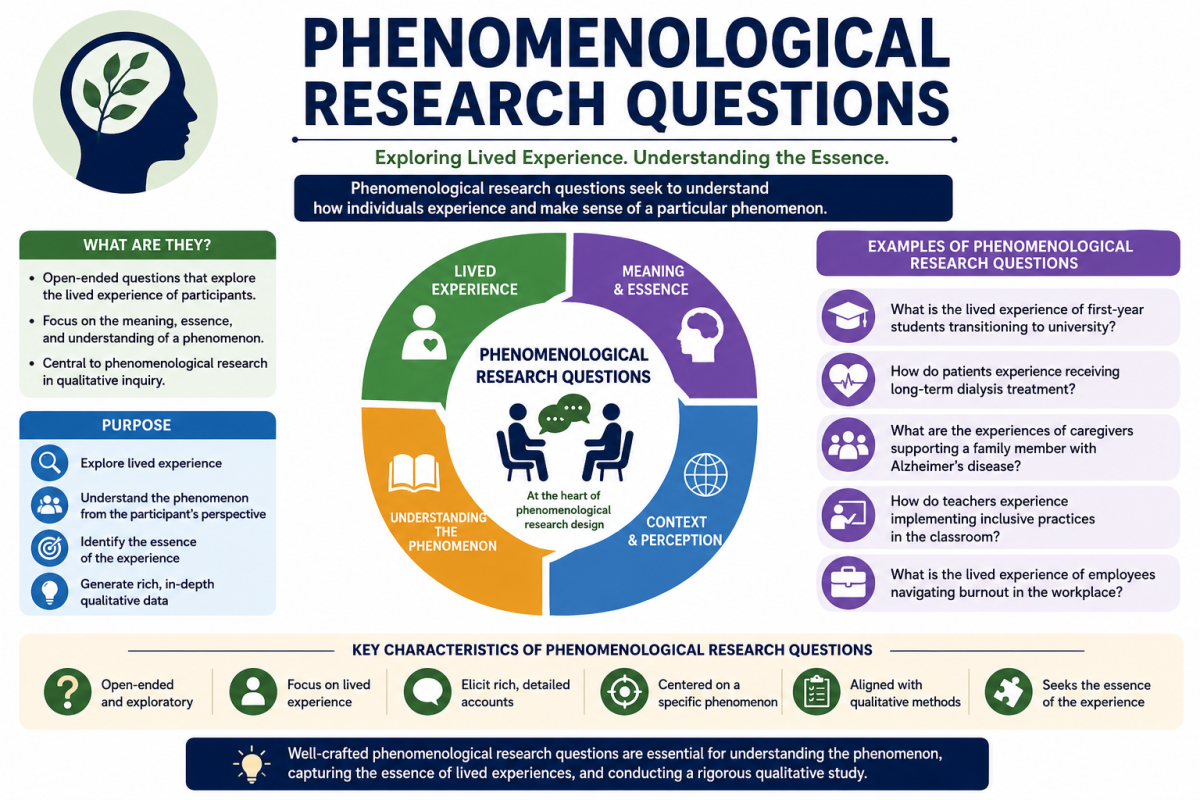
- Phenomenological Research Questions are qualitative questions designed to explore and understand people’s lived experience of a particular phenomenon.
- They are central to phenomenological research, a type of qualitative research that seeks to uncover how individuals experience and interpret events, situations, or conditions in their lives.
- Unlike quantitative questions that focus on measurement and numerical relationships, Phenomenological Research Questions focus on meaning, perception, and human experiences.
- The primary goal is not to determine cause-and-effect relationships but to understand the essence of lived experiences shared by participants.
- These questions are commonly used in social science, psychological research, health research, healthcare research, education, and organizational studies.
Understanding Phenomenology
- Phenomenology is a philosophical and methodological tradition concerned with studying how people experience the world.
- The field was heavily influenced by Husserl, who emphasized understanding experiences as they are consciously perceived.
- Later, Heidegger expanded phenomenology by focusing on interpretation and meaning within human existence.
- Scholars such as Van Manen further developed practical applications of phenomenology in educational and professional research.
- The aim of phenomenology is to uncover the deeper meanings that individuals attach to their experiences.
- Researchers attempt to understand experiences from the participant’s perspective rather than imposing external interpretations.
The Purpose of Phenomenological Research Questions
Phenomenological Research Questions serve several important purposes:
To Explore Lived Experience
- They allow researchers to investigate how people experience a specific phenomenon.
- Participants provide detailed accounts of their experiences.
- Researchers seek rich descriptions rather than simple answers.
To Understand the Phenomenon
- The goal is to develop a deeper understanding of the phenomenon being investigated.
- Researchers examine emotions, perceptions, beliefs, and interpretations.
- The focus remains on how individuals make sense of their experiences.
To Identify Themes
- Through qualitative analysis, researchers identify recurring patterns and meanings.
- These themes contribute to the overall understanding of the phenomenon.
- The process often involves thematic analysis or phenomenological analysis.
To Discover the Essence of the Experience
- Researchers attempt to capture the universal essence shared across participants.
- The focus is on common meanings rather than isolated events.
- This essence becomes the primary outcome of the study.
Characteristics of Strong Phenomenological Research Questions
A strong phenomenological research question typically:
- Focuses on a clearly defined phenomenon.
- Investigates human experiences rather than measurable variables.
- Encourages participants to provide detailed narratives.
- Reflects the overall research purpose.
- Aligns with a phenomenological approach.
- Supports a rigorous qualitative study.
- Allows exploration of both emotional and cognitive dimensions of experience.
- Encourages rich and meaningful qualitative data collection.
Examples of strong characteristics include:
- Open-ended wording.
- Focus on experience rather than explanation.
- Exploration of meaning and interpretation.
- Emphasis on participant’s views.
- Alignment with phenomenological inquiry.
The Role of Phenomenological Research Questions in Research Design
Guiding the Study Design
- The research question determines the overall study design.
- It influences participant selection.
- It shapes data collection strategies.
- It directs data analysis procedures.
Supporting Phenomenological Research Design
- A phenomenological research design is built around understanding experiences.
- The question serves as the foundation for the entire design.
- Every stage of the research process stems from the central question.
Influencing Research Methods
The chosen research question determines which research methods will be used, such as:
- In-depth interviews.
- Focus group discussions.
- Reflective journals.
- Personal narratives.
- Observations.
- Diary entries.
- Focus group interviews.
Shaping Data Analysis
- The question guides phenomenological analysis.
- Researchers identify themes and meanings within participant narratives.
- Findings are interpreted in relation to the phenomenon being studied.
How To Write Phenomenological Research Questions: A 4-Step Process for Developing a Strong Phenomenological Approach and Methodology
Step 1: Identify the Specific Phenomenon You Want to Explore
- Begin by selecting a meaningful phenomenon.
- The phenomenon should involve real human experiences.
- It should be relevant to your research aims and research context.
Examples include:
- Student experience in online learning.
- Living with chronic illness.
- First-time parenthood.
- Workplace burnout.
- Experiences of grief.
- Leadership transitions.
Ask yourself:
- What phenomenon am I interested in?
- Why is this phenomenon important?
- Who experiences it?
- What aspect remains poorly understood?
A clearly defined phenomenon strengthens the entire research inquiry.
Step 2: Focus on Lived Experience Rather Than Measurement
- Phenomenological studies seek understanding, not prediction.
- Avoid questions that measure frequency or statistical relationships.
- Concentrate on how participants experience the phenomenon.
Instead of asking:
- “How many students prefer online learning?”
Ask:
- “How do students experience online learning during their first year at university?”
This shift reflects the principles of qualitative methodology and the phenomenological method.
Important considerations:
- Focus on meaning.
- Explore emotions.
- Investigate perceptions.
- Understand interpretations.
- Examine personal significance.
Step 3: Develop an Open-Ended Research Question
A strong phenomenological question should:
- Begin with “How” or “What.”
- Encourage detailed descriptions.
- Avoid assumptions.
- Remain neutral.
- Reflect the phenomenon being studied.
Examples:
- What is the lived experience of first-generation university students?
- How do nurses experience compassion fatigue in healthcare settings?
- What are the experiences of teachers adapting to virtual classrooms?
At this stage, create a proposed research question and evaluate whether it truly explores experience.
Step 4: Align the Question with Phenomenological Methodology
- Ensure the question supports a phenomenological methodology.
- Confirm that it can be answered through qualitative data collection.
- Verify that it aligns with the intended methodological approach.
Checklist:
- Does it explore a lived experience?
- Does it focus on a specific phenomenon?
- Can participants provide detailed accounts?
- Does it support phenomenological inquiry?
- Can it generate rich qualitative data?
If the answer is yes, the question is likely suitable for a phenomenological study.
How To Write Phenomenological Research Questions: Qualitative Examples from Phenomenological Studies and Student Experience Research Design
Student Experience Examples
Example 1
Research Question:
- What is the lived experience of first-year university students transitioning from high school to higher education?
Why it works:
- Focuses on student experience.
- Explores perceptions and emotions.
- Supports phenomenological analysis.
Example 2
Research Question:
- How do international students experience cultural adaptation during their first year of study?
Why it works:
- Examines a specific phenomenon.
- Allows participants to share detailed experiences.
- Encourages rich narratives.
Healthcare Research Examples
Example 3
Research Question:
- What is the lived experience of patients receiving long-term dialysis treatment?
Example 4
Research Question:
- How do cancer survivors experience life after treatment?
These examples of phenomenological research focus on meaning rather than measurement.
Health Research Examples
Example 5
Research Question:
- What are the experiences of caregivers supporting family members with Alzheimer’s disease?
Example 6
Research Question:
- How do individuals experience recovery following major surgery?
These questions are frequently used in qualitative health research.
Psychological Research Examples
Example 7
Research Question:
- What is the lived experience of individuals coping with workplace anxiety?
Example 8
Research Question:
- How do young adults experience social isolation in the digital age?
These questions contribute to a deeper understanding of the phenomenon.
Education Research Examples
Example 9
Research Question:
- How do teachers experience implementing inclusive classroom practices?
Example 10
Research Question:
- What is the lived experience of students participating in remote learning programs?
Dissertation Research Examples
For a dissertation, researchers often use broader questions such as:
- What is the lived experience of novice school principals during their first year of leadership?
- How do women entrepreneurs experience business growth in rural communities?
- What are the lived experiences of refugees adapting to a new cultural environment?
These are strong examples because they align with phenomenological research design and qualitative research methods.
How To Write Phenomenological Research Questions: Advantages and Strengths vs Disadvantages and Limitations of Phenomenology, Qualitative Methods, and Phenomenological Research Design
Advantages and Strengths
1. Provides Deep Understanding of Human Experiences
- Phenomenology focuses on real human experiences.
- Researchers gain insights that may not emerge through surveys.
- It helps understand the experience from the participant’s perspective.
2. Captures Rich and Detailed Data
- Participants provide detailed narratives.
- Data often reveal emotions, meanings, and interpretations.
- Rich qualitative data strengthen findings.
3. Supports Exploration of Complex Phenomena
- Useful when little is known about a topic.
- Effective for studying specific phenomena.
- Helps reveal hidden dimensions of experience.
4. Encourages Participant-Centered Research
- Participants become active contributors.
- Their voices remain central to the study.
- Researchers prioritize participant’s views.
5. Flexible Data Collection Methods
Researchers may use:
- Interviews.
- Focus group sessions.
- Focus group interviews.
- Diaries.
- Reflective journals.
- Written narratives.
This flexibility supports comprehensive data collection.
6. Valuable Across Multiple Disciplines
Phenomenology is widely used in:
- Education.
- Healthcare research.
- Health research.
- Social science.
- Psychological research.
- Organizational studies.
Disadvantages and Limitations
1. Time-Consuming Research Process
- Collecting detailed narratives requires significant time.
- Interviews can be lengthy.
- Transcription and coding demand substantial effort.
2. Small Number of Participants
- Most phenomenological studies involve a limited number of participants.
- Findings may not be statistically generalizable.
- Researchers prioritize depth over breadth.
3. Potential Researcher Bias
- Researchers may unintentionally influence interpretations.
- Maintaining a phenomenological attitude is essential.
- Practices such as phenomenological reduction help reduce bias.
4. Complex Data Analysis
- Phenomenological analysis requires extensive interpretation.
- Researchers must identify themes carefully.
- The process can be challenging for beginners.
5. Difficulties in Replication
- Experiences are unique and context-dependent.
- Replicating findings exactly may be difficult.
Descriptive vs Interpretive Phenomenology
Descriptive Phenomenology
Associated with Husserl:
- Focuses on describing experiences as they appear.
- Uses phenomenological reduction.
- Seeks objective descriptions.
Interpretive Phenomenology
Associated with Heidegger:
- Focuses on interpretation and meaning.
- Recognizes researcher involvement.
- Explores contextual understanding.
Hermeneutic Phenomenology
- Often linked with Van Manen.
- Combines interpretation with description.
- Examines how individuals assign meaning to experiences.
Interpretative Phenomenological Analysis (IPA)
- A widely used methodological approach.
- Focuses on how individuals make sense of experiences.
- Combines interpretation with detailed exploration.
Phenomenology Compared with Grounded Theory
Phenomenology:
- Explores lived experience.
- Seeks the essence of the experience.
- Focuses on understanding the phenomenon.
Grounded Theory:
- Develops new theories.
- Explains processes and actions.
- Focuses on theory generation.
Choosing between these qualitative approaches depends on the research purpose and research methodology.
Final Thoughts
- Phenomenological Research Questions are fundamental to successful phenomenological research.
- They guide the research process from data collection to data analysis.
- Strong Phenomenological Research Questions help researchers understand the phenomenon, uncover the essence of lived experiences, and generate meaningful insights.
- Whether conducting qualitative health research, social science investigations, healthcare research, dissertation research, or educational studies focused on student experience, carefully crafted Phenomenological Research Questions are essential for understanding the phenomenon and producing a rigorous qualitative study.
Research Questions
Types of Research Questions
Explore different categories of research questions used in academic studies.
Descriptive Research Question
What is happening?
→
Exploratory Research Question
Explore unknowns
→
Explanatory Research Question
Why it happens
→
Comparative Research Question
Compare variables
→
Relationship-Based Research Question
Connections
→
Causal Research Question
Cause-effect
→
Predictive Research Question
Future outcomes
→
Evaluative Research Question
Assess value
→
Interpretive Research Question
Meaning focus
→
Action Research Question
Practical change
→
Phenomenological Research Question
Lived experience
→
Grounded Theory Research Question
Theory building
→
Historical Research Question
Past events
→
Ethnographic Research Question
Culture study
→
Systematic Review Research Question
Evidence synthesis
→
PICO Research Question
Clinical format
→
PEO Research Question
Qualitative health
→
FINER Research Question
Quality criteria
→
Hypothesis-Based Research Question
Testable design
→
Mixed Methods Research Question
Combined approach
→
