
Blog
How To Write Ethnographic Research Questions With Examples

What Are Ethnographic Research Questions? Definition, Purpose, and Role in Ethnographic Research and Ethnography
Ethnographic Research Questions are open-ended questions designed to explore how people think, behave, interact, and make meaning within their natural environments. They are a central component of ethnographic research and help researchers understand the lived experiences of individuals and groups.
Definition of Ethnographic Research Questions
- Ethnographic Research Questions are questions that guide an ethnographer in examining cultural practices, beliefs, values, behaviors, and social interactions within a specific group or community.
- Unlike quantitative studies that focus on numerical outcomes, these questions are rooted in qualitative research and seek rich, descriptive insights.
- They help a researcher explore the study of people within real-life social settings rather than controlled environments.
- These questions are often broad and flexible, allowing the research process to evolve as new discoveries emerge during fieldwork.
- They are commonly used in anthropology, sociology, education, health sciences, and other social science research disciplines.
Key Characteristics of Ethnographic Research Questions
- Open-ended rather than yes/no questions.
- Focused on understanding participants’ points of view.
- Designed to generate detailed ethnographic data.
- Adaptable throughout the research project.
- Emphasize context and social relations.
- Encourage exploration of social worlds and everyday experiences.
- Support the collection of first-hand information.
Purpose of Ethnographic Research Questions
Ethnographic Research Questions serve several important purposes:
To Understand Culture and Social Life
- Help researchers understand how members of the group interpret their experiences.
- Explore shared beliefs, traditions, and social norms.
- Reveal how culture influences behavior and decision-making.
To Guide Data Collection
- Direct participant observation activities.
- Shape ethnographic interview protocols.
- Inform formal interview and informal conversations.
- Assist researchers in deciding what research data to collect.
To Explore Human Experiences
- Investigate how people experience daily life.
- Examine social interaction patterns.
- Understand relationships between individuals and communities.
- Explore social settings that may not be visible through surveys alone.
To Generate Thick Description
- Encourage the collection of detailed observations.
- Help produce thick description, a hallmark of ethnography.
- Allow researchers to provide data that captures the complexity of social life.
Role of Ethnographic Research Questions in Ethnography
- Act as the foundation of the ethnographic method.
- Shape the overall research design.
- Guide fieldwork activities that may last weeks or months.
- Help establish lines of inquiry during conducting research.
- Support the interpretation of ethnographic studies.
- Assist in organizing ethnographic writing and final reporting.
Why They Matter in Qualitative Research
- They help researchers move beyond surface-level observations.
- They encourage asking the right questions during interactions with research participants.
- They generate useful data that reveals hidden meanings and behaviors.
- They contribute to a deeper understanding of social relations and cultural practices.
- They provide valuable insights that may not emerge through other qualitative methods.
How To Write Ethnographic Research Questions: A 4-Step Process for Conducting Ethnographic Research Using the Ethnographic Method
Developing effective Ethnographic Research Questions requires careful planning and a strong understanding of the research methodology.
Step 1: Identify the Social Group, Culture, or Setting You Want to Study
Before writing any research question, clearly determine:
- Who your research subjects will be.
- The community or group you want to observe.
- The social settings where interactions occur.
- The cultural practices you wish to understand.
Ask yourself:
- What group am I studying?
- Why is this group important?
- What behaviors or experiences interest me?
Examples include:
- Nurses in a hospital.
- Remote workers in online communities.
- University students.
- Indigenous communities.
- Teachers in multicultural classrooms.
This step helps narrow the focus of your ethnography research.
Step 2: Review Existing Research and Identify Knowledge Gaps
Strong Ethnographic Research Questions emerge from existing research.
During this stage:
- Conduct archival research.
- Read journal articles.
- Examine previous ethnographic studies.
- Review anthropological and sociological literature.
- Analyze different research findings.
Look for:
- Unanswered questions.
- Contradictory findings.
- Emerging social trends.
- Underrepresented populations.
Questions to consider:
- What has already been studied?
- What remains unknown?
- How can my study contribute new insights?
This ensures your research project adds value to the field.
Step 3: Focus on Experiences, Meanings, and Social Interactions
Ethnographic questions should seek understanding rather than measurement.
Focus on:
- Cultural meanings.
- Daily routines.
- Social interaction.
- Group dynamics.
- Community values.
- Shared beliefs.
Examples of useful types of questions:
- How do members of the group interpret a particular experience?
- What meanings do participants assign to certain behaviors?
- How do social relations influence decision-making?
Good ethnographic questions often begin with:
- How
- What
- Why
- In what ways
These question formats encourage detailed responses from respondents and support qualitative data collection.
Step 4: Refine and Test Your Questions
After drafting your Ethnographic Research Questions:
- Ensure they are open-ended.
- Remove leading language.
- Avoid assumptions.
- Check that they align with your research design.
- Verify that they support participant observation and interviews in ethnographic studies.
A strong question should:
- Be clear and understandable.
- Encourage detailed discussion.
- Be flexible enough to evolve during fieldwork.
- Generate rich ethnographic data.
Examples:
Weak Question:
- Do teachers like technology in classrooms?
Improved Ethnographic Question:
- How do teachers integrate technology into their daily teaching practices, and what meanings do they associate with its use?
By refining questions, researchers improve access to information and increase the likelihood of obtaining meaningful findings.
Ethnographic Research Questions Examples: Sample Questions for Ethnography Research and Different Types of Ethnographic Studies
The best way to understand Ethnographic Research Questions is through examples.
General Ethnography Examples
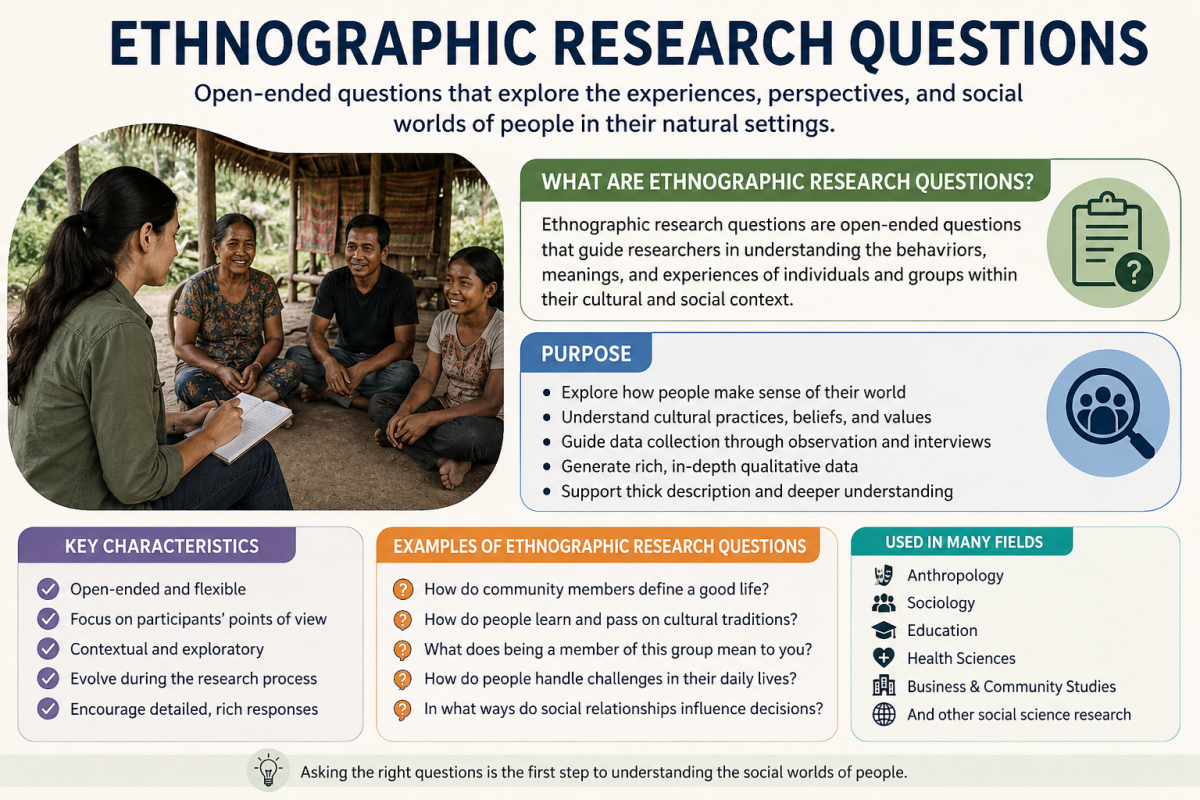
- How do community members maintain social relationships within their neighborhood?
- What cultural values shape everyday interactions among residents?
- How do members of the group resolve conflicts?
Education Ethnography Examples
Ethnography and education often focuses on classroom culture and learning experiences.
Sample questions:
- How do students experience collaborative learning in multicultural classrooms?
- What classroom practices influence student participation?
- How do teachers and students negotiate classroom expectations?
Health Sciences Ethnography Examples
Methodology in health often uses ethnographic approaches.
Sample questions:
- How do nurses manage communication during high-pressure situations?
- What cultural beliefs influence patient healthcare decisions?
- How do healthcare teams coordinate care in hospital environments?
Workplace Ethnography Examples
- How do employees develop informal workplace norms?
- What role does social interaction play in team collaboration?
- How do workers adapt to organizational change?
Online Ethnographic Research Examples
Online ethnographic studies have become increasingly popular.
Questions include:
- How do social media users build online identities?
- What community norms emerge within online forums?
- How do virtual communities create a sense of belonging?
Anthropological Ethnography Examples
Anthropology remains one of the primary disciplines using ethnography.
Examples:
- How are cultural traditions transmitted between generations?
- What rituals reinforce community identity?
- How do local customs influence social behavior?
Types of Ethnographic Studies and Related Questions
Realist Ethnography
Questions focus on objective descriptions of cultural behavior.
Example:
- How do residents organize community events?
Critical Ethnography
Questions examine power structures and inequalities.
Example:
- How do institutional policies affect marginalized groups?
Autoethnography
The researcher becomes part of the study.
Example:
- How does my personal experience reflect broader cultural patterns?
Digital Ethnography
Focuses on online interactions.
Example:
- How do online gaming communities create social norms?
Questions to Ask During an Ethnographic Interview
Useful questions to ask include:
- Can you describe a typical day?
- What activities are most important in your community?
- How would you explain this experience to an outsider?
- What challenges do people commonly face?
- What traditions are important to your group?
- How do people usually respond in this situation?
These questions help collect data that reflects authentic participant experiences.
Ethnographic Research Questions: Advantages and Strengths vs Disadvantages and Limitations of Using Ethnography in Research Studies
Like all research methods, ethnography offers both strengths and limitations.
Advantages and Strengths of Ethnographic Research Questions
1. Provide Deep Understanding of Human Behavior
- Allow researchers to study behavior in natural environments.
- Capture the complexity of social worlds.
- Reveal cultural meanings that surveys often miss.
2. Generate Rich and Detailed Data
- Produce extensive qualitative data.
- Support thick description of social experiences.
- Offer deeper insight into social relations.
3. Capture First-Hand Experiences
- Researchers observe events directly.
- Data through participant observation increases authenticity.
- Reduces reliance on second-hand accounts.
4. Flexible Research Process
- Questions can evolve during fieldwork.
- New lines of inquiry can emerge naturally.
- Supports exploratory research.
5. Encourages Rapport Building
- Long-term engagement helps build trust.
- Strong rapport often leads to more honest responses.
- Participants feel more comfortable sharing experiences.
6. Useful Across Many Disciplines
Ethnographic Research Questions are widely used in:
- Anthropology
- Sociology
- Education
- Health sciences
- Business research
- Community development
Disadvantages and Limitations of Ethnographic Research Questions
1. Time-Consuming
- Fieldwork often requires weeks or months.
- Building relationships takes significant effort.
- Data collection can be lengthy.
2. Resource Intensive
- Travel and observation may increase costs.
- Managing large amounts of research data requires substantial time.
3. Potential Researcher Bias
- Researchers’ interpretations may influence findings.
- Personal assumptions can affect analysis.
- Maintaining objectivity can be challenging.
4. Limited Generalizability
- Findings often focus on specific groups.
- Results may not apply universally.
- Small sample sizes reduce broad applicability.
5. Difficult Data Analysis
- Large volumes of qualitative information must be analyzed.
- Identifying patterns can be complex.
- Coding and interpretation require expertise.
6. Ethical Challenges
- Protecting participant privacy is essential.
- Researchers must obtain informed consent.
- Sensitive observations may create ethical dilemmas.
Final Thoughts
Ethnographic Research Questions are the foundation of successful ethnographic research. They guide the researcher through the entire research process, from data collection to analysis and ethnographic writing. By focusing on people’s lived experiences, cultural meanings, and social interaction, these questions help researchers conduct ethnographic research that generates rich, useful, and meaningful insights. Whether used in anthropology, sociology, health sciences, education, or other qualitative research fields, asking the right questions remains one of the most important factors in producing high-quality ethnography.
Research Questions
Types of Research Questions
Explore different categories of research questions used in academic studies.
Descriptive Research Question
What is happening?
→
Exploratory Research Question
Explore unknowns
→
Explanatory Research Question
Why it happens
→
Comparative Research Question
Compare variables
→
Relationship-Based Research Question
Connections
→
Causal Research Question
Cause-effect
→
Predictive Research Question
Future outcomes
→
Evaluative Research Question
Assess value
→
Interpretive Research Question
Meaning focus
→
Action Research Question
Practical change
→
Phenomenological Research Question
Lived experience
→
Grounded Theory Research Question
Theory building
→
Historical Research Question
Past events
→
Ethnographic Research Question
Culture study
→
Systematic Review Research Question
Evidence synthesis
→
PICO Research Question
Clinical format
→
PEO Research Question
Qualitative health
→
FINER Research Question
Quality criteria
→
Hypothesis-Based Research Question
Testable design
→
Mixed Methods Research Question
Combined approach
→
