
Blog
How To Write PEO Research Questions With Examples

What Are PEO Research Questions? Understanding the PEO Framework, Research Question Format, and Its Role in Health Sciences Research Methodology
- PEO Research Questions are structured questions used primarily in qualitative research, descriptive studies, and some mixed methods research projects.
- The PEO framework helps a researcher formulate a focused research question by breaking a topic into three key components:
- P – Population
- E – Exposure
- O – Outcome
- Unlike the PICO framework, which is commonly associated with evidence-based medicine and intervention studies, PEO Research Questions are especially useful for qualitative research topics and studies exploring experiences, attitudes, perceptions, and behaviors.
Understanding the Components of the PEO Framework
P – Population
- The population refers to the group of people being studied.
- This may include:
- Patients
- Adolescents
- Infants
- Older adults
- Individuals diagnosed with a particular condition
- Healthcare professionals
- A specific client group
- Examples of populations include:
- Adolescents with obesity
- Individuals diagnosed with dementia
- Pregnant women
- Patients with chronic pain
- Healthcare workers in emergency departments
E – Exposure
- Exposure refers to the experience, condition, circumstance, or phenomenon of interest affecting the population.
- Exposure does not necessarily mean a medical treatment.
- It can include:
- Living with a disease
- Dietary habits
- Smoking behavior
- Workplace stress
- Social isolation
- Healthcare policies
- Educational programs
- Examples include:
- Attempts to give up smoking
- Smoking cessation through cold turkey methods
- Long-term caregiving responsibilities
- Exposure to social media
- Dietary restrictions
O – Outcome
- Outcome refers to what the researcher hopes to investigate, understand, or explore.
- In qualitative research, the outcome often focuses on:
- Experiences
- Perceptions
- Attitudes
- Expectations
- Feelings
- Behaviors
- In quantitative research, outcomes may involve:
- Numerical data
- Result or measurement
- Number of successful attempts
- Risk for heart disease
- Clinical prognosis
Why Are PEO Research Questions Important?
- PEO Research Questions help researchers:
- Narrow broad topics into manageable studies.
- Improve the research process.
- Create an answerable research question.
- Develop an appropriate research design.
- Guide data collection activities.
- Improve literature searching.
- Strengthen systematic review methodologies.
- Many universities and LibGuides resources recommend the PEO framework because it creates clarity during project planning.
Role of PEO in Health Sciences Research Methodology
- Within health sciences, PEO Research Questions are commonly used to:
- Explore patient experiences.
- Investigate healthcare delivery.
- Examine outcomes of a service.
- Assess outcomes of a policy.
- Understand attitudes toward treatment.
- Evaluate clinical experiences.
- A researcher may use PEO to investigate:
- How adolescents experience anxiety treatment.
- How patients perceive smoking cessation programs.
- How individuals diagnosed with dementia experience community care services.
PEO Versus PICO
- Many students compare PEO and PICO because both are frameworks for developing a research question.
PEO
- Best for:
- Qualitative research
- Descriptive studies
- Mixed methods research topics
- Experience-based investigations
PICO
- Best for:
- Quantitative research
- Clinical intervention studies
- Treatment effectiveness research
- Evidence-based medicine
- While a PICO question often measures intervention effectiveness, a PEO question might focus on experiences, perceptions, and attitudes rather than numerical outcomes.
How To Write PEO Research Questions: A 4-Step Process for Developing a Strong Clinical Question, Research Design, and Data Collection Strategy
Writing effective PEO Research Questions requires a systematic approach. The following four-step method can help you formulate a focused research question that aligns with your research methodology.
Step 1: Identify the Population
- Begin by determining who will be studied.
- Ask:
- Who is affected by the issue?
- Which patient group is involved?
- What client group should be examined?
- Examples:
- Adolescents
- Infants
- Individuals diagnosed with dementia
- Cancer patients
- Nurses
- A clearly defined population improves the overall research design.
Step 2: Determine the Exposure
- Identify the phenomenon of interest.
- This is the experience or condition influencing the population.
- Ask:
- What situation are participants experiencing?
- What issue should be investigated?
- What topic of interest drives the study?
- Examples:
- Smoking cessation
- Dietary restrictions
- Hospitalization
- Social isolation
- Telemedicine use
- The exposure should be specific enough to guide data collection.
Step 3: Define the Outcome
- Determine what you want to learn.
- Outcomes should align with the purpose of the research project.
- Outcomes may include:
- Attitude
- Expectation
- Experience
- Perception
- Satisfaction
- Quality of life
- Prognosis
- Quantitative and qualitative studies may define outcomes differently.
- In quantitative research:
- Outcomes often involve numerical measurements.
- In qualitative research:
- Outcomes focus on meaning and understanding.
Step 4: Combine the Elements Into a Research Question
- Use the PEO question format to frame the final question.
General Formula
- Population + Exposure + Outcome
Example
- Population: Adults attempting smoking cessation
- Exposure: Cold turkey quitting methods
- Outcome: Perceived effectiveness
- Final Question:
- What are the experiences of adults using cold turkey methods for smoking cessation, and how do they perceive successful attempts to give up smoking?
Tips to Formulate a Focused Research Question
- Keep the question clear.
- Avoid multiple outcomes.
- Ensure the question is answerable.
- Match the question to the research type.
- Align it with your research design.
- Ensure consistency with your data collection methods.
- Review previous studies before finalizing the question.
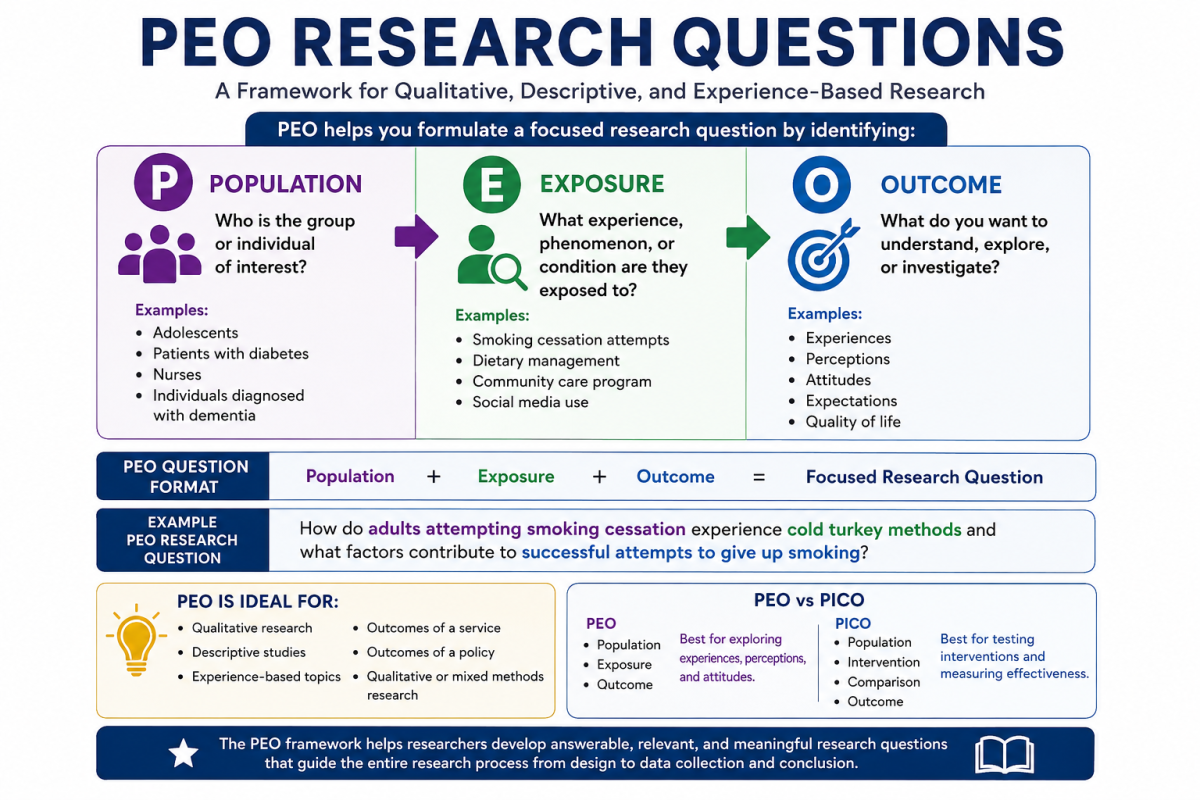
PEO Research Questions With Examples: Sample PEO Questions, Clinical Research Questions, and Comparisons Between PICO Question and PEO Question Formats
The best way to understand PEO Research Questions is through examples.
Example 1: Dementia Care
P
- Individuals diagnosed with dementia
E
- Community-based care programs
O
- Quality of life experiences
PEO Research Question
- How do individuals diagnosed with dementia experience community-based care programs, and how do these services influence their quality of life?
Example 2: Smoking Cessation
P
- Adult smokers
E
- Attempts to give up smoking through cold turkey methods
O
- Perceived success
PEO Research Question
- How do adult smokers describe their attempts to give up smoking using cold turkey methods, and what factors contribute to successful attempts?
Example 3: Adolescent Mental Health
P
- Adolescents
E
- Social media use
O
- Emotional well-being
PEO Research Question
- How does social media exposure influence adolescents’ perceptions of emotional well-being?
Example 4: Dietary Management
P
- Patients with diabetes
E
- Dietary management programs
O
- Patient experiences
PEO Research Question
- What are the experiences of patients participating in dietary management programs for diabetes?
Example 5: Clinical Research
P
- Cancer patients
E
- Chemotherapy treatment
O
- Treatment expectations
Clinical Research Question
- What expectations do cancer patients have regarding chemotherapy treatment outcomes?
Comparing PEO and PICO Question Formats
PEO Question Format
- Population
- Exposure
- Outcome
Sample PEO Question
- How do adolescents experience social media exposure, and what impact does it have on self-esteem?
PICO Question Format
- Population
- Intervention
- Comparison
- Outcome
Sample PICO Question
- Among adolescent smokers, does counseling compared with no counseling improve smoking cessation rates?
Using PICO and PEO Together
- Some research projects combine both approaches.
- Using PICO and PEO can be beneficial when conducting qualitative or mixed methods research.
- Example:
- PEO explores patient experiences.
- PICO measures intervention effectiveness.
Related Frameworks
SPIDER Framework
- SPIDER stands for:
- Sample
- Phenomenon of Interest
- Design
- Evaluation
- Research Type
- A SPIDER question is often useful for qualitative research topics investigating experiences.
SPICE Framework
- SPICE stands for:
- Setting
- Perspective
- Intervention
- Comparison
- Evaluation
- A SPICE question is often useful when evaluating outcomes of a service or outcomes of a policy.
PEO Research Questions: Advantages and Strengths vs Disadvantages and Limitations of the PEO Framework in Qualitative, Descriptive, and Clinical Research Design Using PICO and PEO Approaches
Advantages and Strengths of PEO Research Questions
1. Excellent for Qualitative Research
- PEO Research Questions are particularly useful for qualitative research topics.
- They help researchers explore experiences rather than measurements.
- They are useful for qualitative or mixed methods research.
2. Helps You Formulate a Focused Research Question
- The framework helps you formulate a focused research question quickly.
- It prevents vague and overly broad questions.
3. Supports Multiple Types of Research
- Suitable for:
- Qualitative research
- Descriptive studies
- Mixed methods research
- Clinical research
4. Improves Research Design
- Provides structure during study planning.
- Helps align research methodology with objectives.
5. Enhances Data Collection
- Clarifies what information must be gathered.
- Supports interview guides and survey development.
6. Useful for Systematic Reviews
- Frequently used in systematic review studies involving experiences and perceptions.
7. Patient-Centered Focus
- Emphasizes patient experiences.
- Supports healthcare improvement initiatives.
Disadvantages and Limitations of PEO Research Questions
1. Less Suitable for Intervention Studies
- PEO does not explicitly include intervention and comparison components.
- Researchers evaluating treatment effectiveness may need a PICO question instead.
2. Limited Measurement Focus
- PEO focuses on experiences rather than numerical data.
- It may not determine the success of an intervention using measurable outcomes.
3. Not Ideal for Diagnostic Studies
- Research aiming to diagnose disease or compare diagnostic tools often requires alternative frameworks.
4. May Require Additional Frameworks
- Researchers may include PICO, SPIDER, or SPICE frameworks depending on study goals.
5. Potential for Broad Outcomes
- If outcomes are not clearly defined, studies can become unfocused.
When Should You Use PEO?
Use PEO Research Questions when:
- Investigating patient experiences.
- Exploring attitudes and expectations.
- Conducting qualitative research.
- Studying healthcare experiences.
- Examining outcomes of a service.
- Exploring outcomes of a policy.
- Conducting descriptive research.
- Performing qualitative or mixed methods research.
When Should You Use PICO Instead?
Use a PICO question when:
- Evaluating an intervention.
- Measuring treatment effectiveness.
- Comparing two treatments.
- Conducting quantitative research.
- Working within evidence-based medicine.
Conclusion
PEO Research Questions provide a powerful framework for researchers seeking to understand experiences, perceptions, attitudes, and outcomes within health sciences and clinical research. By focusing on Population, Exposure, and Outcome, the framework helps researchers formulate a focused research question, strengthen research design, improve data collection, and conduct meaningful qualitative research. Although PICO remains the preferred framework for intervention-based quantitative studies, PEO Research Questions are often the best choice for exploring human experiences, making them an essential tool in modern research methodology and healthcare research projects.
Research Questions
Types of Research Questions
Explore different categories of research questions used in academic studies.
Descriptive Research Question
What is happening?
→
Exploratory Research Question
Explore unknowns
→
Explanatory Research Question
Why it happens
→
Comparative Research Question
Compare variables
→
Relationship-Based Research Question
Connections
→
Causal Research Question
Cause-effect
→
Predictive Research Question
Future outcomes
→
Evaluative Research Question
Assess value
→
Interpretive Research Question
Meaning focus
→
Action Research Question
Practical change
→
Phenomenological Research Question
Lived experience
→
Grounded Theory Research Question
Theory building
→
Historical Research Question
Past events
→
Ethnographic Research Question
Culture study
→
Systematic Review Research Question
Evidence synthesis
→
PICO Research Question
Clinical format
→
PEO Research Question
Qualitative health
→
FINER Research Question
Quality criteria
→
Hypothesis-Based Research Question
Testable design
→
Mixed Methods Research Question
Combined approach
→
