
Blog
How To Write Historical Research Questions With Examples

What Are Historical Research Questions? Definition, Purpose, and How to Select a Good Historical Research Question
Historical Research Questions are carefully crafted questions that guide the study of past events, people, societies, and historical processes. They serve as the foundation of any history research project and help researchers focus their investigation on a specific issue, event, or phenomenon.
Definition of Historical Research Questions
- Historical Research Questions are questions designed to investigate and analyze the past using evidence from primary sources and secondary sources.
- They help a historian move beyond simply describing events and encourage deeper analysis and interpretation.
- A historical research question seeks to understand causes, effects, relationships, significance, and change over time.
- Unlike factual questions that require simple answers, Historical Research Questions often require critical thinking and scholarly investigation.
- They encourage researchers to evaluate evidence, compare perspectives, and develop an arguable thesis.
Example
Instead of asking:
- When did World War II begin?
Ask:
- How did economic instability contribute to the rise of political extremism before World War II?
The second question promotes academic research and requires analysis rather than simple fact-finding.
Purpose of Historical Research Questions
Historical Research Questions serve several important purposes:
Provide Direction
- They give structure to the entire research process.
- They help researchers stay focused on a specific topic.
- They prevent unnecessary exploration of unrelated information.
Guide Source Selection
- They help researchers identify relevant source material.
- They determine which primary sources and secondary sources should be examined.
- They allow researchers to locate credible sources more efficiently.
Encourage Analysis
- They push researchers beyond memorizing dates and events.
- They encourage interpretation of evidence.
- They require scholars to analyze historical context and significance.
Support Thesis Development
- They help researchers create a strong thesis statement.
- They provide the basis for constructing arguments about the material.
- They ensure the final paper presents a meaningful contribution to historical understanding.
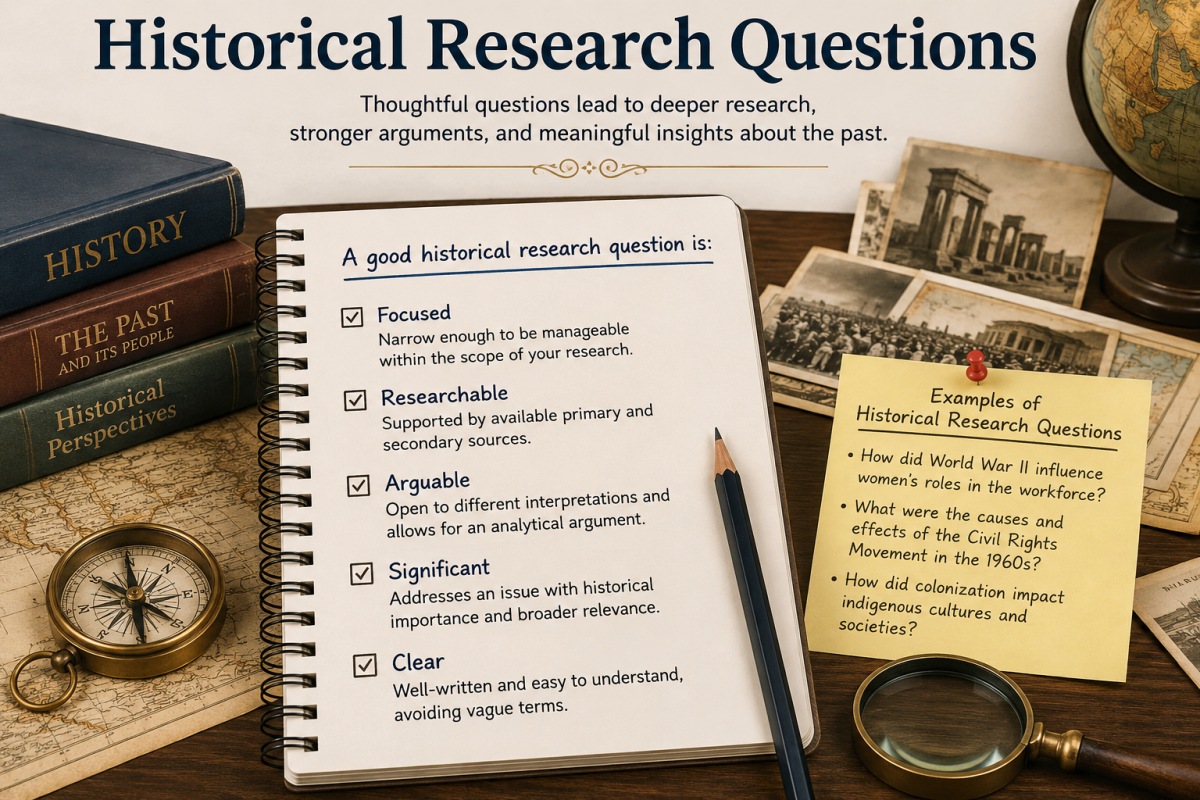
Characteristics of a Good Historical Research Question
A good historical question usually has the following qualities:
Specific and Focused
- The question should be narrow enough to allow detailed investigation.
- Avoid overly broad questions covering centuries or entire continents.
- Focus on one event or historical process within a specific timeframe.
Researchable
- Sufficient source material should exist.
- Researchers must be able to access primary and secondary sources.
- The topic should have available scholarly discussions.
Arguable
- The answer should not be obvious.
- Different historians should be able to offer different interpretations.
- The question should support the development of an argument.
Historically Significant
- The question should address an issue with historical significance.
- It should provide insight into larger historical developments.
- It should help explain important social, political, economic, or cultural changes.
Clear and Understandable
- The wording should be straightforward.
- Avoid vague language.
- Readers should immediately understand what the question investigates.
How to Select a Good Historical Research Question
Start with a Broad Area of Interest
Examples include:
- American History
- The Civil Rights Movement
- World War II
- The defense industry during wartime
- The twentieth century
- Women’s rights movements
- Immigration history
Conduct Preliminary Research
- Read an encyclopedia entry.
- Consult research guides.
- Review academic journals.
- Explore scholarly books.
- Visit a credible website for background information.
Identify a Gap or Problem
Ask:
- What remains unclear?
- What debate exists among historians?
- What phenomenon deserves deeper exploration?
Narrowing Your Topic
For example:
Broad topic:
- World War II
Narrow topic:
- African-American employment opportunities during World War II
Even narrower topic:
- How did white and African-American defense plant workers create and think about interracial relationships during World War II?
This approach makes the research manageable while remaining broad enough for meaningful investigation.
How To Write Historical Research Questions: A 4-Step Process for Narrowing Your Topic, Conducting Research, and Developing a Thesis Statement
Creating strong Historical Research Questions requires a systematic approach.
Step 1: Select a Historical Topic in Mind
The first step is choosing a historical topic that genuinely interests you.
Consider Areas Such As:
- American History
- U.S. foreign policy
- World War I
- World War II
- The 1960s
- Colonial history
- Social movements
- Labor history
- The defense industry
Why This Step Matters
- Interest helps maintain motivation.
- Curiosity inspires deeper investigation.
- Passion often leads to stronger research and writing.
Step 2: Conduct Preliminary Research
Before finalizing a research question, gather background information.
Useful Sources Include:
- Encyclopedia articles
- Research guides
- Scholarly books
- Journal articles
- Digital archives
- Historical websites
Goals of Preliminary Research
- Understand historical context.
- Identify key debates.
- Discover available source material.
- Learn what scholars have written.
Questions to Ask
- What happened?
- Why did it happen?
- Who was affected?
- What interpretations exist?
Step 3: Narrow and Refine the Focus
Many students choose topics that are overly broad.
Example of an Overly Broad Question
- What caused World War II?
This question is too broad because countless factors contributed.
Refined Version
- How did economic conditions in Germany contribute to political radicalization between 1929 and 1933?
Methods for Narrowing Your Topic
Narrow by Time
- Focus on a specific decade.
- Examine a particular year.
- Study a defined historical period.
Narrow by Location
- A city
- A state
- A country
- A region
Narrow by Population
- Women
- Workers
- Immigrants
- Soldiers
- African-American communities
Narrow by Theme
- Politics
- Economics
- Culture
- Education
- Technology
Step 4: Create a Research Question and Develop a Thesis Statement
After refining your topic, formulate a question that asks for explanation and analysis.
Strong Historical Research Questions Often Ask You to Explain
- Causes
- Consequences
- Relationships
- Historical significance
- Continuity and change
Example
Question:
- How did African-American defense plant workers create and think about interracial relationships during World War II?
Potential Thesis Statement:
- Employment within the wartime defense industry encouraged greater interracial interaction, although social and institutional barriers limited lasting equality.
This thesis provides a clear argument and establishes the direction for writing your paper.
Historical Research Questions Examples: Good Historical Questions for American History, History Research Topics, and Thesis Development
The following examples demonstrate how Historical Research Questions can be used across different research topics.
American History Examples
Political History
- How did the New Deal reshape public expectations of the federal government in the U.S.?
Civil Rights History
- To what extent did grassroots activism influence Civil Rights legislation during the 1960s?
Immigration History
- How did immigration policies affect immigrant communities during the early twentieth century?
Labor History
- How did industrialization transform working-class life in major American cities?
World War II Examples
Military History
- How did technological innovation influence military strategy during World War II?
Social History
- How did wartime employment opportunities affect women in the workforce?
Race Relations
- How did white and African-American defense plant workers create and think about interracial relationships during World War II?
Economic History
- How did the defense industry contribute to economic growth in the U.S. during wartime?
Questions That Ask About Historical Significance
- Why was the Marshall Plan historically significant?
- What was the significance of the Brown v. Board of Education decision?
- Why is the Civil Rights Movement considered a turning point in American history?
Questions That Ask About Relationships
These questions ask you to explain the relationship between one event or historical process and another.
Examples:
- What was the relationship between industrialization and urbanization?
- How did economic depression influence political extremism?
- How did technological advances affect warfare?
Questions That Ask About Change Over Time
- How did attitudes toward women’s rights change during the twentieth century?
- How did voting rights expand in the United States between 1900 and 1970?
- How did public perceptions of government evolve after World War II?
Questions Suitable for Thesis Development
- How did television influence political campaigns during the 1960s?
- How did Cold War tensions shape educational policies?
- How did labor unions influence workplace reforms?
Each of these questions is arguable, researchable, and capable of supporting a comprehensive thesis.
Historical Research Questions: Advantages and Strengths vs Disadvantages and Limitations in History Research and Interpretation
Understanding the strengths and limitations of Historical Research Questions helps researchers use them effectively.
Advantages and Strengths
Encourage Critical Thinking
- Researchers must evaluate evidence carefully.
- They must analyze competing interpretations.
- They must assess historical significance.
Promote Deep Understanding
- They move beyond memorization.
- They encourage thoughtful exploration.
- They reveal the complexity of historical events.
Support Strong Academic Research
- They guide the research process.
- They help organize evidence.
- They strengthen research findings.
Improve Thesis Development
- They provide a clear foundation for a thesis statement.
- They help researchers construct persuasive arguments.
- They support effective writing about history.
Encourage Multiple Perspectives
- Historians often disagree.
- Different sources provide different viewpoints.
- Researchers learn to evaluate each perspective critically.
Provide Insight into Historical Change
- They help explain continuity and change.
- They highlight relationships between events.
- They reveal broader historical processes.
Disadvantages and Limitations
Limited Source Availability
- Researchers may struggle to find primary sources.
- Some historical records have been lost.
- Important voices may be absent from the historical record.
Potential Bias
- Sources can reflect personal perspectives.
- Historians may interpret evidence differently.
- Bias can influence conclusions.
Complexity of Interpretation
- Historical evidence is rarely straightforward.
- Multiple explanations may exist.
- Definitive answers are often difficult to obtain.
Time-Consuming Research
- Historical research requires extensive reading.
- Researchers need to find credible sources.
- Source evaluation can take considerable time.
Risk of Vague Questions
- Poorly constructed questions weaken analysis.
- Broad questions create organizational problems.
- Researchers may struggle to answer this question effectively.
Difficulty Establishing Causation
- Many historical events have multiple causes.
- Researchers must avoid oversimplification.
- Historical processes often involve numerous interconnected factors.
Summary
- Historical Research Questions are the foundation of effective history research.
- They guide the selection of sources, shape the research project, and support the development of a strong thesis.
- A good historical question is clear, narrow, arguable, and historically significant.
- Successful Historical Research Questions emerge through careful topic selection, preliminary research, and thoughtful refinement.
- By using primary and secondary sources, understanding historical context, and developing evidence-based arguments, researchers can produce meaningful conclusions and make valuable scholarly contributions.
- Whether studying American History, World War II, the defense industry, the twentieth century, or another historical phenomenon, well-crafted Historical Research Questions provide the framework for successful academic research and effective research and writing.
Research Questions
Types of Research Questions
Explore different categories of research questions used in academic studies.
Descriptive Research Question
What is happening?
→
Exploratory Research Question
Explore unknowns
→
Explanatory Research Question
Why it happens
→
Comparative Research Question
Compare variables
→
Relationship-Based Research Question
Connections
→
Causal Research Question
Cause-effect
→
Predictive Research Question
Future outcomes
→
Evaluative Research Question
Assess value
→
Interpretive Research Question
Meaning focus
→
Action Research Question
Practical change
→
Phenomenological Research Question
Lived experience
→
Grounded Theory Research Question
Theory building
→
Historical Research Question
Past events
→
Ethnographic Research Question
Culture study
→
Systematic Review Research Question
Evidence synthesis
→
PICO Research Question
Clinical format
→
PEO Research Question
Qualitative health
→
FINER Research Question
Quality criteria
→
Hypothesis-Based Research Question
Testable design
→
Mixed Methods Research Question
Combined approach
→
