
Blog
How To Write Mixed-Methods Research Questions, with Examples

What is Mixed-Methods Research Questions?
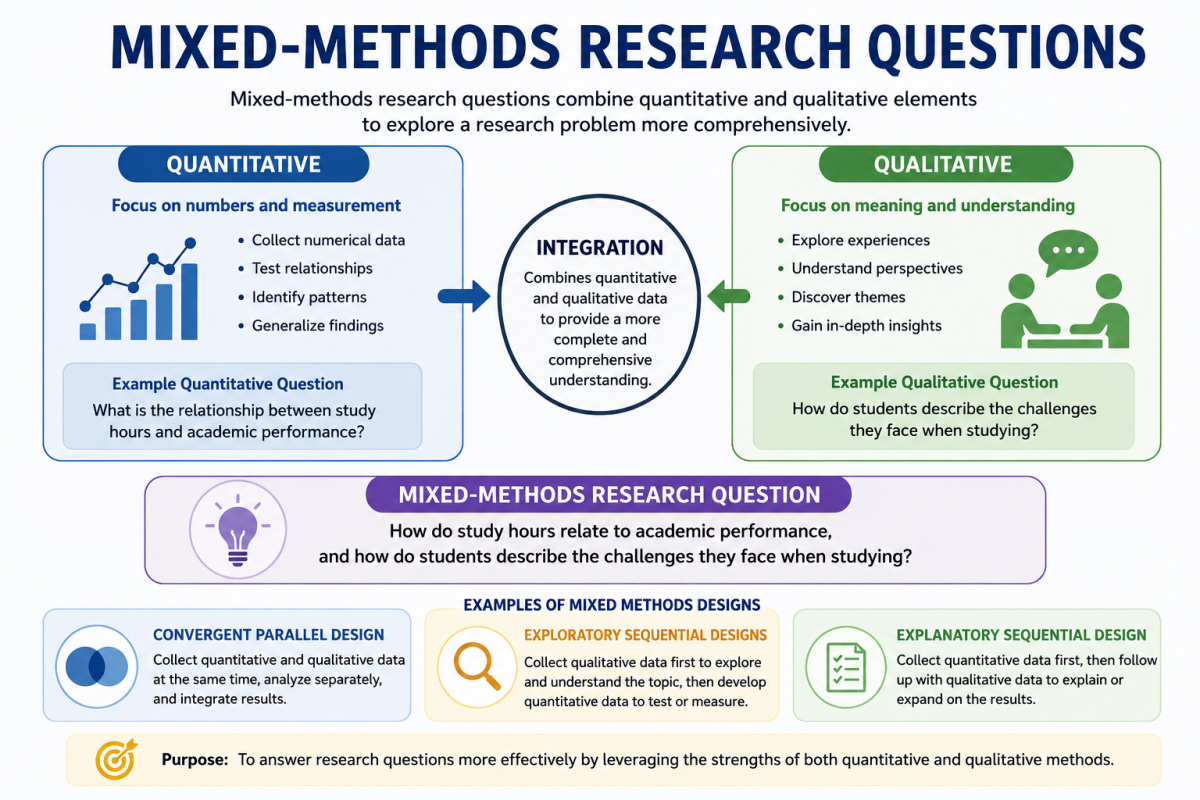
- Mixed-methods research questions are research questions designed for a study that combines both qualitative and quantitative forms of inquiry. In simple terms, they help the researcher study a research problem using both numerical evidence and detailed human explanations. This means the researcher does not rely only on statistics, surveys, or measurements, and does not rely only on interviews, observations, or focus groups. Instead, mixed-methods research questions guide the collection and integration of both quantitative and qualitative data.
- A mixed methods research question is useful when one type of data is not enough to answer the research problem fully. For example, quantitative data may show that students’ academic performance has declined, but qualitative interviews may explain why the decline is happening. In this case, the quantitative results show the pattern, while the qualitative findings explain the experiences, causes, or meanings behind the pattern.
- Mixed-methods research questions are commonly used in mixed methods research, social science, health research, education, psychology, business, and policy studies. They are especially helpful when the research aims require a comprehensive understanding of a topic. This is why many researchers use mixed methods when they want to compare trends, measure relationships, explore experiences, and integrate findings into one stronger explanation.
- Unlike a purely qualitative research question, which focuses mainly on meanings, experiences, opinions, or processes, mixed-methods research questions also include numerical or measurable elements. Unlike a purely quantitative research question, which focuses mainly on variables, measurement, relationships, or statistical differences, a mixed methods research question also includes personal experiences, perceptions, explanations, or contextual insights.
- A strong mixed-methods research question usually connects three major parts:
- The quantitative part, which may involve numerical measurement, statistical comparison, surveys, structured questionnaires, or quantitative data collection and analysis.
- The qualitative part, which may involve qualitative interviews, open-ended responses, focus groups, observations, or qualitative data collection and analysis.
- The integration part, which explains how the qualitative and quantitative findings will be combined to answer the main research question.
- In mixed methods research design, researchers often create one broad mixed methods research question and then support it with smaller qualitative and quantitative sub-questions. For example, a research paper may have one main question about how a training programme affects employee performance and two sub-questions: one measuring performance scores and another exploring employee experiences after the training.
- Therefore, mixed-methods research questions are important because they help the researcher move beyond a single research approach. They support a mixed methods approach where qualitative and quantitative research methods work together. When written properly, they make the research process clearer, the methodology stronger, and the final findings more meaningful.
How to Formulate Mixed-Methods Research Questions
Step 1: Start with a clear research problem and purpose
- The first step in writing mixed-methods research questions is to identify the research problem clearly. A research problem is the issue, gap, challenge, or situation that the research study wants to investigate. Without a clear research problem, the research question may become too broad, confusing, or difficult to answer.
- Before writing the research question, ask yourself:
- What issue needs to be studied?
- Why is this issue important?
- What is already known about the issue?
- What is still unclear or missing?
- Why would both qualitative and quantitative data be useful?
- This step is important because mixed methods research should not be used only because it sounds advanced. The researcher should use mixed methods only when the research problem requires both numerical evidence and deeper explanation. A mixed method study should have a clear reason for combining qualitative and quantitative methods.
- For example, a researcher may want to study why university students are not using online learning platforms effectively. A quantitative research approach may measure how often students use the platform, how long they stay logged in, and how their usage relates to grades. However, this may not explain why students avoid the platform. Qualitative research may then explore student attitudes, challenges, internet access, motivation, and learning preferences.
- In this case, the research problem naturally supports mixed-methods research questions because the researcher needs both measurement and explanation. The quantitative findings may show the size of the problem, while the qualitative results may explain the reasons behind it.
- At this stage, the researcher should also identify the research objectives. Research objectives help convert the broad problem into specific goals. For example:
- To measure the relationship between online learning platform usage and student performance.
- To explore students’ experiences with online learning platforms.
- To integrate quantitative and qualitative findings to understand how platform usage affects learning outcomes.
- These objectives make it easier to create a mixed methods research question because they show what needs to be measured, what needs to be explored, and how the findings should be integrated.
- A good research problem should also match the research methodology. If the problem only requires numerical comparison, then quantitative methods may be enough. If the problem only requires understanding lived experiences, then qualitative methods may be enough. However, when the research problem needs both numerical evidence and personal explanation, mixed-methods research questions are appropriate.
Step 2: Decide what quantitative and qualitative data you need
- The second step is to decide the type of data required for the study. Since mixed methods research uses both qualitative and quantitative data, the researcher must be clear about what each type of data will contribute to the study.
- Quantitative data is usually numerical. It may include scores, percentages, frequencies, ratings, test results, survey responses, performance measures, or statistical relationships. Quantitative data collection and analysis helps the researcher identify patterns, differences, trends, or relationships between variables.
- Qualitative data is usually descriptive. It may include interview responses, focus groups, open-ended survey answers, observations, field notes, documents, or participant narratives. Qualitative data collection and analysis helps the researcher understand meanings, experiences, beliefs, motivations, and explanations.
- When formulating mixed-methods research questions, the researcher should ask:
- What needs to be measured?
- What needs to be explained?
- What type of data will answer each part of the problem?
- Will the study begin with quantitative data followed by qualitative data?
- Will the study begin with qualitative exploration followed by quantitative testing?
- Will qualitative and quantitative data be collected at the same time?
- This decision helps the researcher choose a suitable mixed methods design. For example, in a convergent parallel design, quantitative and qualitative data are collected during the same phase, analysed separately, and then integrated. This design is useful when the researcher wants to compare or combine both types of findings at the same time.
- In an exploratory sequential design, the researcher begins with qualitative data collection, such as interviews or focus groups, and then uses the qualitative findings to develop a survey, tool, or quantitative phase. This design is useful when little is known about a topic and the researcher needs to explore the issue before measuring it.
- In an explanatory sequential design, the researcher begins with quantitative data collection and analysis, then adds qualitative research to explain the quantitative results. This is useful when numerical results need deeper interpretation. For example, a survey may show that employees have low job satisfaction, followed by qualitative interviews to understand the reasons.
- This step is also where the researcher decides whether the study is giving equal weight to qualitative and quantitative research or whether one approach is more dominant. Some mixed methods studies give equal importance to both parts. Others may be mainly quantitative with adding qualitative explanation, or mainly qualitative with a supporting quantitative component.
- A strong mixed methods research question should make this balance clear. It should show whether the study is measuring, exploring, comparing, explaining, or integrating findings.
Step 3: Write the quantitative, qualitative, and mixed-methods parts clearly
- The third step is to draft the actual research question. A clear mixed methods research question normally includes the quantitative part, the qualitative part, and the integration part. This makes the question easier to understand and easier to answer.
- Start by writing the quantitative research question. This question should focus on measurement, relationship, difference, frequency, prediction, or effect. For example:
- What is the relationship between employee training and job performance?
- To what extent does mobile banking usage influence customer satisfaction?
- How do students’ study hours predict academic performance?
- Next, write the qualitative research question. This question should focus on experiences, perceptions, meanings, challenges, explanations, or processes. For example:
- How do employees describe their experiences with workplace training?
- What challenges do customers experience when using mobile banking services?
- How do students explain the factors that influence their study habits?
- After that, write the mixed-methods research question that connects both parts. This question should show how the quantitative and qualitative findings will be integrated. For example:
- How do quantitative results on employee training and job performance integrate with qualitative findings on employee experiences to explain the effectiveness of workplace training?
- How do quantitative findings on mobile banking usage combine with qualitative findings on customer experiences to provide a comprehensive understanding of customer satisfaction?
- How do students’ quantitative study-hour patterns and qualitative explanations of learning behaviour together explain academic performance?
- The mixed-methods research questions should not look like two unrelated questions placed together. The qualitative and quantitative sections should speak to the same research problem. They should be connected by the same research aims, population, setting, or outcome.
- A useful formula is:
- What is the relationship/effect/difference between [quantitative variables], and how do participants describe/explain [qualitative experience] in relation to the same issue?
- Another useful formula is:
- How do quantitative and qualitative findings combine to explain [main research problem] among [target population]?
- Researchers should also avoid writing questions that are too broad. For example, “How does education affect society?” is too wide for a mixed methods study. A better research question would be, “How does access to digital learning resources influence academic performance, and how do students describe their experiences using these resources?”
- This version is stronger because it includes quantitative analysis, qualitative approaches, a clear population, and a clear topic. It also allows the researcher to integrate qualitative and quantitative data during data collection and analysis.
Step 4: Check alignment with the research design and methodology
- The fourth step is to review the research question and make sure it matches the research design, data collection methods, and research methodology. This is important because even a well-written research question can fail if it does not align with the study design.
- Ask yourself:
- Does the research question clearly require both qualitative and quantitative data?
- Does the question match the selected mixed methods design?
- Can the question be answered using the planned data collection methods?
- Does the question support integration of qualitative and quantitative findings?
- Is the question realistic for the time, resources, and sample size available?
- Does the question reduce possible research biases by using both forms of evidence?
- For example, if the researcher chooses a convergent parallel design, the mixed-methods research questions should allow qualitative and quantitative data to be collected during the same stage. If the researcher chooses an exploratory sequential design, the question should show that qualitative findings will inform the later quantitative phase. If the researcher chooses an explanatory sequential design, the question should show that quantitative results will be explained through qualitative data collection.
- This step also helps the researcher avoid confusion between qualitative or quantitative questions and mixed-methods research questions. A question that only asks “how many,” “how much,” or “what is the relationship” is usually quantitative. A question that only asks “how do people experience” or “what meanings do participants give” is usually qualitative. A mixed methods research question should bring both sides together.
- Scholars such as Creswell often emphasise that mixed methods research involves not only collecting both types of data, but also integrating them. This is why integration is central to a strong mixed methods research design. The researcher should not simply collect qualitative and quantitative data separately and report them in different sections without showing how they connect.
- Good mixed-methods research questions should therefore guide the full research process. They should shape the introduction to mixed methods research, the methodology chapter, the data collection and analysis methods, the findings section, and the discussion. They should also make it easier for readers, supervisors, or journal reviewers to understand why the study uses a mixed methods approach.
- In a strong research paper, the mixed methods research question should be specific, researchable, balanced, and aligned with the research objectives. It should also fit the research paradigms guiding the study. Since mixed methods research often combines different research approaches, the question should allow the researcher to respect both numerical measurement and human meaning.
When to Use Mixed-Methods Research Questions
- Mixed-methods research questions should be used when the researcher needs a comprehensive understanding of a research problem. Some topics are too complex to be answered using only qualitative or quantitative methods. In such cases, mixed methods research allows the researcher to measure patterns and also understand the reasons behind those patterns.
- Use mixed-methods research questions when quantitative results need explanation. For example, a survey may show that patients are dissatisfied with a healthcare service, but the numbers may not explain why. Adding qualitative interviews can help explain the emotions, experiences, barriers, and expectations behind the survey scores.
- Use mixed-methods research questions when qualitative findings need to be tested with a larger sample. For example, focus groups may reveal that students struggle with online learning because of poor internet access, lack of motivation, and unclear instructions. The researcher may then create a questionnaire to measure how common these issues are among a larger group.
- Use mixed-methods research questions when the research project involves complex human behaviour. In social research, education, healthcare, business, and community studies, people’s actions are often influenced by measurable factors and personal experiences. Mixed methods research is useful because it combines qualitative and quantitative research methods to produce richer findings.
- Use mixed-methods research questions when the study needs stronger evidence for decision-making. For example, organisations, universities, public agencies, and National Institutes of Health-style research projects often need both statistical evidence and participant perspectives. Quantitative findings may show whether a programme works, while qualitative findings may explain how and why it works.
- Use mixed-methods research questions when one method may create an incomplete picture. Traditional quantitative research may overlook context, feelings, and meaning. Qualitative research may provide deep insight but may not show how widespread a pattern is. Combining qualitative and quantitative data helps balance these limitations.
- Use mixed-methods research questions when the researcher wants to reduce research biases. Using only one method can sometimes limit the findings. A mixed methods approach allows the researcher to compare quantitative and qualitative findings, identify contradictions, and develop a more reliable interpretation.
- However, mixed-methods research questions should not be used for every study. They require more time, stronger planning, research training, and careful data collection and analysis. The researcher must be ready to handle both quantitative data collection and analysis and qualitative data collection and analysis. If the study does not need both forms of evidence, a purely quantitative or qualitative methodology may be more suitable.
Examples of Mixed-Methods Research Questions
- The following examples show how mixed-methods research questions can be written across different fields. Each example includes a clear connection between quantitative and qualitative research, making it easier to understand how the mixed methods design works.
Example 1: Education
- Main mixed methods research question:
- How do students’ use of digital learning platforms influence academic performance, and how do students describe their experiences with these platforms?
- Quantitative part:
- What is the relationship between frequency of digital platform use and students’ academic performance scores?
- Qualitative part:
- How do students describe the benefits and challenges of using digital learning platforms?
- Integration focus:
- This mixed methods research question allows the researcher to compare numerical performance data with students’ personal experiences. The quantitative results may show whether platform use is linked to better grades, while the qualitative findings may explain how platform design, internet access, motivation, or teacher support affects learning.
Example 2: Healthcare
- Main mixed methods research question:
- How does patient waiting time influence satisfaction scores, and how do patients explain their experiences of waiting for healthcare services?
- Quantitative part:
- To what extent does waiting time predict patient satisfaction ratings?
- Qualitative part:
- How do patients describe the emotional and practical effects of long waiting times?
- Integration focus:
- This question is suitable for a mixed methods study because patient satisfaction is both numerical and experiential. Quantitative data may show whether longer waiting times reduce satisfaction, while qualitative interviews may explain feelings of frustration, uncertainty, trust, or communication gaps.
Example 3: Business and Management
- Main mixed methods research question:
- How does employee training affect job performance, and how do employees describe the usefulness of the training they receive?
- Quantitative part:
- What is the effect of employee training hours on job performance ratings?
- Qualitative part:
- How do employees describe the relevance, quality, and practical value of workplace training?
- Integration focus:
- This mixed-methods research question helps the researcher understand not only whether training improves performance but also why employees may or may not find the training useful. The study may use surveys, performance records, and focus groups to integrate quantitative and qualitative data.
Example 4: Social Science
- Main mixed methods research question:
- How does social media use relate to self-esteem among young adults, and how do young adults explain the role of social media in shaping their self-image?
- Quantitative part:
- What is the relationship between daily social media use and self-esteem scores?
- Qualitative part:
- How do young adults describe their experiences of comparison, confidence, and identity on social media?
- Integration focus:
- This is a strong social science example because the topic includes measurable behaviour and personal meaning. The quantitative analysis may identify patterns between screen time and self-esteem, while qualitative approaches may explain how users interpret likes, comments, images, and online interactions.
Example 5: Exploratory Sequential Design
- Main mixed methods research question:
- What challenges do first-year university students experience during academic adjustment, and how common are these challenges across the wider student population?
- Qualitative phase:
- What academic, social, and emotional challenges do first-year students describe during their transition to university?
- Quantitative phase:
- How frequently do these challenges occur among first-year students?
- Integration focus:
- This example fits an exploratory sequential design because the researcher begins with qualitative data collection, such as interviews or focus groups, then develops a quantitative survey based on the qualitative results. The qualitative findings help identify the issues, while the quantitative findings show how common they are.
Example 6: Convergent Parallel Design
- Main mixed methods research question:
- How do teachers’ workload levels relate to burnout scores, and how do teachers describe their experiences of workload pressure?
- Quantitative part:
- What is the relationship between weekly workload hours and teacher burnout scores?
- Qualitative part:
- How do teachers describe the emotional, professional, and personal effects of workload pressure?
- Integration focus:
- This example fits a convergent parallel design because the researcher can collect quantitative and qualitative data during the same period. The quantitative findings may show the strength of the relationship between workload and burnout, while qualitative findings may explain how workload affects motivation, stress, and teaching quality.
Example 7: Public Policy
- Main mixed methods research question:
- How does access to public transport influence employment participation, and how do residents describe transport-related barriers to work?
- Quantitative part:
- What is the relationship between distance from public transport and employment participation rates?
- Qualitative part:
- How do residents explain the effects of transport access on job searching, punctuality, and work opportunities?
- Integration focus:
- This mixed methods research question is useful because transport access can be measured numerically, but its real-life impact is better understood through participant experiences. By combining qualitative and quantitative methods, the researcher can produce findings that are more useful for policy decisions.
- Overall, good mixed-methods research questions are clear, balanced, and connected to the research problem. They show what will be measured, what will be explored, and how the researcher will integrate qualitative and quantitative findings. Whether the study uses a mixed methods design in education, healthcare, business, or social research, the goal is always to produce a deeper and more complete understanding than either qualitative or quantitative research could provide alone.
Research Questions
Types of Research Questions
Explore different categories of research questions used in academic studies.
Descriptive Research Question
What is happening?
→
Exploratory Research Question
Explore unknowns
→
Explanatory Research Question
Why it happens
→
Comparative Research Question
Compare variables
→
Relationship-Based Research Question
Connections
→
Causal Research Question
Cause-effect
→
Predictive Research Question
Future outcomes
→
Evaluative Research Question
Assess value
→
Interpretive Research Question
Meaning focus
→
Action Research Question
Practical change
→
Phenomenological Research Question
Lived experience
→
Grounded Theory Research Question
Theory building
→
Historical Research Question
Past events
→
Ethnographic Research Question
Culture study
→
Systematic Review Research Question
Evidence synthesis
→
PICO Research Question
Clinical format
→
PEO Research Question
Qualitative health
→
FINER Research Question
Quality criteria
→
Hypothesis-Based Research Question
Testable design
→
Mixed Methods Research Question
Combined approach
→
